Browsing: La Scena Online

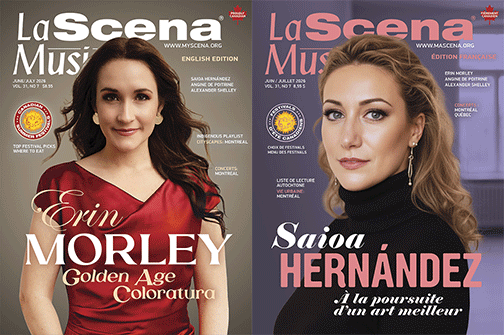
La Scena Online is the digital magazine of La Scene Musicale.Contents: News, Concert reviews, CD reviews, Interviews, Obituaries, etc; Editor: Wah Keung Chan; Assistant Editor: Andreanne Venne
ISSN: 1206-9973

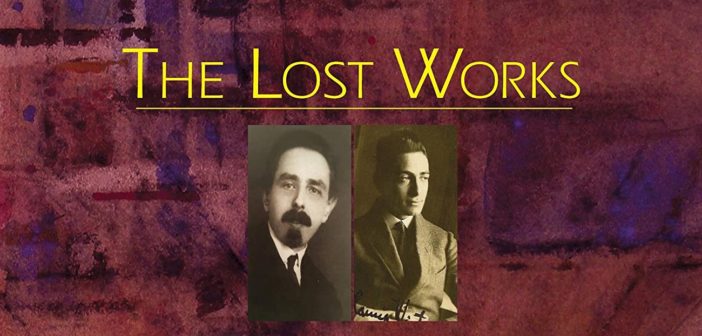
The only connection between these two composers is their victimisation and the last syllable of their names. Both were silenced for political reasons; neither has found due recognition. Samuil Feinberg (1890-1962), raised in cosmopolitan Odessa, was invalided out of the first world war and settled for a teaching post at the Moscow Conservatoire. His solo career as a pianist was curtailed by Stalinism and he lived out a life of near-total obscurity, known only for being the first pianist in the USSR to give a public recital of Bach’s Well-Tempered Clavier. The three works on this album are dated 1912 to…

Share:

It is a grim fact of musical life that, when a composer dies, his music goes into limbo for at least ten years. In that time, music directors and programmers shove the complete oeuvre into a drawer and wait, they say, for the reputation to settle. For a few lucky composers, a decade passes and there is a revival. For the others, just silence. The French composer Henri Dutilleux died in May 2013 at the age of 97. All his life Dutilleux struggled to make himself heard against the all-controlling modernism of Pierre Boulez on one hand and the ornithological…

Share:

I am about to break another rule. When I confined myself to reviewing just one album of the week around 15 years ago, I declared there would be no three-star reviews. Three is a cop-out. If it’s a great or good record it deserves four or five. Anything else I will only write about if, weak as it is, there is something instructive about its failure. So this week we have a three-star: why? Because it’s Zemlinsky and he’s caught between two stools. Like others of his generation, Alexander von Zemlinsky (1871-1942) was torn between late-romanticism and atonality, so he…

Share:

Let me take you into the process by which new releases get selected for review – at least by me who for years has reviewed just one album a week. The process is not scientific, but I’ll describe it as best I can. Monday morning I face two towering piles of CDs. First, I reject the known knowns – famous artists recording familiar repertoire, and probably not for the first time. They won’t have much to say that changes the state of my world. Then it’s the turn of the unknown unknowns, where both the composer and artist are extremely…

Share:

Determined as I was to review only modern works until this plague desists, I hit a brick wall this week with a pair of mid-20th century piano concertos on a respected label that were so sluggishly conducted it was all I could do to stop screaming profanities at the heavens. Could this be a sign that someone up there wants me to give up reviewing the modern stuff? If so, I got the message, thanks. Just no more bad conductors, please. Happily (and believe me I’m happy now), close at hand was a work I haven’t heard live since I…

Share:

You’d probably meet Morton Feldman if you hung out long enough in the Village in the early 70s. He was one of those guys with an idea in his head that was going to save the world if only you gave him enough time to explain it – like an hour, a day, the rest of your life. You might think that never in human history did time pass slower than it did in the Village in the 1970s until you hear the stuff Feldman was writing in which the passage of time ceases to have any meaning at all.…

Share:

After the atonal terrors of Threnody for the Victims of Hiroshima, his breakthrough work, Penderecki dismayed both the western avant-garde and the atheist Polish state by writing an overtly devotional church oratorio. Premiered for the 700th anniversary of Münster cathedral in West Germany in March 1966, it was greeted with shifting unease and polite reviews. By presenting it as ‘a homage to J S Bach’ the composer only increased the confusion. Penderecki was Catholic, Bach Lutheran. Nowhere in this hour-long recitation of modernist discords and vocal shrieks can the orderly and respectful spirit of Bach be definitely ascertained. Heard again,…

Share:

Since we’re unlikely in the next few years to hear another live performance of Berio’s massive Sinfonia – his collage tribute to Mahler’s second symphony – we’ll have to make do with the works that followed it. Coro developed out of Cries of London, written for the King’s Singers in 1973-74. It is a montage of street songs, madrigals, verses by Pablo Neuruda and snatches of colloquialism, built upon a large orchestral foundation – 84 instruments – of pure ascetic modernism. It’s wonderfully challenging to all our musical preconceptions and frequently beautiful beyond words. This is peak-period Berio, before he…

Share:

Around the turn of the century, an Argentine-Israeli composer living in Massachusetts was suddenly all the rage. Osvaldo Golijov was a maker of fusions, welding symphonic, jazz and folk music  into orchestral scores, often with a choral component. Such was his success, that he was showered with commissions by Big Five US orchestras and film deals from Hollywood. It all got a bit much for Golijov, who missed one deadline after another before eventually pronouncing himself blocked. Nothing has been heard from him for a decade and eclecticism has gone totally out of fashion. So I was quite thrilled to…

Share:

I wish more piano albums were like this, formed by an original idea and a lot of unfamiliar sounds to tweak the ear. All five composers performed were involved in some way with the Bauhaus that Walter Gropius founded at Weimar in 1919 to rethink the look of the built environment. Gropius was wedded to visual austerity even while he was married to Alma Mahler and the composers who gathered around him were not entirely a bundle of laughs. (One who does not feature here is Erwin Ratz, Gropius’s secretary, who went on to become a hugely controversial editor of…

Share:
1 75 76 77 78 79 172