This page is also available in / Cette page est également disponible en:
 Français (French)
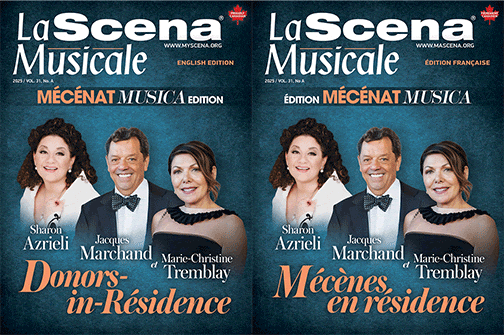
Mécénat Musica Donors-in-Residence help donors join Mécénat Musica and are Mécénat Musica donors to keep culture healthy forever, for generations to come. Since 2019, Jacques Marchand & Marie-Christine Tremblay’s leadership and collaboration have resulted in more than 100 Mécénat Musica donors for 24 cultural organizations.
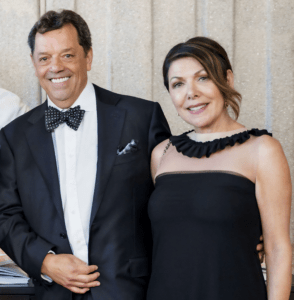
Photo: Andree Lanthier
“I told some: we’ll keep your regular season going and still invest in a perpetual fund.”
Jacques Marchand’s life falls neatly into two movements, each with its own tempo. The first is entrepreneurial: decades building LaSalle College from a local institution into a global network. The second is artistic: a late-career turn that channels his lifelong love of music into sustained, strategic philanthropy.
In 1979 Marchand was recruited by LaSalle’s founder, Jean-Paul Morin. Fresh from graduate studies and a post at HEC Montréal, he was drawn by the chance to learn from a founder and true entrepreneur. Within three years he became general manager and, soon after, a shareholder tasked with ensuring continuity when the founder retired. That transition coincided with constructing a larger campus designed to take the college into the next 30 to 40 years. The plan made sense, until demographic data warned of declining youth populations in Quebec.
The answer was internationalization. The first breakthrough came in Morocco, where local school owners proposed a partnership to deliver a Canadian curriculum in Casablanca and Rabat. The model was pragmatic: share ownership with capable local partners, train their teachers in Montreal, and phase in Canadian faculty only where necessary. Federal export programs helped reduce risk by subsidizing start-up costs and temporary assignments of Canadian instructors. With proof of an established concept, similar projects followed in Singapore, China, Malaysia, Turkey, Tunisia, and across South America. Over a dozen years, LaSalle expanded to 12 countries across five continents and enrolment grew from about 1,000 students to more than 5,000 at the Montreal campus!
Marchand’s approach favoured measured risk starting small in each market, scaling with persistence, and matching ambition to capacity. Later, when the organization had the strength to absorb bigger moves, he led acquisitions—notably, the first private university in Morocco. The result is a Canadian education group with a uniquely global footprint and local partners who share governance, reputation, and standards. True to his family’s business approach, in recent years Marchand has stepped back from day-to-day leadership, handing the presidency to his son Claude, who worked his way up the company.
Beginnings in Music
Marchand grew up in Laval-des-Rapides in a family of modest means but full of generosity. He credits his mom for his philanthropic spirit. Until his voice broke, he sang soprano solos like “Minuit, Chrétien” at Bon-Pasteur church and, at age 13, fell in love with the Beatles. The pull of music never left him, “it just wasn’t a way to make a living,” says Marchand.
At age 60, with more control over his time, he began to study piano alongside a youngster to help encourage him that it was an achievable task. He soon mastered playing Beatles hits like Let it Be. When he wanted more classical training, the late Rolande Royer of La Petite Maison des Arts suggested he study with Jean-Philippe Sylvestre, a piano prodigy since age three. One day, Sylvestre confided he was considering giving up being a concert pianist in order to find more stable work and start a family.
This inspired Marchand to help, and he did what he’d always done in business—mapped out the ecosystem, met the decision-makers, and worked to open doors. He approached conductors and orchestras (from Yannick Nézet-Séguin to Kent Nagano and Alain Trudel), and secured early engagements.
“Meeting orchestras also opened my eyes to their challenges—especially smaller ones like those in Laval and Longueuil. I decided to help them raise more funds so they could hire more musicians. I hosted salon concerts at home, invited business people, and when they fell in love with the artists, it became easier for them to give. That’s how I built a network around classical music.”
Mécénat Musica
Those living-room concerts served a larger goal: building durable financial foundations for music organizations. Marchand saw that annual fundraising—essential as it is—keeps leaders on a treadmill; what they lacked was compounding capital and predictable yield. Enter Mécénat Musica, a program focused on endowment-style perpetual funds. Marchand became a leading advocate and organizer, particularly on Quebec’s francophone side, helping more than 20 ensembles create or grow endowments that distribute a steady annual percentage.
“At first, they’d say, ‘Great idea, but we barely have funds to run our season—we spend all year fundraising; we can’t also put money into an endowment,’” says Marchand. “I told some: we’ll keep your regular season going and still invest in a perpetual fund.
“Over the past six or seven years, we’ve built meaningful endowments. Each year those funds distribute around five per cent. A $25,000 donation, combined with other donations and government matching, grows to $1 million or more; a $5-million fund yields around $250,000 annually, which is a big part of a budget. It’s much easier than begging for that amount every single year.”
Marchand’s advocacy extends to policy. His 2021 letters to ministers contributed to the Quebec government’s decision to renew the one-time additional tax credit for one large cultural donation. “I would like the government to allow each citizen to make two lifetime large cultural donations instead of just one, and to increase the envelope for Mécénat Placements Culture from $5 million to $25 million,” Marchand says. “In good years, increase the matching envelope. Culture should be treated like education and health.”
What is his message to businesses? “We should transfer part of our collective wealth to artists through various mechanisms—Mécénat Musica, annual fundraisers, direct artist support. Companies can also enhance employees’ quality of life by facilitating access to performances—tickets aren’t cheap once you add parking, childcare, a meal—just as firms subsidize gym memberships. Investing in culture strengthens our society. With education, health, and the arts all well-supported, our society becomes even more distinct and strong.”
This page is also available in / Cette page est également disponible en:
Français (French)