After 24 seasons driven by generosity, passion, and an uncompromising organizational vision, this summer’s Music@Menlo Chamber Music Festival and Institute will send off its founders and artistic directors pianist Wu Han and cellist David Finckel with one last tango in Menlo Park, California.
As they have done in the past, America’s chamber music power couple assembled a mouth-watering cast of guest artists for the festival’s 2026 edition. Along with the star-studded artist faculty, this year’s festival hosted a small, but select, cohort of music writers participating in the Music Critics’ Association of North America (MCANA) Writers’ Institute. As one of its newest members, I eagerly awaited my chance to hear those artists live and to do my favourite thing: sprinkle a little salt and pepper in my report of the festival’s opening weekend.
California Dreaming… On Such A Winter’s Day
Stepping into the lush California sunlight, on the lookout for my Uber ride at the San Francisco airport, I feel a cool wind swirl through the light fabric of my garment. Not the warm embrace I imagined that morning in Montreal, some 3,000 miles northeast. Leaving behind scorching July temperatures, I packed my most colourful assortment of Hawaiian shirts in hope of a milder climate. Instead, less than 600 miles north of Mexico, I find myself zipping up my jacket and reaching for my sweater.
Clearly, the Bay Area’s notoriously variable microclimate escaped me. Exposed to Pacific winds and the cold California Current along the coast, protected by hills and ridges across the peninsula, the region’s weather variations oscillate 15-20 degrees in a single day. Were it not for 30 years of frost and blizzards, I could reiterate the famous quibble, often misattributed to Mark Twain, “the coldest winter I ever spent was a summer in San Francisco”.
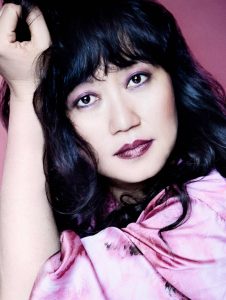
Wu Han. Photo: Lisa-Marie Mazzucco
Mirroring the region’s topographic originality, Music@Menlo nurtures a micro-system of its own. “From the get-go, the festival had the most idealistic design,” says co-founder and pianist Wu Han. “The very first year, we were making recordings called Menlo Live, we had an institute, conferences, and a full-blown lecture series; we hit 94% audience attendance, including the contemporary music concert. Because it was so idealistic and we were so ambitious, people paid attention to it immediately.”
Hosted at the Menlo School, a private college preparatory school (grades 6-12) located near the junction of the affluent Atherton and Menlo Park neighbouring cities, Music@Menlo has presented formidable learning and listening experiences since 2003. Comfortably nested in Menlo School’s impeccably elite campus, the festival takes full advantage of state-of-the-art facilities and performance venues.
Over the course of three weeks, some 44 senior artists, faculty and lecturers share the stage at the school’s three performance venues: the 2021-built Spieker Centre for the Arts, the Spieker Ballroom and the Martin Family Hall. The Spieker Center is an example of modern-day, angular architecture with floor-to-ceiling glass facades designed to bring in natural light, nurturing a feeling of space and comfort. Most of the festival’s main events take place there.
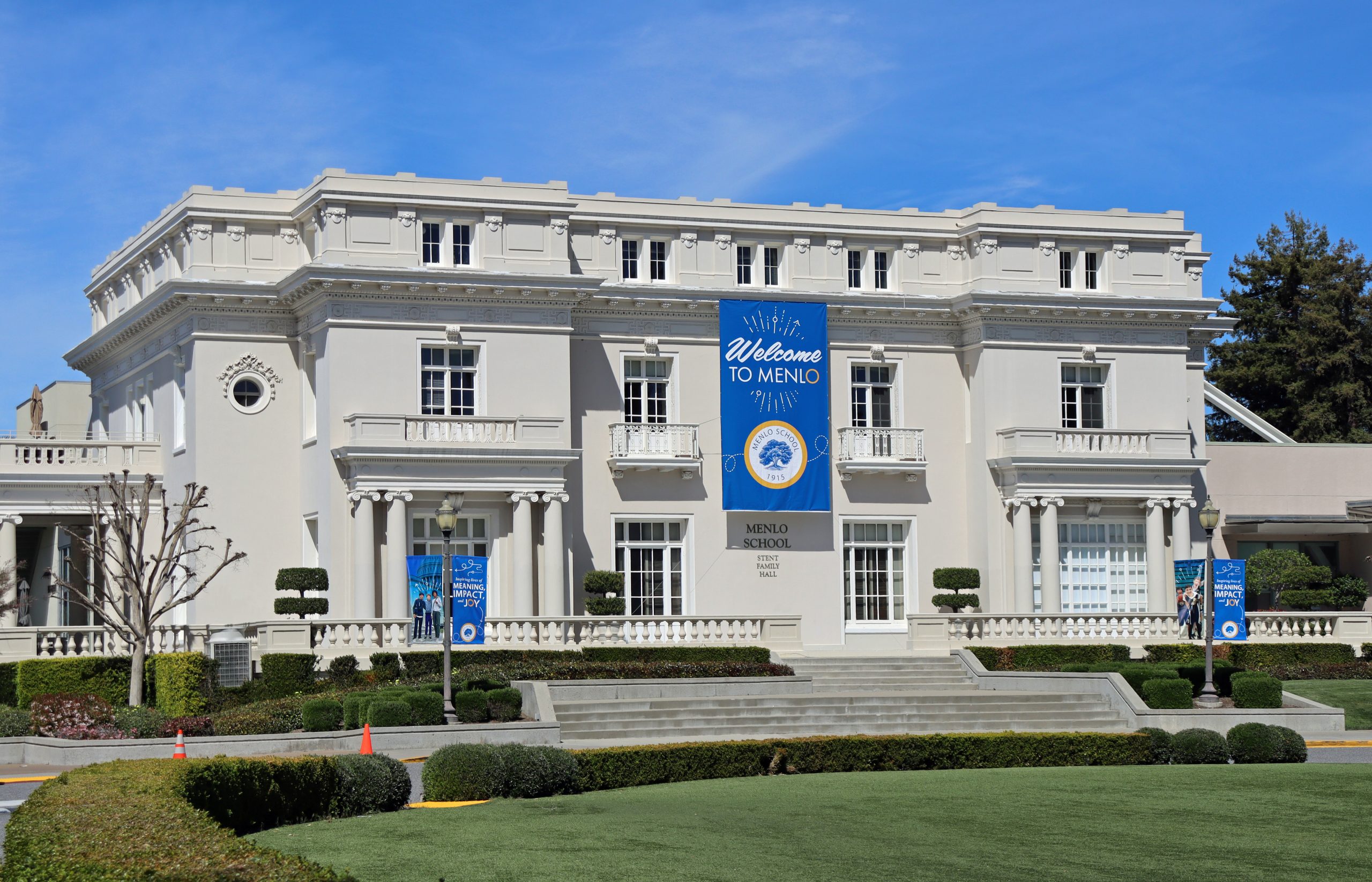
Stent Family Hall at Menlo School in Atherton, California (2025). Photo: Coolcaesar
On the other hand, Spieker Ballroom located in the Stent Family Hall—an imposing white mansion at the helm of the campus’s looping entrance—is straight out of The Great Gatsby. Designed in the late 19th century by the prolific Irish-American architect, William Curlett, the building was commissioned by wealthy industrialist couple Theodore Payne and Mary O’Brien.
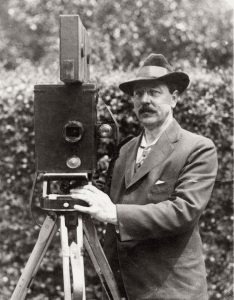
Leon F. Douglass (~1915).
Photo: Uncredited/The Douglass Archives
In 1921, the expansive, Italianate-style building was acquired by Leon F. Douglass, an inventor who contributed to the development of the phonograph in the United States. He was also a co-founding business partner of the Victor Talking Machine Company, which later merged with the Radio Corporation of America and became known as RCA Victor. The list of artists who recorded on Victor’s Red Seal label includes Enrico Caruso, Leonard Bernstein, Duke Ellington, Benny Goodman, Billie Holiday, Jascha Heifetz, Sergei Rachmaninov, and Arturo Toscanini.
Fittingly, Douglass’ story weaves in the same threads flowing through Music@Menlo’s own fabric: technological innovation coupled with the highest artistic standards. Part of the reason Han and Finckel selected Silicon Valley in 2002 was to prove that the two could co-exist.
“Back then, people were saying that the tech industry could not care less about art and classical music. We didn’t believe that. We did our own research and found out there were 11 youth symphony orchestras here. What does that tell you?” says Wu Han. Today, the main employers in the area are Meta and Stanford University. And 65% of the festival’s public is comprised of Menlo Park and Atherton residents—a statistic that supports Han and Finckel’s prediction from a quarter of a century ago.
Yet, the bond that unites technology and art is nuanced. While dramatically enhancing the accessibility of music worldwide, Wu Han reminds us that, “each technological advancement also decreases human interactions. You don’t need to make music together or attend concerts once you have radio, CDs, or the iPhone. Therefore, it’s so important for all of us who are serving the arts to make music affordable and accessible for everyone around us, and to understand the impact of this incredible art form called chamber music.”
While the notions of affordability and accessibility are tricky given the festival’s location in one of America’s most affluent regions, Music@Menlo serves its mission faithfully. This year’s edition includes seven chamber music concerts, three Carte Blanche piano recitals, five Encounters or public lectures, 13 Prelude Performances by emerging artists, and three Young Performers concerts by high-school age students.
In addition to concerts, Music@Menlo offers a tuition-free Chamber Music Institute that provides daily coaching sessions and plenty of hands-on performance experience. The highly sought-after institute is broken down in two tiers: the International Program Artists (IP), designed for early-career artists, 20-30 years old and the Smith Family Young Performers Program Artists (YP), training young artists, aged 13 to 19.
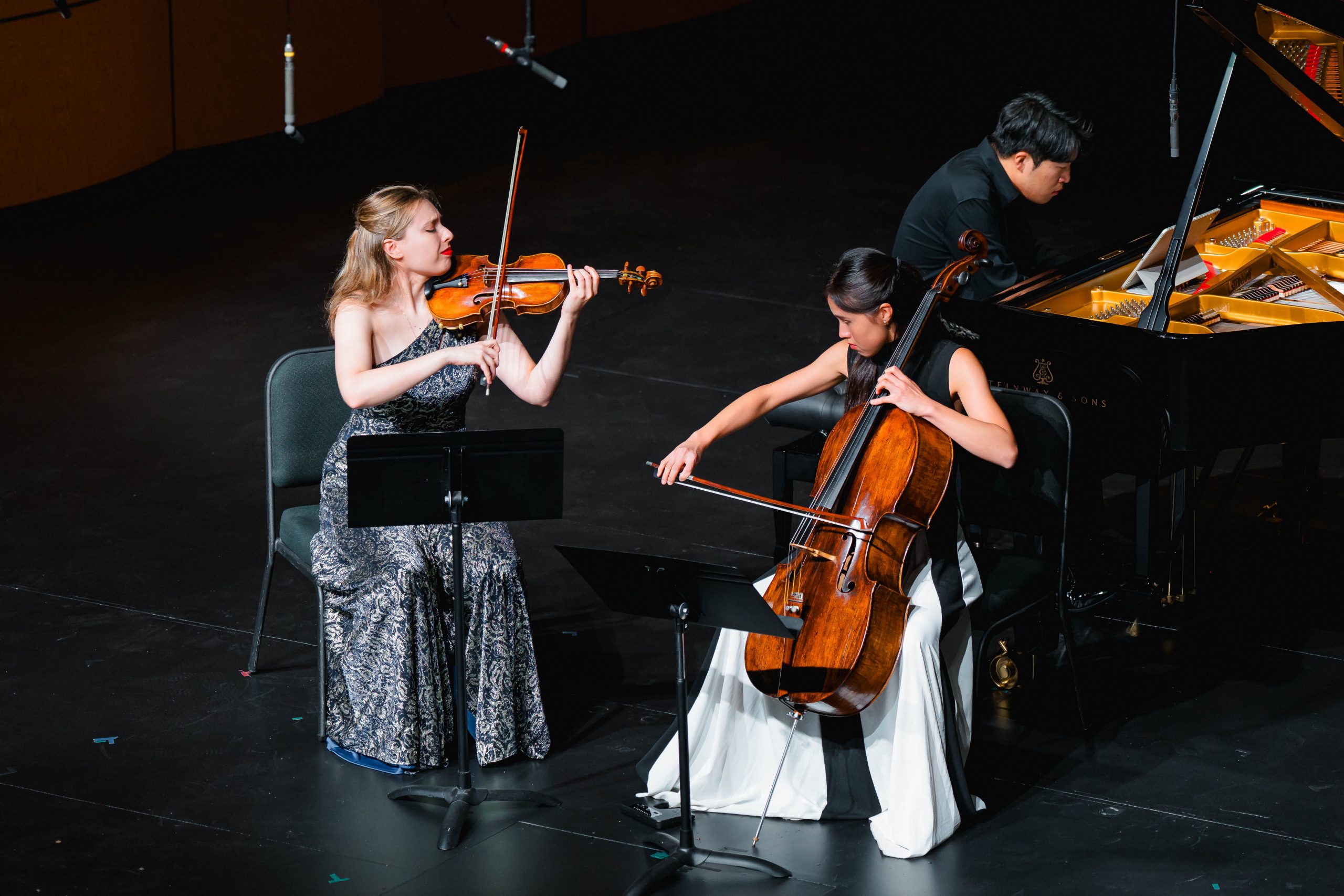
Julia Schilz (violin); Shengyu Meng (cello); and Jialin Yao (piano). Photo: Harrison Truong
Day One: Friday, July 17th
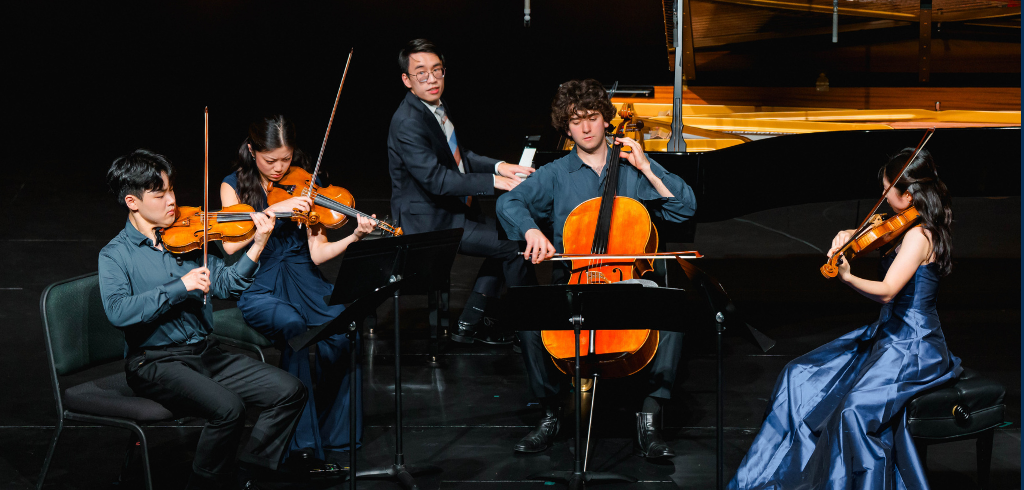
The opening concert was given by two different groups of IP participants. The players’ quality was immediately evident through their technical and expressive assurance in Beethoven’s Piano Trio in E-flat major op.1 and Dvořák’s Piano Quintet in A major op.81, B155. Inexperience crept up a few times, mostly in the form of the group’s lack of cohesion and attentiveness to moments of softer dynamic shading.
At this early stage of the institute, their individual challenge is to dare not to be heard at all times—a counter-intuitive proposition given each IP’s strong presence and ability, and a challenge inversely proportional to their age. Yet, both ensembles improved over the course of the performance, and will continue to grow and trust each other more as they play the same works again in different halls. The 384-seat Spieker Centre was packed with an attentive and cultured audience. To my delight, there was no applause in between movements, a phenomenon practically unheard of in Montreal’s highly sympathetic public (pardon the pun).
Later that evening, at the first encounter led by Michael Parloff, the audience proved just as keen and numerous. A tall, lonely figure on stage in the packed, 220-seat auditorium of Martin Family Hall, the former Metropolitan Opera Orchestra principal flute was accompanied by nothing more than a retractable projector screen.
Speaking in an unhurried, mellow voice, Parloff drew the audience into a seemingly improvised lecture about the early musical developments of Bach, Mozart, Schubert and Mendelssohn. As his storytelling turned, swirled, and waltzed through both well-known and little-known episodes of each composer’s youth, an AI-generated image followed seamlessly, grounding the public’s imagination unto concrete, and plausible, situations and environments. For two hours, separated by a 20-minute intermission, everything worked like a well-oiled machine: audio excerpts, slides, the rise and decay of Parloff’s speech, and the attentive responsiveness of the audience. Parloff indisputably stole the show on opening night.
Music@Menlo runs through Aug. 8.