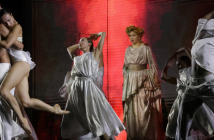
A century after its first performance at Milan’s Teatro alla Scala, Puccini’s Turandot continues to possess the peculiar capacity to transform an opera house into an empire. Few works in the repertory combined such extravagant orchestral and choral forces with the visual language of ritual, pageantry and fairy tale quite so naturally. At the Arena di Verona, where scale itself had long been part of the theatrical vocabulary, Franco Zeffirelli’s celebrated production made a persuasive case for Turandot as grand opera in its most unabashedly monumental form.
Scene from Arena di Verona’s Turandot. Photo: Ennevi Foto
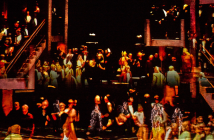
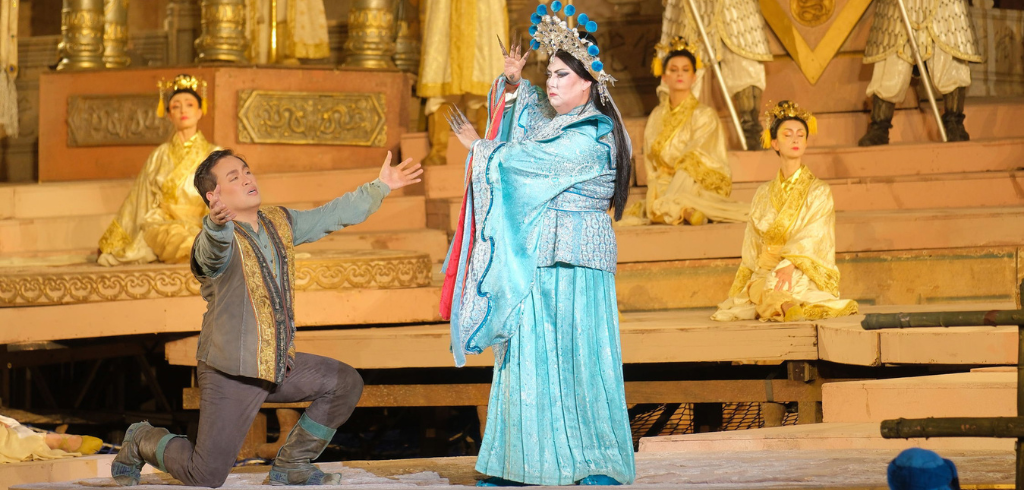
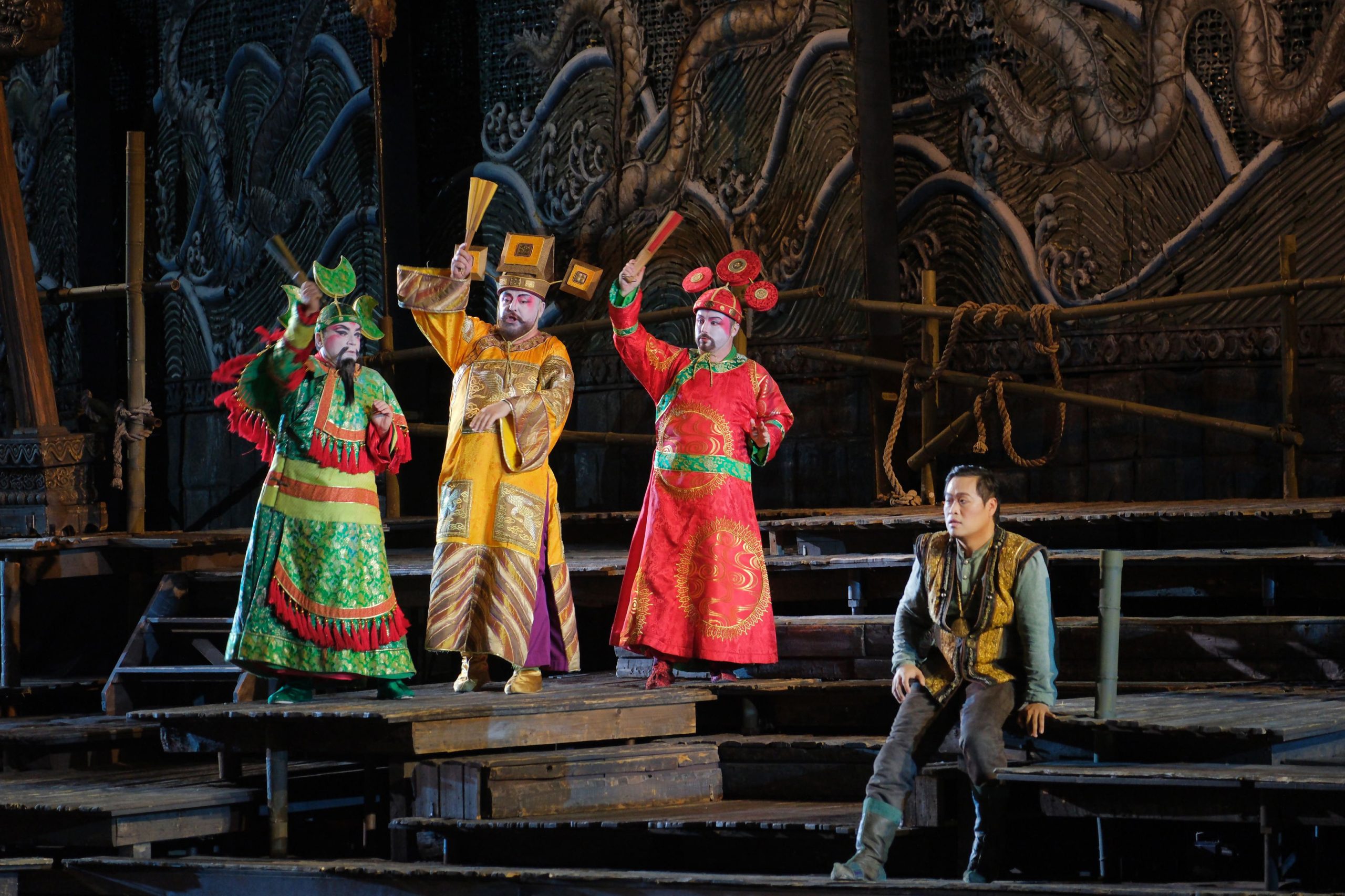
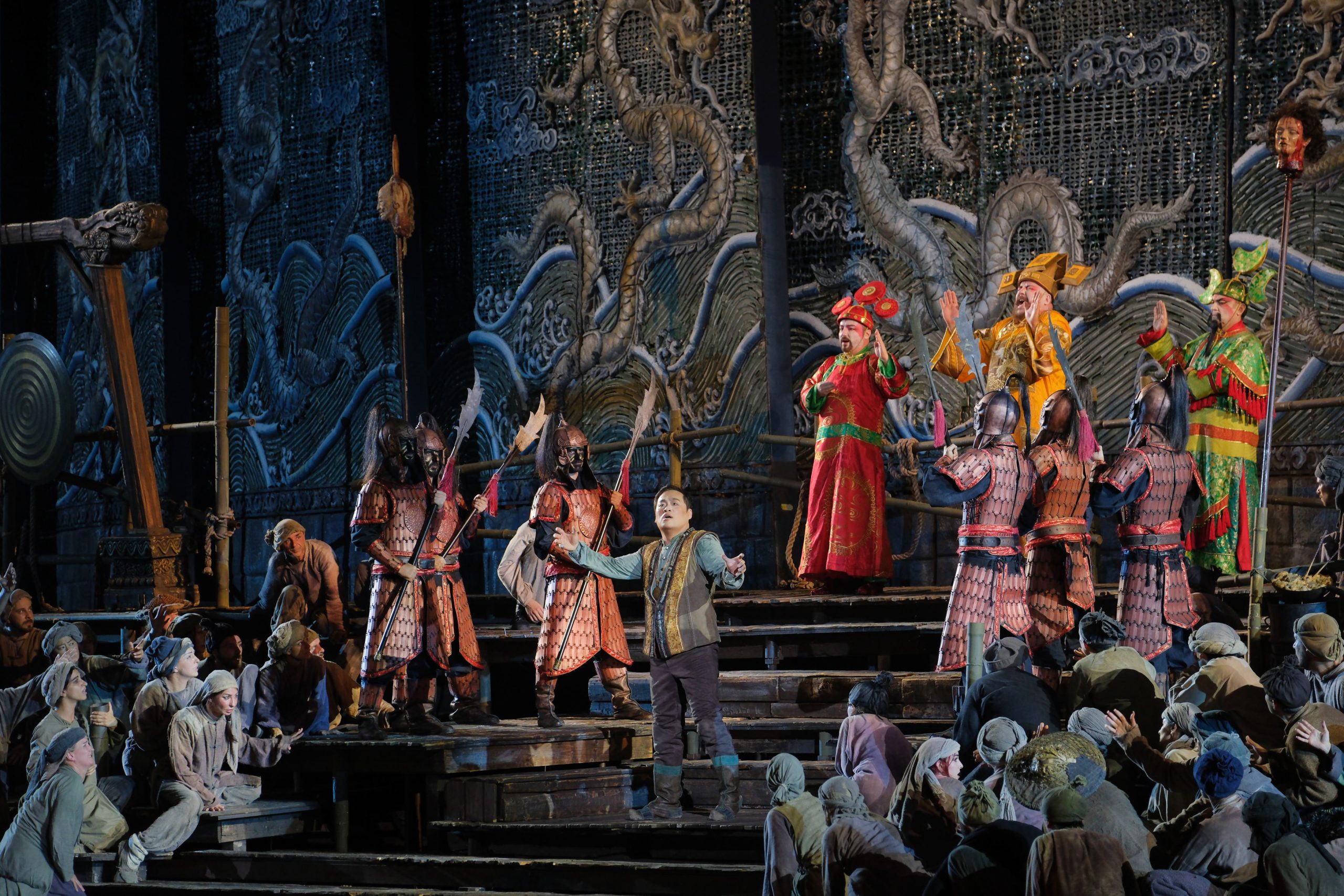
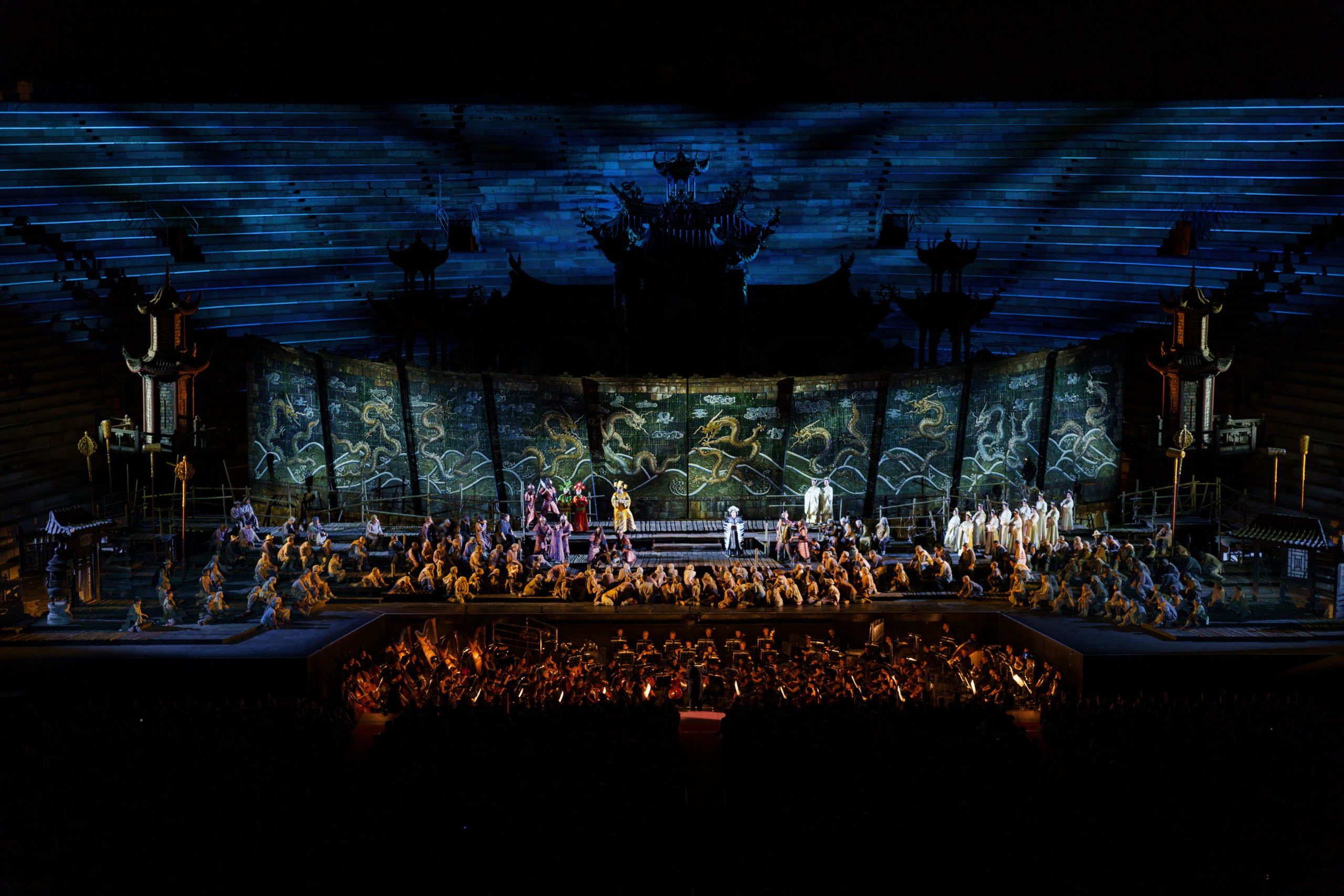
Originally created for the Arena in 2010, Zeffirelli’s staging (seen Aug. 7) remains an exercise in operatic gigantism. The stage teems with mandarins, soldiers, courtiers, executioners, priests, children and dancers, while Emi Wada’s sumptuous costumes supply an abundance of colour, embroidery and ceremonial splendour. The great scenic reveal of the imperial palace remains an effective coup de théâtre, transforming the Arena into an immense ceremonial court.
The production’s longevity, however, also makes its limitations more apparent. Zeffirelli’s conception was always fundamentally pictorial: the images are magnificent, but the psychological trajectory connecting them was less fully articulated. His Turandot presents an imaginary China of fairy-tale exoticism and imperial grandeur, but offers comparatively little insight into the troubled psychology beneath Puccini’s sumptuous surface. Turandot’s transformation from executioner to lover remains particularly difficult to reconcile with a staging that tends to present her as an imposing icon rather than a woman undergoing an interior crisis.
Scene from Arena di Verona’s Turandot. Photo: Ennevi Foto
The sheer abundance of scenery, extras and choreography occasionally competes with the principals. Yet the Arena is perhaps the one theatre in which such excess could plausibly work. Zeffirelli understood that an open-air amphitheatre of this scale demands an equally monumental theatrical vocabulary. The result is occasionally overwhelming, but rarely visually indifferent.
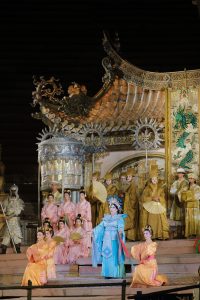
Anna Pirozzi in the title role of Arena di Verona’s Turandot. Photo: Ennevi Foto
Anna Pirozzi supplied the evening with a Turandot worthy of such dimensions. Her dramatic soprano carried effortlessly across the enormous auditorium, its upper register ringing with authority while the middle voice retains sufficient body to sustain the character’s declamatory writing. Yet what distinguished her performance from a merely athletic assumption of the role was her ability to temper vocal power with musical control.
Pirozzi has already established herself as one of the leading contemporary interpreters of Turandot, with recent performances at both La Scala and Metropolitan Opera confirming the suitability of her voice to Puccini’s most formidable soprano role. At Verona, she gives the princess the necessary hauteur without reducing her to a collection of high notes. “In questa reggia” had the character of an imperial proclamation, while the riddles were delivered with almost clinical confidence. Her Turandot is formidable because she appears to believe absolutely in the invulnerability she has constructed around herself.
The transformation in the final act remains dramatically more problematic, largely because Zeffirelli’s staging does not sufficiently chart it. Pirozzi nevertheless supplied, through vocal colour and phrasing, some of the emotional evolution that the production itself leaves implicit.
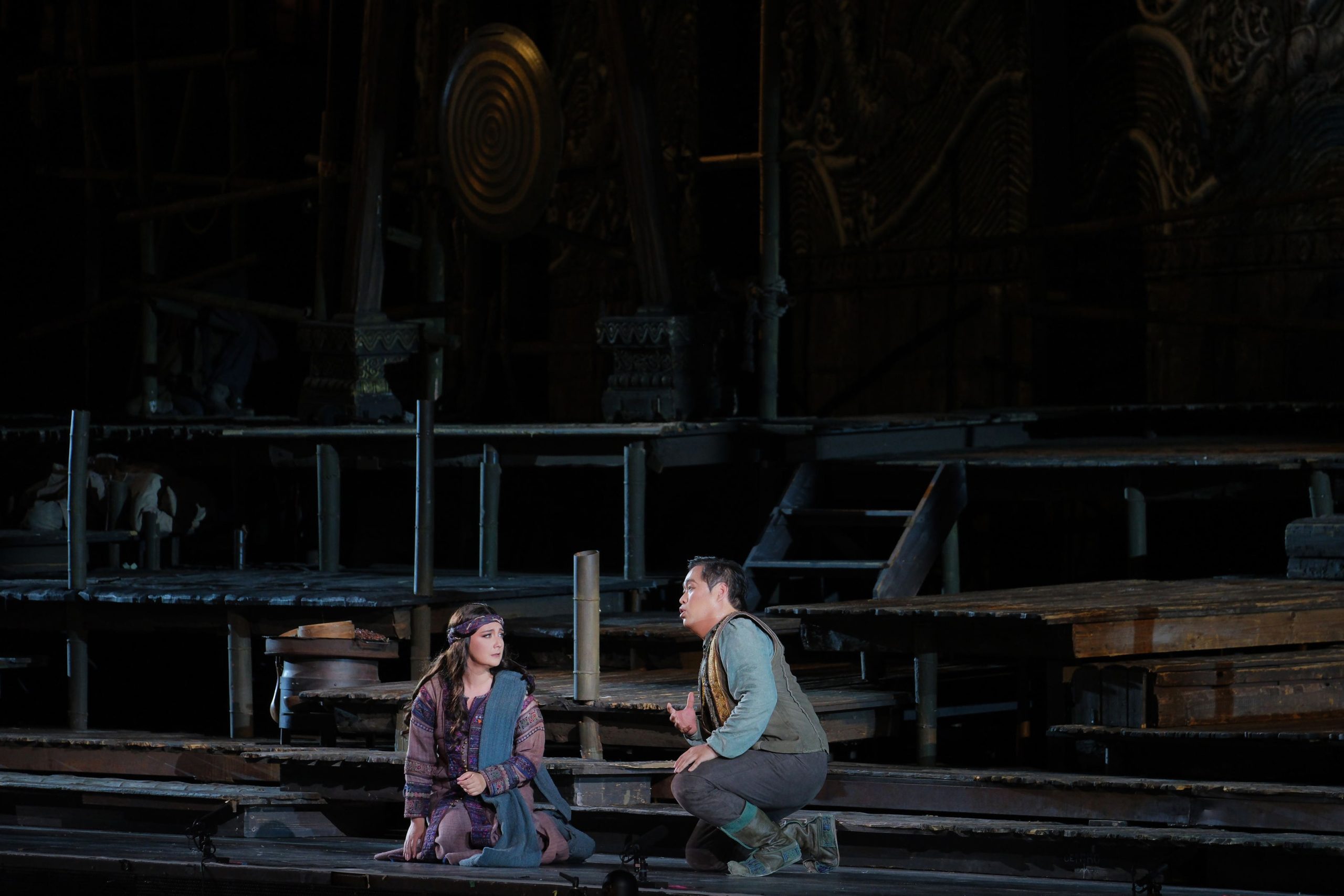
SeokJong Baek, who replaced the originally announced Calaf, made a strong impression in the Arena. His tenor possesses the requisite amplitude and metallic brilliance for the part, particularly in the upper register, but he also brought a welcome musicality to a role too often reduced to its single famous aria. Baek’s “Nessun dorma” was delivered with assurance, but the performance was not built around the aria alone. He gave Calaf a sense of impulsiveness and romantic obstinacy that suited the character’s extraordinary decision to challenge Turandot despite what had happened to her previous suitors. His vocal security allowed him to ride the Arena’s expansive acoustic without resorting to indiscriminate force.
SeokJong Baek (Calaf) in Arena di Verona’s Turandot. Photo: Ennevi Foto
The real emotional counterweight to the protagonists was Mariangela Sicilia’s Liù. Having previously sung the role in this same Zeffirelli production, she brought an evident familiarity with its scale while refusing to allow Liù to become merely another figure in the pageant. Her lyric soprano was warm and pliant, with a delicacy in the quieter passages that contrasted effectively with the surrounding grandeur. There was nothing sentimental about her interpretation. Her Liù was moving precisely because Sicilia allowed the character’s courage to emerge without exaggeration.
Her death scene consequently provided one of the evening’s most genuinely affecting passages. For all the enormous visual resources at Zeffirelli’s disposal, the emotional centre of Turandot remained a young woman standing alone before an empire she was prepared to defy.
Alexander Vinogradov brought to Timur the dark sonority and authority expected of a Russian bass. His substantial projection and naturally resonant lower register served him well in the role. His usually inadequate diction was less obtrusive here—a considerable blessing. The characterization was less fully developed than his vocal means, but the voice itself endowed Timur with the requisite patriarchal gravity and made his grief at Liù’s death appropriately weighty.
Scene from Arena di Verona’s Turandot. Photo: Ennevi Foto
The supporting cast contributed effectively to the production’s sense of scale, while the Arena chorus and children’s chorus were crucial to its theatrical impact. Puccini used the chorus in Turandot not merely as an accompaniment to the principals but as a collective protagonist: the crowd could be bloodthirsty, fearful, fascinated and suddenly submissive, sometimes within the space of a few bars. The massed forces of the Arena were therefore particularly well suited to the work.
The orchestra, under Andrea Battistoni, offered a performance that illuminated the sophistication beneath Puccini’s apparently straightforward theatrical rhetoric. The score was full of contrasts: savage percussion and delicate woodwind writing, massive choral climaxes and passages of remarkable intimacy, exotic colour and unmistakably late-Romantic harmonic language. Battistoni maintained a firm theatrical pulse while allowing the orchestra to reveal these finer details. The result was energetic without becoming crude and grand without sacrificing refinement.
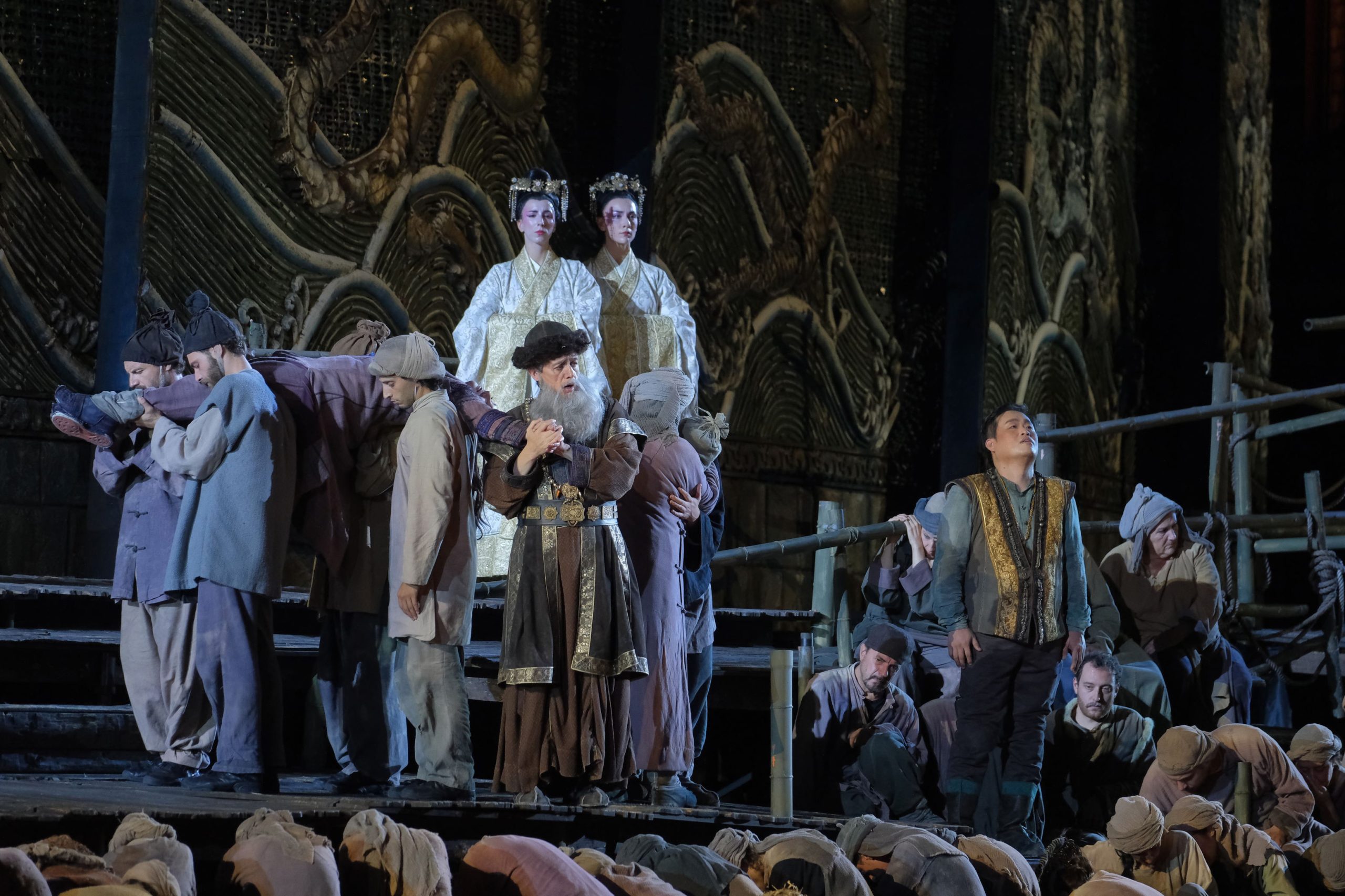
Scene from Arena di Verona’s Turandot. Photo: Ennevi Foto
This balance was especially welcome in an Arena performance, where the sheer dimensions of the space could encourage conductors to treat Turandot as an exercise in sonic gigantism. Battistoni instead kept the music moving, giving the score an urgency that prevented the spectacle from becoming entirely static.
A century after Turandot first reached the stage, Verona once again offered the opera in a form that was unapologetically spectacular. Zeffirelli’s production may no longer have seemed entirely adequate to the work’s psychological complexities, but its grandeur remained difficult to resist. In the Arena, where opera has always existed on the precarious border between drama and spectacle, Turandot found a natural, if occasionally overwhelming, home.
Arena di Verona’s Turandot continues its run with various cast changes through Sept. 11.