If not every hour I spent in the Bayreuth Festspielhaus this year felt entirely worthwhile, every minute of Olivier Messiaen’s four-and-a-half-hour Saint François d’Assise in Salzburg was profoundly affecting (seen Aug. 4).
Premiered in 1983 at the Palais Garnier in Paris with José van Dam in the title role, the richness of Messiaen’s score is unequalled. Birdsong, Gregorian chant, vast blocks of orchestral colour and passages of the most delicate luminosity coexist in a musical language that seems at once ancient and startlingly new. Yet its abundance never becomes mere excess. Everything leads towards a single spiritual journey: François’s gradual renunciation of worldly existence.
I found myself wishing that, alongside the many hours I devote to Wagner, I could hear this extraordinary work at least once every two years. Yet, compared with Wagner’s operas, Saint François d’Assise is rarely performed. Its productions nevertheless tend to become landmarks, particularly when entrusted to major visual artists. At the Ruhrtriennale in 2003, Ilya and Emilia Kabakov transformed the Jahrhunderthalle into one of their “total installations,” dominated by The Cupola, an immense luminous dome whose changing colours responded in synaesthetic dialogue with Messiaen’s score. In Munich in 2011, Hermann Nitsch turned the work into an action-painting spectacle—an extension of his Orgien Mysterien Theater. More recently, in Geneva in 2024, Adel Abdessemed recast François’s encounter with poverty and suffering through images of migration, discarded materials and ecological destruction.
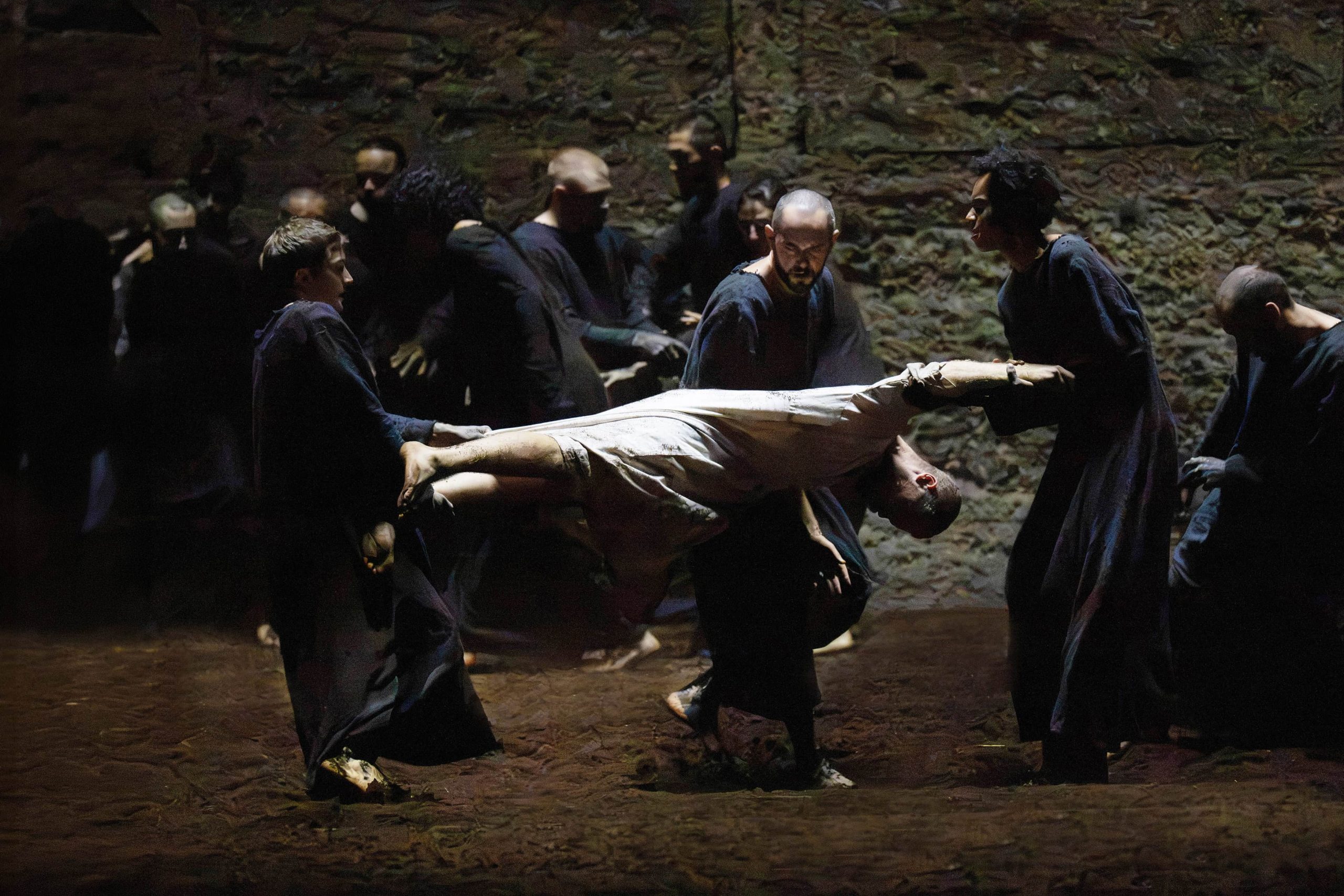
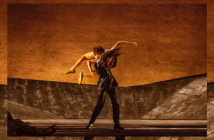
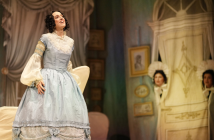
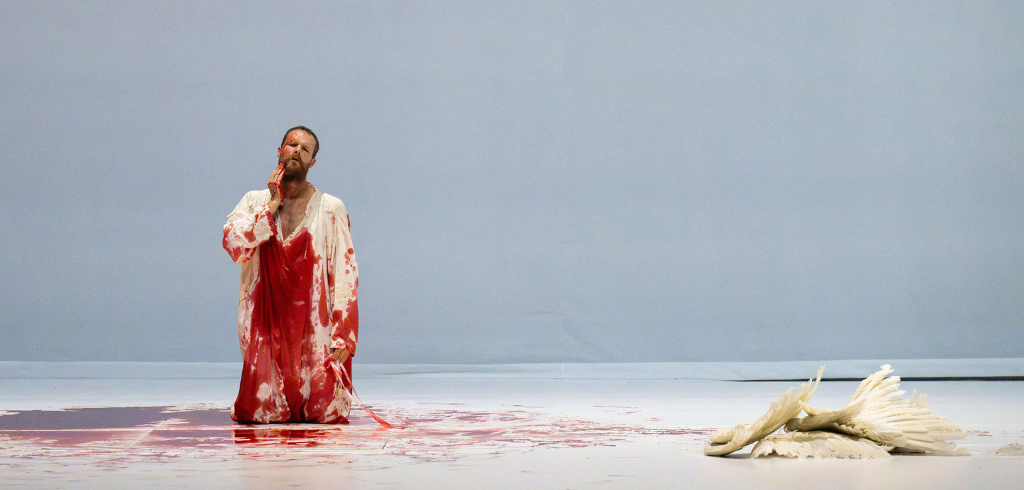
Philippe Sly (Saint François) in Salzburg Festival’s Saint François d’Assise. Photo: SF/Monika Rittershaus
With Saint François d’Assise at Salzburg, Romeo Castellucci has created another operatic landmark. Rarely has it been clearer that the Italian director’s origins in the visual arts remain fundamental to his theatre. He approaches the stage as a plastic medium in which bodies, images, sound, architecture, animals and machines carry meaning. Working here as director, set, costume and lighting designer, he has created a world in which beauty coexists with violence, and the sacred with the abject. His interest in performance artists such as Gina Pane and Chris Burden was evident in the exposure of the body to pain and extreme vulnerability. Religious imagery recurs throughout his work—as it did in his production of Mahler’s Second Symphony, Resurrection, in Aix-en-Provence in 2022—but never as an affirmation of doctrine. Instead, Christianity’s central mysteries—sacrifice, incarnation, suffering and resurrection—are subjected to intense physical and theatrical scrutiny.
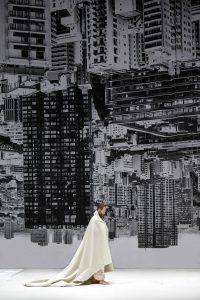
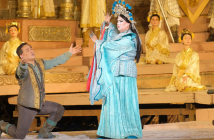
Philippe Sly (Saint François) in Salzburg Festival’s Saint François d’Assise. Photo: SF/Monika Rittershaus
In the rock face of the Felsenreitschule, Castellucci found both the mountain of La Verna—where Saint François received the stigmata—and an existing backdrop that seemed to precede human history. The opening downpour, the bread baked by the friars, the earth from which dark figures emerged to inflict the stigmata, and finally the sheep crossing the stage after François’s death were not illustrations of the libretto. They gave material form to its spiritual ideas.
The sad spectacle of the dead and dying birds falling onto the stage at the end of Scene 6, “The Sermon to the Birds,” made explicit Castellucci’s deep concern for the current extinction crisis. The same concern was evident in his production of Mozart’s Requiem in Aix-en-Provence, which I saw again this summer. There, names of animals that have become extinct, along with monuments and treasures from around the world that have been lost forever, were projected on the stone wall of the Archevêché. This year, the list was considerably longer than it had been in 2019, when the production premiered.
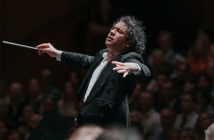
Maxime Pascal, conducting the Vienna Philharmonic, faced the formidable task of holding together Messiaen’s immense score—some 2,500 pages in manuscript—with its enormous orchestra, vast percussion section and three Ondes Martenot positioned on balconies on either side of the Felsenreitschule stage. Yet he never treated the work as merely monumental. Instead, he revealed the architecture beneath the profusion and, more importantly, the extraordinary tenderness within it. Under his direction, the Vienna Philharmonic didn’t just play magnificently; its musicians seemed to create the spiritual and natural world through which François moved.
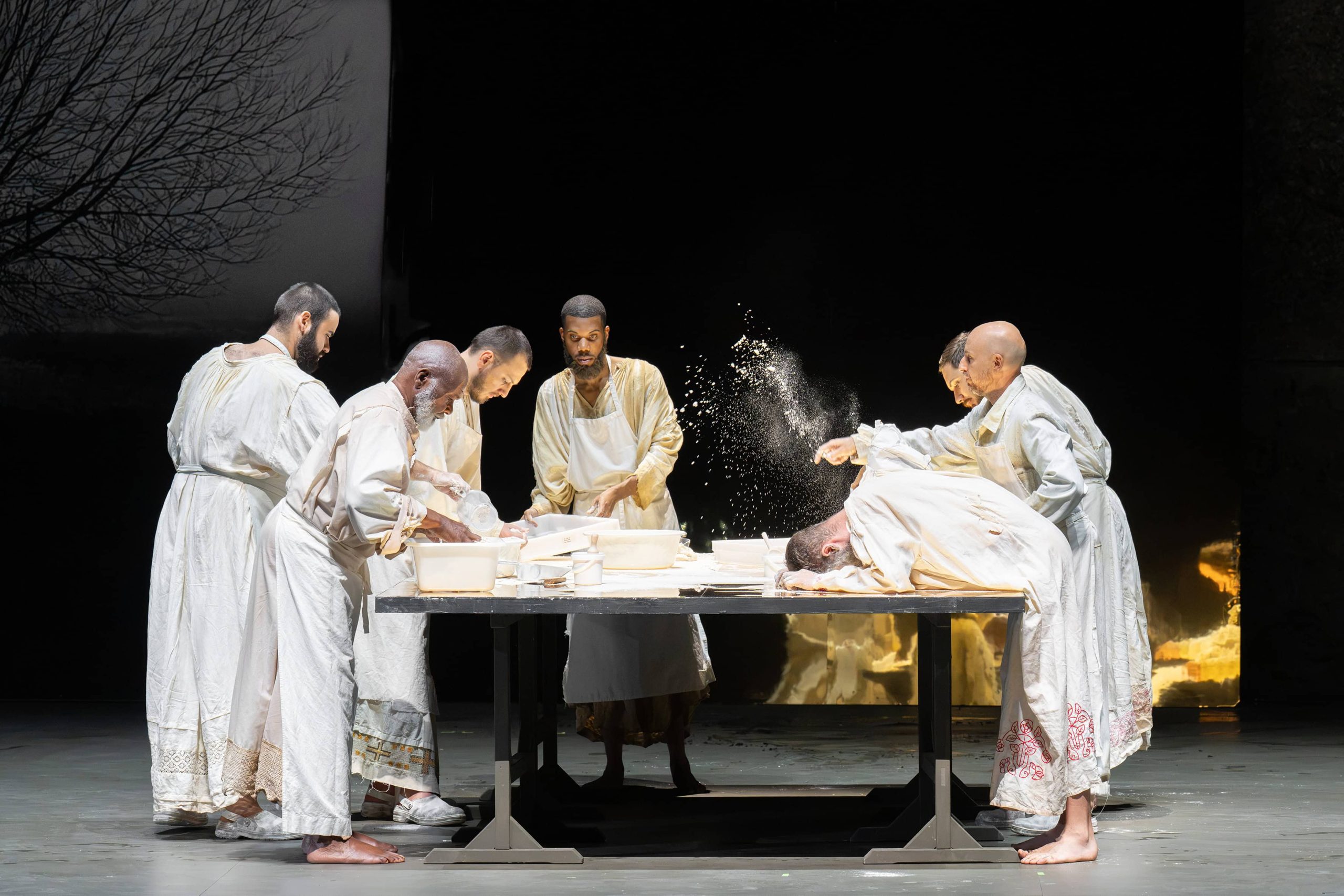
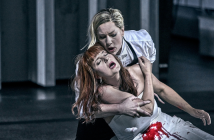
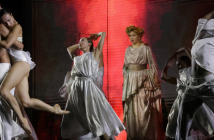
Scene from Salzburg Festival’s Saint François d’Assise. Photo: SF/Monika Rittershaus
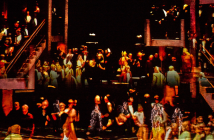
Messiaen’s choral writing is exceptionally demanding. The chorus functions in turn as a crowd, a celestial presence and, singing offstage, the voice of Christ. Prepared by chorus master Jozef Chabroň, the Vienna State Opera Chorus performed with remarkable precision, weight and near-liturgical purity. Its members remained invisible until the curtain calls, when the full scale of the forces that had been at work throughout the evening was finally revealed to thunderous applause.
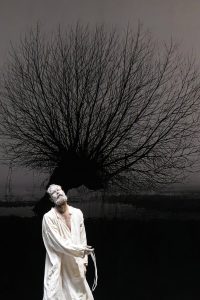
Philippe Sly (Saint François) in Salzburg Festival’s Saint François d’Assise. Photo: SF/Monika Rittershaus
Philippe Sly must have seemed a godsend to Castellucci: a bass-baritone with a voice of extraordinary beauty and remarkable clarity of diction, but also an actor capable of expressing meaning through every movement. I had already admired him as Guglielmo in Anne Teresa De Keersmaeker’s 2017 production of Così fan tutte at the Paris Opera, where his physical presence made him equally compelling as an actor, dancer and singer.
Castellucci demands a great deal from him here. Sly is dragged, thrown and flung across the stage; François’s suffering and transformation are enacted upon his body. At moments, the stage acquires the dramatic intensity of a painting by Tintoretto, with bodies massed into choruses, caught in movement and organised around the tormented saint. At the centre of these turbulent compositions, Sly conveys both François’s physical fragility and the terrifying force of his spiritual conviction.
It is hard to imagine a more credible angel than Lauranne Oliva. She possesses an otherworldly quality in both her appearance and her beautiful voice. Her physical grace suggests a being governed by laws different from our own, while her singing is effortless and her diction clear and direct. She can be tender, imperious and unsettling: not a consoling angel, but a messenger whose arrival inspires both wonder and fear.
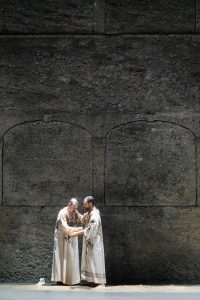
Russell Braun (Brother Léon) & Philippe Sly (Saint François) in Salzburg Festival’s Saint François d’Assise. Photo: SF/Monika Rittershaus
Sean Panikkar sings the Leper, while the character is embodied onstage by an elderly, infirm man, naked and covered in excrement. François recoils before overcoming his revulsion and washing him. The scene is almost unbearable in its physical reality, but Panikkar’s expressive dignity prevents the Leper from being reduced to a symbol of suffering. Disgust, fear, compassion and grace pass between the three men in one of the opera’s most moving encounters.
The friars formed a particularly strong ensemble, each with a distinct vocal and dramatic identity. Russell Braun gave moving expression to the doubts of Brother Léon and his recurring fear that life itself is unbearable. The great Willard White, as Brother Bernard, needed only a few moments to make his authority felt. Aaron-Casey Gould, Léo Vermot-Desroches, Ivan Lyvch and Marius Aron completed the community with assurance. What could easily have become an undifferentiated group of minor characters emerged as a recognisable brotherhood, by turns bewildered, resistant and transformed by François’s example.
The production also carried the imprint of another authorial intelligence: that of Markus Hinterhäuser. In the program, Castellucci paid tribute to him in unusually direct terms:
“By way of conclusion, I would like to add that it has only been possible to bring this production into existence through the inspired vision of Markus Hinterhäuser. Our work on Saint François d’Assise would have come to nothing without the artistic ambition and support lent to it by Markus, himself the victim now of petty politics that would arrogantly seek to fetter culture while lacking the ability to understand the consequences.”
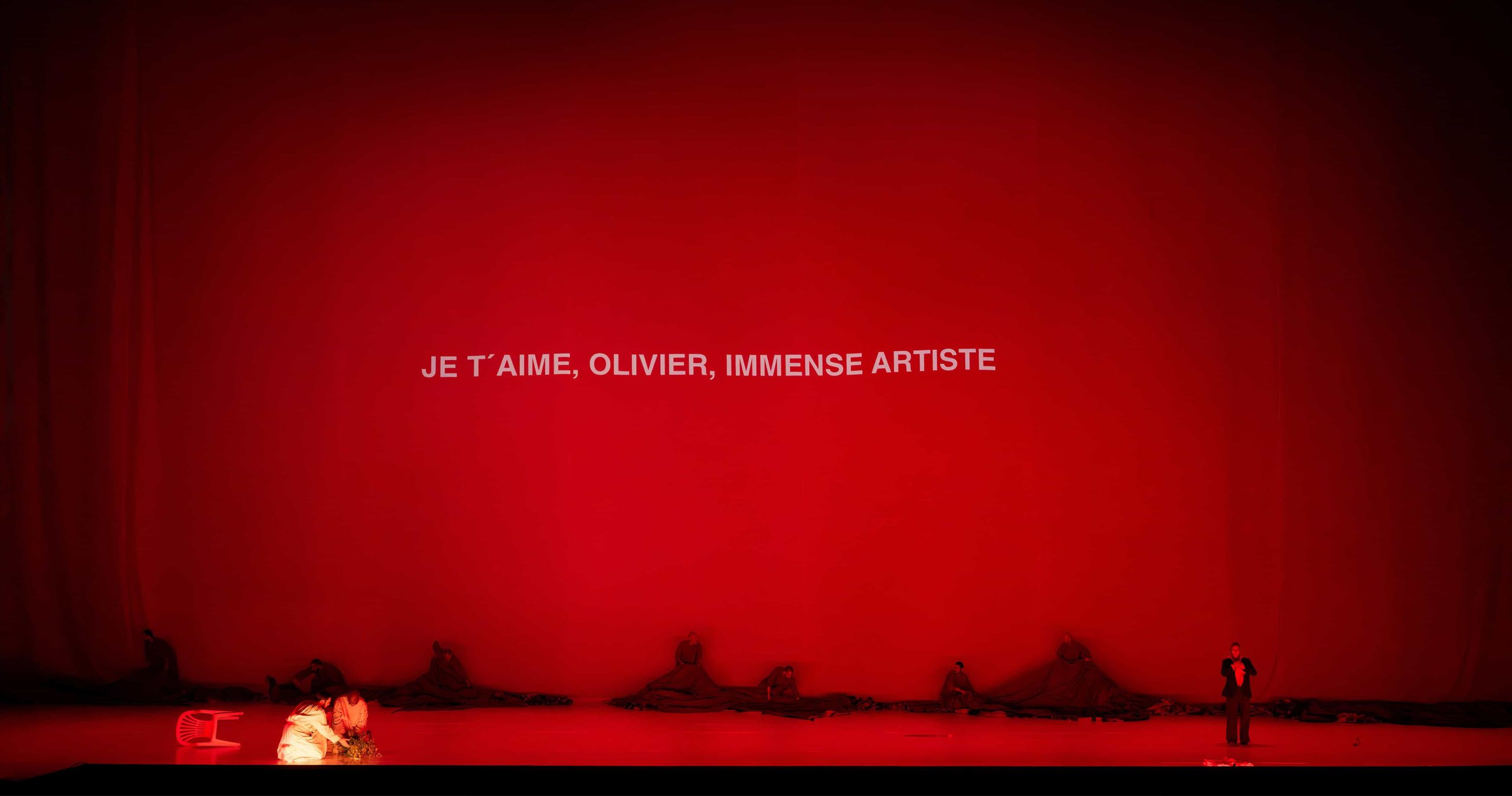
Scene from Salzburg Festival’s Saint François d’Assise. Photo: SF/Monika Rittershaus
These words are more than a gesture of gratitude. They are an accusation that places the production squarely within the current political turmoil surrounding the leadership of the Salzburg Festival.
Messiaen’s Saint François d’Assise was undoubtedly the highlight of my summer of opera, from Glyndebourne and Aix to Bayreuth and Salzburg. It was also one of Hinterhäuser’s final and most magnificent statements of artistic intent as director of the festival.
Salzburg Festival’s Saint François d’Assise continues its run through Aug. 23.