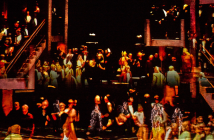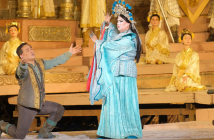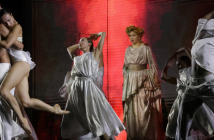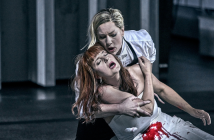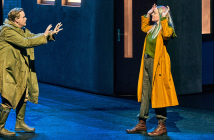
Opernhaus Zürich’s Die Fledermaus (seen Dec. 7) opens with a prelude in the form of a short film. It’s a party: young, good-looking people, drinks in hand, music loud, spirits high. Eisenstein and Falke appear as younger men, joking, showing off, pushing things a little too far. A bat costume turns up, laughter spills over, and the night slides out of control.
There’s an easy brightness to it, but not everyone lands the same way. Falke already seems slightly out of step, the one who laughs a fraction too late, the one for whom the joke will stick. The moment passes, as parties do, but when the action finally begins, the imbalance has been set—lightly, almost playfully, and with just enough weight to matter later.

This opening gesture encapsulates the staging by Anna Bernreitner, which favours narrative clarity and forward momentum, a framing that feels especially apt in this Johann Strauss bicentenary year. Indeed, her production comes as refreshment at the end of a twelve-month relay in which opera houses across the world have been gamely attempting to out-Strauss one another—sometimes with inspiration, sometimes with sheer determination.
Written in 1874, in the aftermath of Vienna’s stock market crash of 1873, Die Fledermaus emerged from a moment of economic anxiety and social disillusionment. Its famous refrain—“Glücklich ist, wer vergisst, was doch nicht zu ändern ist” (“Happy are those who forget what cannot be changed.”)—was never merely escapist; it articulated a collective strategy for coping through pleasure, wit, and selective amnesia. That strategy, it turns out, has lost none of its relevance.
With Matthias Schulz now at its helm, Opernhaus Zürich’s contribution to the Strauss year may not aim for the loudest bicentenary splash, but it stands out as one of the stronger musical offerings of the anniversary—a relief, perhaps, after a year in which champagne corks have popped at varying pitches. The evening is anchored decisively by Lorenzo Viotti’s conducting, which gives Strauss’s score exactly what it requires: rhythmic buoyancy, stylistic precision, and an unfailing sense of theatrical momentum while avoiding nostalgic indulgence. Nevertheless, Viotti lets the waltzes breathe, ensembles fizz and handles the transitions—so crucial in operetta—with natural ease. The orchestra responds with a polished alertness that reminds us how finely calibrated Johann Strauss’s music really is.

The vocal performances benefit enormously from this musical foundation, and it is striking how consistently strong the male contingent proves throughout the evening. Matthias Klink’s Eisenstein is vocally rich and dramatically grounded, offering a portrait of bourgeois complacency rather than caricature. With ample vocal beauty and dramatic intelligence, Yannick Debus has Dr. Falke emerge as the quiet linchpin of the drama, less prankster than stage manager of the evening’s collective self-deception. His revenge is not cruel; it is a social experiment.
Andrew Owens brings wit and lyricism to the role of Alfred, delivering some of the evening’s most uproarious gags. Noted for the warmth and depth of his dark baritone, Ruben Drole imbues Frank, the prison governor, with an initial air of authority before charting his descent into debauchery. A bureaucrat quick to exchange duty for diversion, Frank adopts a false identity at Orlofsky’s ball, exposing how fragile power becomes once the uniform is shed.

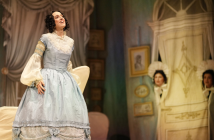
Among the women, Golda Schultz stood apart unmistakably. Her Rosalinde combined vocal radiance and dramatic power. Her Csárdás emerged as one of the evening’s true high points: poised and expansive—a reminder that Strauss knew exactly when to let the glitter pause and the music speak plainly. By contrast, Regula Mühlemann’s Adele and Marina Viotti’s Prince Orlofsky made a more modest impression. Both performances were musically competent, yet lacked the dramatic incisiveness and vocal personality needed to register fully alongside Schultz’s commanding presence.
In the wider landscape of the Strauss anniversary—marked by gala nights, retooled classics, and the occasional concept-laden, history-buff Herheim exercise at the Theater an der Wien—Zürich’s Fledermaus resists the urge to gild every moment, and lets rhythm, ensemble, and phrasing do the persuasive work.
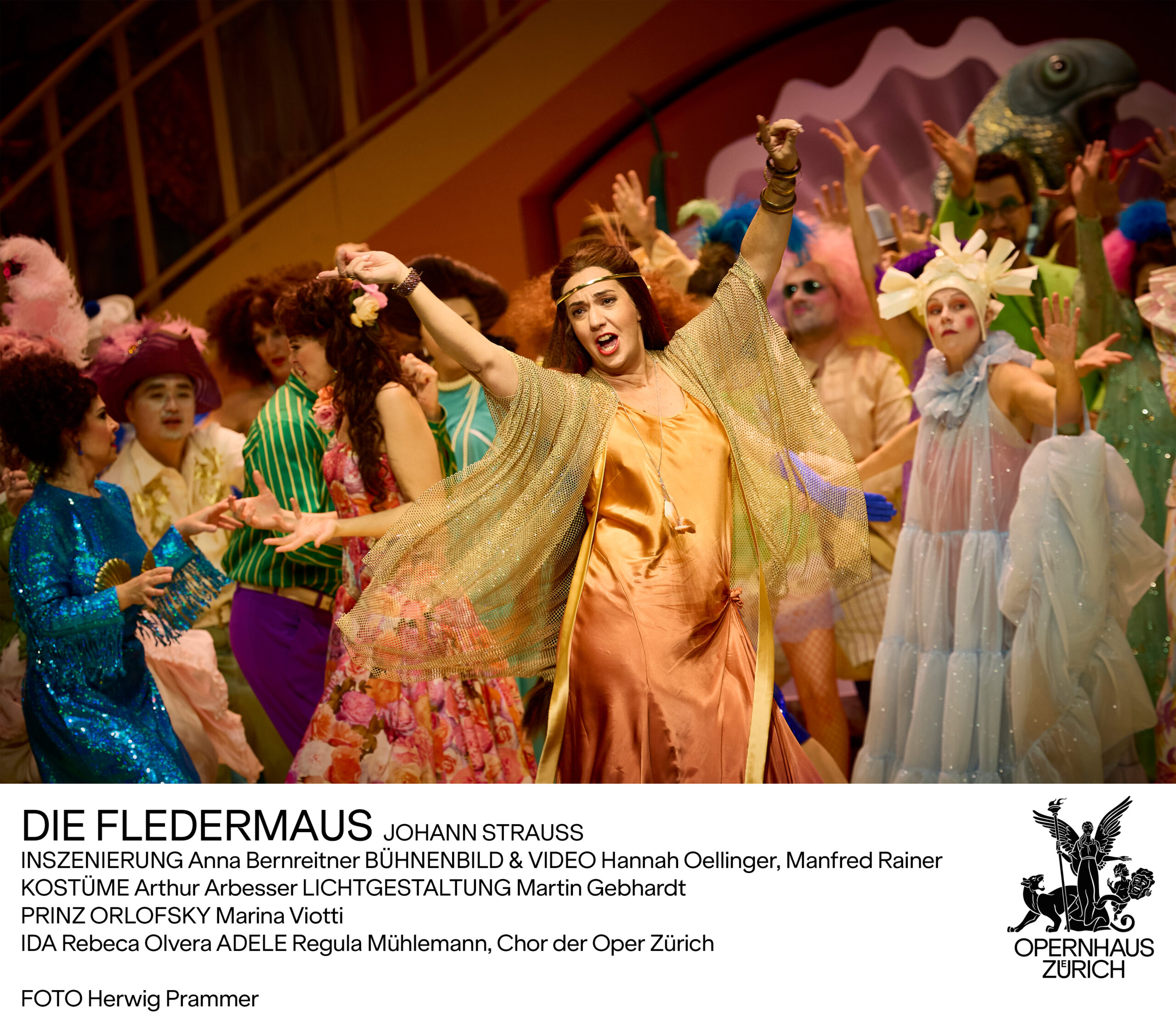
If Die Fledermaus remains relevant today, it is because it understands how societies cope when reality intrudes: by dancing, laughing, forgiving one another, and pretending—at least until morning—that nothing serious has happened. Zürich’s Fledermaus makes that point with intelligence and good timing. In a bicentenary year spent strolling, sometimes staggering, through Strauss’s legacy, this production waltzes with notably assured steps.
Opernhaus Zürich’s production of Die Fledermaus runs through Jan. 10, 2026