As the weather in Montreal starts to warm again, Rafael Payare and Orchestre symphonique de Montréal hailed the return of spring with some fitting Stravinsky (The Rite of Spring) and welcomed an exciting guest soloist: pianist Bruce Liu. Twenty-eight-year-old Liu, back home in Montreal, returned to play Tchaikovsky’s Piano Concerto No. 1, while the OSM unveiled Denis Gougeon’s newest work within a program of great Canadian talent (seen Apr. 22).
Gougeon was in the hall to witness the world premiere of his composition La Traversée, an OSM commission dedicated to Payare himself. This 12-minute piece celebrates a passing, journey, or crossing through conflicting ideas, highlighted in Gougeon’s own program notes citing the ‘unpredictable’ and ‘daring’ sounds of contrasting instruments. This was emphasized not only in the contrasting registers of the piccolo and contrabassoon, but also in fleeting conversations between the crystalline piccolo and muted trumpets. A piece with minimal melodic sections but vivid orchestration, La Traversée created a temperamental and morose atmosphere rich with the sounds of xylophone and triangle.
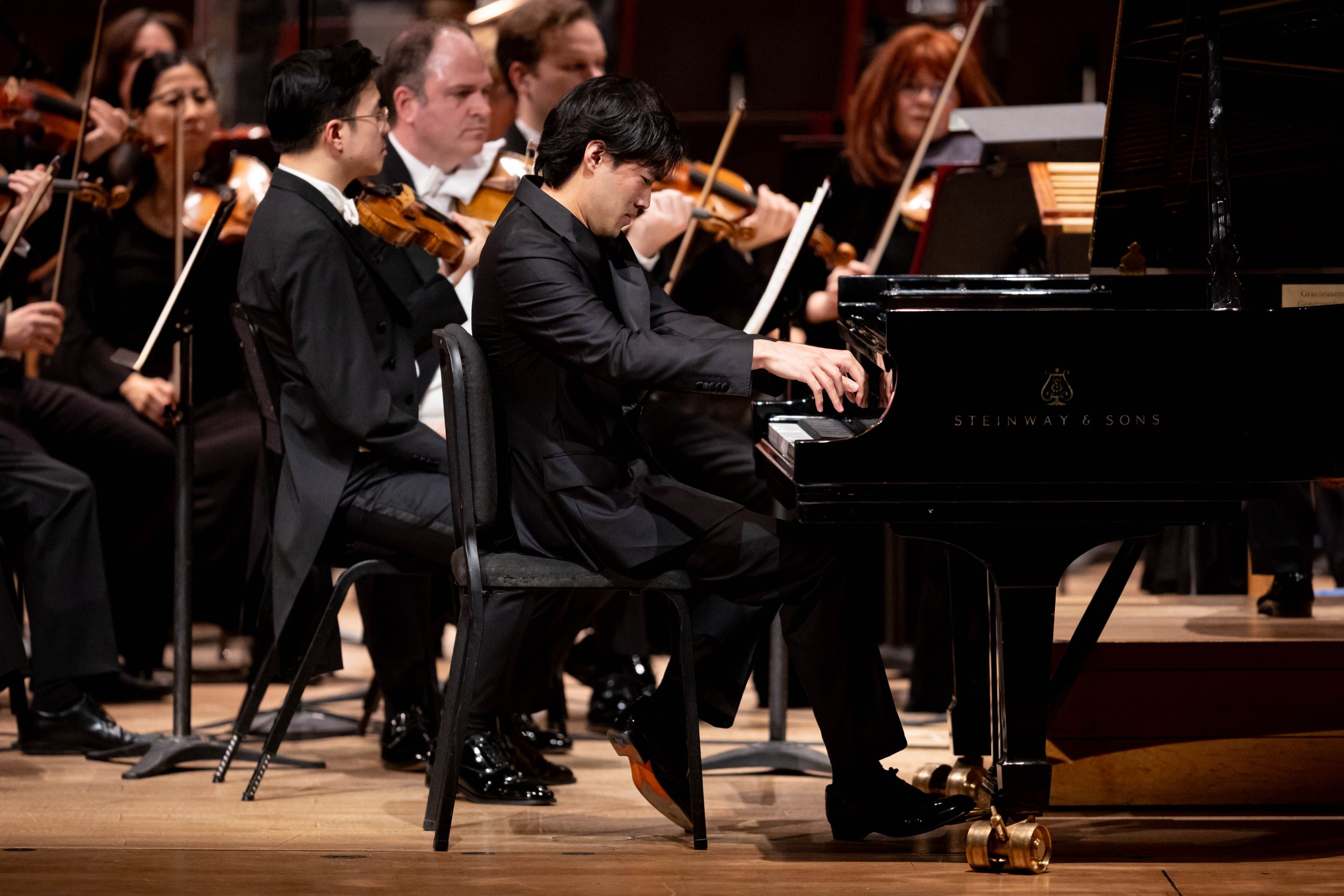
Bruce Liu with Orchestre symphonique de Montréal. Photo: Antoine Saito
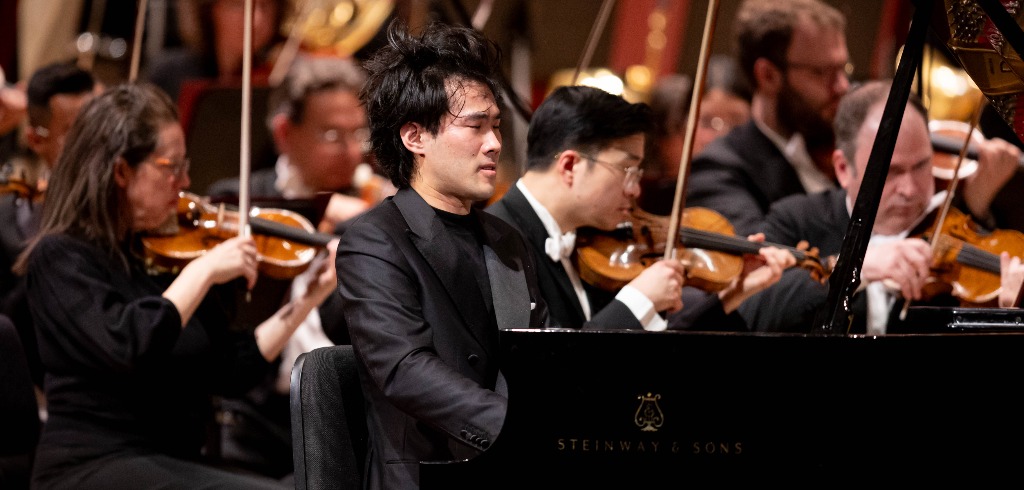
Bruce Liu’s performance of Tchaikovsky’s concerto was excellent. Seated on a regular chair instead of the typical piano bench, his mastery was evident in his articulation. His power gave way to the ferocity necessary for his part, and his greatest strength onstage was in his incredible clarity; virtually none of his playing was ever buried by OSM or vice versa. The end of the first movement marked an impressive and well-balanced cadenza. I like a slightly more drawn-out intro to the first movement than Payare conducted, but perhaps that’s because I like to savour the gorgeous theme that never returns in the piece before it disappears for good.
At only 28, Liu stands out as a master pianist of his generation, most notably having won First Prize at the 18th Chopin International Piano Competition in 2021. Tchaikovsky’s piano solos in this concerto can feel a bit disconnected from the rest of the fuller orchestral passages, but Liu had no trouble bridging the gap when they rejoined in layers. The second movement’s melodic theme flowed from the piano throughout the rest of the sections, with Liu then offering quiet encouragement behind the lower strings right before an intense third Allegro con fuoco movement.
For his encore—or dessert as he likes to refer to it—Liu offered the most breathtakingly crystalline and mesmerizing rendition of Debussy’s Rêverie, which is exactly my kind of music.
An even more daunting task awaited Payare in the second half: recording The Rite of Spring for OSM’s upcoming album. The Rite of Spring tells of an ancient pagan ritual in which a young virgin dances herself to death to appease the god of Spring. It’s morbid, dissonant, and highly erratic in nature. For a complex work so disruptive of the status quo at the time of its premiere in 1913, I’d say Payare did the piece justice.
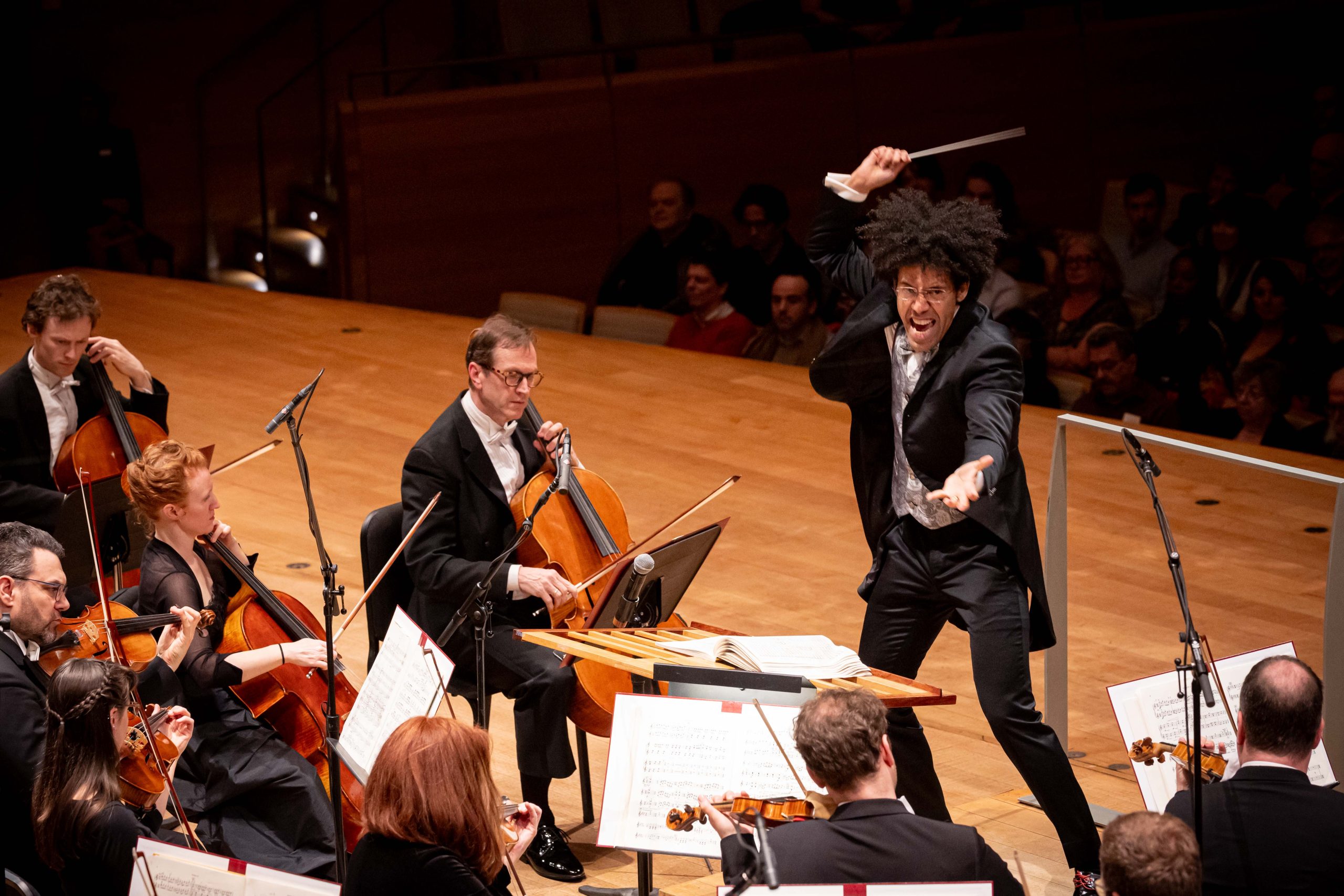
Rafael Payare conducts Orchestre symphonique de Montréal. Photo: Antoine Saito
Never have I seen such vigour and physical expression in the Venezuelan conductor. A sudden and amusing thought came to me during the wildly energetic second half of the “Adoration of the Earth” movement: that his footwork reminded me of none other than someone playing Dance Dance Revolution.
He didn’t tire in the second half which saw Payare pummeling the air in time with the timpani’s aggressive stomps. Stravinsky’s wild scoring and fuller orchestration make the more volatile sections of the music more forgiving for any orchestra, but the musicians still responded enthusiastically and with great precision to their leader. They kept the gentle dances soulful, and the frequent outbursts sharp. In the wake of thunderous percussion and all eight horns playing bells up, a quick solo flute scale offered a brief reprieve before the heavy punctuation of the whole orchestra’s final notes.
All in all, a fantastic demonstration of what Payare and his musicians can do. In the spirit of spring and a new season, we received some news with spectacular enthusiasm and applause: the renewal of Payare’s contract with OSM for another five years until the 2031-2032 season. With the unfolding of the night’s events plus the recent announcements of the 2026-2027 program, I can only wait in eager anticipation of what’s next.
For more on Orchestre symphonique de Montréal’s season visit www.osm.ca