While Montreal anticipates its annual summer jazz festival, there are plenty of other fascinating, if lesser-known music festivals throughout the city. The Montreal Chamber Music Festival held its own lively jazz night on June 19, inviting distinguished trumpeter Jens Lindemann to Salle Bourgie for Brass on Fire!, a delicious and energetic performance of around 15 pieces celebrating not only jazz, but musical joy as a whole.
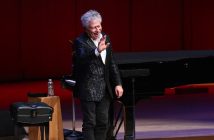
Lindemann, hailing from Alberta, was as charismatic as he was virtuosic. In addition to his mastery of the seven brass instruments he brought onstage (mostly trumpets), his brilliant comedic timing tied all the pieces into a hilarious and cohesive package for a roaring audience. As he jokingly boasted several times, he’d studied at Juilliard and played at Carnegie Hall. This good humour translated into his improvisations, complementing his music with a bit of cheeky flair.
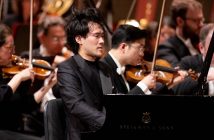
As per a more traditional chamber concert in line with the festival, Lindemann began with trumpet versions of classical pieces alongside the talented London-based Barbican Quartet. Amarins Wierdsma on violin, Kate Maloney on violin, Christoph Slenczka on viola, and Yoanna Prodanova on cello played with Lindemann for a few pieces before the program reverted back to a more upbeat and jazzy style.
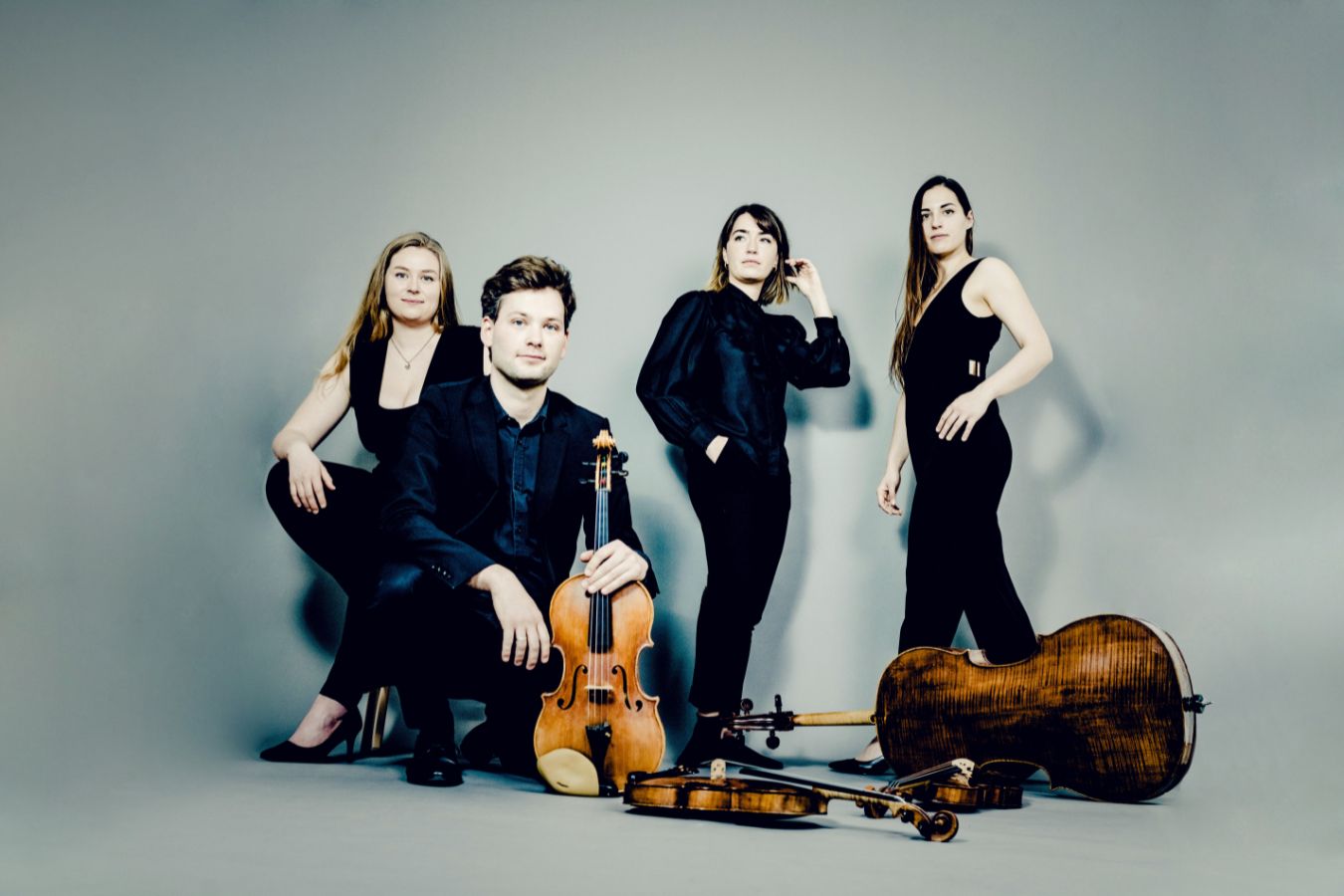
Barbican Quartet. Photo: Andrej Grilc
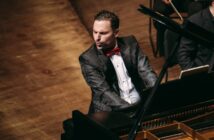
Despite the name “Brass on Fire,” Lindemann was the only brass player on stage and is actually the first classical brass soloist to ever receive the Order of Canada. In addition to the Barbican Quartet, he was joined by a host of other great Canadian talent: Taurey Butler and Kristian Alexandrov on piano, Eric Lagacé on double bass, and Jamie Holmes on drums.
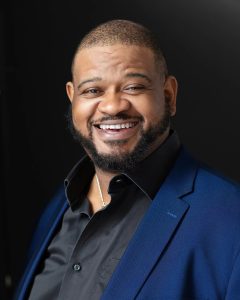
Taurey Butler
I previously attended Butler’s amazing Charlie Brown-themed Christmas concert, when his synergy with Alexandrov on a second grand piano was just as notable that night. Butler, Holmes, and Lagacé then played a somewhat droll rendition of the typically bittersweet “Smile” by Charlie Chaplin. Lindemann and Alexandrov flaunted their 20+ year collaboration and friendship with “Inception,” a flowing piece written for Lindemann by Alexandrov himself, played on flugelhorn; it seemed to highlight the piano more so than the brass.
Lindemann doesn’t allow himself to be defined and squeezed into one box, necessarily. He demonstrated how to make the most of his trumpets’ abilities with differing effects, like using the rubber end of a (clean!) toilet plunger to create a muted and raspy Ellington sound for “Echoes of Harlem.” He used the flugelhorn for a mellow tone and picked up the late-great French trumpeter Maurice André’s crystalline piccolo trumpet for Bach’s “Air on the G String.” Among the plethora of brass instruments on stage, three of the more visually memorable ones were the matte black carbon fibre trumpet, the multicolour metallic foil trumpet, and the Dizzy Gillespie-esque bent-up trumpet.
The on-stage band played a variety of pieces from different genres and eras. Chuck Mangione’s “Feel So Good” exhibited smooth jazz, with Lagacé swapping to bass guitar. Astor Piazzolla’s “Oblivion” was passionate and yearning with the entire band and quartet sharing the melodies. Jimmy Webb’s “MacArthur Park” was languid with a gorgeous multicolour arrangement and pop-like instrumentation. Lindemann surprised us with a rapid version of “The Devil Goes Down to Georgia” by The Charlie Daniels Band. It was entertaining but perhaps less well-executed, and seemingly out of place within the scope of the night.
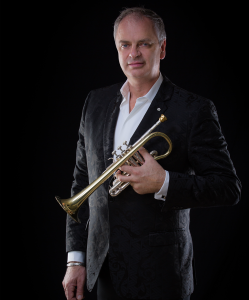
Jens Lindemann
The standout piece of the night for me was a version of Allan Gilliland’s “Dreaming of the Masters.” Lindemann’s two-movement performance ranged from a moderate cinematic presence to a display of his technique, full of smooth circular breathing and frantic double-tonguing. Alexandrov also joined Holmes in covering drums, the two demonstrating a masterclass in percussion.
Despite Lindemann’s obvious prowess in playing his instruments, what struck me most was his ability to balance his comedy with the serious.
A year ago, Lindemann and many others lost their homes in the LA fires. An unassuming video of him playing “Smile” over the ruins of his home went viral as a beacon of hope and optimism, and he spoke briefly about his gratitude and his responsibility as an artist with a public platform. He spoke about the need for live music and the arts now, more than ever. Before Bill Whelan’s “Riverdance” as an encore piece, he played one of his most oft-performed pieces—Oscar Peterson’s “Hymn to Freedom”—which he cited forthright as an important and appropriate theme for the modern day.
Whether in words or through his playing, Lindemann is a storyteller. We in Salle Bourgie are hanging onto every note.
More on the Montreal Chamber Music Festival can be found here.