For those like me who grew up obsessing over Disney movies and music, A Whole New World of Alan Menken—the show written and performed by the composer himself—was the perfect homage to an illustrious legacy that is still constantly growing with new additions to his repertoire. Throughout the impressive two-and-a-half-hour-long (and decade-old) show, Menken took us on a magic carpet ride through a mostly chronological retelling of his career, chock full of personal anecdotes and fun behind-the-scenes facts from his works (seen at Toronto’s Roy Thomson Hall on Apr. 17).
The show, with additional materials by Jennifer Lucy Cook and Richard Kraft, was a fabulous recap of Menken’s published works so dearly recognized in film and on stage today. With a surprisingly capable and flexible voice, Menken performed snippets from over 50 works from his famous Disney scores and live-action extensions (The Little Mermaid, Beauty and the Beast, Aladdin, Pocahontas, Hercules, Enchanted, Spellbound, etc.) to a host of Broadway musicals (Little Shop of Horrors, Sister Act, Newsies, A Bronx Tale, etc.), a sprinkling of the medieval musical show Galavant, and many more.
We were also privileged to hear Menken “pulling back the curtain,” so to speak, playing unreleased pieces that didn’t make the cut throughout his career. Pieces like a duet for Pocahontas and John Smith that never came to be, or a passionate solo from Hercules that was swept aside for the more heroic-sounding “Go the Distance.”

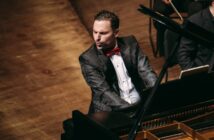
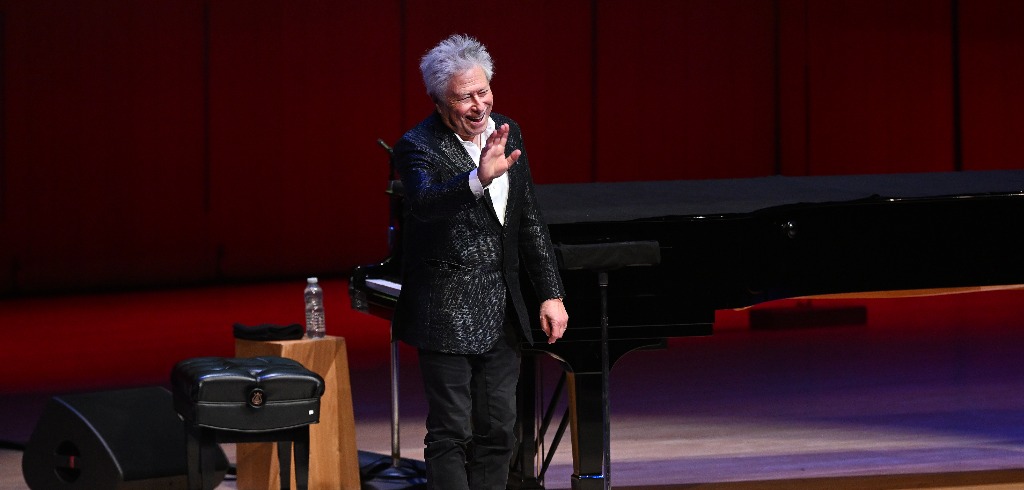
Alan Menken performs A Whole New World of Alan Menken. Photo: Jag Gundu/Roy Thomson Hall
For every work Menken introduced, he first discussed his partnerships with the many artists he had worked with. In particular, much of the show was dedicated to his great friend and “collaborative soulmate,” Howard Ashman, the lyricist who passed away in 1991 due to complications from AIDS. Menken first worked with Ashman on the 1979 musical God Bless You, Mr. Rosewater, after which the pair’s popularity blew up with Little Shop of Horrors. The duo then wrote the music for the so-called Disney Renaissance, pioneering the “I want” song trope (a work that expresses a character’s longing or motivation) with pieces like “Part of Your World” and “Belle,” from The Little Mermaid and Beauty and the Beast, respectively.
While Menken continued to perform pieces from those two movies, he kept us aware of the grim reality of working with Ashman in the hospital as his health declined. He shared behind-the-scenes footage of his collaborative process with Ashman, who passed away in 1991 while working on music from Aladdin, six months before Beauty and the Beast itself was finished. With that heavy story, Menken performed “Sheridan Square,” an emotional and heavy tribute they’d written together for their friends lost to AIDS prior to Ashman’s own passing, which was itself a proper recognition of their friendship and synergy together.
Menken lightened it up by sharing a funny and self-deprecating story: he is one of two artists who have achieved EGOT status (receiving an Emmy, Grammy, Oscar, Tony) while also holding a Razzie, an award for the worst of something in film (an anti-Oscar, if you will). Turns out winning the Academy Awards for Best Score and Best Original Song (“Beauty and the Beast” from the film of the same name) the night after getting the Razzie for worst song of the year (“High Times, Hard Times” from Newsies) really softens the blow. Who would’ve thought?

Alan Menken performs A Whole New World of Alan Menken. Photo: Jag Gundu/Roy Thomson Hall
Only One Gripe
Did the show appeal to my childhood joy? Yes. Did I wish there was an orchestra alongside to play the scores I could appreciate in more depth as an adult? Honestly, also yes. The show’s greatest charm is its intimate atmosphere and deep appreciation for Menken’s lyricists and collaborators. What it was missing was a lot of the nuance that makes Menken’s works sing.
Though I adore the singable Disney songs, I admire Menken most for his ability to weave orchestral magic in his scores through layering melodies and emotional climaxes. To reimagine simple themes throughout the course of a song, then a whole story, and then into a fuller stage production score. To infuse a scene with the exact right intensity, darkening and unfolding where necessary. Give a listen to—no, watch—the deceptively repetitive “Kingdom Dance” from Tangled or the entirety of The Hunchback of Notre Dame, and you’ll see what I mean. It would’ve been a dream to witness Menken conduct an orchestra live to really make his scores sing with the complexity they deserve.
Nevertheless, that was not the intention of the show, and the classics certainly appeal to a greater audience of all ages. I still had a blast watching a man I admire present his works and their stories with his heart on his sleeve, and I won’t be able to help but sing along to his music whenever it plays in my home. So in the least narcissistic way possible, A Whole New World of Alan Menken was a love letter to himself and all those who helped his gift—through lyrics, singing, animation, or production — blossom into the music we treasure today.