Valentin Schwarz’s production of Wagner’s Ring had its final outing at this year’s Bayreuth Festival with two complete cycles, the second of which I saw from Aug. 15-20. Its journey began in 2022 and as is the festival’s tradition, it was revived over a consecutive four-year period. Without a doubt, this was one of the more notorious Bayreuth stagings in recent years, greeted with a sea of booing at its inaugural showing. This year, the reception was less vociferous, yet it continues to be divisive.
A Family Affair
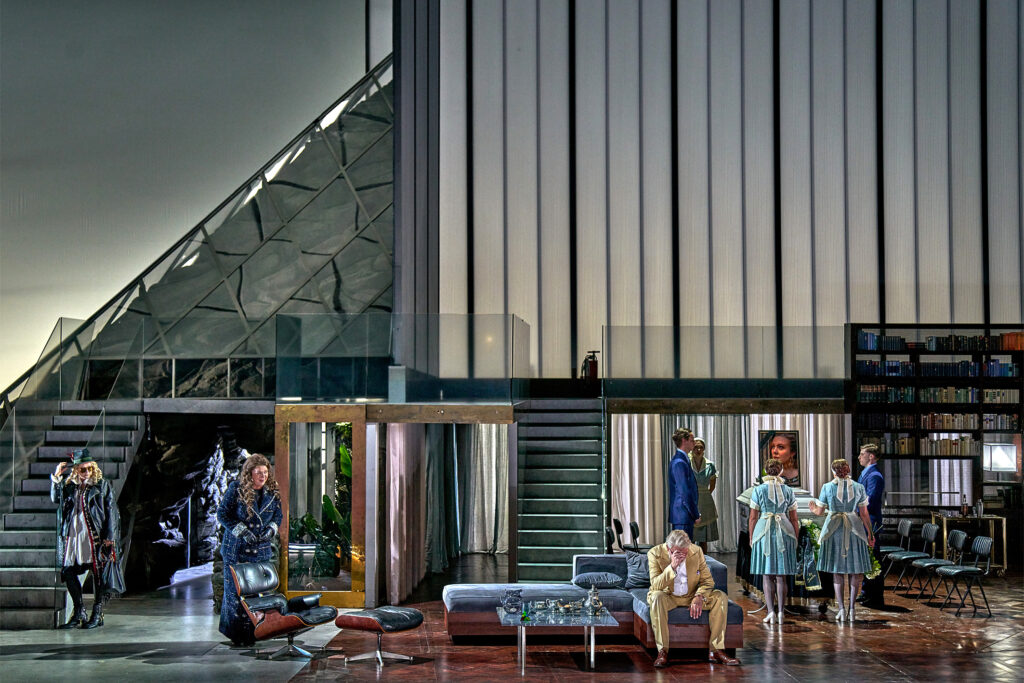
Schwarz excises most of the magic we associate with Wagner’s tales of the gods inspired by Norse mythology. Instead, we are firmly in the realm of trashy reality television. Wotan, the head of the clan, telegraphs his nouveau riche status from the outset, clearly drunk, swigging champagne from a bejeweled magnum. The work’s most famous music, the Ride of the Valkyries, finds the warrior maidens bandaged, at various degrees of recovery from plastic surgery, rather than heroically rescuing fallen heroes.
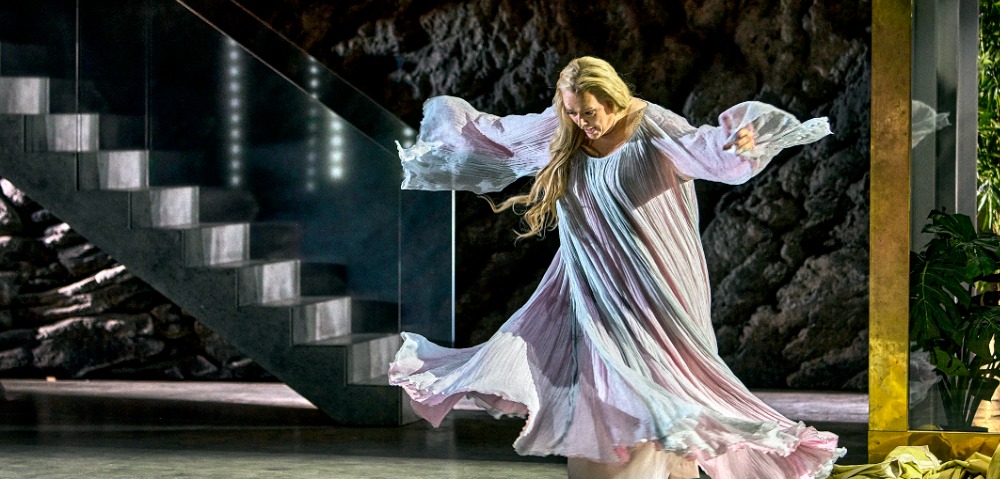
Scene from Bayreuth Festival’s Die Walküre. Photo: Enrico Nawrath
To a certain degree, the concept works, especially in the Das Rheingold. Scenes involving Wotan, his wife Fricka, her sister Freia, fellow ‘demi-gods’ Donner and Froh and the giants Fafner and Fasolt (here, shady gangster-like architects who have come to extract their payment), work within the Kardashian template. There are even some amusing nods to tradition by having Donner, god of thunder, repeatedly tee off with his golf club.
The Extra Ingredients
Where things begin to go off track is with those elements more usually regarded as supernatural. Traditionally, Wotan and Loge (god of fire, here, the family’s slimy lawyer) go to Niebelheim, the realm where the dwarf Alberich has used the ring’s power to enslave the Nibelung race, who sit at anvils endlessly forging objects for him from the gold. Schwarz anthropomorphizes the ring, making it into a child—a young gold baseball-capped boy who displays severely violent, destructive tendencies. This is the first of many invented characters the director introduces to a story already chock full of them.
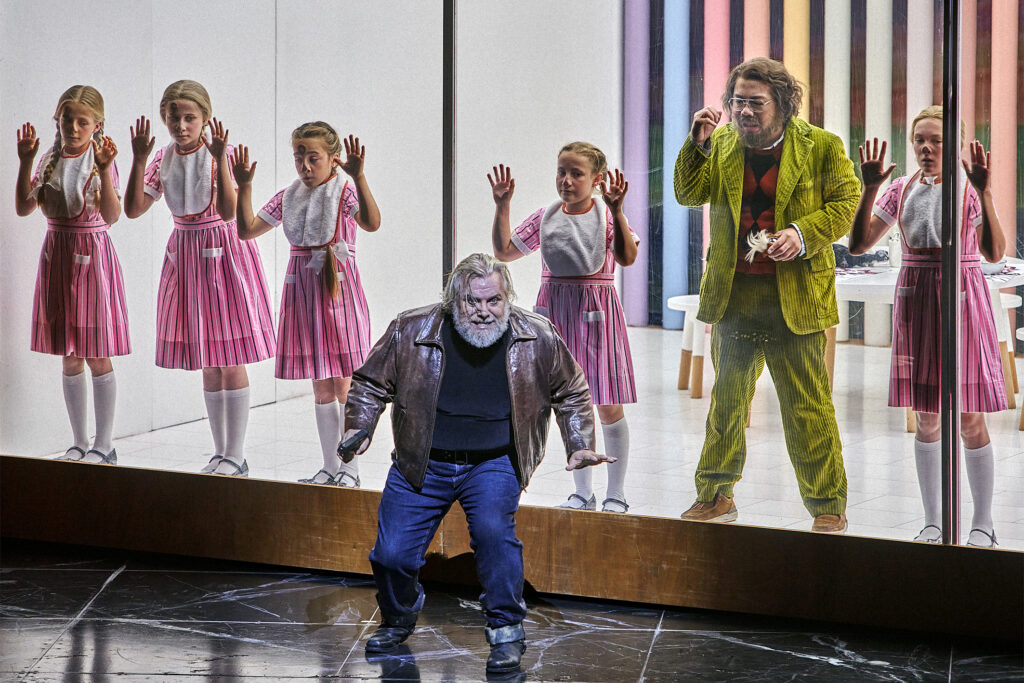
Olafur Sigurdarson (Alberich) & Ya-Chung Huang (Mime) in Bayreuth Festival’s Das Rheingold. Photo: Enrico Nawrath
Alberich and his brother Mime are also in charge of a cadre of blond, pig-tailed school girls who are held captive in a school room behind glass. These children represent the gold, and as the story unfolds, both the boy and one of the girls take on increasing importance as chattel in an implied child trafficking ring involving Wotan and his family.
Too Many Cooks?
Exchanging the precious gold for the lives of children is a bold take, and if handled with more clarity and consistency, could have been theatrically powerful. At first, the violent boy is offered as payment to the architects, but Wotan wants to keep him, and so, one of the girls is brought in as a substitute. She is saved from a very creepy implied fate by Erda, the earth goddess, who here is a permanent fixture (head housekeeper?) in Wotan’s household. This bait-and-switch complicates an already difficult-to-follow narrative.
By the time we get to the third opera, Siegfried, the boy is now a man in his early-30s. He is revealed to be one of the original story’s main characters (albeit mute at this stage), Hagen, the illegitimate son of Alberich. In Götterdämmerung, Hagen ultimately murders Siegfried in an effort to recover the ring for himself. Frustratingly, the energy expended to establish the boy/man as clearly disturbed and bent on revenge goes for naught. Hagen does an about-face after killing Siegfried, covers him with an impromptu jacket-as-shroud and has a quiet, reflective moment with the hero’s child (yet another Schwarz creation). Why invest so much in an invented figure who is completely unsupported by the text and music in the first three operas, only to give up on his characterization at the end?
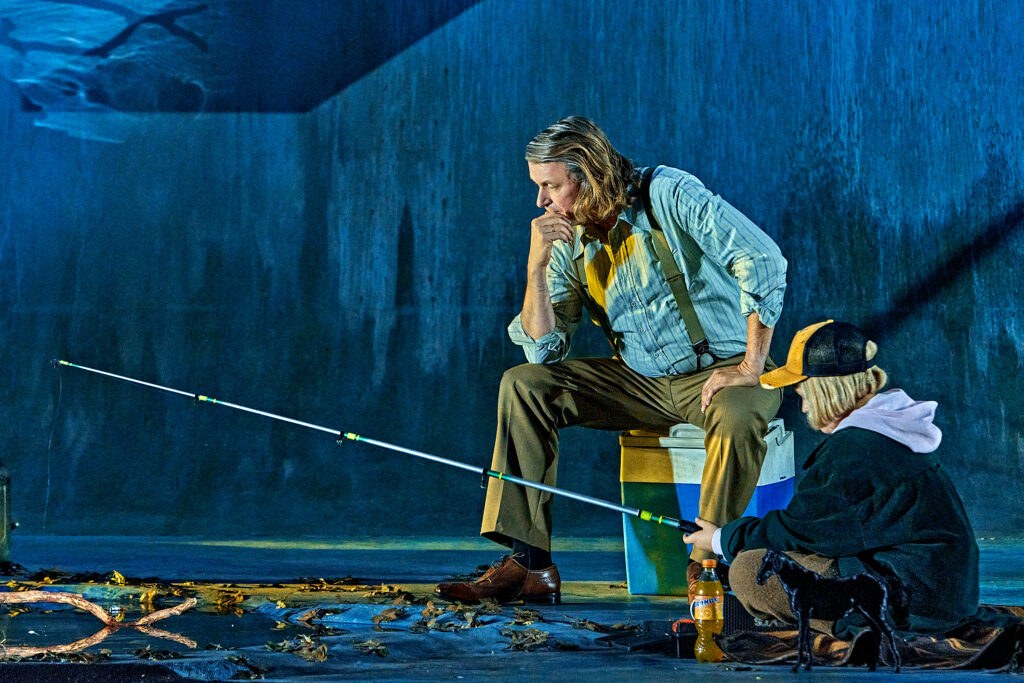
Klaus Florian Vogt (Siegfried) with his daughter in Bayreuth Festival’s Götterdämmerung. Photo: Enrico Nawrath
Another new character is Siegfried and Brünnhilde’s daughter. She turns up at the beginning of Götterdämmerung and becomes a prominent feature throughout the cycle’s final opera. Schwarz repeatedly tries to make us sympathize with the child, or with Brünnhilde as a mother, only succeeding to distract from the situation at hand. Brünnhilde flings the girl about the stage as she builds up to the dramatic revelation that she is Siegfried’s wife. The child runs around frantically from one side of the stage to the other during her mother’s Immolation scene. These moments are already embedded with so much emotion, the addition of the daughter yields no extra payoff and deflates the dramatic tensions of Wagner’s original story .
The girl who is taken in by Erda in Das Rheingold shows up again later as a young woman, first in Act 3 of Siegfried and then even more prominently, during the final moments of the cycle. Here, she is apparently pregnant (I confess this wasn’t obvious to me) and one supposes, could represent a new beginning after the world of the gods is destroyed. But again, to give such prominence to a character with whom we have zero emotional investment, at the musical pinnacle of this monumental work, suggests a serious dramaturgical failing.
Precious Things
Schwarz’s invented characters compete for our attention with an array of physical objects whose significance wax and wane throughout. The gold is not only associated with the various children, but with props like the boy’s golden baseball cap and a pair of blingy gold (brass) knuckles that the Woodbird gives to Hagen as a young man. The iconic spear which is central to the original drama shows up in various guises as a pistol, a machine gun, a toy gun, a Star Wars light sabre, a crutch converted to a sword… No one needs dungeons and dragons literalism, but it became increasingly difficult to keep track of all the various props, especially given some were so small as to be impossible to identify.
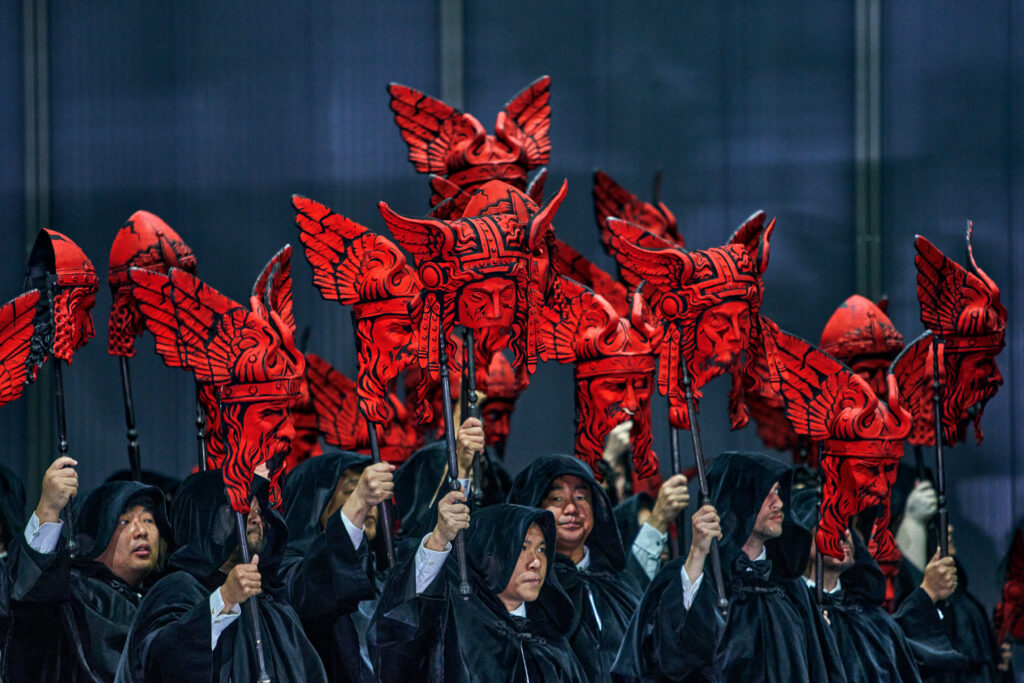
Chorus in Bayreuth Festival’s Götterdämmerung. Photo Enrico Nawrath
One recurring image that was used with admirable consistency and point was a child’s painting of a ‘traditional’ Wagnerian winged-helmet face. Its meaning remained illusive, but it worked to tie together various storylines and characters across the tetralogy. We see the girls creating the painting in Das Rheingold; it returns in Sieglinde and Siegmund’s imagining of their childhood bedroom in Die Walküre and ultimately, shows up as the masks carried by the chorus in Götterdämmerung. The sole chorus scene in the Ring started shakily in terms of coordination with the pit, and was barely choreographed. In the original 2022 cycle, the chorus’s grand music was reflected in some interesting crisscross floor patterns. In 2025, this was completely abandoned and the chorus was mostly left in a shapeless lump. They demonstrated their enthusiasm for Hagen’s war-alarm by jerking their masks up and down.
Moments of Ring Radiance
Amongst all the confusion that defines this staging, there were many musical moments to cherish. Wagner created roles that are among the standard repertoire’s most challenging. In Catherine Foster, the festival had a superb Brünnhilde. She first sang the role at Bayreuth in the 2013 Frank Castorf Ring and more than a decade later, still sounds fresh and commanding. Foster possesses a lyrical instrument that is beautiful, warm and yet, can still ride over the large orchestra. She gave her all to the character, even when forced into some very questionable mouth-to-mouth contact with her father Wotan at the end of Die Walküre (implied incest in the past?) and Hagen in Götterdämmerung.
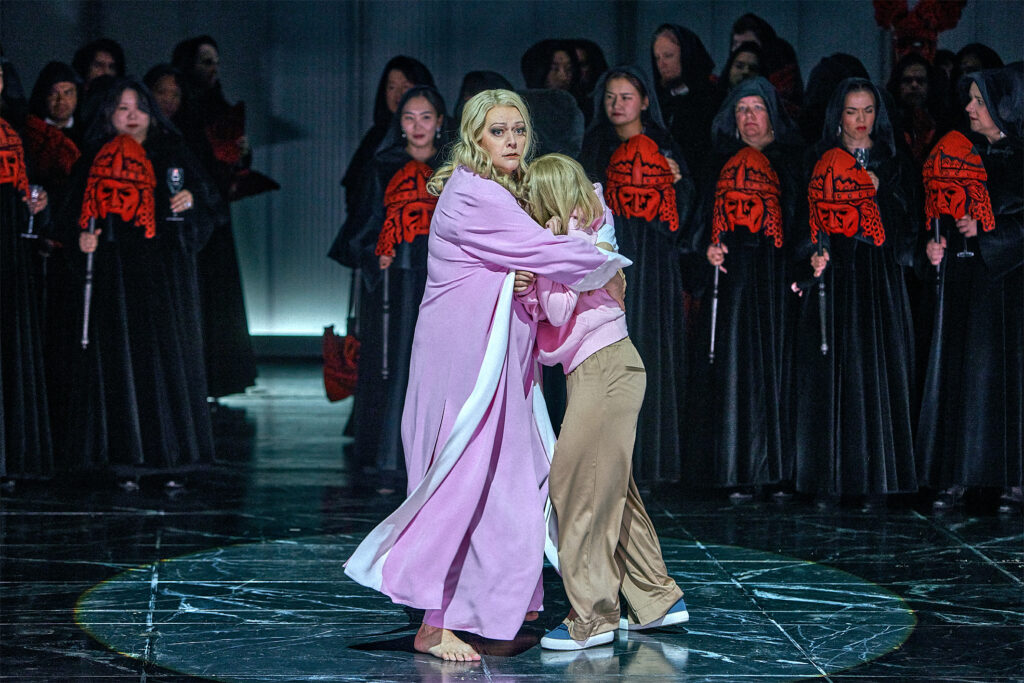
Catherine Foster ( Brünnhilde) with her daughter in Bayreuth Festival’s Götterdämmerung. Photo: Enrico Nawrath
The other outstanding vocalist was Klaus Florian Vogt as Siegfried. Much has already been said about his unusual vocal production and ‘choir boy’ tone, but it all works in the famous Festspielhaus acoustic. His stamina, technical security and lyricism carried him through all the considerable demands of the role.
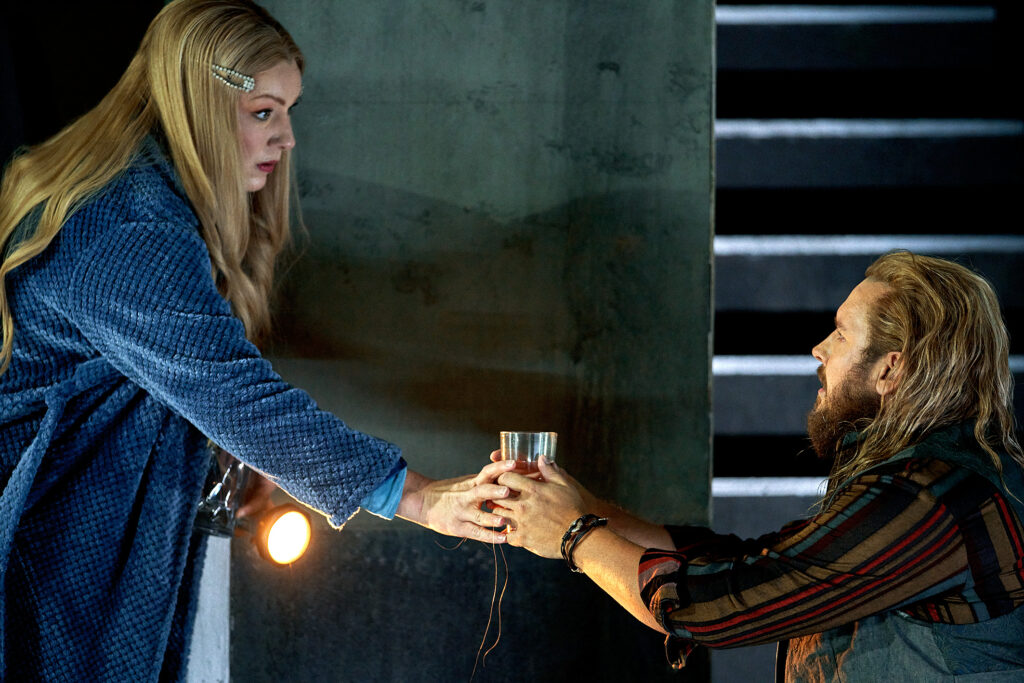
Jennifer Holloway (Sieglinde) & Michael Spyres (Siegmund) in Bayreuth Festival’s Die Walküre. Photo: Enrico Nawrath
Another tenor, Michael Spyres, offered what was probably the most beautiful singing of the entire cycle. He launched the Winterstürme in Act 1 of Die Walküre with optimal light lyricism, and the famous Wälse cries recalling his ancestors were sustained even longer than I remember from last year. As his sister/lover Sieglinde, soprano Jennifer Holloway made a house debut. Formerly a mezzo, she is now making a mark in big lyric German roles like Salome. While she acted affectingly and her tone filled the hall, her sound could be wiry and was affected by a wide vibrato in her uppermost range. She received loud ovations from the audience, and will return in the festival’s first performances of Wagner’s early opera, Rienzi, next year.
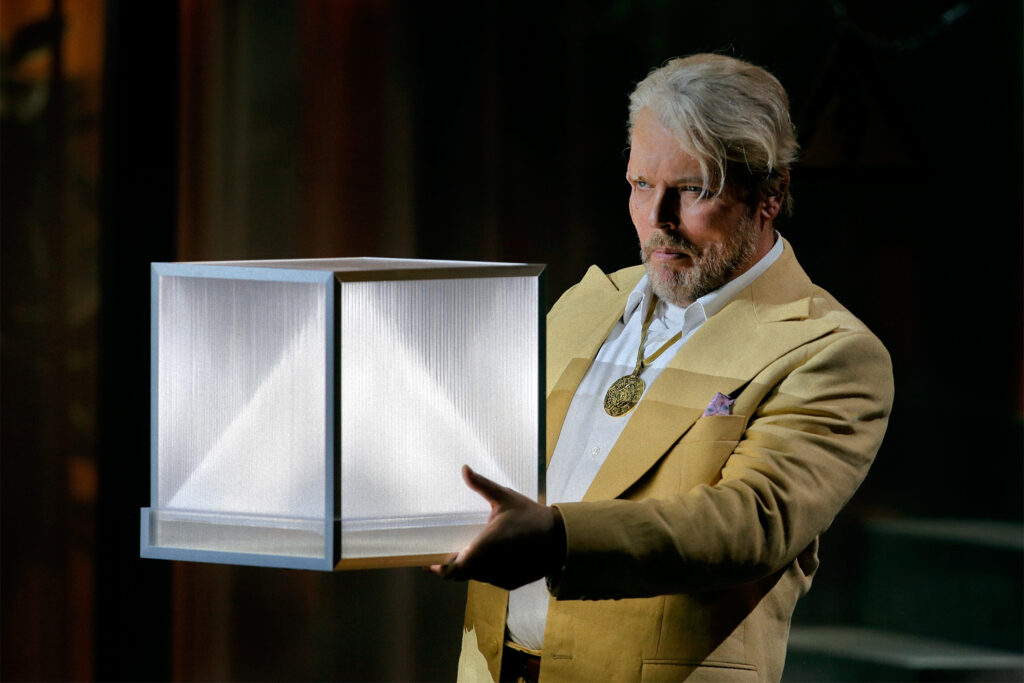
Tomasz Konieczny (Wotan) in Bayreuth Festival’s Das Rheingold. Photo: Enrico Nawrath
Bass-baritone Tomasz Konieczny continues to be divisive. There is no doubt that he whole-heartedly enters into Schwarz’s not particularly flattering concept of Wotan. Vocally, he is able to sustain the rigours of this punishingly high, lengthy role with a secure technique. When he tries to throttle down his volume a notch in his farewell to Brünnhilde, he unfortunately resorts to crooning. His diction is not ideally clear with pure vowels emerging as diphthongs. However, Konieczny deserves all the bravos for sticking with this Ring from conception to its retirement.
With so many named roles, it’s difficult to single out all the worthy artists. A highlight was mezzo-soprano Anna Kissjudit, the cycle’s new Erda. She offers the ideal sepulchral tone to characterize the earth goddess. She will make a role debut as Fricka in Das Rheingold and Die Walküre in next season’s new Ring. This year’s Fricka was Christa Mayer, a veteran of the Schwarz Ring. She is reliably one of the most idiomatic Wagner singers at every festival, with a rich, noble tone that seems to fill the hall effortlessly.
Donner may be one of the cycle’s shorter roles but baritone Nicholas Brownlee used it to show why he was such a success as Wotan in Das Rheingold at the Bavarian State Opera this season. At Bayreuth, he’ll be back next year as the Dutchman which promises to be a highlight. I would make bets that he’ll be Wotan on the green hill at a future date. Baritone Olafur Sigurdarson exudes creepiness as Alberich and uses his pungent, trumpeting tone to striking effect. Bass Mika Kares’ dark, voluminous vocalism is ideal for Hagen. Vocally he left nothing to be desired, so it was a shame the character arc built up for him over the cycle was allowed to fizzle so anticlimactically.
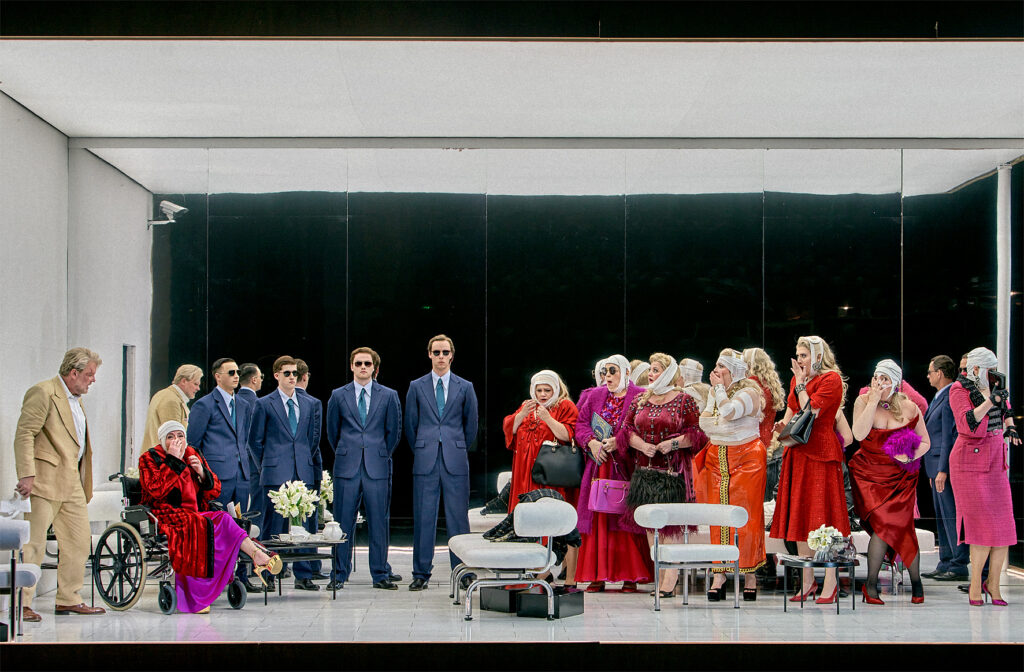
The Valkyries in Bayreuth Festival’s Die Walküre. Photo: Enrico Nawrath
Conductor Simone Young led the musical proceedings for the second season running. There were moments when the fabled Bayreuth acoustic with its submerged orchestra seemed to work against the climaxes that would optimally add an extra thrill. But overall, Young maintained natural tempi that felt neither rushed nor unnecessarily slow. The festival orchestra played magnificently.
Looking forward to next year, the festival has announced a new Ring cycle in which AI will be an image-generating source. Plans change, but at one point in time the 2026, 150th anniversary season was supposed to have featured revivals of Tannhäuser, Lohengrin, Tristan und Isolde and Die Meistersinger von Nürnberg. That is clearly no longer the case, with what is presumably a less-expensive AI-based Ring taking their place. Even in a country where opera receives considerably more public subsidy that it does in Canada, there are signs things have begun to change.
For more about the Bayreuth Festival’s 2026 season visit www.bayreuther-festspiele.de/en