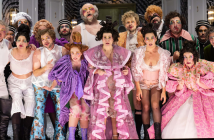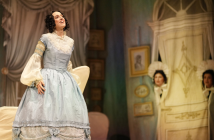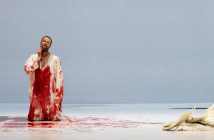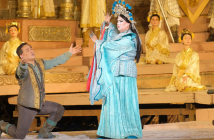
The Winter’s Tale, Shakespeare’s strange amalgam of tragedy and rustic comedy, was given ballet form in 2014 by choreographer Christopher Wheeldon and composer Joby Talbot, a co-production between The National Ballet of Canada and London’s Royal Ballet and Opera. In many ways it is the very model of the contemporary story ballet with its filmic score, modern yet not overly avant-garde choreography, and fast-paced narrative. It returned to Toronto on Nov. 14 with a completely new cast from its 2015 local premiere in a satisfying revival of a work that is at once disturbing and emotionally-cathartic.
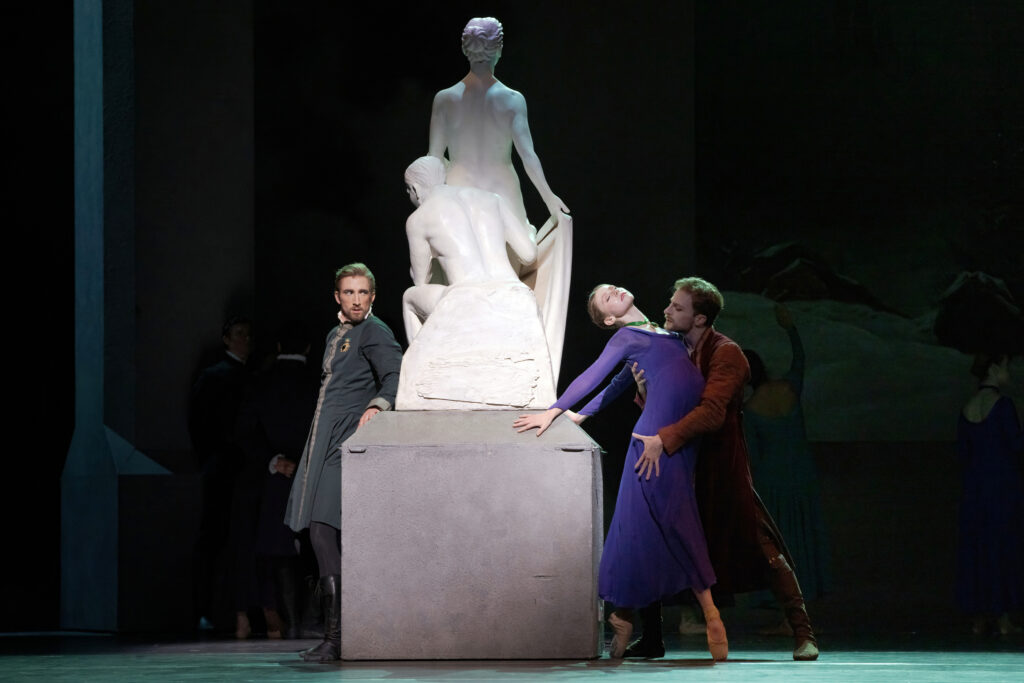
Ben Rudisin, Isabella Kinch & Donald Thom in The Winter’s Tale. Photo: Karolina Kuras
As with its source material, the opening act is a harrowing drama that for some, might merit its own trigger warning. Leontes, King of Sicilia, in true Othello-form, suspects his wife Hermione of having an affair with boyhood friend Polixenes, King of Bohemia. His accusations are completely unfounded and ultimately lead to the tragic death of Hermione and their son, Mamillius.
Wheeldon adds a prologue in which we briefly see the two kings as boys who initiate a signature penché-type movement that will come to signify their friendship. Their adult counterparts quickly step in and coronate themselves with the boys’ Christmas cracker crowns which symbolize their kingly personas throughout.
Atmospheric Designs
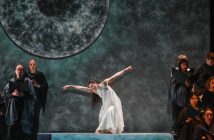
The foreboding mood of the opening act is emphasized by designer Bob Crowley’s cool colour palette and Natasha Katz’s dark, shadowy lighting. Much use is made of de Chirico-inspired towering rectangular arches and vertiginous staircases. Leontes’ henchmen are dressed all in black, and are only too happy to do his bidding.
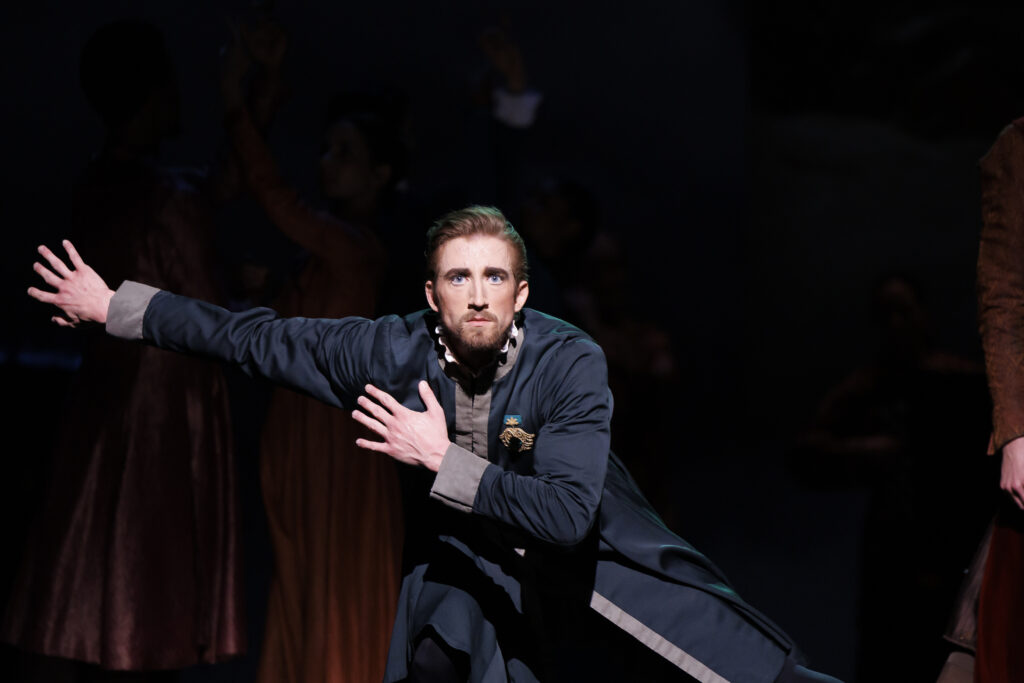
Ben Rudisin in The Winter’s Tale. Photo: Bruce Zinger
In this oppressive milieu, Leontes breaks down, subject to hallucinatory episodes in which he imagines Hermione and Polixenes (Donald Thom) engaged in romantic dalliances. A significant design feature are several oversized classical sculptures around which Leontes skulks, pursuing the two ‘lovers’. In plain light, the couple are merely conversing, but as the illumination darkens, the king imagines them passionately embracing. Leontes affects tortured, angular poses, perhaps Wheeldon’s most effective physical conveyance of inner psychology.
The Winter’s Tale‘s Darkness
It is here that we confront the work’s dark heart in a pas de deux of sorts for Leontes and Hermione where he violently throws and lifts his now-pregnant wife in a disturbing scene of spousal abuse. Principal Ben Rudisin and second soloist Isabella Kinch unflinchingly manifest his infectious jealousy and her proud incredulity. The scene ends with their son dying of shock, followed by Hermione’s collapse and death.
Completing the triangle of Leontes and Hermione is head of the household, Paulina, the queen’s protector, danced by principal Heather Ogden. The role is intrinsic to the drama and delivers some of its most affecting moments. After Hermione’s death, Paulina and Leontes are positioned in front of the show curtain where she pours out her grief, pounding on the suddenly remorseful king.
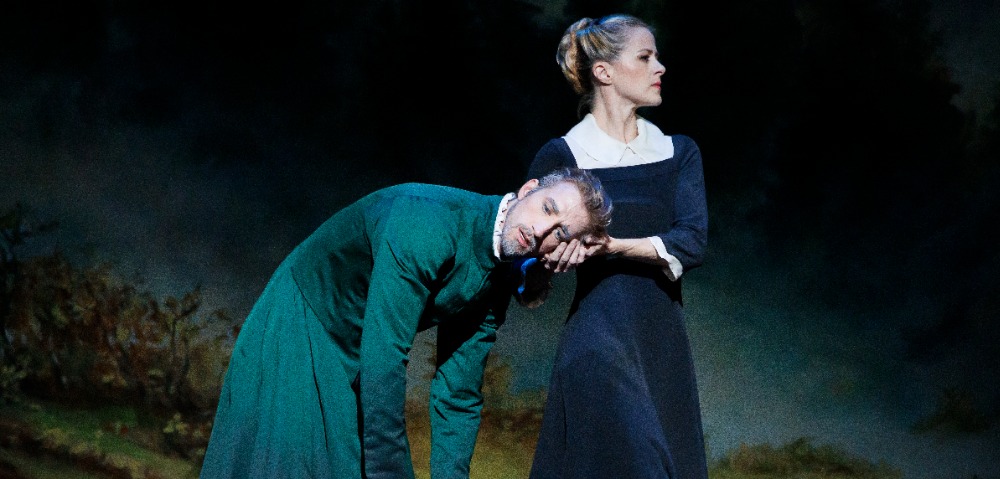
A particularly effective leitmotif finds Leontes a broken man, bent 90 degrees with his head resting on Paulina’s hands as they slowly walk across the stage. She has somehow become his caregiver despite his unforgivable actions. Ogden once again demonstrates her status as a supreme communicator, her final supplicatory dance in front of the statue of the dead Mamillius indicating both her sadness and reconciliation with tragedy.
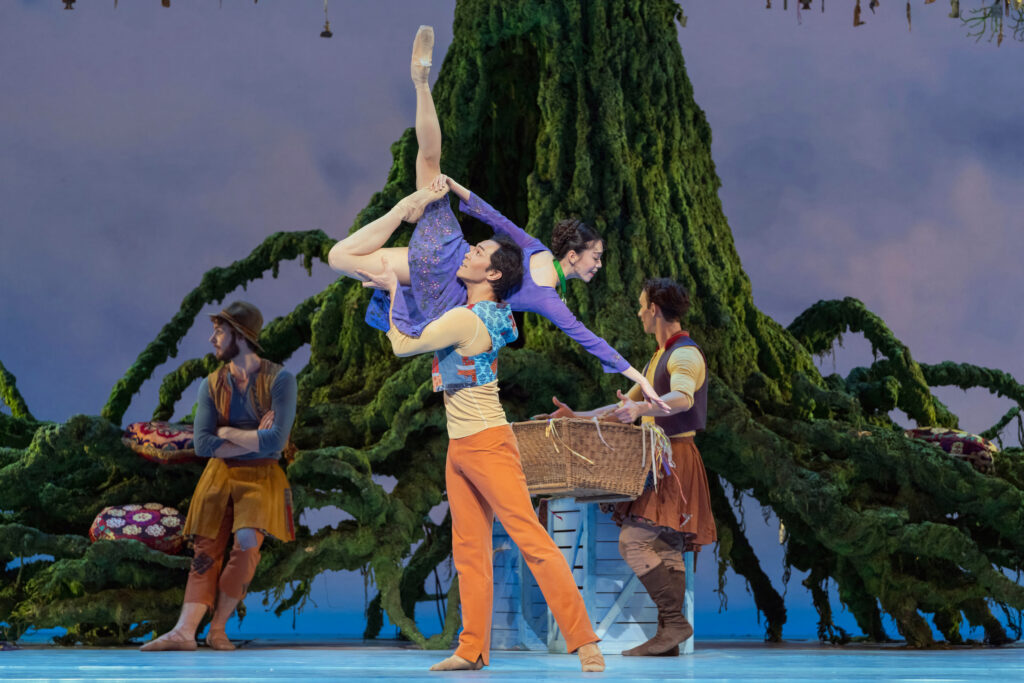
Tirion Law and Naoya Ebe in The Winter’s Tale. Photo: Karolina Kuras
Bucolic Transformation
Act 2 comes as a complete contrast. We are now in Polixenes’ Bohemia dominated by a huge tree decorated with ornaments while shepherds and shepherdesses frolic in bright garb. At the end of the previous act, Hermione’s baby daughter Perdita has been whisked away to Bohemia by Paulina’s husband, Antigonous, and subsequently rescued by a shepherd. Sixteen years later, she has fallen in love with Polixenes’ son Florizel who has disguised himself as a rustic to evade his father’s disapproval of Perdita’s low social status.
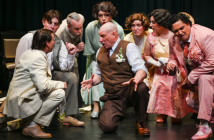
The act is a showcase for some lovely duets for Perdita and Florizel danced by principals Tirion Law and Naoya Ebe. Their choreography is pleasing but perhaps not Wheeldon’s most individualised. The glory of the act are the group dances featuring four main couples and the corps. There is something Ashton-esque about these bucolic scenes that wouldn’t be out of place in La fille mal gardée. Particularly charming are second soloist Erica Lall and corps member Albjon Gjorllaku as the principal shepherds: they light up the stage with their smiles and humour.
Perdita and Florizel flee to Sicilia to escape Polixenes’ wrath. Leontes recognizes the emerald he gave to Hermione that Paulina sent with baby Perdita when she was taken to Bohemia. The family is thus reunited and the young couple marry. Paulina reveals a new statue commemorating Leontes’ dead wife and son. Miraculously, the statue comes to life, or at least, its Hermione half does.
A Miraculous Resurrection
What follows is a deeply moving pas de deux between a repentant Leontes and the wife whose death he caused. Wheeldon is careful to cede power to Hermione here by exploiting her height on pointe and giving her big, sweeping gestures while her disgraced husband is mostly prone. This feels like a necessary corrective to his violence towards her in Act 1 without completely erasing its memory. Kinch was especially effective here in conveying feelings of reluctant reconciliation.
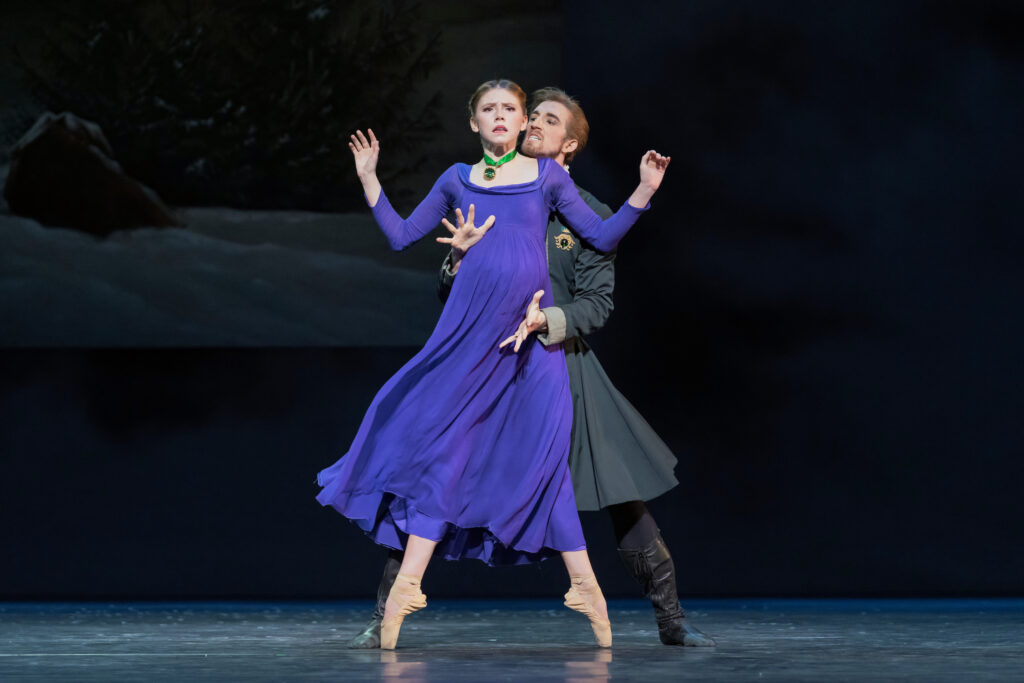
Isabella Kinch & Ben Rudisin in The Winter’s Tale. Photo: Karolina Kuras
Joby Talbot’s score supplies plot-driven effects where necessary. The several sea journeys get roiling sounds from the pit and accompany Daniel Brodie’s atmospheric projections in the manner of a film score. Overall, this is not memorable music, but rather, functions to set the tale’s mood and ignite rhythms. Much more effective is the use of an onstage banda comprised of bansuri, dulcimer, accordion and percussion that lends exoticism to the group scenes.
Throughout its run, this successful revival will showcase most of the company’s new batch of principal dancers in leading roles. The Winter’s Tale shows how the traditional story ballet can be successfully adapted to a contemporary aesthetic. Its darker elements, however, do strike a note of discord with current conversations around domestic violence. While the company should be given credit for showcasing the work and allowing the audience make up its own mind with regard to its themes, some sort of contextual support materials might have been in order. (Update Nov. 19: The company’s website does include the following warning: “This production contains scenes of intimate partner violence that may be disturbing to some patrons.”)
The National Ballet of Canada’s The Winter’s Tale continues its run at Toronto’s Four Season’s Centre for the Performing Arts through Nov. 21.