Puccini’s Tosca is an opera built on irresistible contradictions: a thriller wrapped in velvet, a story of political terror carried on some of the most seductive melodic writing of the turn of the 20th century. Premiered in 1900, Tosca emerged from an age on the brink—compressed, volatile, and unmistakably modern in its psychological and political urgency. In the right hands, its three acts unfold with the unrelenting logic of a trap closing—beauty and brutality tightening together until the drama combusts.
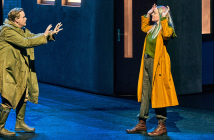
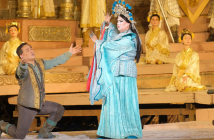
At the Opéra Bastille, Pierre Audi’s revival demonstrated how effective quiet intelligence can be in a work this volatile. His staging remains classical, lucid, dignified—attentive not to historical reconstruction but to an atmosphere of authenticity that allows Puccini’s passions to flare without interference. He also replaces the traditional Magdalene painting with a different image altogether: Cavaradossi’s unfinished work is modeled on Bouguereau’s Les Oréades (1902), a vision of mythic nymphs that is unmistakably non-religious. In a church setting, the presence of this sensuous, secular canvas deepens the tension of the opening scene, undercutting piety with something more ambiguous—almost pagan—and sharpening Tosca’s jealousy with a modern twist.

Scene from Opera national de Paris’ Tosca
Photo: Elisa Haberer
There is a touch of elegy to this revival as well, a quiet homage to a director whose sudden death last summer saddened the opera world. Christof Hetzer’s sets evoke Roman architecture in broad, atmospheric strokes—suggestive rather than literal, grounded more in mood than in strict historical reconstruction—and Jean Kalman’s chiaroscuro lighting casts the evoked architecture in the kind of light one associates with Rome itself, lending Scarpia’s realm a patrician weight without tipping into historical literalism.
This run of Tosca comprises 24 performances, and it’s no surprise that every date featuring star tenor Jonas Kaufmann has sold out. Friday (Dec. 5) evening’s audience even included the English actor Ralph Fiennes, who is directing Paris Opera’s new Eugene Onegin to open in the New Year. Seeing him there, I couldn’t help but imagine that The English Patient would be inevitably smitten with Kaufmann’s performance.
Indeed, two performers supplied the evening’s most dramatic voltage. Kaufmann, even while conserving his resources, retains a dramatic magnetism that no other tenor today approaches and Ludovic Tézier, in a role he absolutely owns, offered a Scarpia of suave cruelty, phrased with lethal precision. When they finally meet in Act II, the atmosphere feels poised on the edge of detonation—an explosion sparked by two artists who know precisely how to marshal and release their power. Kaufmann’s “Vittoria!”—that great cry of defiance on hearing of Napoleon’s triumph—rang through the house with a force this theatre has seldom known, a reminder that even now he can hurl a phrase like a weapon.

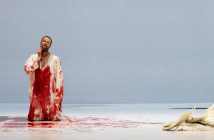
Ludovic Tézier (Scarpia), Jonas Kaufmann (Cavaradossi) & Saioa Hernández in the title role of Opera national de Paris’ Tosca
Photo: Elisa Haberer
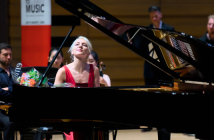
Saioa Hernández, in the title role, brought formidable vocal power, though not always beauty. She commands the stage with ease, but offered no inner tremor, nothing to suggest the woman behind the diva.
Kaufmann’s final aria, “E lucevan le stelle,” carried its own history with it. He has brought down houses with this aria—most famously at the Vienna State Opera, where after an ecstatic ovation he encored it, and Angela Gheorghiu missed her cue for the next scene, prompting him to ad-lib onstage, “Non abbiamo il soprano,” a moment still circulating on YouTube. For me, Kaufmann sings this aria as beautifully now as he did then. No tenor today can match his phrasing, his timbre. It may no longer have the sheer power we heard from him as Werther at Opéra Bastille in 2010, but what he offers now is something else, just as beautiful but distilled and burnished.

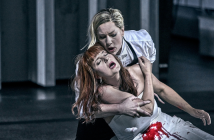
Saioa Hernández (Tosca) & Ludovic Tézier (Scarpia) in Opera national de Paris’ Tosca
Photo: Elisa Haberer
If only the pit had matched the dramatic stakes unfolding above it. Oksana Lyniv, whose Der fliegende Holländer in Bayreuth showed how her structural clarity and rigor can benefit Wagner, offered a reading of Tosca that felt overly contained. Puccini needs lyricism, elasticity, a willingness to let phrases bloom dangerously outward. Here the score was tidy, disciplined—too careful where Puccini demands risk, too taut where the line should breathe. The orchestra supported the singers but rarely rose to meet them; moments that should have surged instead settled politely into place.
And yet, despite this imbalance, the evening achieved its own gravitational pull. Audi’s meditative staging, Tézier’s immaculate villainy, and Kaufmann’s matchless charisma combined to generate a current strong enough to override what the podium withheld. The essential flame of Tosca—its collision of desire, terror, and sacrifice—was not flawless, but undeniably alive.
Opéra national de Paris’s production of Tosca runs through Apr. 18, 2026 with a variety of cast changes.