
For its 150th anniversary, Bavarian State Opera’s Munich Opera Festival had the novel idea of producing all three Da Ponte/Mozart operas as a trilogy, using three different stage directors. Each interpretation was unconventional, but only one was truly brilliant, Don Giovanni. The other two varied from the grotesque to the vulgar.

A scene from Bavarian State Opera’s Le nozze di Figaro. Photo: Geoffroy Schied
Several Canadian singers appear at this year’s festival: Philippe Sly in the title role and Emily D’Angelo as Cherubino in Le nozze di Figaro. Baritone Joshua Hopkins jumped in at the last minute as Guglielmo in Così fan tutte, seen the following day. Tunisian-Canadian mezzo-soprano Rihab Chaieb was a sensual Lola in Cavalleria Rusticana on July 9th and rising tenor Zachary Rioux will appear as Citésippe in a new production of Fauré’s rarely performed Pénélope on July 18th.
Kazakhstan-born actor/director Evgeny Titov, a veteran theatre director relatively new to opera, ignored the obvious paths to success for Le nozze di Figaro (seen July 3rd). Class tensions and the required pace of an opera which takes place in a single day yielded instead to the fail safe option of every unimaginative director: sex. The centrepiece of the production was a “sex chair” with dildos that levered up into the seated person. It was located in a sex dungeon which Count Almaviva had bequeathed to the soon‑to‑be-wed Figaro and Susanna.
To add spice to the story, a financially-troubled Count Almaviva has converted his palace into a marijuana grow-op. Music teacher Don Basilio, dressed in rubber, is no longer merely trying to convince Susanna to accept the Count’s advances, he too is a predator.

Willard White (Bartolo) and Dorothea Röschmann (Marcellina) in Bavarian State Opera’s Le nozze di Figaro. Photo: Geoffroy Schied
The other intriguers, the slimy doctor Bartolo and old maid Marcellina, were sung by British bass‑baritone Willard White and German soprano Dorothea Röschmann. White, now in his late seventies, is much diminished, his voice too light for the role. His Italian was adequate but he could not navigate the passage “Se tutto il codice dovessi volgere, se tutto l’indice dovesse leggere” in his singular aria in order to convey the character’s malice and spitefulness. Röschmann, once a brilliant Countess herself, was too vocally healthy for the secondary role of Marcellina. Titov converted the old matron into a sex‑crazed retired madam, which Röschmann portrayed with unbridled gusto.
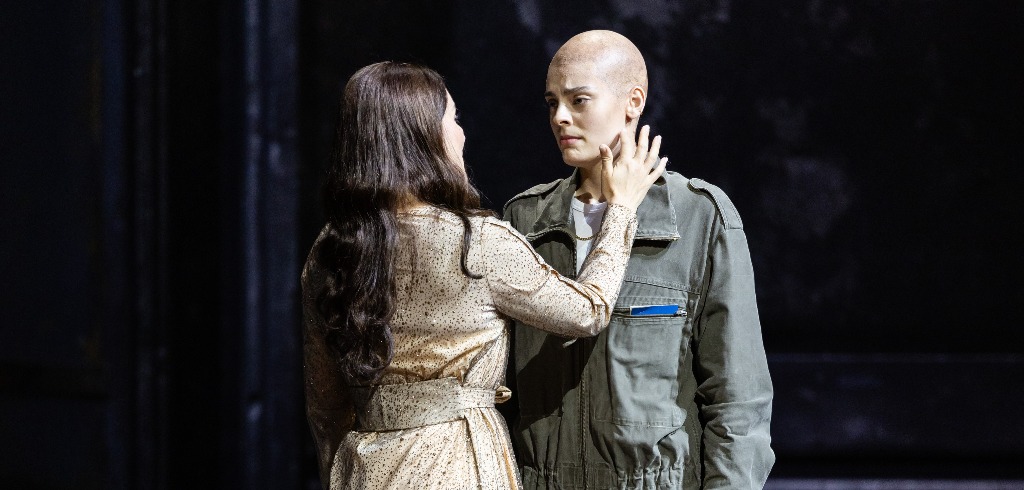
Canadian mezzo Emily D’Angelo was dramatically convincing as the adolescent boy Cherubino, but her light mezzo is getting heavier, sounding almost matronly at moments. Nonetheless, the Act I aria “Non so più” Act II’s “Voi che sapete” were well interpreted. One dilemma with Titov’s updating to the 1970s: compulsory military service was no longer in practice.

Emily D’Angelo (Cherubino), Julie Fuchs (Susanna), and Maria Bengtsson (Countess) in Bavarian State Opera’s Le nozze di Figaro. Photo: Geoffroy Schied
German baritone Björn Bürger stepped into the role of the Count at the last minute. His portrayal, that of a sex‑crazed nobleman-turned-drug-lord, was amusing. However, his voice was too similar to Philippe Sly’s Figaro. His Act III aria, “Hai già vinto la causa” was somewhat underwhelming, but his amorous lamentations in his duet with Susanna, “Crudel! perché finora,” were more convincing.
Swedish lyric soprano Maria Bengtsson disappointed in her Act II aria, “Porgi, amor, qualche ristoro,” in large part due to Finnish conductor Susanna Mälkki’s lack of support. The conductor’s frenzied pace throughout the opera made things difficult for the singers. Bengtsson’s Act III aria, “Dove sono i bei momenti,” was far better as Mälkki’s tempi more appropriate. The soprano aptly conveyed the Countess’s ennui, but she certainly could not convey nobility being reduced to the spouse of a drug dealer.

Julie Fuchs (Susanna), Maria Bengtsson (Countess) and Philippe Sly (Figaro) in Bavarian State Opera’s Le nozze di Figaro. Photo: Geoffroy Schied
The most outstanding performances came from the Figaro and Susanna. Thanks to his beautifully virile timbre and great acting skills, Canadian baritone Philippe Sly was an outstanding Figaro. With minor gestures, he conveyed his rank as well as his pride and craftiness. His interpretation of the Act IV aria, “Tutto è disposto… Aprite un po’ quegl’occhi,” was the highlight of the evening.
French light lyric soprano Julie Fuchs was the only singer other than Sly to offer almost perfect Italian. Her beautiful voice, excellent phrasing and charisma made Susanna the central character. Her light soprano blended well with Bengtsson’s in the Act III duet “Canzonetta sull’aria.” She was able to convey the character’s many moods: joyous and frivolous in her Act II aria, “Venite inginocchiatevi,” and sensual in Act IV’s “Giunse alfin il momento… Deh vieni, non tardar.” Her chemistry with Sly was infectious, rendering the couple both credible and likable.
Act IV is hard to pull off in general, but proved impossible in Titov’s updating. Two secret trysts with the Countess disguised as Susanna and vice versa are far from easy to stage convincingly. The subterfuges were too obvious in the Count’s indoor grow‑op (in lieu of the palace gardens) with bright lights above the plants. I doubt anyone was fooled by the attempted disguises. Under such circumstances, the last act fell flat. Instead of the final reconciliation, the Count is taken to the “sex seat,” where the Countess lowers the lever, raising a phallus into her sexually-submissive husband. Da Ponte must have been rolling in his grave.
Bavarian State Opera’s Munich Opera Festival continues until July 31. Full details can be found at www.staatsoper.de