Browsing: La Scena Online

La Scena Online is the digital magazine of La Scene Musicale.Contents: News, Concert reviews, CD reviews, Interviews, Obituaries, etc; Editor: Wah Keung Chan; Assistant Editor: Andreanne Venne
ISSN: 1206-9973

Leó Weiner was the lost soul of Hungarian music. A professor at the Franz Liszt Academy from 1908, alongside Bartok and Kodaly, he shared his colleagues’ fascination with folk music but not their modernism. Weiner’s world belonged to Brahms and Liszt, his orchestration to the 1890s. His first violin concerto is a delight – Bruch without the big tune but with an entwinement of soloist and orchestra and much letting down of hair in the gypsy dances. This is thought to be its first complete performance and none of its 25 minutes outstays its welcome. Júlia Pusker is the unflashy…

Share:
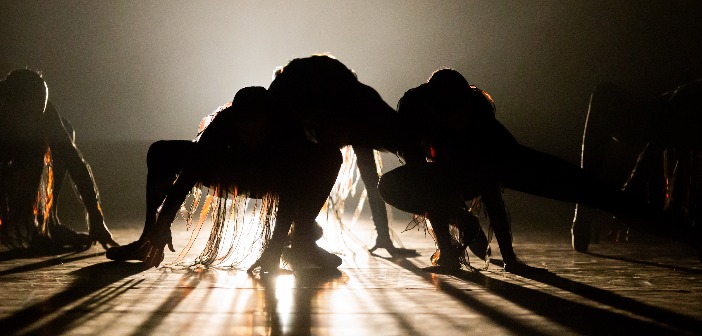
Royal Winnipeg Ballet (RWB) has commissioned three Indigenous story ballets over the decades, each one making, for its time, a newsworthy impact. 1971’s The Ecstasy of Rita Joe, choreographed by Norbert Vesak, was a hard-hitting depiction of racism, while 2014’s Going Home Star—Truth and Reconciliation, by Mark Godden, put the residential school scandal onstage. Then came 2024’s traditional Indigenous tale, T’əl: The Wild Man of the Woods, and, this time, an Indigenous choreographer: Cameron sinkʷə Fraser-Monroe, a member of the Tla’amin Nation of British Columbia’s northern Sunshine Coast. RWB recently presented T’əl (pronounced “tall”) on a seven-stop tour of BC—which I…

Share:

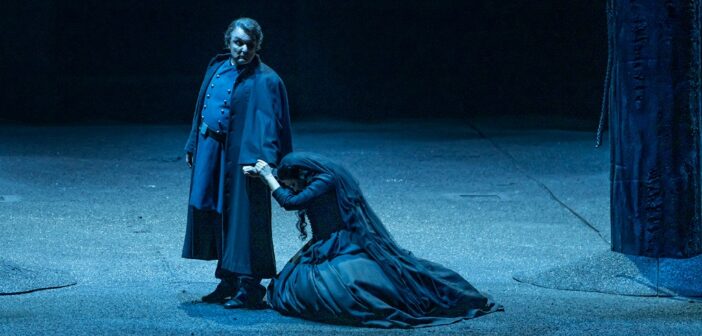
With the Paris Opera’s 2026 season now in full swing—and offering several genuinely striking productions, Eugene Onegin directed by Ralph Fiennes among them — this Un ballo in maschera (seen Feb. 8) feels thoroughly routine, save for the presence of Anna Netrebko and Ludovic Tézier. Verdi’s Ballo occupies an intriguing middle position in his output. Written in 1859, it belongs neither to the early “galley years” nor to the fully mature period of Don Carlo or Otello. It is a transitional work in which political drama, psychological shading, and melodic brilliance coexist somewhat uneasily—a piece that can support, and even…

Share:

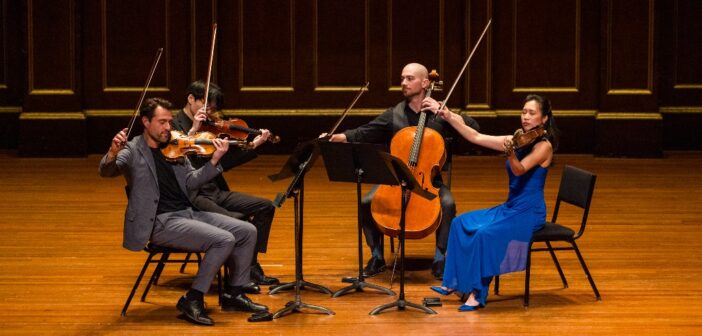
On Feb. 8, the temperature in Montreal plummeted to -16°C and a biting wind lowered it by some magnitudes more. The city was in need of some warmth and sun, and they got it. The Dover Quartet rolled into town to play for the Ladies’ Morning Musical Club and fortuitously gifted the audience in Oscar Peterson Concert Hall one of Joseph Haydn’s (1732-1809) “Sun” quartets–op. 20, no. 4. in D major. Note: there is nothing particularly sunny about the opus 20 quartets. The nickname comes from one of the early editions having a picture of a sun on its cover.…

Share:

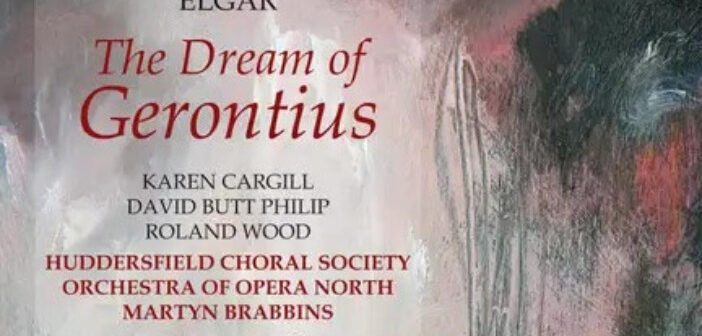
Edward Elgar’s great oratorio could justly be called a deathbed masterpiece – not his own, for it was written in the fullness of his powers, but that of Gerontius who spends the first part of the work dying in an agony of faith and doubt and the second in the company of a Guardian Angel who escorts him into eternity. The dying man is a tenor, the angel a soprano. A baritone and chorus cover the rest. The work is devotional and Roman Catholic though not preachy or pompous. Elgar is not in the business of saving immortal souls. He…

Share:

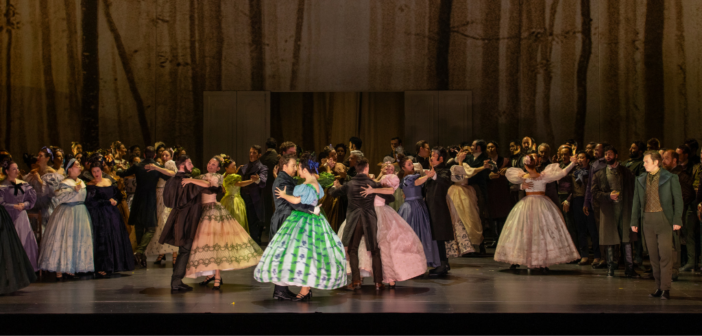
The excitement around this sold-out Eugene Onegin at the Palais Garnier (seen Feb. 1) begins with a name: Ralph Fiennes. One senses his presence before a note is played. This is not a production that announces a concept; it unfolds as an act of direction in the cinematic sense. Fiennes shapes time, stillness, and gesture with the instincts of an actor and film-maker. The theatre itself—Garnier’s red velvet, gold leaf, painted ceilings—lingers in the peripheral vision like a living extension of the staging. Built in the same decade as Tchaikovsky’s opera, it feels less like a venue than like part…

Share:

At Opéra national de Paris’s Opéra Bastille, Calixto Bieito staging of Wagner’s Siegfried arrives as the third panel of a much-anticipated new Ring. Musically, the evening often reaches a very high level (seen Jan. 31). Theatrically, it descends into something that is not so much provocative as empty. Let us begin with what worked, because it worked magnificently. The singing was, across the board, of a calibre one rarely encounters in this punishing score. As Mime, Gerhard Siegel was a masterclass in vocal characterisation. His tenor, bright yet edged with acid irony, captured the character’s neurotic cunning without ever descending…

Share:

There is a tension within this recording that I have struggled to resolve. The Cuarteto Casals are currently among the world’s best string quartets, certainly top ten. Their two previous volumes of Shostakovich quartets earned my unfettered admiration. The playing on these albums is hyper-athletic, the interpretations informed, sensitive and intelligent. Just about as good as it gets. My first hearing of this final set left me unconvinced. The 13th quartet – a 20-minute-long movement led by the viola – felt overly harsh, unmediated by the possibility of beauty. The 14th, dedicated to a cellist, pulled too much in the…

Share:

Paradisum is an unusual theatrical experience—a dark and brooding new circus show grounded in contemporary dance, with enough high-flying acts of derring-do to arouse the audience to frequent applause. That at least was the case in Vancouver when Hungary’s Recirquel premiered Bence Vági’s Paradisum in North America as part of the DanceHouse season, presented in partnership with the Cultch. Key to this brooding and also beautiful work is the mysteriously threatening setting—mountains and towers rise imposingly, then collapse and reform, or melt into thin air and reappear in new configurations. Once I became aware of the simplicity of the stagecraft,…

Share:

Rigoletto,  Giuseppe Verdi’s masterpiece and one of opera’s most tragic stories, opened Canadian Opera Company’s winter season on Jan. 24 to a full house on a frigid night. To start, the audience warmed up their vocals with a rousing rendition of “O Canada,” sung with more bravado than usual, given the recent political climate.  The Story Rigoletto is a jaded jester in the court of the Duke of Mantua. His master is an arrogant philanderer who boasts of his many amorous conquests. When Rigoletto mocks Monterone, whose daughter has been dishonoured by the Duke, Monterone curses him with the same…

Share:
1 3 4 5 6 7 172