Royal Winnipeg Ballet (RWB) has commissioned three Indigenous story ballets over the decades, each one making, for its time, a newsworthy impact. 1971’s The Ecstasy of Rita Joe, choreographed by Norbert Vesak, was a hard-hitting depiction of racism, while 2014’s Going Home Star—Truth and Reconciliation, by Mark Godden, put the residential school scandal onstage. Then came 2024’s traditional Indigenous tale, T’əl: The Wild Man of the Woods, and, this time, an Indigenous choreographer: Cameron sinkʷə Fraser-Monroe, a member of the Tla’amin Nation of British Columbia’s northern Sunshine Coast.
RWB recently presented T’əl (pronounced “tall”) on a seven-stop tour of BC—which I saw at the Centre in Vancouver on February 9—on a double bill with Carmina Burana, a 1998 work by Argentinean Mauricio Wainrot. Both works run about an hour, and both feature an open breezy style of contemporary ballet movement. But, of course, it was the newer work that garnered the most press, even generating a lengthy feature internationally, with the New York Times celebrating “the first full-length work by an Indigenous choreographer to be commissioned by a major company.”
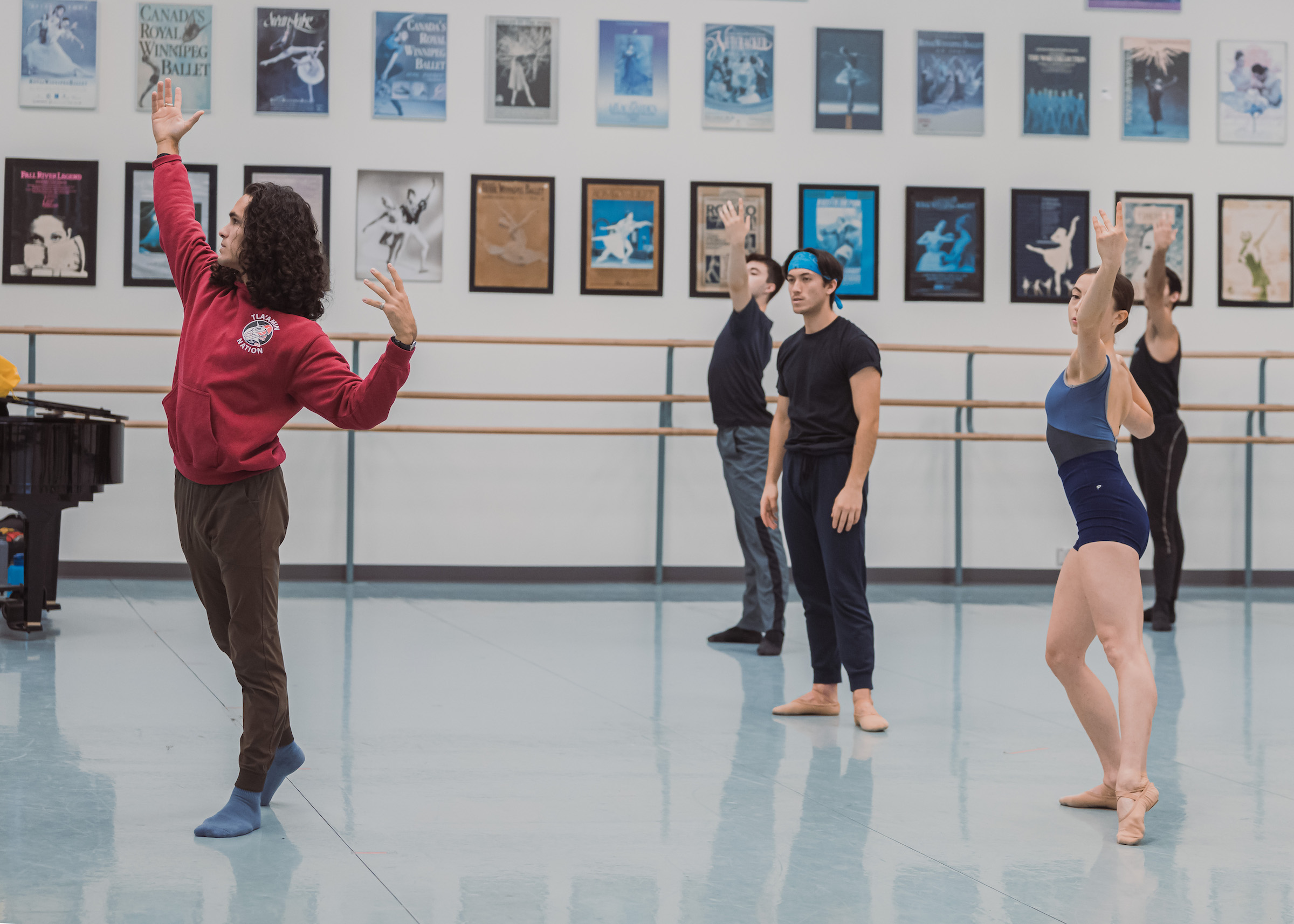
RWB Company in rehearsal with Cameron Fraser-Monroe
Photo: Courtesy of the Royal Winnipeg Ballet
T’əl opens in darkness, with the voice of Elder Elsie Paul introducing the story, first in Ayajuthem, the language of the Tla’amin Nation, and then in English. She helps us, at intervals, keep track of the story of T’əl (Logan Savard), a shadowy figure who kidnaps children, gluing them to the ground with melted tree pitch until it is their turn to be eaten. Erica (Kyra Soo) goes to the rescue after her Middle Sister (Amanda Solheim) is kidnapped.
Cellist and composer Cris Derksen, a Juno-nominated artist with Cree and Mennonite heritage, composed the powerful score, in a style that Fraser-Monroe, in a curtain speech, aptly called “orchestral pow-wow.” The compelling mix of drum, chant, orchestral strings and electronic elements, in a range of moods, enriches the ballet. It drives the opening scene for 17 dancers that features both very centred, balletic dance, with graceful lifts, and modern-inflected off-kilter moves. At times, there is an almost ceremonial quality to the rhythm and quality of the movement that brought dramatic weight to the whole.
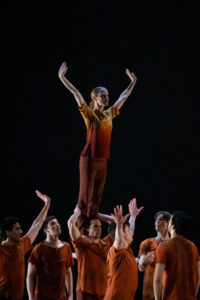
Elizabeth Lamont and RWB Company in T’əl: The Wild Man of the Woods (2024)
Photo: Daniel Crump
As the ballet progressed, the use of mime and character interaction brought the story to the forefront, with Elsie Paul’s voice-overs a welcome aid to understand what was going on. It was important to Fraser-Monroe to have the 94-year-old voice the tale, an oral history that was almost lost due to colonial assimilation policies, including the federal government’s potlatch ban (1885-1951), which made it illegal for Indigenous peoples to continue their cultural practices. Many ballets are based on European children’s stories—Pinocchio, Snow White, Cinderella—and now there is T’əl, based on an Indigenous one that Paul helped keep alive.
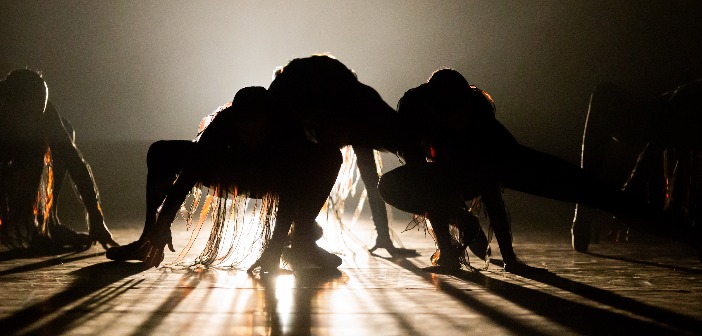
The ballet is danced in soft slippers, except, in a nice touch, by six women in black tights and fringed tops cast as Noseeums, or mosquitoes, whose black pointe shoes contribute to their spiky insect appearance (costumes are by Navajo designer Asa Benally). The Noseeums are formed from T’əl’s ashes after he is shoved into a fire.
Fraser-Monroe has a wide background in dance. Besides being an alumnus of the RWB’s ballet school, he began Ukrainian dancing at age three in Vernon, BC (he is also of Ukrainian and Scottish descent), later training in hoop and grass dancing styles. More use of these various influences would be welcome as the young choreographer—Fraser-Monroe is still in his twenties—develops his own unique artistic voice.
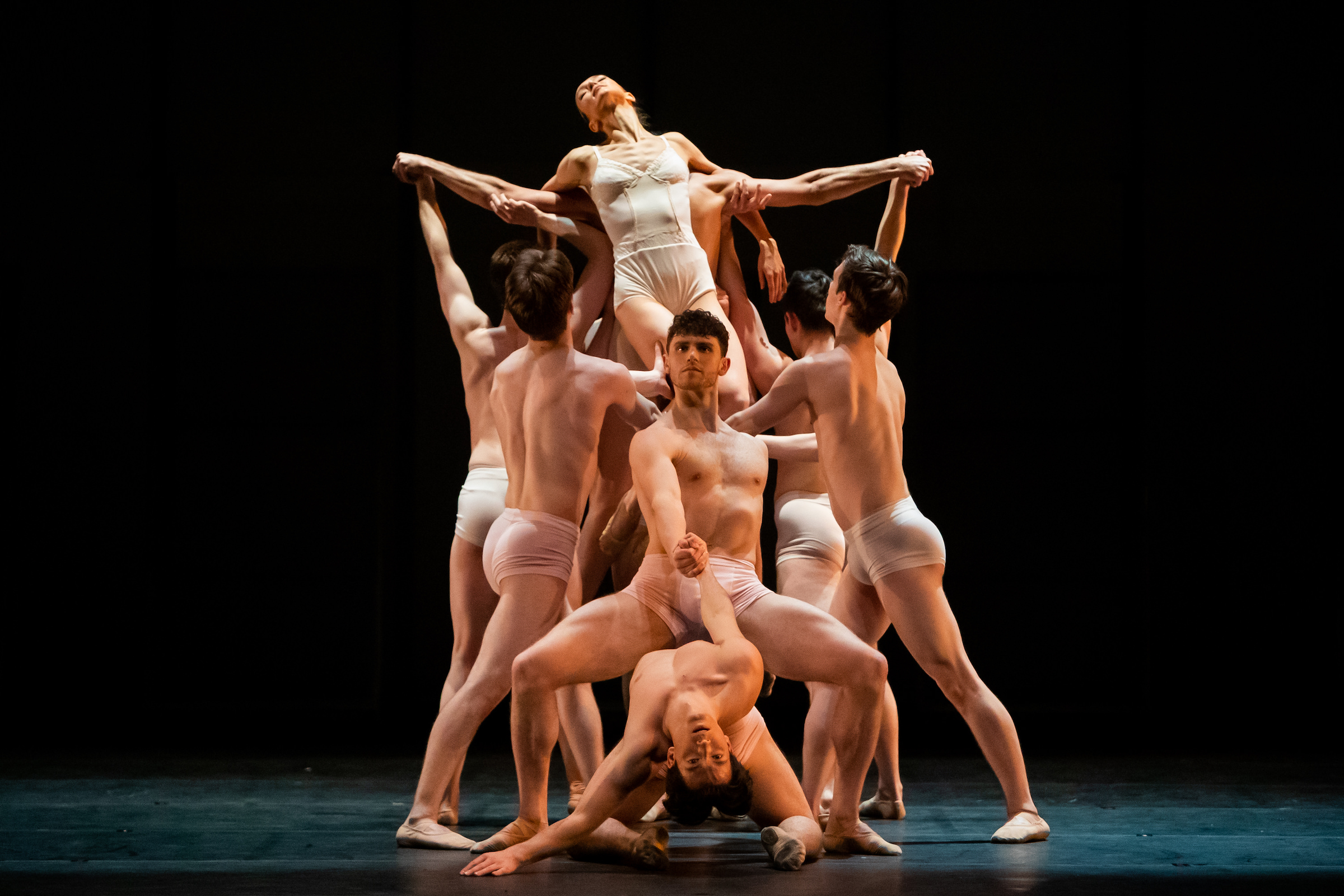
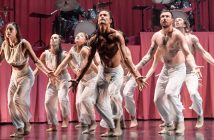
RWB Company in Carmina Burana (2024)
Photo: Daniel Crump
Wainrot’s Carmina Burana, which closed the evening, is set to German composer Carl Orff’s 1936 cantata of the same name, inspired by 13th-century songs and poems discovered in a Bavarian monastery in 1803. Wainrot’s ballet, commissioned by the Royal Ballet of Flanders and added to the RWB’s repertoire in 2002, follows the music, not the songs and poems (which include bawdy drinking scenes and a sorrowful swan roasting on a spit). It is an abstract, not a dramatic ballet, with many rhythmically engrossing scenes. As such it drove the house to its feet at the end of the evening, a satisfying result for the company on its first sighting in Vancouver (aside from an annual Nutcracker) in ten years.
The visit was also the first under new artistic director Christopher Stowell, the American who has been at the helm since June 2025, succeeding longstanding director André Lewis. Stowell is a former San Francisco Ballet principal dancer and, from 2017 to 2022, was associate artistic director at the National Ballet of Canada. He is also the son of Kent Stowell and Francia Russell, former co-directors of Seattle’s eminent Pacific Northwest Ballet, which has a strong Balanchine tradition. All told, his is an illustrious pedigree to bring to Canada’s oldest professional ballet company and to the next chapter in the Royal Winnipeg Ballet story.
For more on Royal Winnipeg Ballet’s season visit www.rwb.org