At Opéra national de Paris’s Opéra Bastille, Calixto Bieito staging of Wagner’s Siegfried arrives as the third panel of a much-anticipated new Ring. Musically, the evening often reaches a very high level (seen Jan. 31). Theatrically, it descends into something that is not so much provocative as empty.
Let us begin with what worked, because it worked magnificently. The singing was, across the board, of a calibre one rarely encounters in this punishing score.
As Mime, Gerhard Siegel was a masterclass in vocal characterisation. His tenor, bright yet edged with acid irony, captured the character’s neurotic cunning without ever descending into caricature. Even when the staging reduced him to arbitrary business, his precise timing, expressive diction, and sharply focused tone kept the drama alive.
Andreas Schager does not possess what one would call a conventionally beautiful voice, but that observation becomes irrelevant in the face of what he accomplishes. The sheer volume, stamina, and control required to carry Siegfried are feats in themselves. He does not flag. He does not retreat. He rides the orchestra with astonishing endurance, and by the end one has to acknowledge that this is a heroic performance in the most literal sense.
As the Wanderer, Derek Welton brought a voice of striking amplitude and grain, its dark, burnished timbre conveying authority without heaviness. Even constrained by the mediocrity of the staging, his presence made it unmistakable that this is a god who has renounced his power and now wanders anonymously through the ruins of his former order.
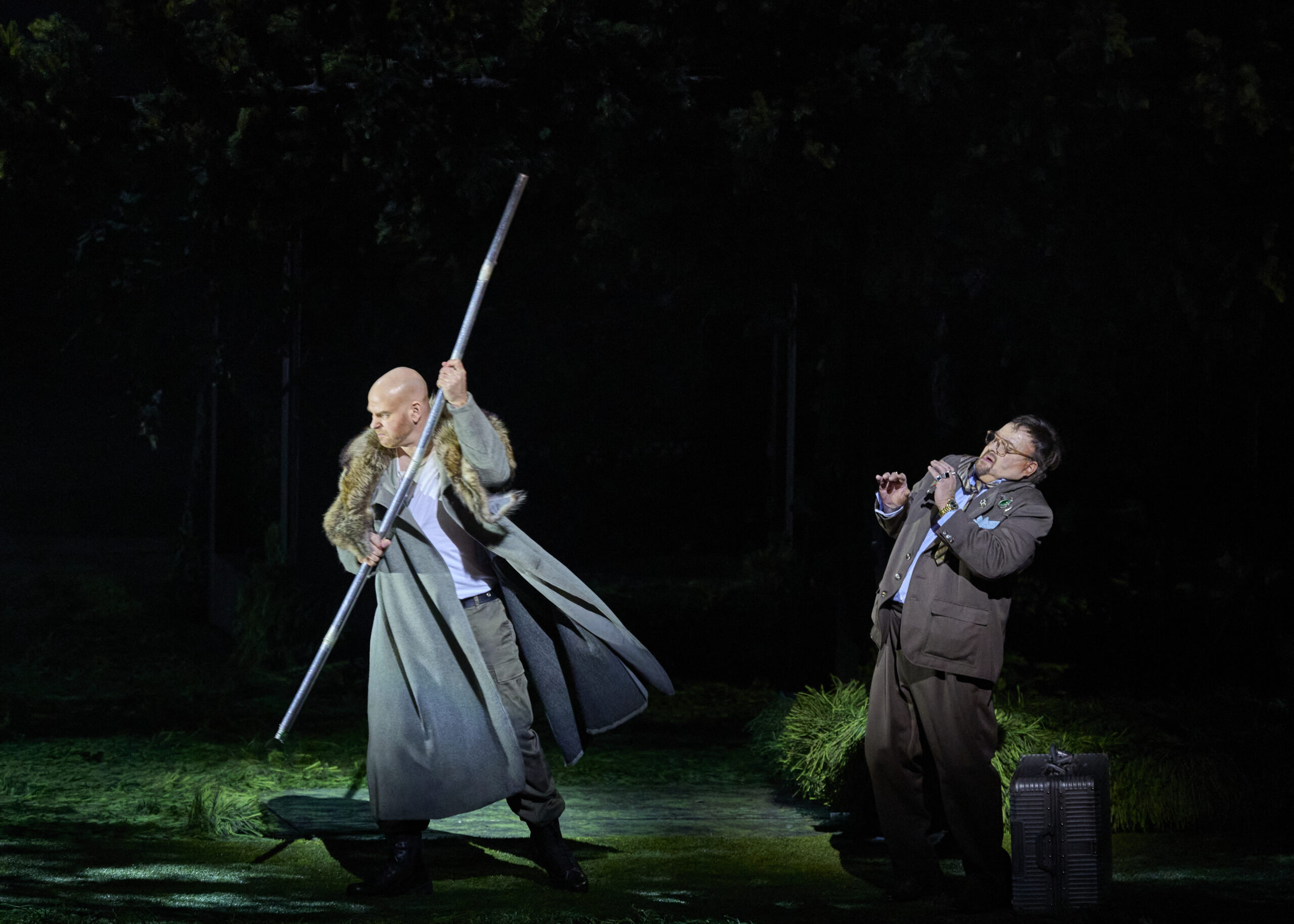
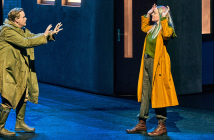
Derek Welton (Wanderer) & Gerhard Siegel (Mime) in Paris Opera’s Siegfried
Photo: Herwig Prammer
To this must be added a formidable Alberich from Brian Mulligan, whose dark, focused tone and sharply etched delivery gave his exchanges with the Wanderer in Act II an intensity and clarity that momentarily restored a sense of dramatic stakes to the evening.
Equally striking was Mika Kares as Fafner, his cavernous, velvety bass carrying an aura of menace and grandeur that reminded one how much Wagner achieves through vocal colour alone.
In the pit, Pablo Heras-Casado drew remarkable colours from the orchestra. Wagner gives this opera some of the most pictorial, soloistic writing in the entire Ring. These are not background effects but moments where individual instruments become characters, landscape, or psychological states.
The score is full of passages where a single timbre carries the drama: the bass clarinet’s sly colour around Mime, the biting anvils in the forge, and the flute, clarinet, and distant horns in the Forest Murmurs were shaped with chamber-like clarity and air. Low brass and Wagner tubas gave Fafner and Erda geological depth, while radiant high violins, noble horns, and shimmering harps made Brünnhilde’s awakening blaze with light.
Here Tamara Wilson was a revelation. Never have I heard her sing so valiantly. In a role that can destroy even the most seasoned dramatic soprano, she remained vocally intact to the very last bars of the duet. The high notes rang. The line held. There was radiance rather than fatigue and an exceptional assumption of this gruelling role.
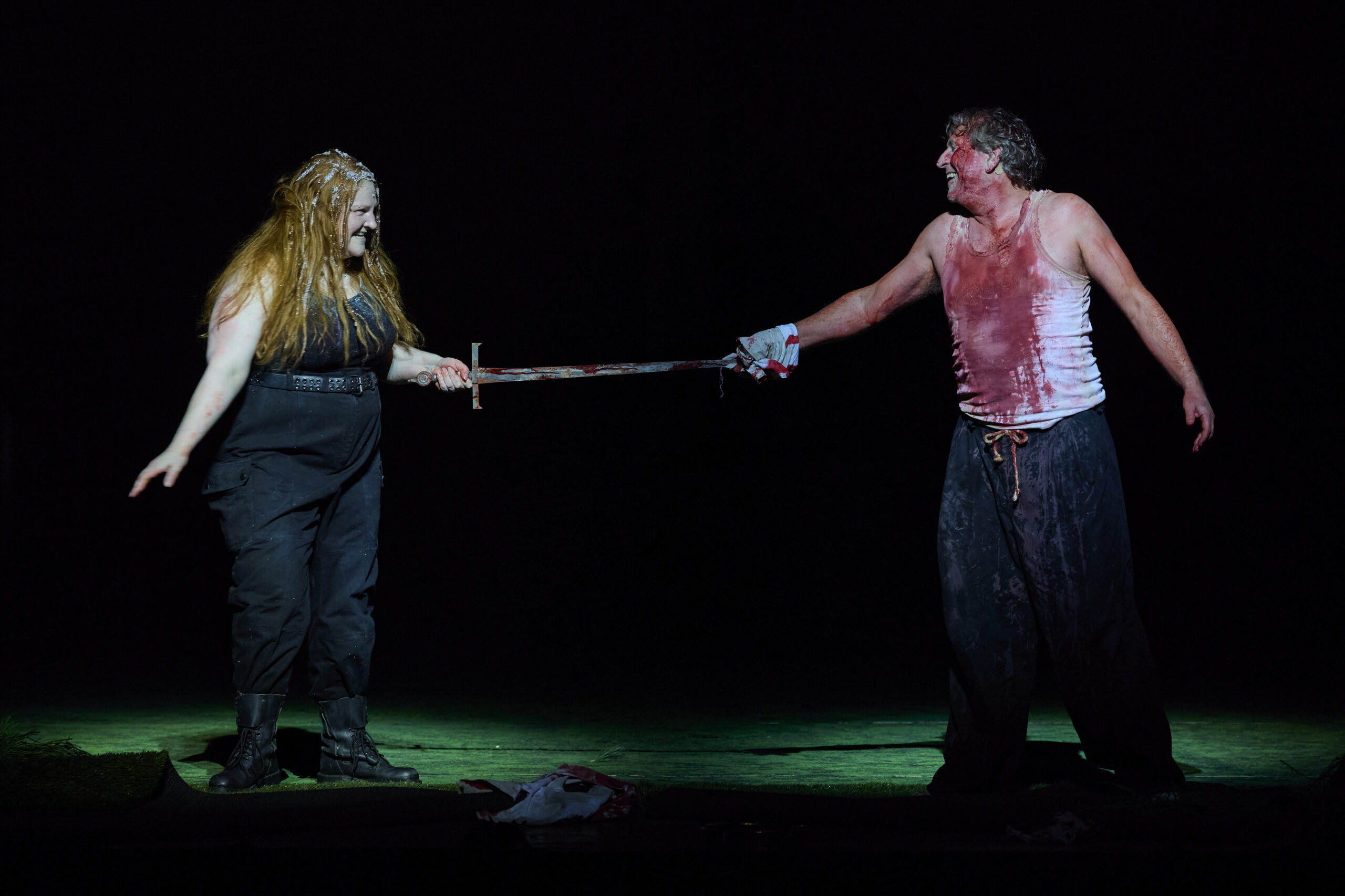
Tamara Wilson (Brünnhilde) & Andreas Schager in the title role of Paris Opera’s Siegfried
Photo: Herwig Prammer
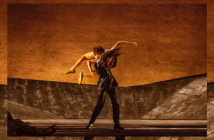
Visually, there was one striking idea: the opening forest, with its inverted trees recalling Georg Baselitz, reflected in water. It was an image of real beauty and poetic suggestion (Stage design: Rebecca Ringst). For a moment, one felt that this production might offer a powerful visual metaphor for inversion, memory, and myth in a ruined world.
That promise evaporated almost immediately.
What followed was a mise en scène so dramatically inert, so devoid of theatrical thought, that it became difficult to understand what one was watching. This is not a question of conservatism or resistance to radical staging. Opera today is enriched by directors such as Krzysztof Warlikowski and Romeo Castellucci, whose work can be fiercely deconstructive yet remains grounded in an acute sense of theatre, image, and meaning.
The last Ring cycle at the Bayreuth Festival was directed by Valentin Schwarz, just 33 when he was signed on (Patrice Chéreau was 31 for the 1976 centennial Ring). Its episodes did not always align seamlessly, yet they were charged with beauty and flashes that announced, unmistakably, the presence of a young genius.
Even the famously controversial Ring by Frank Castorf at Bayreuth Festival (2013-2017)—so loudly decried at its premiere—was the work of a true theatre maker. One could argue with it, resist it, debate it. It had a language, a point of view, a dramaturgical spine.
Here, there is nothing to argue with because there is nothing to grasp.
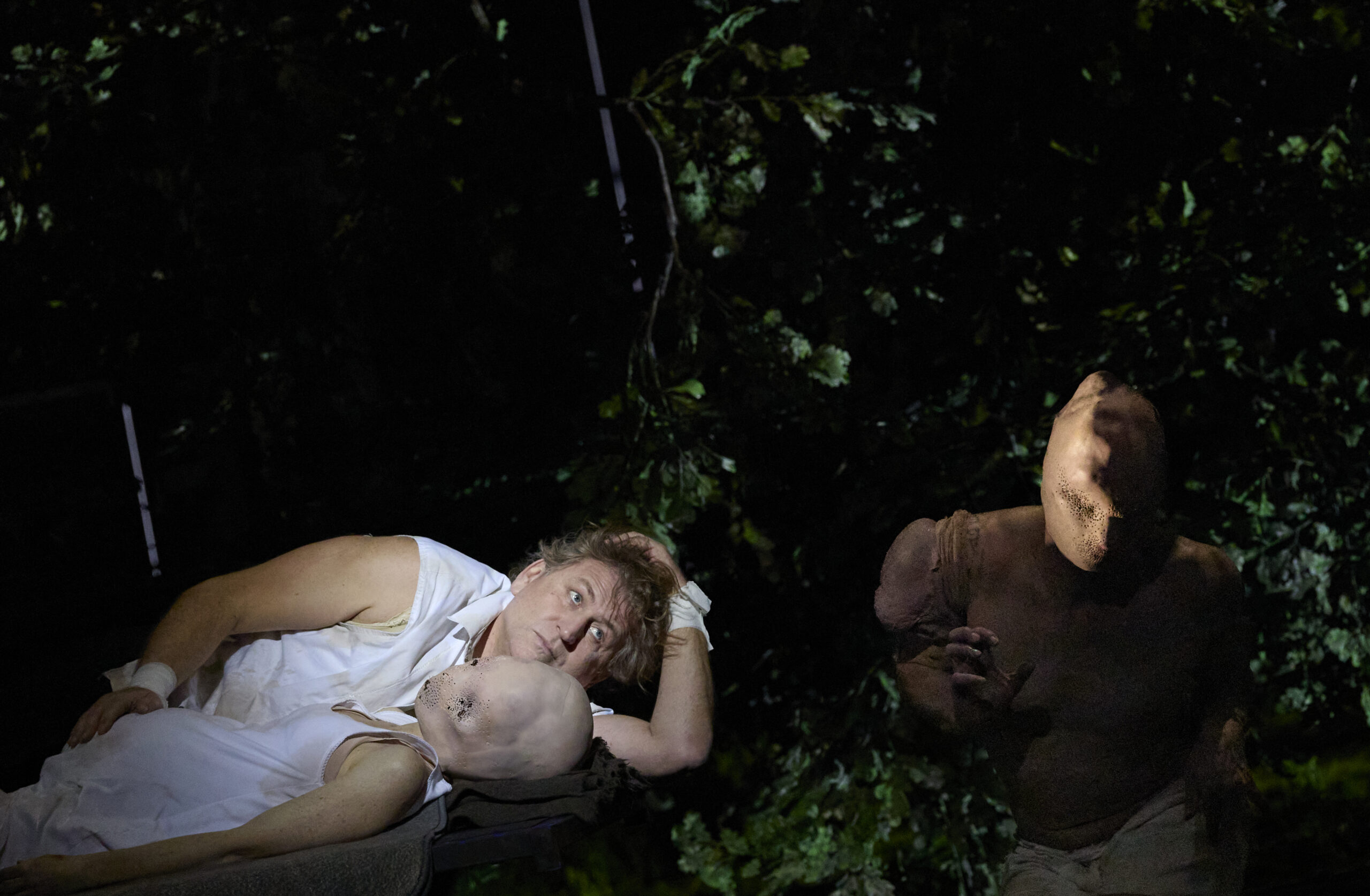
Andreas Schager in the title role of Paris Opera’s Siegfried
Photo: Herwig Prammer
The singers wander through a landscape of arbitrary actions with no discernible logic. Props appear without meaning—Siegfried hauling a car door like a sled/backpack hybrid—and gestures accumulate without consequence. This is not provocative ambiguity but a theatrical vacuum.
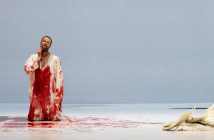
Visually, the performers frequently resemble children caught in an egg-and-flour fight at Mardi Gras. They are smeared, splattered, and left to remain so for hours. Instead of evolving into a visual metaphor, this becomes an endurance test for the audience, who must stare at this mess for nearly five hours without any apparent symbolic development.
One scene epitomizes the problem: in the encounter between Erda and the Wanderer, he bends her over a table, repeatedly pushes her face into the hard surface and then pours soup over her head—a heavy-handed visual pun standing in for earth itself. This is not shocking, illuminating, or meaningful. It is crude, with no discernible relationship to Wagner’s text, myth, or psychology. That the moment remains watchable at all is due to Canadian mezzo-soprano Marie-Nicole Lemieux, whose opulent, bronze-hued voice and grave musical authority make her an exemplary Erda, and who sustains astonishing dignity despite every effort of the staging to diminish her.
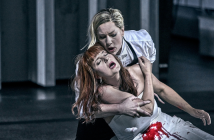
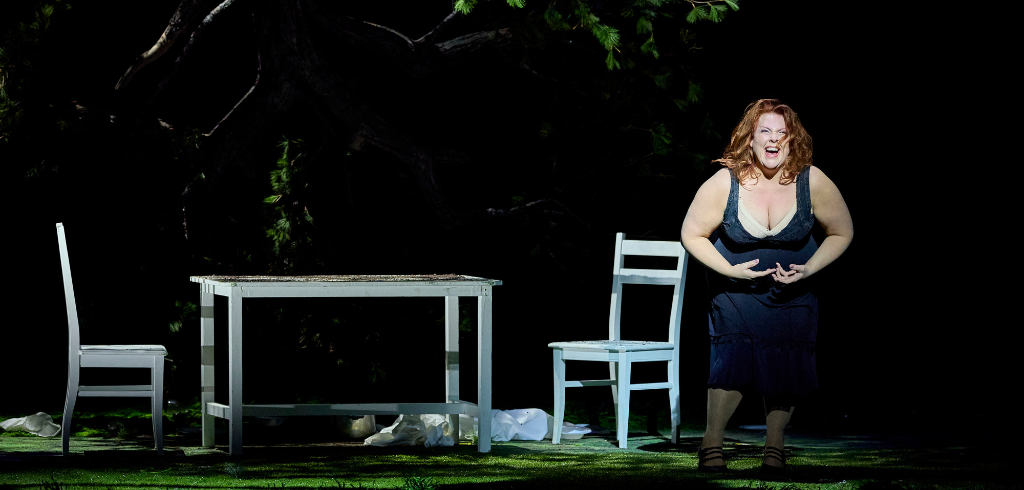
This is where discomfort turns into something more troubling. Repeatedly, female figures are subjected to humiliating, degrading treatment that feels less like an interpretive choice and more like a gratuitous impulse. Whether intended or not, the cumulative effect with the totally gratuitous and violent abortion performed by Alberich on a frail, deformed, anonymous female character suggests a profoundly misogynistic gaze. At the very least, it reveals a striking lack of sensitivity to how such images read in a contemporary context.
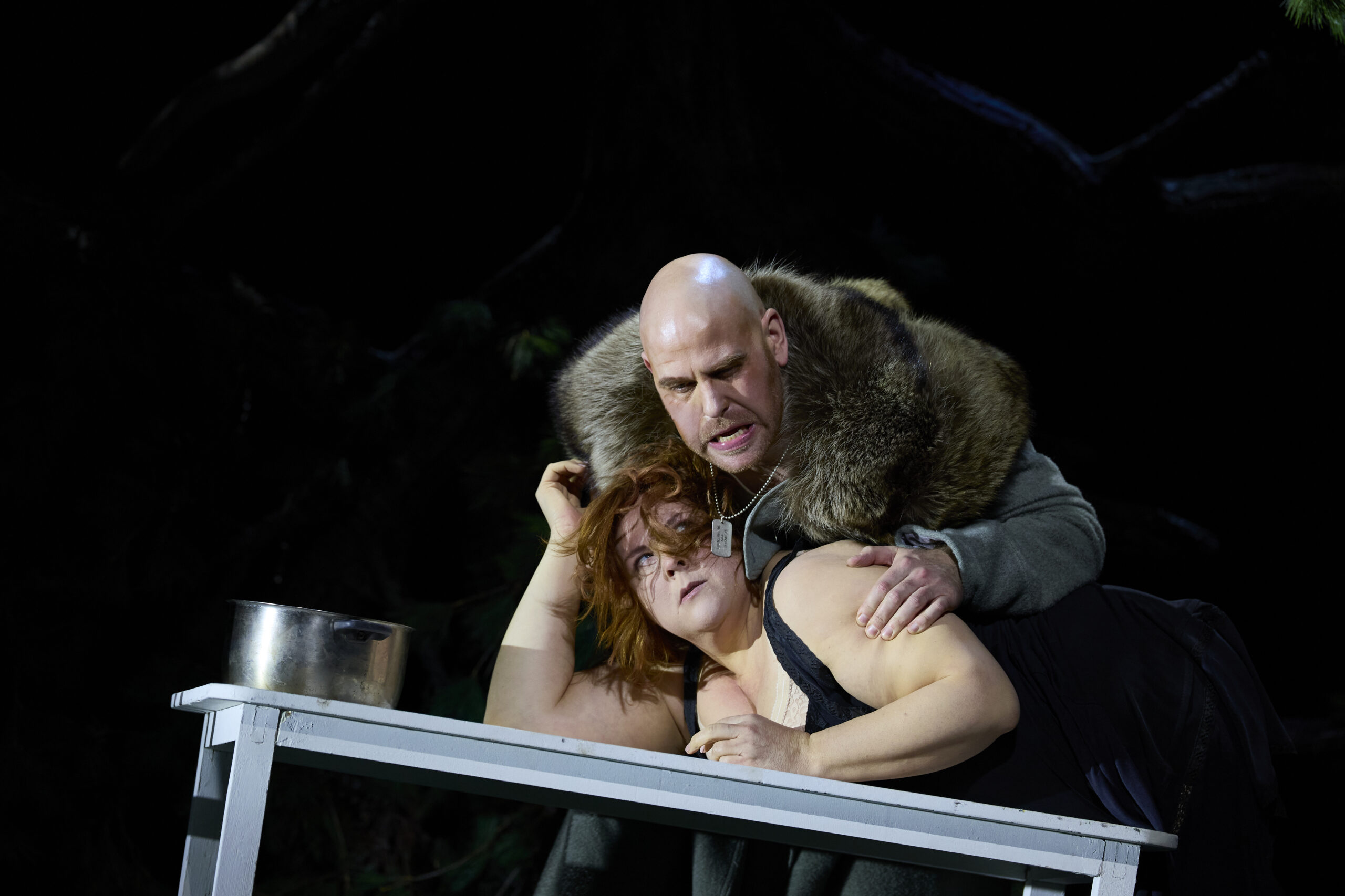
Marie-Nicole Lemieux (Erda) & Derek Welton (Wanderer) in Paris Opera’s Siegfried
Photo: Herwig Prammer
What is most surprising is not that this production exists, but that so many seasoned observers seem willing to accept it as theatre. This is not daring. This is not radical. It is not even particularly offensive. It is simply empty.
The music, the singers, and the orchestra carried the evening. The staging contributed nothing beyond a single beautiful opening image and many hours of visual and dramatic frustration. In a work as rich, strange, and theatrically fertile as Siegfried, that is perhaps the greatest failure of all.
More on Opéra national de Paris’s Siegfried can be found here.