Browsing: La Scena Online

La Scena Online is the digital magazine of La Scene Musicale.Contents: News, Concert reviews, CD reviews, Interviews, Obituaries, etc; Editor: Wah Keung Chan; Assistant Editor: Andreanne Venne
ISSN: 1206-9973
Over every mountain-top Lies peace, In every tree-top You scarcely feel A breath of wind; The little birds are hushed in the wood. Wait, soon you too Will be at peace. Johann Wolfgang von Goethe, The Book of Lieder, trans. Richard Stokes (London: Faber, 2005). The great German polymath, Johann Wolfgang von Goethe wrote these lines, The Wanderer’s Nightsong in 1776. One of his most famous poems, it masterfully delivers a feeling of all-enveloping serenity, not even broken by birdsong. Over 50 years later, in 1828 Franz Schubert (1797–1828) wrote his last sonata (Bb major, D. 960) months before his…

Share:
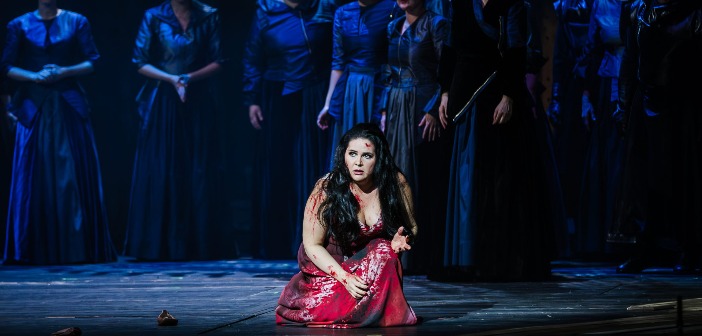
Hungarian State Opera’s revival of their 2016 production of Donizetti’s Lucia di Lammermoor by Máté Szabó gives us a new Lucia ascendant who succeeds within a dramatic vacuum. Up until now, soprano Zita Szemere has mostly been known for lyric roles such as Ilia, Norina, and Blonde. Here, she cranks things up a notch on her own vocal terms. She offers a beautifully sung, and convincingly dramatic Lucia, the tragic heroine abused by the men in her life, who only gains agency once she has been driven mad. Would that the production around her could offer a better showcase for…

Share:

Calixto Bieito’s Carmen at the Opéra Bastille—a production created in 1999 at the Festival de Peralada (Spain) and revived in Paris since 2017—arrives with the reputation of a once-scandalous staging. Yet what unfolds on stage today feels less provocative than crude. The production (seen Feb. 22) is built on a succession of aggressively literal gestures—sexual exhibitionism, staged violence, crudely stylized mob behavior—presented with little variation or psychological progression. Rather than revealing new facets of the characters, these devices reduce them to caricature: Carmen becomes a bundle of mannerisms, Don José a schematic figure of brutality, Escamillo a hollow emblem of…

Share:

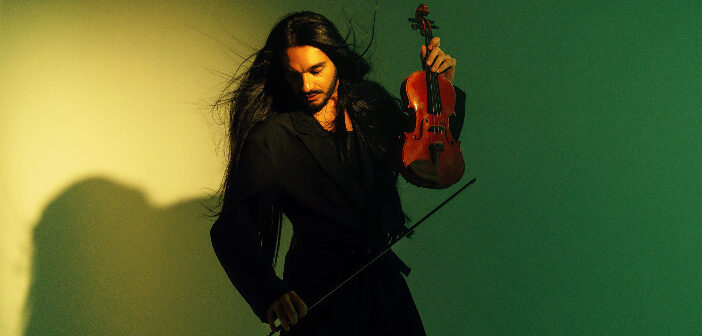
The Serbian violinist Nemanja Radulovic is a maverick in the manner of Nigel Kennedy and David Garrett, a stage animal with a twist of difference. On his latest album, Radulovic wears a monk-like cassock down to the floor with hair down to his waist, as if he had spent the last forty days in a cave, communing with the eternal. The music he performs here is by Prokofiev, a composer whose eye was forever on the earthly and the existential. The surprise lies in the soloist’s approach. Radulovic plays the concerto softly and with introspection, requiring the Philharmonia Orchestra (conducted…

Share:

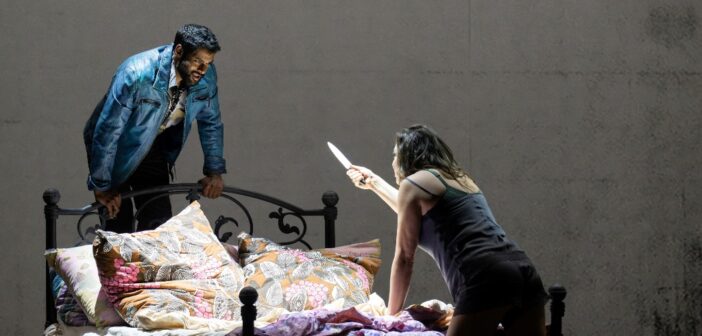
Like its material, Komische Oper Berlin’s new production of Shostakovich’s Lady Macbeth of Mtsensk by director Barrie Kosky is unrelentingly grim. The action takes place in an undefined space with a white rectangle superimposed upon a distressed gray wall. Props are minimal, the principal one being the title character’s bed where all manner of lust, violence and murder takes place. Visual excitement is ignited by the strategic movements of the chorus, and the unrelenting acrobatic demands placed on the principals. The story is told in a remarkably straightforward manner, but it’s the coalescence of all these artistic elements that pushes…

Share:

The second concert in Konzerthausorchester Berlin’s “Vom Anfangen” (“On Beginnings”) festival featured works that could be described as unfinished in different ways. This superbly-curated evening brought together Schubert, Bartók, Kurtág and Puccini—strange bedfellows perhaps—in a program of stimulating connections (seen Feb. 20).  As detailed in the program notes, György Kurtág (currently celebrating his 100th birthday) cites Schubert as his inspiration to compose, and for his ideal of musical beauty. In that light, the orchestra, under their chief conductor Joana Mallwitz, began with Schubert’s two-movement “Unfinished” symphony of 1822. There is much debate as to whether this work was truly unfinished,…

Share:

In the age of Chopin and Liszt, Charles-Valentin Morhange (known as Alkan) was the pianist they all feared. So formidable was his technique and so elevated his ambition that only Alkan was able to perform the works he composed at the prescribed speed. Chopin, in his will, entrusted him with completing his unfinished works. Alkan, around 1850, was the foremost pianist in Paris. Then things fell apart. Rejected by the Conservatoire as head of its piano department, Alkan retired to his apartment and lived as a hermit. When he finally emerged two decades later, all the great pianists attended his…

Share:

Celebrated bass-baritone José van Dam has passed away at age 85. His death on February 17, 2026, was announced by the Queen Elisabeth Music Chapel, a Belgian academic institute that was greatly shaped by van Dam’s contributions as founder and Master in residence of its voice section. Van Dam was one of today’s most requested interpreters of the bass-baritone repertoire, and he featured on the cover of La Scena’s October 2000 issue.  As a tribute, we republish our interview with the singer below. José van Dam: Master Singer by Wah Keung Chan, October 1, 2000 It is refreshing to hear…

Share:

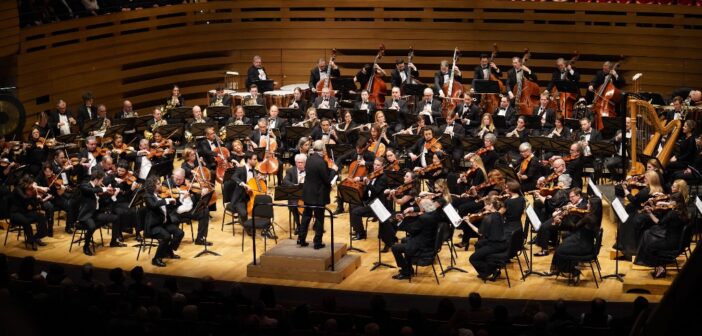
Mahler’s longest, most philosophically ambitious, and second most lavishly scored symphony, in a less than full-sized hall, could so easily have proved too much of a good thing. Not a bit of it. Among several special—if not unique—features, the Budapest Festival Orchestra is known for its quality of listening: listening to each other and listening to the music. Accordingly, under Iván Fischer’s economical, yet never less than whole-hearted direction, they never pushed sonic thrills across the physical pain barrier or into mere vulgarity. Textures were transparent, the balance against orchestral and vocal solos optimally discreet. The notion that Mahler expanded…

Share:

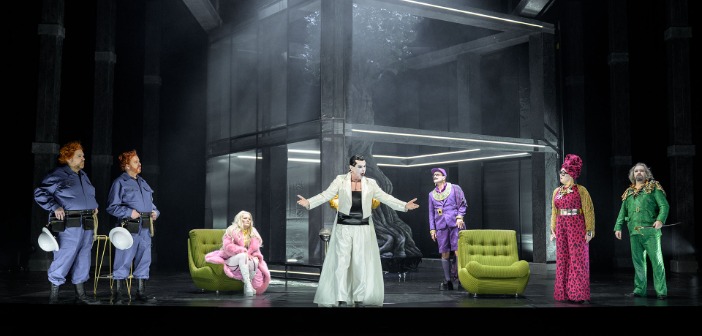
With director Sláva Daubnerová’s production of Wagner’s Das Rheingold (seen Feb. 15), Prague’s National Theatre embarks on a new Ring Cycle between now and 2028. The last time the company presented the Ring was in 2005, in a version from Germany’s Deutsche Oper am Rhein with Canadian soprano Frances Ginzer as Brünnhilde. For any company, a new staging of Wagner’s tetralogy is a huge undertaking and upon first evidence, things are off to a provocative, if visually overladen start.  Daubnerová, along with set designers Boris Kudlička and Kateřina Hubená (also on costumes) and costume designer Dorota Karolczak have created a…

Share:
1 2 3 4 5 6 172