Review of VANESSA, by Samuel Barber and Gian Carlo Menotti; presented by Heartbeat Opera at the Baruch College Performing Arts Center, New York City; viewed May 16, 2026; further performances are scheduled through May 31, 2026.
Heartbeat Opera, the innovative and protean company that’s been mounting striking productions since 2014, has crafted a beautifully performed and arrestingly staged condensation of Samuel Barber and Gian Carlo Menotti’s Pulitzer Prize-winning 1958 English-language opera, Vanessa.
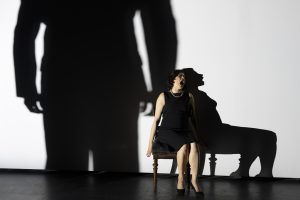
Inna Dukach as Vanessa; photo by Russ Rowland
By turns passionate, spooky, enigmatic and thrilling, the gothic-inflected story centers on the title character, a middle-aged aristocrat living in a provincial enclave “in a northern country,” who, twenty years before the opera opens, had been jilted by her one true love, Anatol. Vanessa subsequently shut herself away in her rambling manor house, draping over all the portraits and mirrors, and entering into an emotional suspended animation, her life frozen in an obdurate belief that Anatol would one day return.
That day appears to have come.
A Waiting Game
Thus, on a bleak winter night, Vanessa sits expectantly in her great room – along with her mother, the old Baroness (who for undisclosed reasons refuses ever to speak to her daughter) and Vanessa’s putative niece, Erika (a sullen twenty-year old who seems to be a spinster-in-training) – all keeping vigil for the arrival of Anatol, who has sent ahead word of his coming.
The Anatol who shows up, however, proves not to be Vanessa’s one-time paramour, but the latter’s strapping son and namesake, who grew up on his now deceased father’s regretful panegyrics to his lost Vanessa.
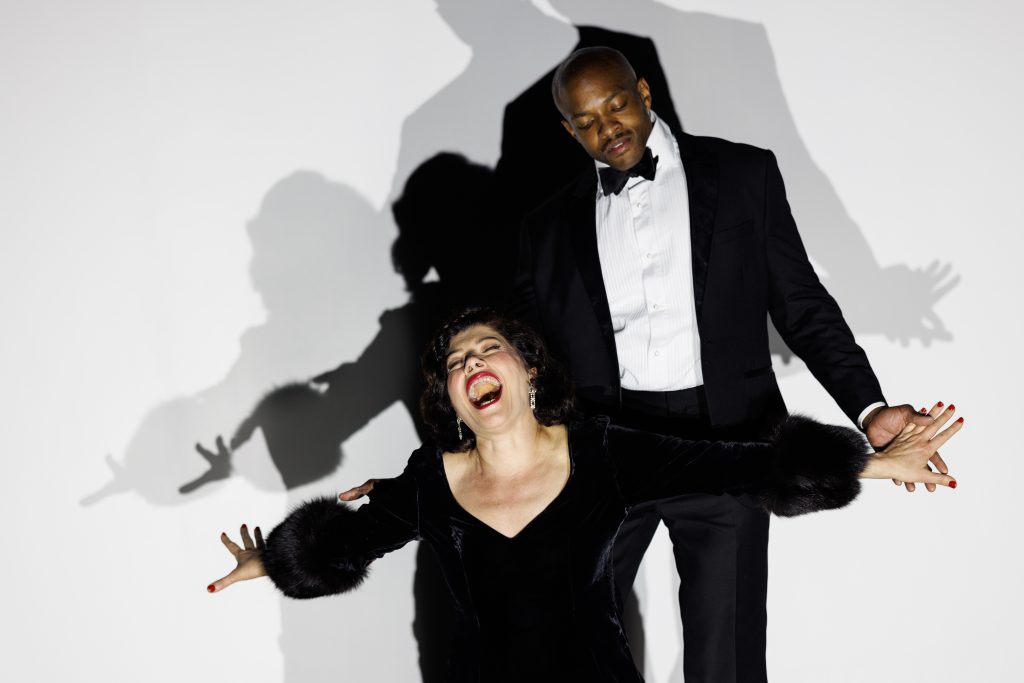
Inna Dukach as Vanessa and Freddie Ballentine as Anatol; photo by Maria Baranova
All for Love?
Well, young Anatol proves quite the amorous operator, wooing both Vanessa and Erika in turn (and in tandem). Part cad, part Lochinvar – an opportunist, a cynic, and an impenitent exponent of “modernity” (“Outside this house, the world has changed,” he tells Erika, cajoling her with the prospect of travel, hedonism and free love) he is the catalyst of a rapid reversal of all the forces and relationships that have held the household in its decades-long arrested development.
If one does the math concerning Erika’s age in conjunction with a consideration of the peculiar absence of any explanation as to Erika’s unnamed parents, one begins to have the creeping suspicion that beneath the bourgeois, Chekhovian geometry of the situation, there are darker secrets, a hint of illicit relations, of concealed progeniture. The older Baroness’ censorious silence may guard her scandalized awareness of what lies beneath.
Shadows on the Wall
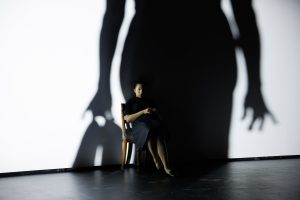
Inna Dukach as Vanessa; photo by Russ Rowland
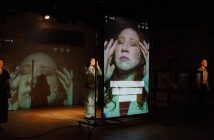
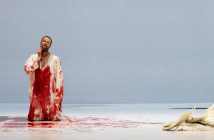
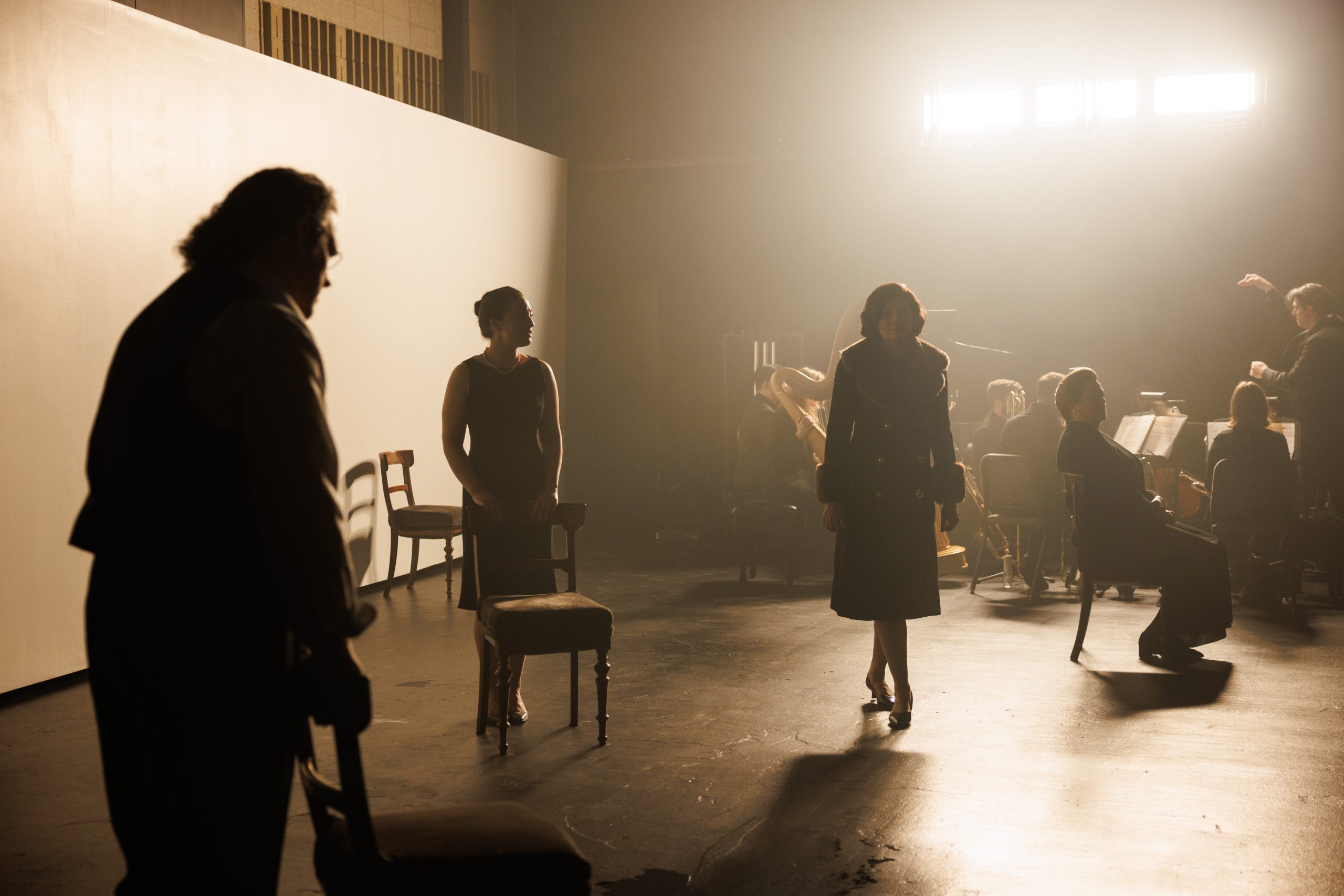
In this Heartbeat Opera rendering, Vanessa’s provocative flavor is enhanced by the astringent minimalism of Jiaying Zhang and R.B. Schlather’s design of the space and the inventive lighting scheme by Yuki Nakase Link; and director Schlather’s fluid, expressionistic and at times nigh-mathematical deployment of his players’ bodies. Performers’ outsized, jet-black silhouettes loom across a field of dazzling, desolate white. It’s a darkly layered tale told in elegant and unsettling griseaille, eschewing the usual literalness of Cecil Beaton-esque stuffiness and Edwardian manners.
Bless All in This House
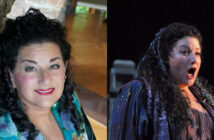
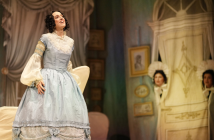
The role of Vanessa is heroically embodied here by lyric-spinto-soprano Inna Dukach. Her passionate performance of “Do Not Utter a Word” upon Anatol’s arrival is riveting stuff.
Mezzo-soprano Kelsey Lauritano gives us a thoroughgoing and rich-voiced portrait of the walking textbook of melancholia that is Erika, capable both of venality and valor yet inexorably doomed. Her heartbreaking “Must the Winger Come So Soon?” is a gorgeously presented set piece.
The virile roué Anatol is played with enormous power and vocal flexibility by tenor Freddie Ballentine.
The older Baroness is portrayed by mezzo-soprano Mary Phillips with a black-ice steeliness in her voice and a mien of coiled reserve that is essential to the enigma of her position amidst the other two women of the house.
Finally, the comic pathos of the Old Doctor is rendered with admirable and endearing verve by baritone Joshua Jeremiah.
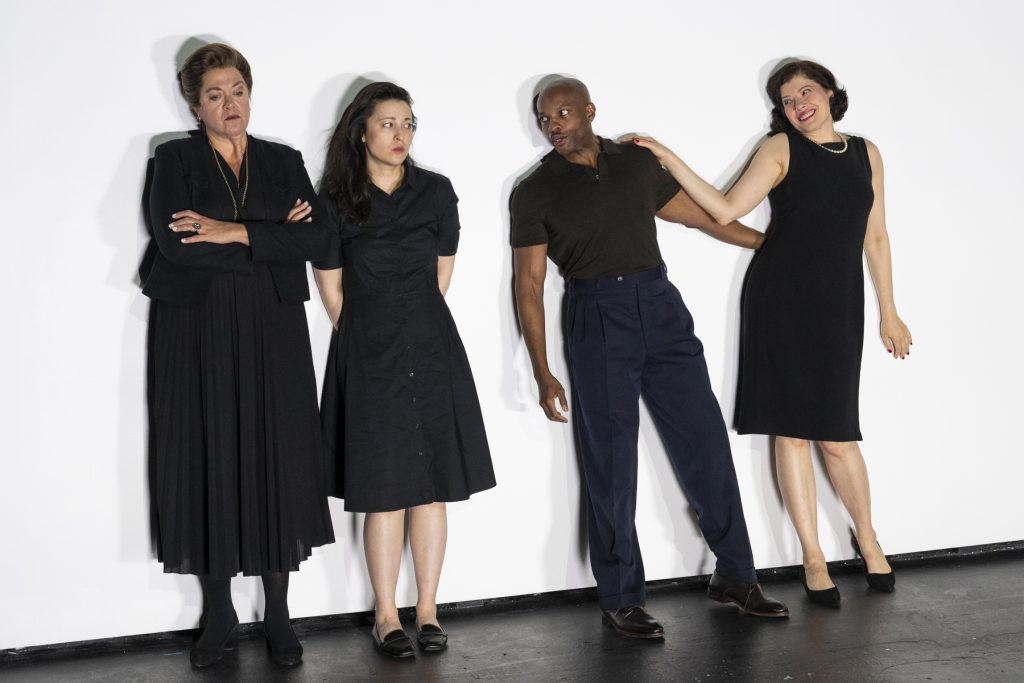
Mary Phillips as the Baroness, Freddie Ballentine …ukach as Vanessa; photo by Russ Rowland
Vanessa here, Vanessa there
Heartbeat Opera’s production of Vanessa originated last summer at the Williamstown Theatre Festival – the first opera to be hosted by that redoubtable 71-year-old company.
Jacob Ashworth has adapted Menotti’s libretto, excising minor characters and a supporting ensemble to create an intoxicating distillate of 100-minutes-proof of drama. Dan Schlosberg’s re-orchestration of Barber’s score for a seven-player chamber-sized ensemble by (consummately conducted by Ashworth) impressively honors the lushness, piquant dissonances and overall intricacy of Barber’s original, which calls for an orchestra some tenfold the size here.
G. Schirmer, Inc., the original opera’s licensing organ, must be ecstatic that they may now offer so viable an alternative for companies of modest size and resources.