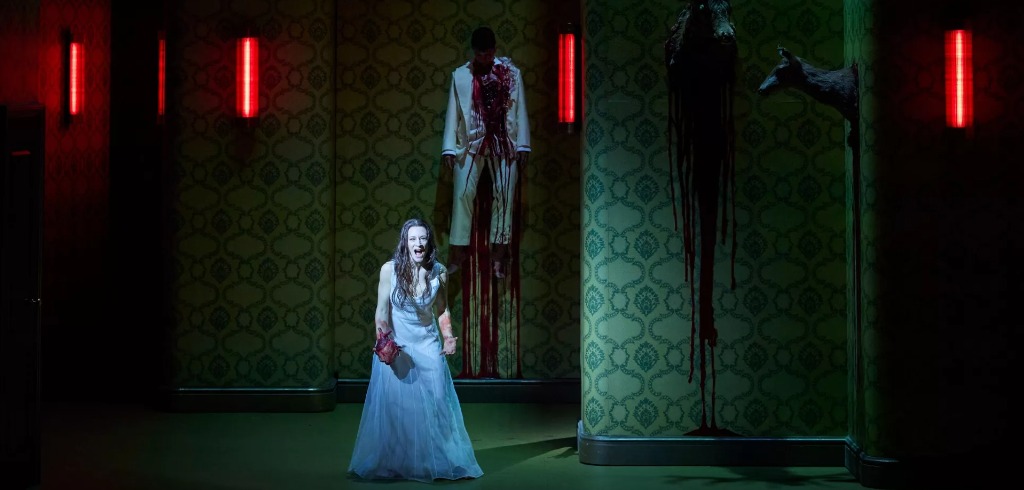
With Opéra-Comique’s new production of Lucie de Lammermoor—the little-known French version of Donizetti’s most famous work—a rarity has returned to the Parisian stage not as a mere curiosity piece, but as a living and surprisingly potent work of theatre. In reviving the original adaptation created for Paris in 1839—premiered not at the Opéra-Comique itself but at the Théâtre de la Renaissance—the Salle Favart-based company offers more than a linguistic variant of the familiar Lucia di Lammermoor: this Lucie reveals a different dramatic metabolism altogether—leaner, colder, psychologically more exposed. Under Speranza Scappucci’s superb musical direction and with a cast led by the extraordinary Sabine Devieilhe, the production (seen May 4) confirms that the French Lucie deserves a rightful place alongside her Italian cousin.
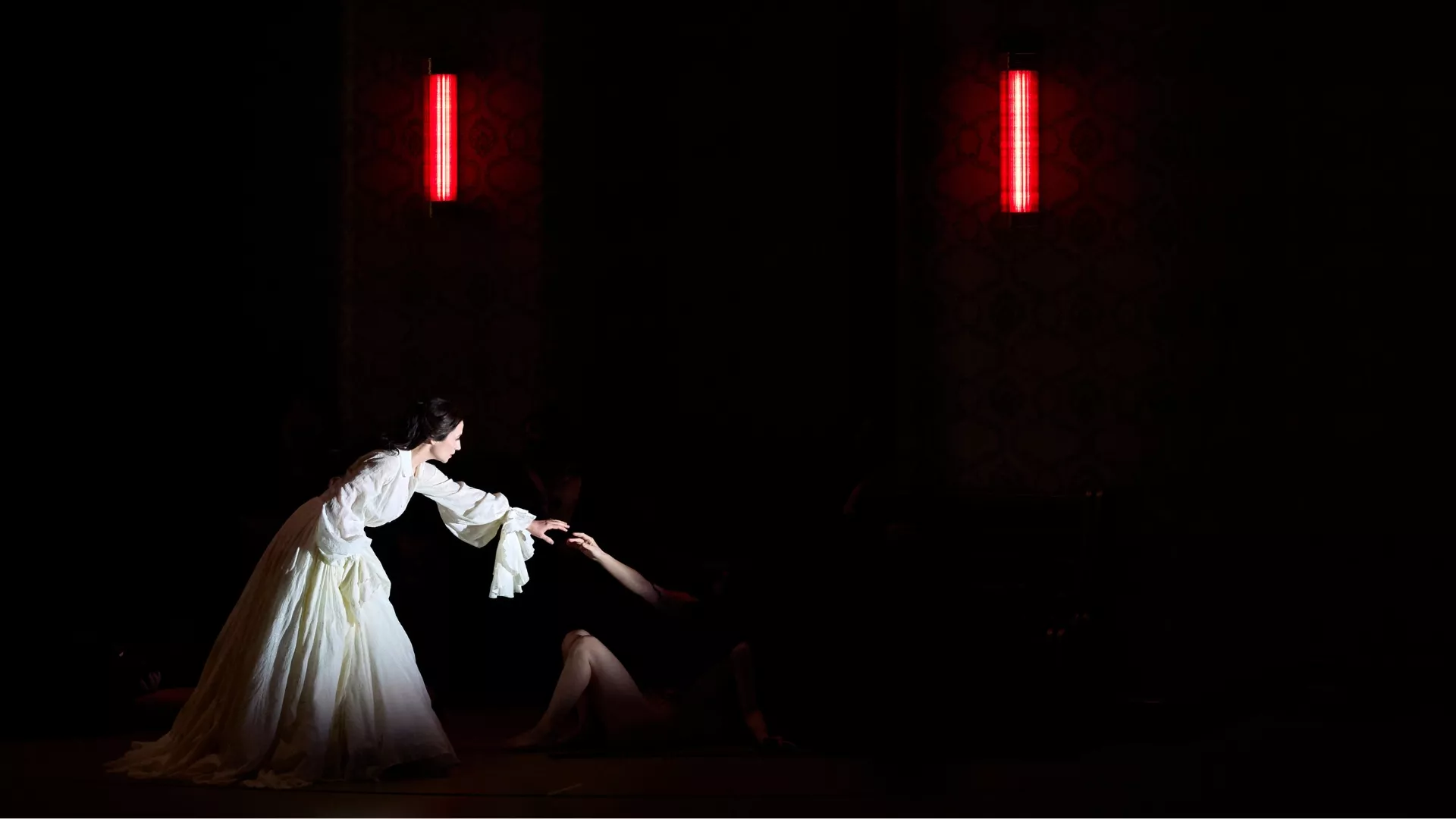
Sabine Devieilhe (Lucie Ashton) & Elise Maître (comédienne) in Opéra-Comique’s Lucie de Lammermoor, 2026. Photo: Herwig Prammer
Devieilhe’s performance reinforces her reputation as one of the finest coloratura sopranos on the international stage. What is remarkable is not merely the technical mastery—though the precision of the line, the crystalline attacks, and the astonishing control across the registers remain almost unequalled today—but the intelligence of the characterization. Her Lucie is fragile without affectation, haunted rather than hysterical. The French text itself transforms the role, stripping away some of the ornamental brilliance associated with the Italian version and replacing it with a more intimate, inward form of anguish. The famous final scene becomes less a display piece than a psychological disintegration unfolding in real time. Devieilhe demonstrates that Donizetti’s French adaptation lives through language as much as through vocal fireworks, and every phrase is shaped with almost instrumental refinement.
Opposite her, Etienne Dupuis confirms why he remains such a favourite with Parisian audiences. Vocally, he brings warmth, authority, and elegance to the role of Lucie’s brother, Henri Ashton, but it is the dramatic commitment that gives the performance its terrifying edge. Dupuis avoids caricature; his Henri is not simply brutal, but trapped within a suffocating social machinery of honour, class, and desperation. The dark-grained baritone retains its beauty even under pressure, and his French diction is, of course, exemplary.
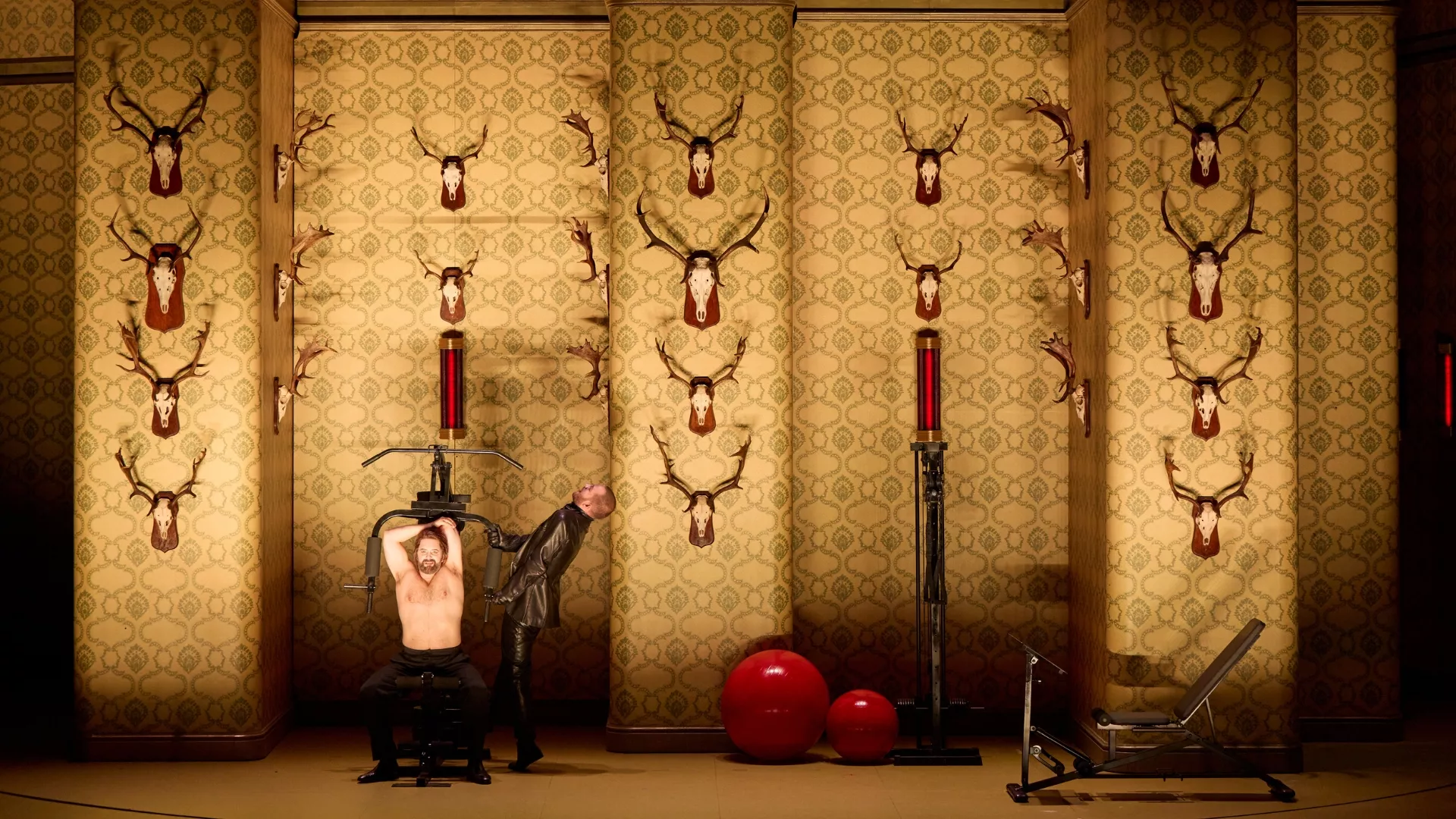
Etienne Dupuis (Henri Ashton) & Yoann Le Lan (Gilbert) in Opéra-Comique’s Lucie de Lammermoor, 2026. Photo: Herwig Prammer
But the revelation of the evening is without doubt tenor Léo Vermot-Desroches as Edgar. Rarely does one encounter a voice of such amplitude and dramatic thrust in this repertoire. Comparisons are ultimately difficult, because Vermot-Desroches possesses one of those genuinely exceptional instruments that immediately announce themselves as singular. There are moments when the sound acquires a curious, overly covered quality, as though the voice were preparing to pounce, but such reservations ultimately dissolve when one hears the finesse of the vocal emission: the phrasing is intelligent, the musicality refined, and the line consistently shaped with expressive purpose. The final scenes achieve an almost Verdian intensity unusual in Donizetti.
The smaller roles are exceptionally well cast. Edwin Crossley-Mercer brings warmth and authority to Raymond Bidebent, the Ashton family’s chaplain and spiritual adviser, his resonant bass lending real presence to the ensembles. Joann Le Lan makes a strong impression as the darkly insinuating Gilbert, an almost Iago-like figure lurking at the edges of the drama, while lyric tenor Sahy Ratia is excellent as Lord Bucklaw, singing with elegance and secure projection.
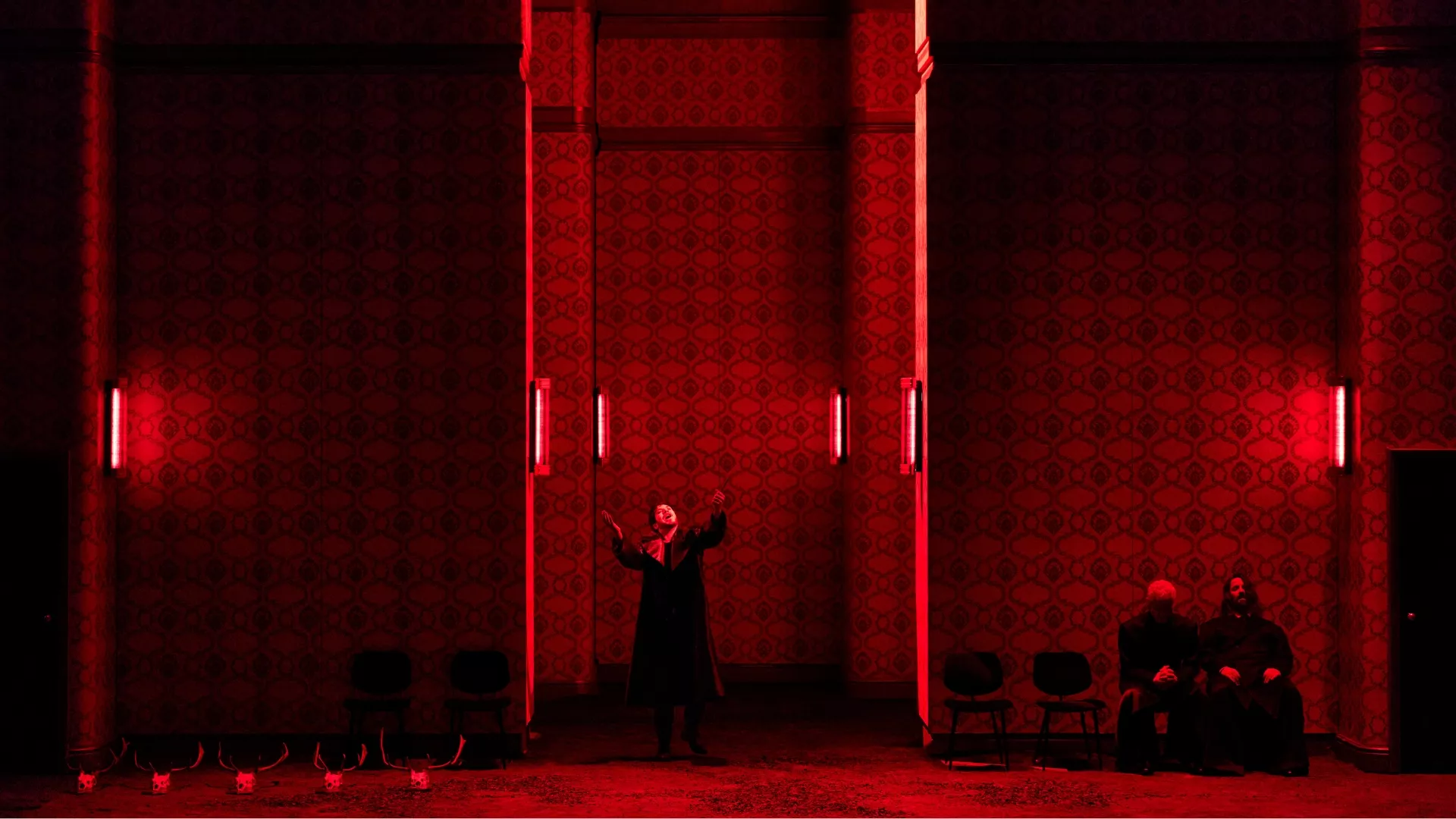
Léo Vermot-Desroches (Edgar Ravenswood), Edwin Crossley-Mercer (Raymond Bidebent) and Etienne Dupuis (Henri Ashton) in Opéra-Comique’s Lucie de Lammermoor, 2026. Photo: Herwig Prammer
In the pit, Speranza Scappucci proves an ideal conductor for this repertoire. Few of her contemporaries understand bel canto as completely as she does—not as decorative elegance, but as dramatic architecture sustained through rhythm, breath, and tension. She allows the score to breathe while never permitting it to drag. The orchestral textures remain transparent, flexible, and supportive of the singers. Crucially, she understands the specifically French qualities of this version: its sharper theatrical pacing, its darker orchestral colouring, and its movement away from Italianate ornament toward Romantic declamation.
The staging by Evgeny Titov, who studied in Saint Petersburg, clearly draws on the traditions of Russian Regietheater. The production often feels like a paler version of Dmitri Tcherniakov, borrowing the same vocabulary of psychological claustrophobia, ritualized family violence, and oppressive interiors (brilliantly rendered by designer Lizzie Clachan), though without Tcherniakov’s extraordinary precision of psychological insight. As for the gang rape in the opening scene, the shock value of this kind of directorial stunt—by now produced ad nauseam on the operatic stage, invariably by male directors—has become increasingly unnerving, particularly when it adds little genuine insight into the drama itself. Still, Titov’s approach serves the work effectively enough in its broader psychological atmosphere. The cold visual palette (again finely balanced by Clachan) and relentless emotional pressure align convincingly with the stripped-down dramaturgy of the French version.

Sabine Devieilhe (Lucie Ashton) & Léo Vermot-Desroches (Edgar Ravenswood) in Opéra-Comique’s Lucie de Lammermoor, 2026. Photo: Herwig Prammer
What emerges most clearly over the course of the evening is how radically different Lucie de Lammermoor feels from the Italian Lucia. Donizetti’s adaptation for Paris trims secondary material, tightens the dramatic structure, and places greater emphasis on theatrical immediacy. The result is a work less ornamental— no extended fioriture accompanied by the harp—and more penetrating. At the Opéra-Comique, that cutting edge is never softened. Instead, it becomes the production’s central truth.
This revival demonstrates that Lucie is not simply an alternative version for specialists. In the right hands—and these are very much the right hands—it becomes a compelling rediscovery of Donizetti’s answer to French Romantic opera.
More on Opéra Comique’s season and this production of Lucie de Lammermoor can be found here.