Munich’s Staatstheater am Gärtnerplatz occupies a singular position within Germany’s operatic landscape. Unlike its illustrious neighbour, the Bayerische Staatsoper, it neither attempts to compete in monumental spectacle nor to cultivate an international star system. Instead, it has quietly established itself as one of Europe’s most imaginative repertory theatres, demonstrating with remarkable consistency that artistic distinction depends far more upon intelligence than upon financial resources.
The extraordinary breadth of its programming is perhaps its greatest achievement. Within a single season, audiences may encounter Viennese operetta, musical theatre, Romantic ballet, Brecht and Weill, and rarely performed twentieth-century opera. Such diversity is not assembled as an exercise in eclecticism but reflects a coherent artistic philosophy: lighter repertoire is treated with the same seriousness as canonical opera, while neglected and contemporary works receive the same care traditionally reserved for established masterpieces. Few theatres of comparable size exhibit such stylistic versatility.
Equally admirable is the company’s refusal to rely upon directorial sensationalism. Whether reimagining Giselle as an introspective psychological drama, revitalising Lehár’s Der Graf von Luxemburg through an intelligent modern adaptation, uncovering the tragic human core of Gottfried von Einem’s Der Besuch der alten Dame, or allowing Brecht and Weill’s Die Dreigroschenoper to speak through the clarity of a semi-staged concert performance, these productions consistently privilege dramaturgical insight over conceptual exhibitionism. Even when individual experiments prove more persuasive than others, they invariably arise from thoughtful engagement with the works themselves rather than a desire to impose novelty for its own sake.
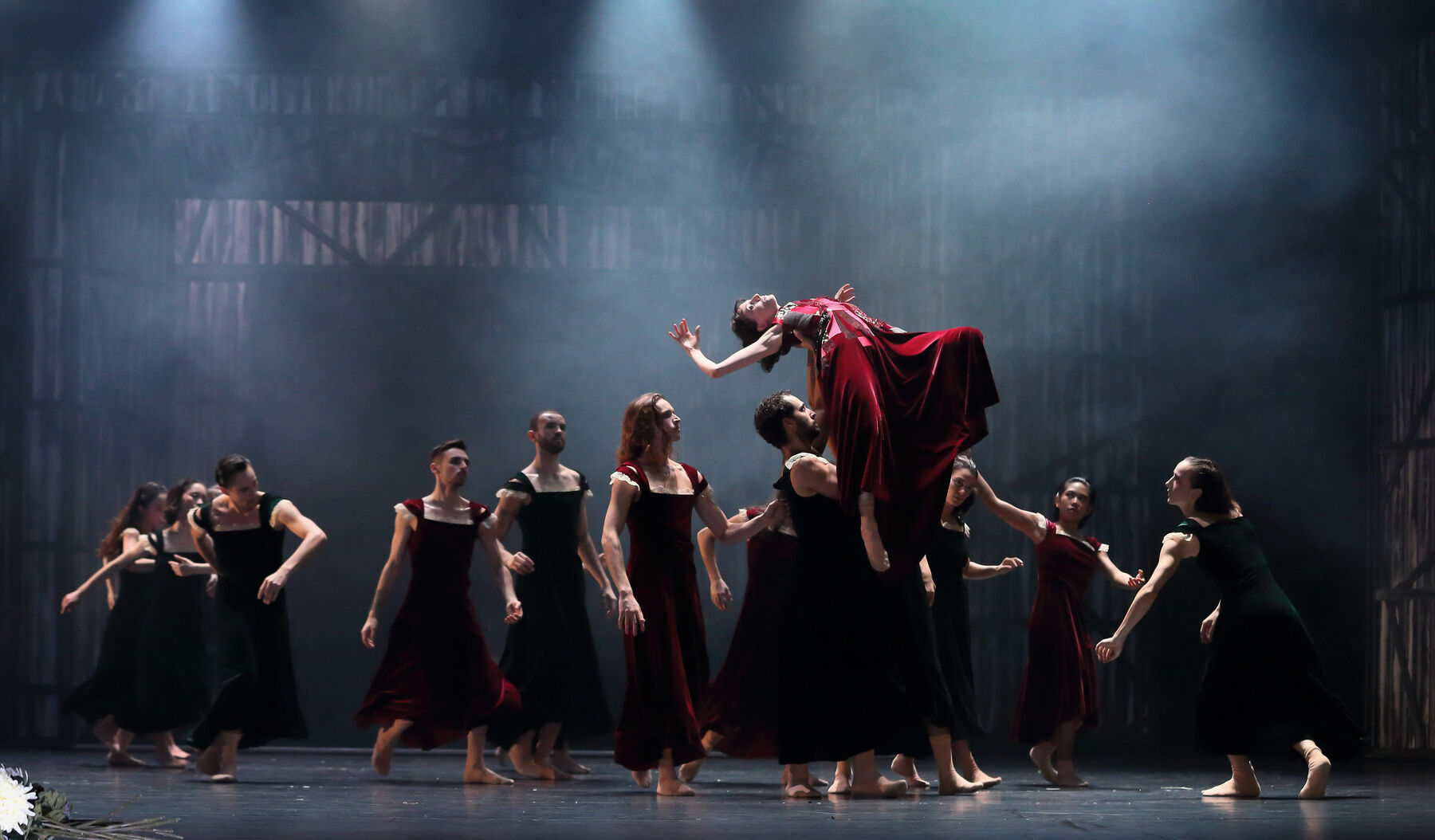
Isabella Pirondi (Bathilde/Myrtha) in Staatstheater am Gärtnerplatz’s Giselle. Photo: Marie-Laure Briane
Giselle (June 27)
The dancing itself reflected the production’s determination to move away from classical idealisation. Karl Alfred Schreiner’s choreography replaced much of the ballet’s academic vocabulary with grounded, almost ritualistic movement that emphasised collective psychology over technical display. The village scenes were animated by folk-inspired gestures, while the Wilis moved with a stark, almost expressionist severity that reinforced their status as manifestations of guilt rather than supernatural maidens. Heiko Pfützner’s barn setting and Talbot Runhof’s earthy costumes effectively created an insular Alpine community whose hostility towards outsiders became a dramatic force in itself, even if the suppression of some of the ballet’s most celebrated dances inevitably diminished the work’s poetic and choreographic richness.

Andreja Zidaric (Angèle Didier) in Staatstheater am Gärtnerplatz’s Der Graf von Luxemburg.
Photo: Anna Schnauss
Der Graf von Luxemburg (June 28)
Vocally, the production maintained an admirable balance between operatic polish and the conversational ease that operetta demands. The ensemble sang with clarity of diction and unfailing style, allowing Lehár’s melodies to bloom naturally without excessive sentimentality. The staging embraced movement and dance with infectious energy, particularly in the scenes set at Le Chat Noir, where lively choreography and bustling stage business captured the intoxicating glamour of Parisian nightlife. The result was an operetta that never stood still, its elegance and effervescence perfectly matching the score’s irresistible charm.

Norbert Ernst (Butler), Sophie Rennert (Claire Zachanassian) & Angelo Konzett (Panther Puppeteer) in Staatstheater am Gärtnerplatz’s Der Besuch der alten Dame. Photo: Markus Tordik
Der Besuch der alten Dame (July 3)
Although Gottfried von Einem’s score rarely invites vocal display for its own sake, the cast met its considerable demands with impressive dramatic commitment. The singers approached their roles as genuine singing actors, shaping the text with exceptional clarity while navigating the score’s abrupt shifts between lyricism and violence. Nikolaus Habjan’s staging was equally remarkable. The use of the marionette as Claire’s monstrous double was not merely a theatrical curiosity but the central metaphor of the evening, lending the production an unsettling visual poetry. The gradual transformation of the townspeople into puppet-like figures and the increasingly dominant use of red created an atmosphere of inexorable moral decay that proved as eloquent as the music itself.
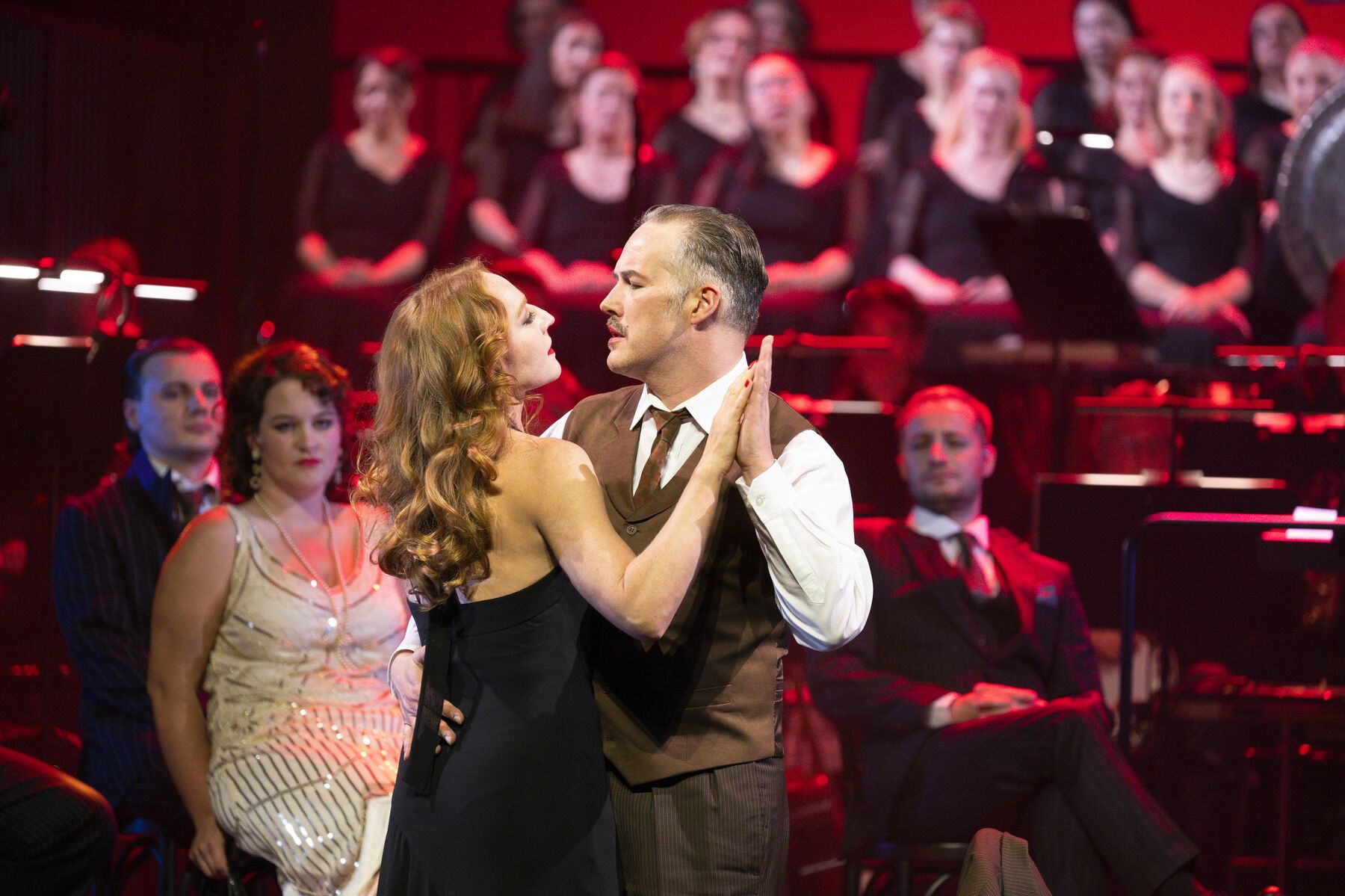
Brigitte Hobmeier (Spelunken-Jenny) & Daniel Prohaska (Macheath) in Staatstheater am Gärtnerplatz’s Die Dreigroschenoper. Photo: Anna Schnauss
Die Dreigroschenoper (July 4)
Musically, the cast displayed precisely the stylistic flexibility that Weill’s score requires, moving effortlessly between cabaret idiom and operatic projection while delivering Brecht’s text with exemplary clarity. The evening also benefited from surprisingly effective movement direction. Despite the concert format, the performers interacted with remarkable fluidity, and the occasional choreography—most memorably in the Kanonen-Song—added sharp theatrical definition without compromising the work’s alienating intent. The semi-staged presentation proved that elaborate scenery is hardly necessary when a cast possesses sufficient dramatic imagination and physical presence to conjure an entire world through gesture, movement and song.

Alexander Hille (Albert), Luca Seixas (Hilarion) & Amelie Lambrichts (Giselle) in Staatstheater am Gärtnerplatz’s Giselle. Photo: Marie-Laure Briane
Such ambition would count for little without an ensemble capable of traversing these vastly different idioms. Yet the company’s resident artists repeatedly reveal exceptional versatility, moving effortlessly between operetta, modern opera, musical theatre and Brechtian cabaret. Familiar faces reappear from one production to the next in entirely different dramatic and vocal worlds, creating the increasingly rare impression of a genuine repertory company rather than a succession of guest appearances. The musical leadership is equally dependable, consistently revealing stylistic understanding while extracting performances of refinement from an orchestra operating on far more modest resources than Munich’s larger institutions.
Perhaps most impressive of all is the Gärtnerplatz’s ability to accomplish so much with comparatively limited means. Intelligent staging repeatedly substitutes imagination for lavish expenditure, proving that theatrical vitality need not depend upon extravagant budgets. Rather than masking financial realities, the theatre transforms them into artistic virtues, favouring concentration, ensemble playing and interpretative coherence over spectacle.
In an era when many opera houses increasingly gravitate towards predictable repertory, celebrity casting and expensive visual excess, the Staatstheater am Gärtnerplatz offers a refreshing alternative. It has become not merely Munich’s “second” opera house but one of the city’s most indispensable cultural institutions: adventurous in repertoire, intellectually curious in interpretation, consistently entertaining without sacrificing artistic seriousness, and a compelling reminder that genuine theatrical excellence is measured not by scale, but by imagination.
For more on the Staatstheater am Gärtnerplatz season visit www.gaertnerplatztheater.de/en/start/index.html