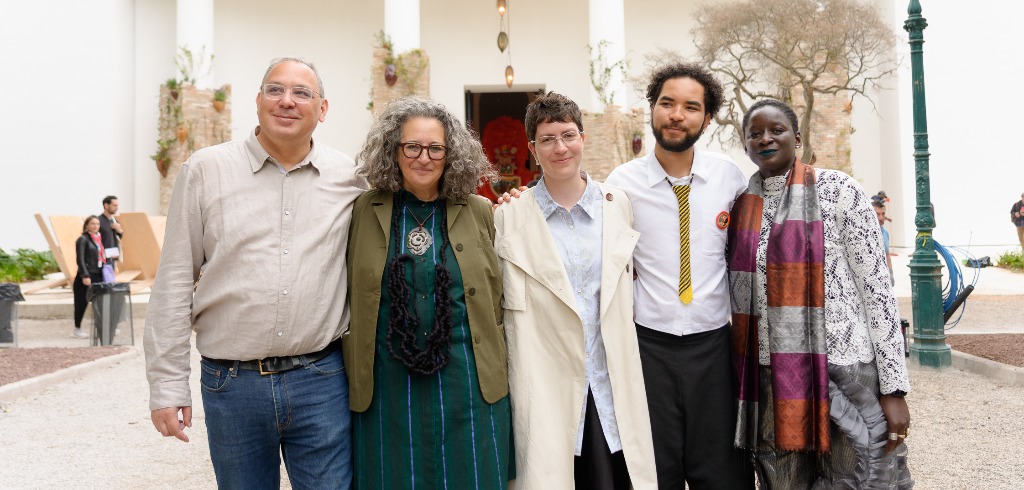
The 61st Venice Biennale opened this week under the shadow of absence. The South African curator Koyo Kouoh, who conceived In Minor Keys before her untimely death earlier this year, never saw the exhibition unfold. Yet her presence remained palpable throughout the preview days. It was felt not only in the many enthralling works her collaborators Rasha Salti, Gabe Beckhurst Feijoo, Marie Hélène Pereira, Rory Tsapayi, and Siddhartha Mitter—carried through to realization with remarkable fidelity—but also in the atmosphere of attentiveness and emotional density that seemed to structure the exhibition itself. Many have described this Biennale as chaotic, and amid the political upheaval it undeniably was, but somehow that too felt inseparable from Kouoh’s vision: a Biennale conceived less as a triumphal spectacle than as a moment of truth, vulnerability, and reckoning.
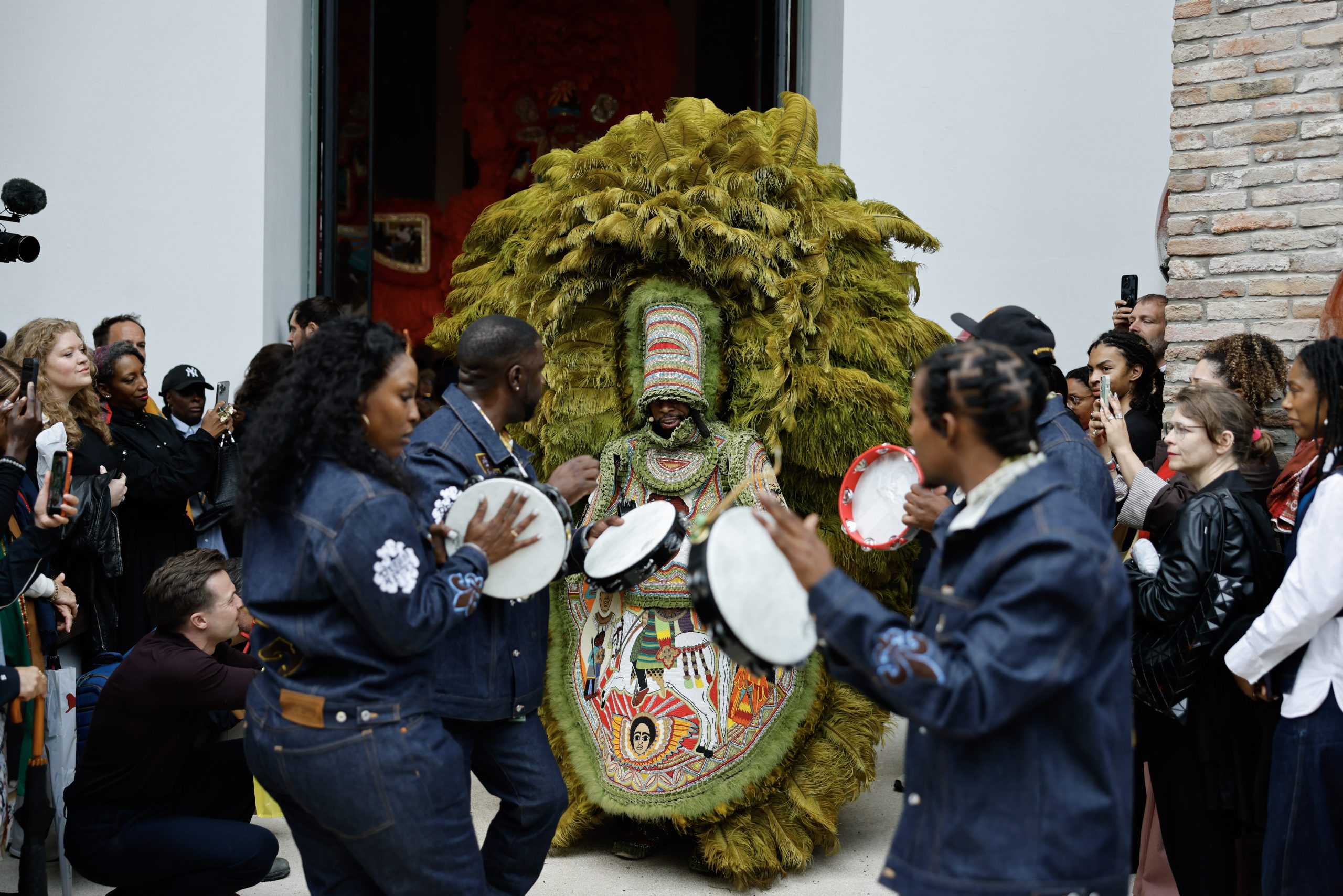
Big Chief Demond Melancon. Photo: Jacopo Salvi
Even before the official opening, the international jury resigned, refusing to evaluate pavilions representing states whose leaders are subject to International Criminal Court warrants. Predictably, protests against Israel’s presence were organized in part by the Art Not Genocide Alliance, while other demonstrations, including a performance by Pussy Riot, targeted Russia’s return to the Biennale amid its ongoing war against Ukraine. Posters denouncing “art washing” appeared across Venice.
Against this backdrop, the historical structure of the Biennale itself appeared increasingly fragile. The Giardini still organizes nations according to twentieth-century geopolitical hierarchies that no longer reflect the actual geography of contemporary artistic production. More than in previous editions, the national pavilion system felt exhausted—trapped between cultural diplomacy, soft power, artistic ambition, and yes—art washing. Yet within that shaky framework, several national presentations stood out with considerable force.

Lubaina Himid. Photo: Andrea Avezzù
Among the strongest was Lubaina Himid’s British Pavilion, Predicting History: Testing Translation. Himid filled the pavilion with large-scale paintings of staged interiors revolving around labour, domesticity, music, and everyday ritual. Frieze-like compositions depicting sewing, cooking, and ordinary gestures alternated with more enigmatic canvases populated by animals and unsettling textual fragments. Its confidence lay precisely in its refusal to compete for attention.
The Canadian Pavilion, represented by Iranian-born artist Abbas Akhavan in Entre chien et loup, reimagined one of the Biennale’s most discreet buildings, tucked beneath the neoclassical British Pavilion like the obedient colony Canada once was. Through water, plants, reflected light, and sculptural interventions, Akhavan continued his longstanding engagement with gardens, architecture, and political histories embedded within cultivated space.

Yto Barrada. Photo: Jacopo Salvi
Nearby, the French Pavilion—conceived by Yto Barrada under the title Comme Saturne—unfolded through cycles and reprises rather than linear narrative. Despite its conceptual sophistication, the pavilion felt overly hermetic and emotionally distant. What might once have registered as poetic restraint here often drifted toward curatorial mannerism.

Ei Arakawa-Nash. Photo: Luca Zambelli Bais
The Japanese Pavilion, Ei Arakawa-Nash’s Grass Babies, Moon Babies, offered one of the most unexpectedly affecting experiences in the Giardini. Visitors were invited to hold and care for life-size baby dolls, even changing their diapers, prompting reflections on intimacy, care, participation, and national identity.

Florentina Holzinger. Photo: Andrea Avezzù
By contrast, Florentina Holzinger’s Austrian Pavilion became the unavoidable spectacle of preview week. Nude performers moved through an environment of suspended structures, endurance actions, mechanical systems, and bodily exposure. One performer suspended upside down inside a monumental bell quickly became one of the most circulated images of the Biennale. Yet beneath the choreography of provocation, the pavilion often felt like a reheated version of Viennese Actionism; a recycling of strategies of shock and bodily transgression that long ago lost their disruptive force. What once carried genuine political and aesthetic danger now appeared as a dull circus act, void of meaning, despite the constant noise surrounding the pavilion.

Alma Allen. Photo: Jacopo Salvi
The United States Pavilion, however, became emblematic of the tensions surrounding cultural representation and soft power. Its presentation by sculptor Alma Allen—virtually unknown internationally —struck many observers as politically cautious and aesthetically conservative. Allen’s gilded bronzes, hovering uncertainly between abstraction and figuration, seemed designed less for critical engagement than for institutional decorum.
If the Giardini established the Biennale’s public face, the Arsenale formed its emotional and intellectual center.
Kouoh’s curatorial approach benefited enormously from the scale of the Arsenale, whose vast industrial halls were occupied in a scenographic yet restrained manner. Monumental works emerged gradually through darkness, sound bleed, pauses, and shifting sightlines. It was never a question of filling the architecture with oversized gestures, but rather of allowing relationships between works to unfold through atmosphere and duration.
Two ideas quietly structured the exhibition. First was a deliberate decentering of the Atlantic world: Latin America, Africa, and the Middle East occupied a central place within the exhibition’s geography, challenging the dominance of Western commercial systems. Second was the fluid arrangement of the works themselves. Despite major differences in medium and subject matter, the transitions between installations felt remarkably organic, producing a sense of harmonic diversity rather than fragmentation.
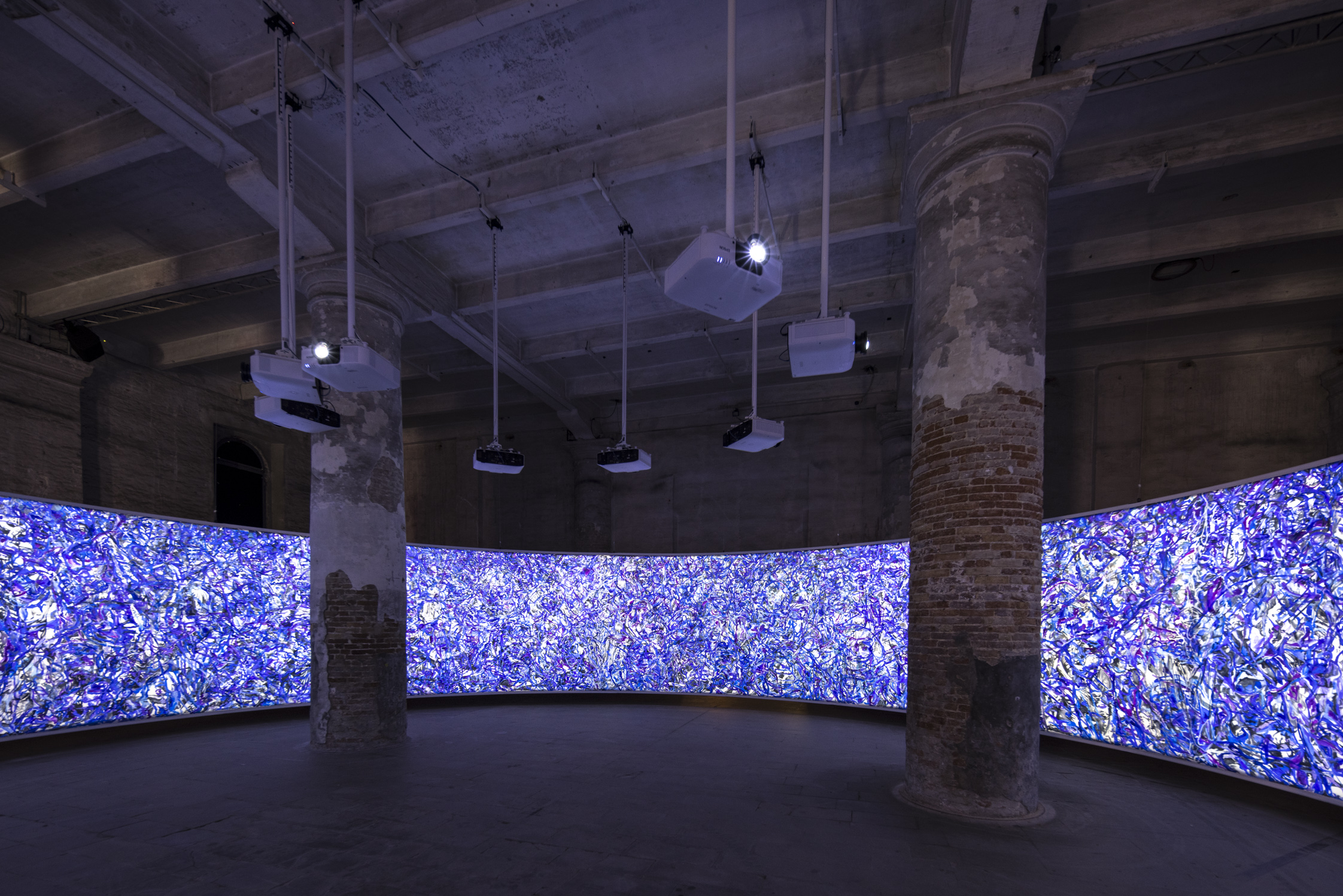
Khaled Sabsabi. Photo: Marco Zorzanello
The opening installation, Khaled Sabsabi’s khalil, meaning “friend” in Arabic, invited viewers into a sensory environment of projected images and sound organized along a circular path. Drawing on Sufi philosophy, Sabsabi explored collectivity and the relationship between inner and outer experience.
American artist Nick Cave presented no fewer than seven works unfolding across both the Arsenale and the Venetian waterfront. Addressing grief, mourning, rebirth, and radical connection, the works extended Cave’s longstanding Soundsuit vocabulary, fusing body and nature through gramophone hoods, birds, and blooming florals that transformed voice into both resistance and celebration. Conceived in dialogue with Kouoh before her death, the presentation honoured forms of creativity capable of sustaining beauty and community amid historical collapse.
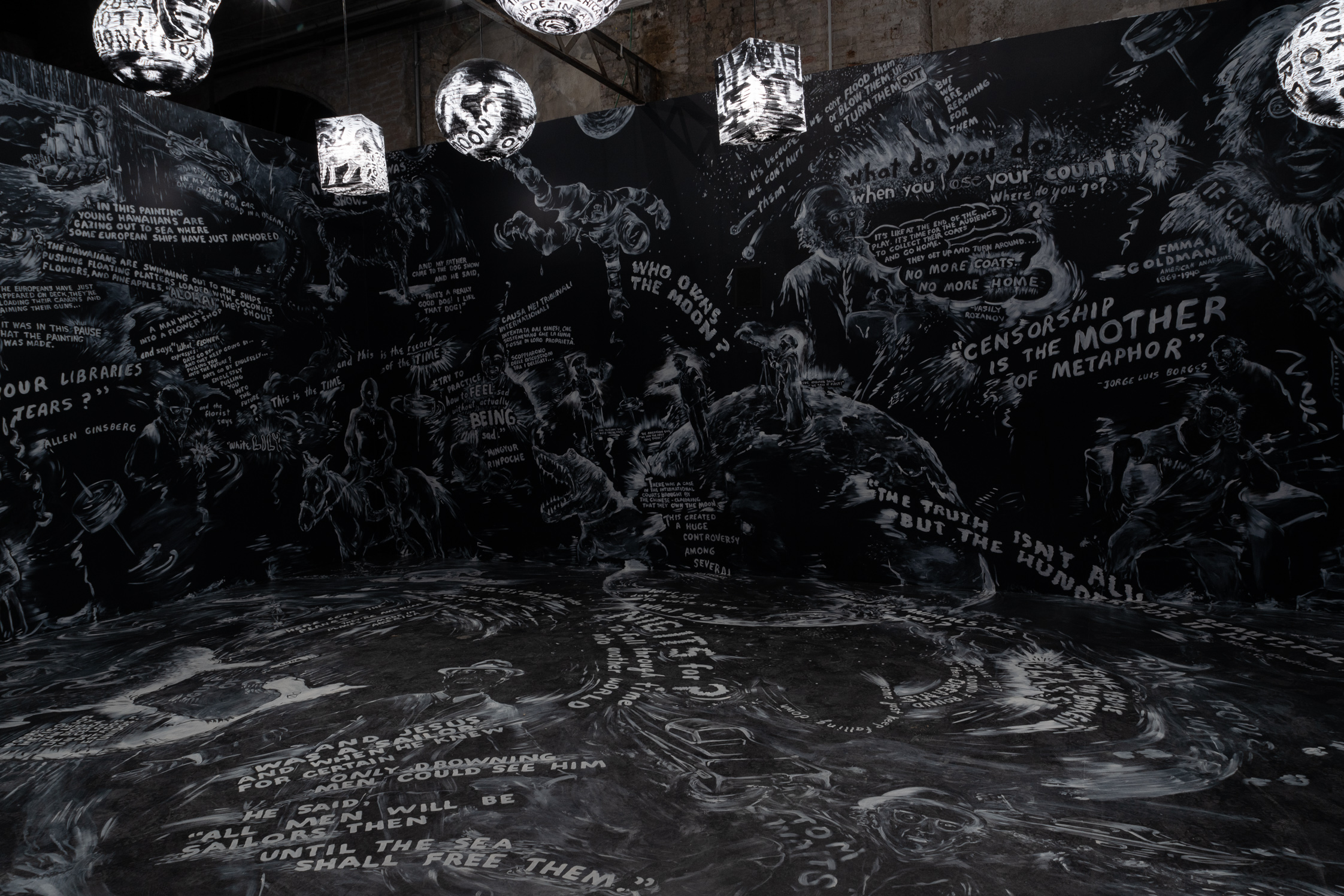
Laurie Anderson. Photo: Luca Zambelli Bais
Laurie Anderson—whose presence gave the Biennale one of its strongest connections to experimental music, spoken word, and performance—transformed an entire room into a dark subterranean environment animated by sound, projected language, drawings, and fragments of text hastily scrawled across the walls and floor in white. Mixing political satire, personal reflection, dystopian humour, and poetic observation, the installation functioned like an immersive stream of consciousness, surrounding viewers with a continuous flow of voices and thoughts.
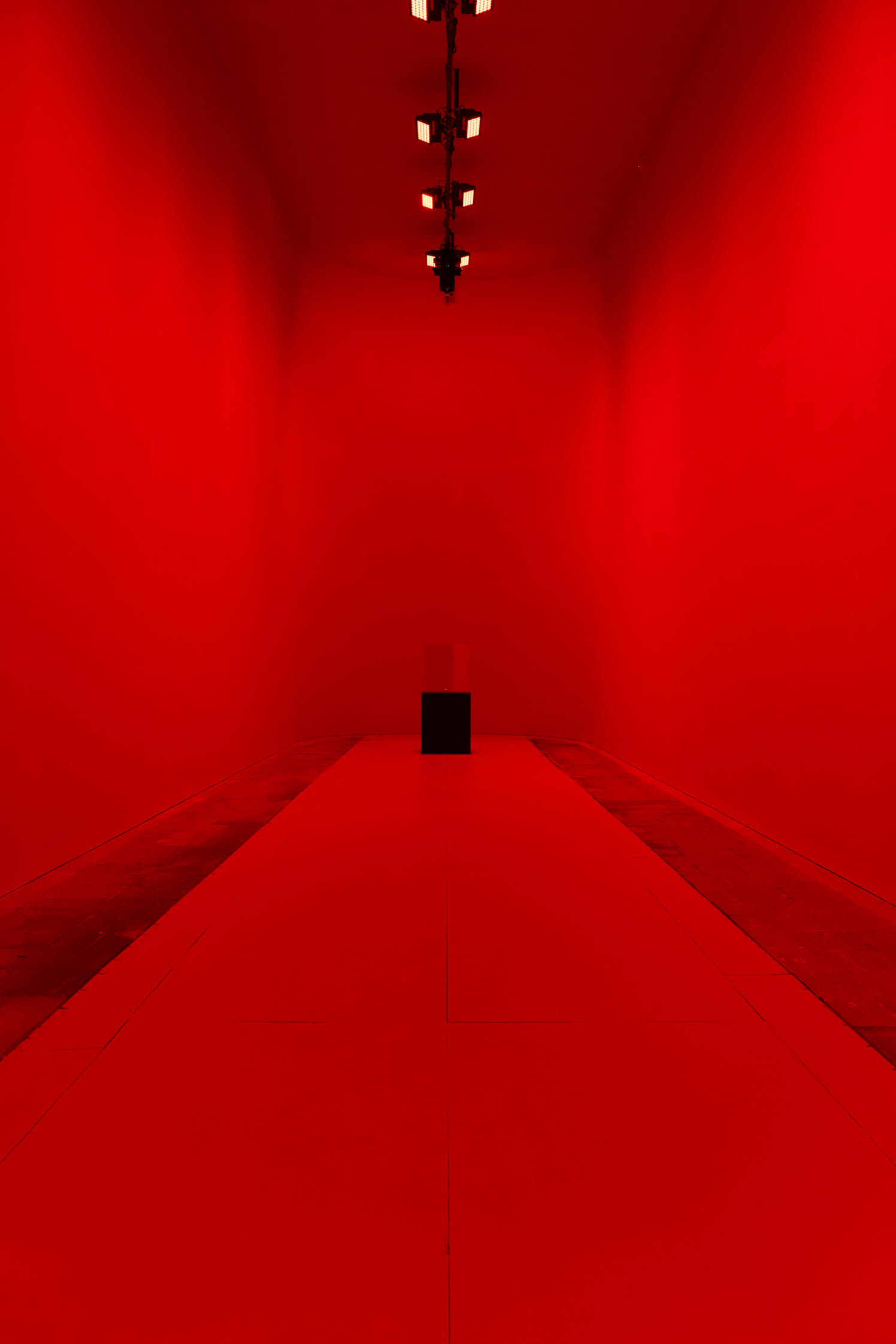
Alfredo Jaar. Photo: Luca Zambelli Bais
Alfredo Jaar contributed one of the Arsenale’s most subtle political works. Through light, text, and carefully controlled architecture, Jaar centered his installation around a tiny cube composed of cobalt, lithium, coltan, rare earths, copper, platinum, and other strategic minerals essential to contemporary digital technologies. The work exposed the hidden infrastructures of extraction and exploitation underlying the supposedly immaterial world of high technology.
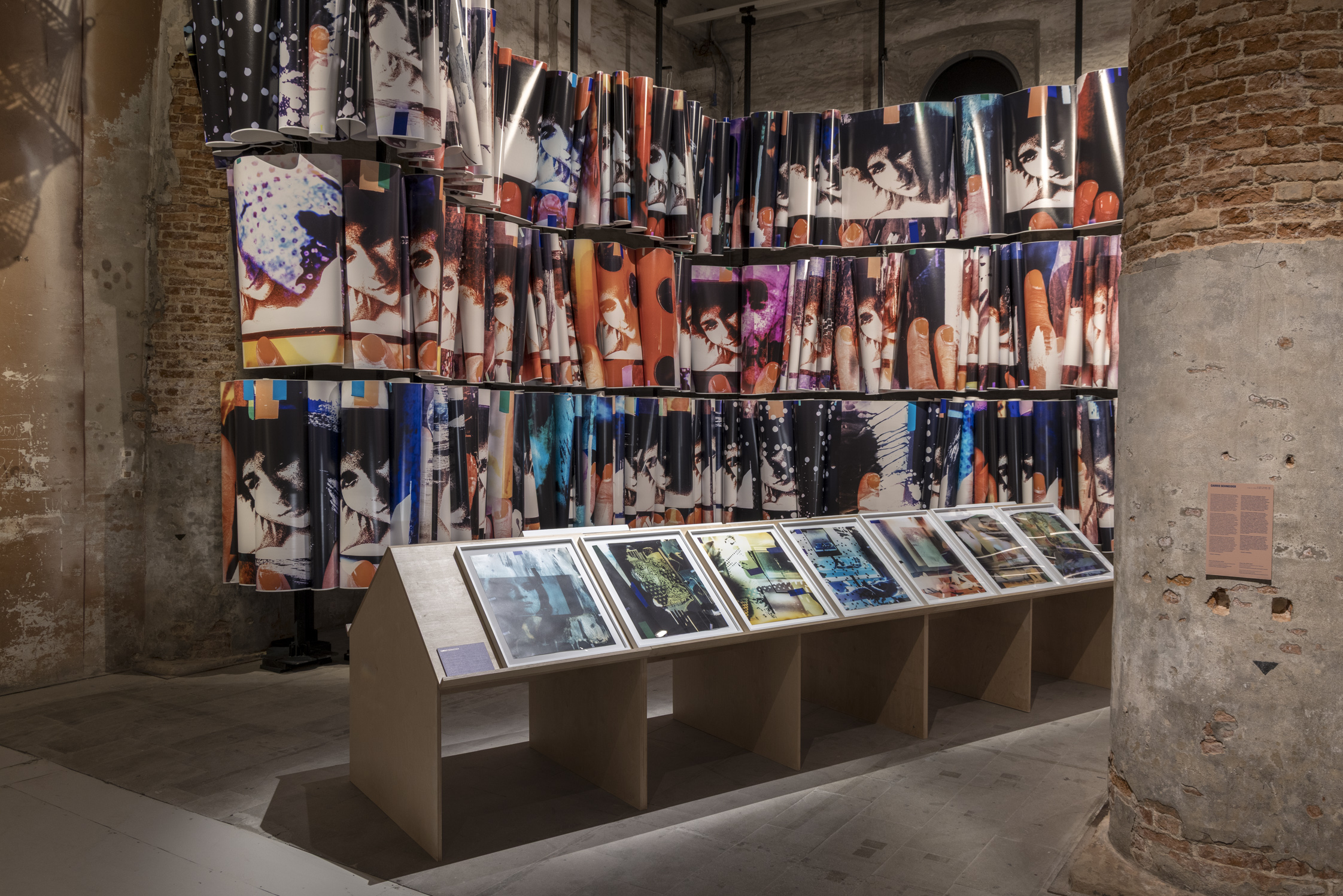
Carrie Schneider. Photo: Marco Zorzanello
Carrie Schneider transformed repetition into duration through a vast photographic installation derived from Chris Marker’s La Jetée (1962). Stretching along the elongated architecture of the Arsenale, the repeated images gradually altered viewers’ perception of time and memory.
Elsewhere in Venice, collateral and independent exhibitions frequently rivaled the official Biennale in ambition and intensity.
One of the strongest, the South African artist Gabrielle Goliath, was banned from participating before the Biennale even opened. The reason being that the South African culture minister Gayton McKenzie considered her piece Elegy—a tribute to the Palestinian poet Hiba Abu Nada, who was killed in an Israeli airstrike in Gaza in October 2023— to be “highly divisive.” In spite of efforts to silence her, Goliath’s piece was shown close to the Biennale and to great effect at the Chiesa di Sant’Antonin. Staged there within a sacred architectural setting, Elegy’s sustained vocal lament resonated deeply and its messages of memory, death, and communal conscience reached an even wider audience.
Marina Abramović’s exhibition Transforming Energy at the Gallerie dell’Accademia di Venezia is a rare and powerful encounter between contemporary performance art and the weight of Venetian history. Her presence transforms the museum into a space of profound emotional intensity, where silence, memory, and the human body acquire an almost sacred dimension.
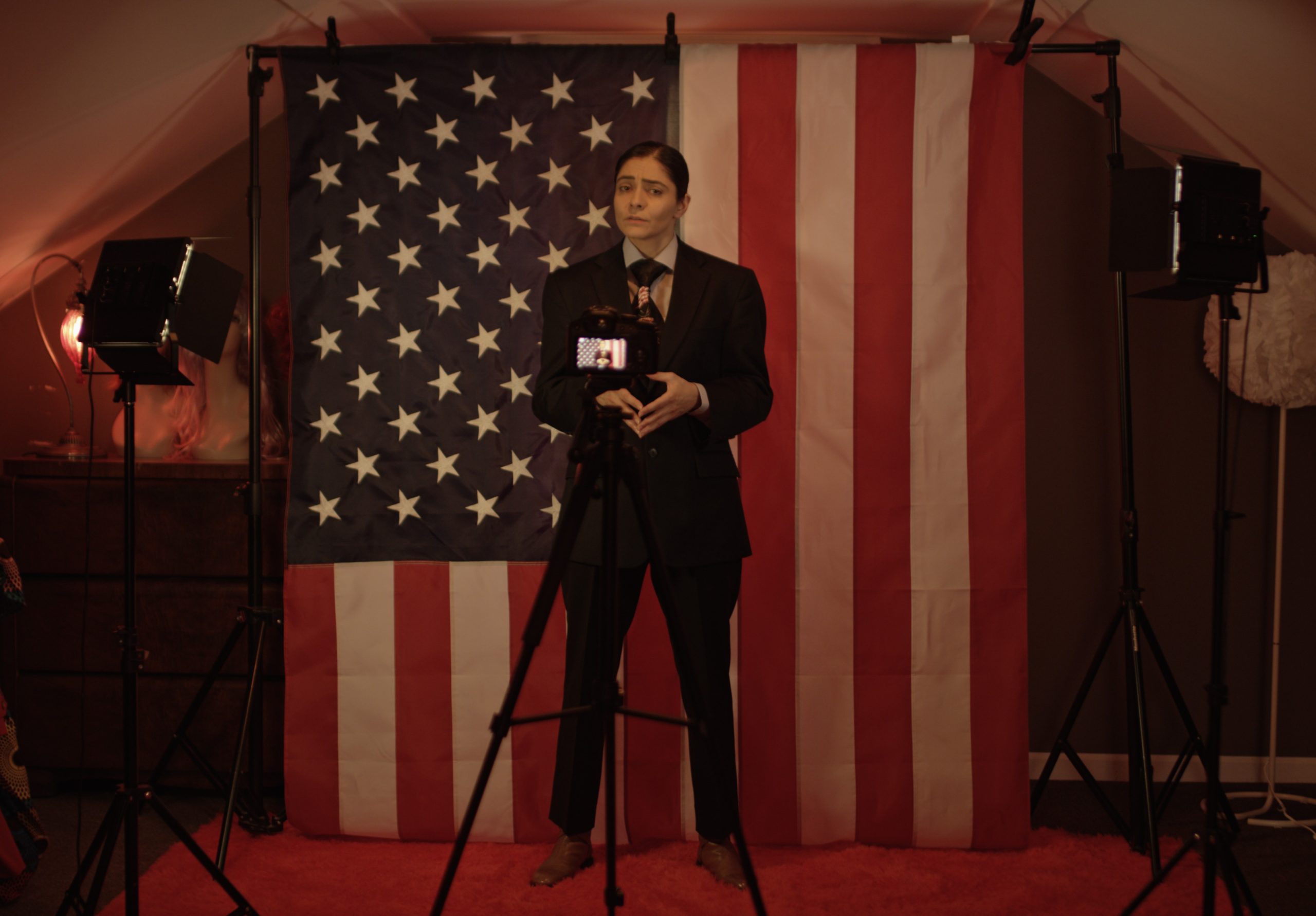
Shirin Neshat. Photo: Courtesy of the artist, Gladstone, and Lia Rumma Gallery, Milan/Naples
Shirin Neshat’s Do U Dare! at Palazzo Marin in Venice is a three-part film installation exploring exile, female identity, surveillance, and the emotional violence of contemporary media culture. While one strand of the work draws on the tragic story of Nasim Aghdam, the project more broadly reflects on alienation, self-performance, and the fragile psychological condition of individuals caught between cultures, technologies, and systems of power.
At the Fondazione Giorgio Cini on San Giorgio Maggiore, the exhibition dedicated to Georg Baselitz acquired an unavoidable elegiac dimension following the artist’s death only days before the Biennale opened. Recent paintings and sculptures reaffirmed the physical force and material scale that have defined Baselitz’s work for decades.
Erwin Wurm’s exhibition at Palazzo Fortuny, proved among the strongest collateral events in Venice. His absurd clothing sculptures unfolded with unexpected elegance through Mariano Fortuny’s dense interiors of textiles and design, balancing humor and formal precision with remarkable intelligence.
At Ca’ Tron, the installation conceived by Ilya and Emilia Kabakov assembled ordinary objects loaned by Venetians and longtime residents of the city, each accompanied by written reflections. The project extended the Kabakovs’ enduring attention to memory and the emotional residue attached to everyday things.
Beautiful independent projects such as Paradiso: abitare a Venezia at Palazzo Molin Querini, curated by Caroline Corbetta, bring together artists, architects, writers, and local initiatives. The exhibition focused on the increasingly precarious conditions of living and working in Venice itself. During Biennale week—when the city becomes temporarily overwhelmed by the international art world—Paradiso redirected attention toward Venice as a lived environment rather than a cultural backdrop. Another, Outta Love, at Palazzo Vendramin ai Carmini, presented by Stallmann Galerie, offered a glimpse of stars and lesser-known artists such as Daniel Spivakov and Miko Pavlov alongside Jenny Saville, Wolfgang Tillmans, Lawrence Weiner, and others; works carefully gleaned through the brilliant eye of Lina Stallmann.
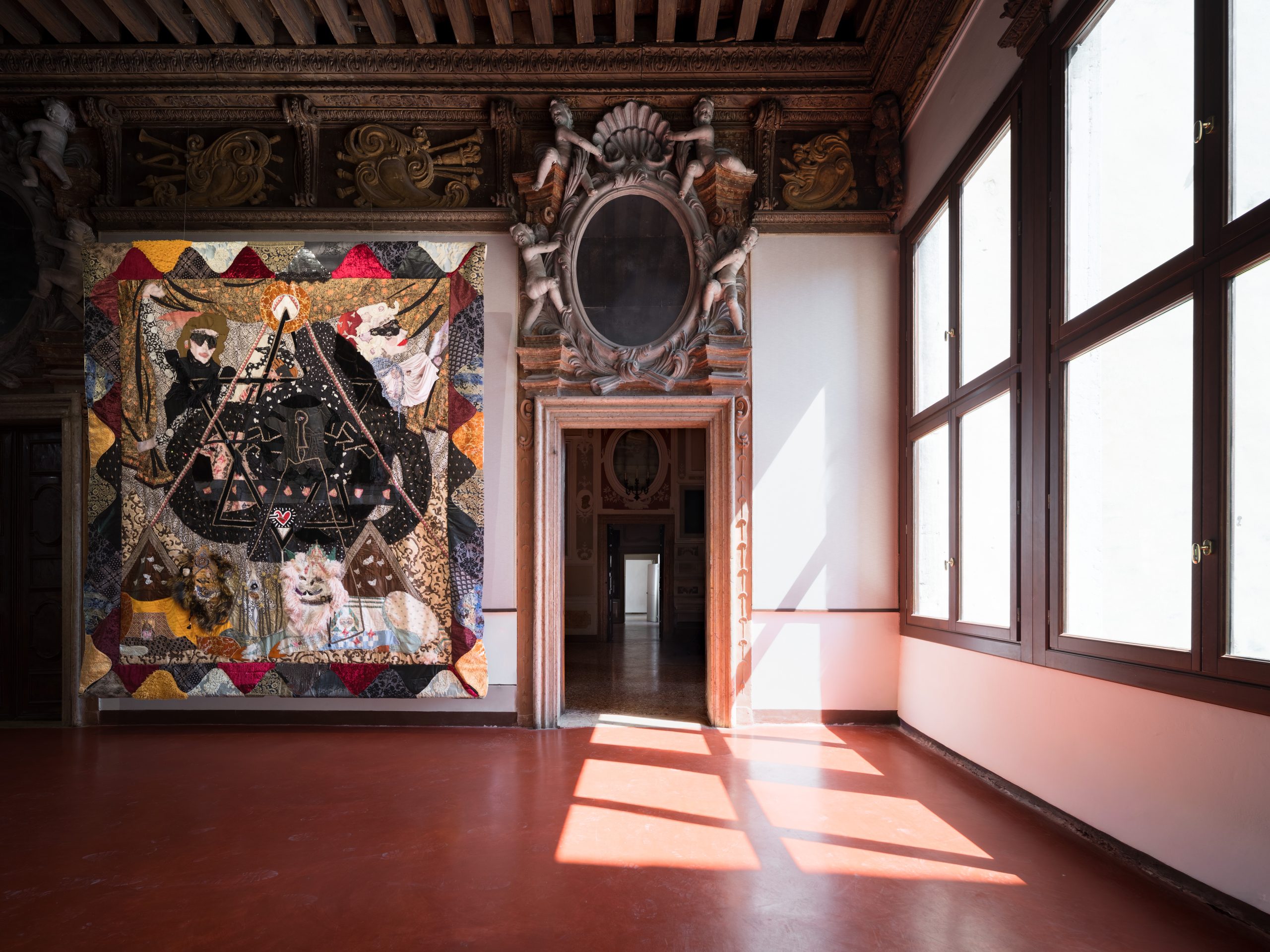
Outta Love. Photo: Ugo Carmeni
The contrast between Kouoh’s international exhibition and the national pavilions remained striking throughout the week. While In Minor Keys functioned as a regenerative and deeply relational exhibition, many pavilions seemed trapped within the logic of national branding and cultural diplomacy, revealing the growing disconnect between contemporary artistic circulation and the Biennale’s inherited geopolitical structure.
And yet even this tension ultimately reinforced the significance of Kouoh’s achievement. Her Biennale neither denied crisis nor surrendered entirely to it. She frequently quoted Toni Morrison’s remark: “You can’t constantly hold onto the crisis. You need love, you need magic.” That principle became palpable throughout the exhibition.
By the end of the May 6–11 preview week, the 61st Venice Biennale had established itself not as an exhibition of singular masterpieces or market sensations, but as a rare attempt to reimagine what a large-scale international exhibition might still become. Its authority emerged not through spectacle, but through attention.
In a contemporary art world increasingly dominated by speed, noise, branding, and excess, Koyo Kouoh trusted slowness. That decision gave the Biennale its extraordinary emotional force.
For more on this year’s Venice Biennale, visit www.labiennale.org/en