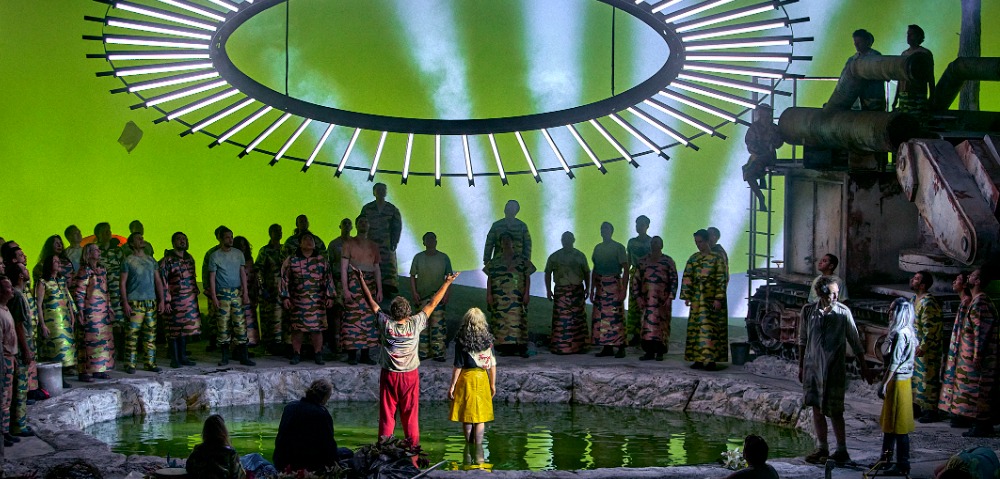
American theatre director Jay Scheib’s 2023 production of Wagner’s Parsifal received its third revival at this summer’s Bayreuth Festival (seen Aug. 17). It originally made headlines for its extensive use of AR, the pluses and minuses of which I evaluated when I saw it at last year’s festival.
In this regard, not much has changed this year given the strictures of the technology. Anecdotally, it seemed even less audience members elected to wear the somewhat heavy, and hot, AR glasses. I spoke with several people who tried using them in past years, and found it too uncomfortable, especially in typically hot, humid Bayreuth summer weather. I found the darkening effect of the glasses to be even more alienating than in 2024, perhaps because the novelty of the AR imagery had worn off.
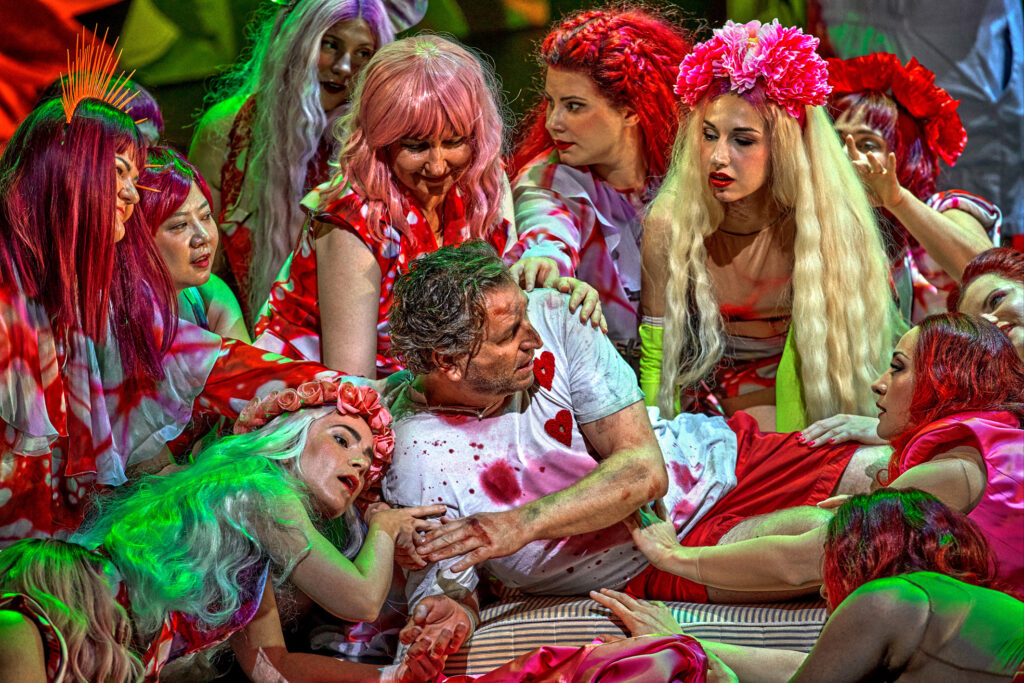
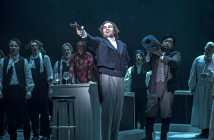
Andreas Schager in the title role of Bayreuth Festival’s Parsifal. Photo: Enrico Nawrath
The program book enthusiastically talks about how “the audience becomes part of the augmented environment, [finding]itself in the state of weightlessness.” But don’t we attend live opera in order to experience a visceral connection, grounded in what is happening on the stage? The dark scrim introduced by the glasses may invoke weightlessness, but also excises one of the main reasons for watching Parsifal live rather than on a video screen at home.
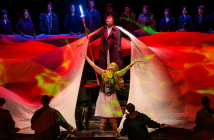
The augmented reality images themselves—flying spears, leaping wounded rabbits, ‘sexy’ winking women—certainly add a level of visual excitement, but to what end? And here, the audience not only has AR to distract them, but also, much of the action is being livestreamed onto a huge upstage screen. Ultimately, the eye can only handle so much, and the serious ruminations on faith, misogyny, group think, enlightenment and suffering that Parsifal can engender take a back seat.
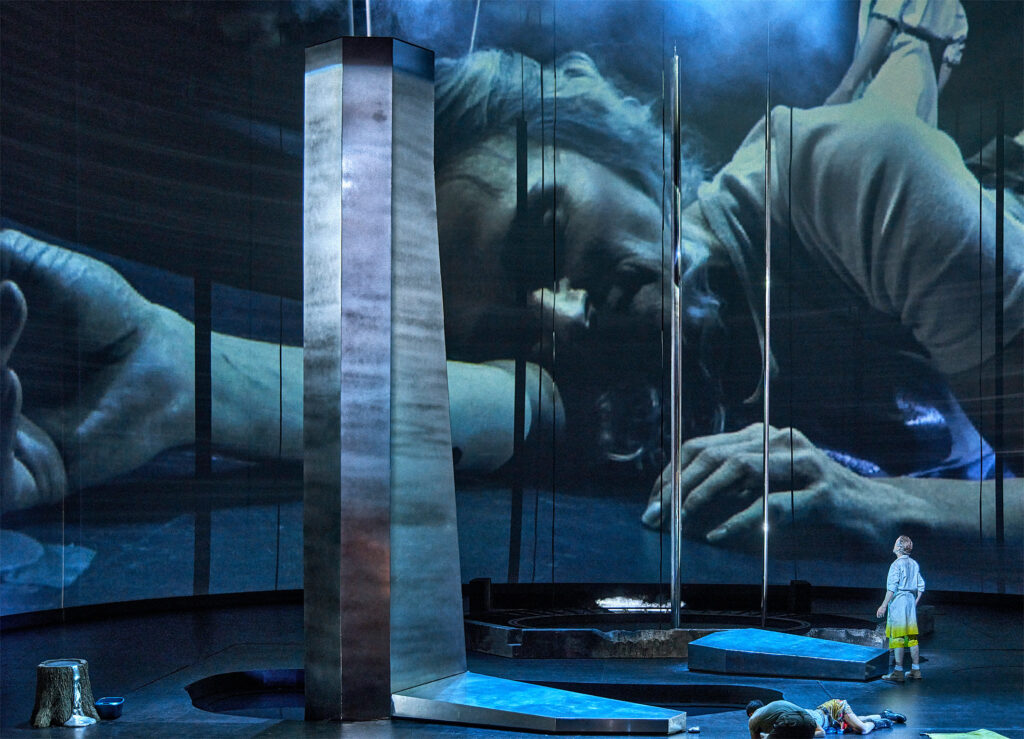
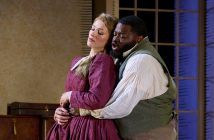
Scene from Bayreuth Festival’s Parsifal. Photo: Enrico Nawrath
If you elect to focus on just the stage action by removing your glasses, this is a relatively straightforward telling of the story. One significant addition is the silent figure of Parsifal’s mother who acts as a sort of double for Kundry, often mirroring her placement, and even, her costuming. This makes some sense, given that it is the sorceress who reveals to Parsifal his mother’s identity in Act 2. The mother is ever watchful throughout, reminding us that as Kundry recounts, she loved her son deeply and died from heartbreak when he left home.

Ekaterina Gubanova (Kundry) & Andreas Schager in the title role of Bayreuth Festival’s Parsifal. Photo: Enrico Nawrath
In a random gesture, Guernemanz embraces the mother figure at the opera’s conclusion. It’s difficult to know what this might imply. Did Pasifal’s father not actually die in battle, or is this more symbolic of the general healing of the community? The embrace recalls Guernemanz and Kundry’s enthusiastic lovemaking (projected on the big screen) during the prelude. Each of these encounters feel rather unearned with little to support them in the text or score.
Musically, things were at a high level. In the title role, tenor Andreas Schager delivers a sensitive portrayal. He clearly telegraphs his character’s journey from “pure fool” to enlightened saviour of the Knights of the Grail. Mezzo-soprano Ekaterina Gubanova approached the top of her range very gingerly in the opening of her long Act 2 narrative, but rallied for a spectacular, highly-charged ending.
Günther Groissböck stepped in as Gurnemanz for an ill Georg Zeppenfeld. The Austrian bass has sung the role at Bayreuth in the previous Uwe Eric Laufenberg production, but seemed completely at ease dramatically in the present conception. At times, his top notes emerged with little vibrancy, but overall, this was a compelling portrayal of a grueling, long role.
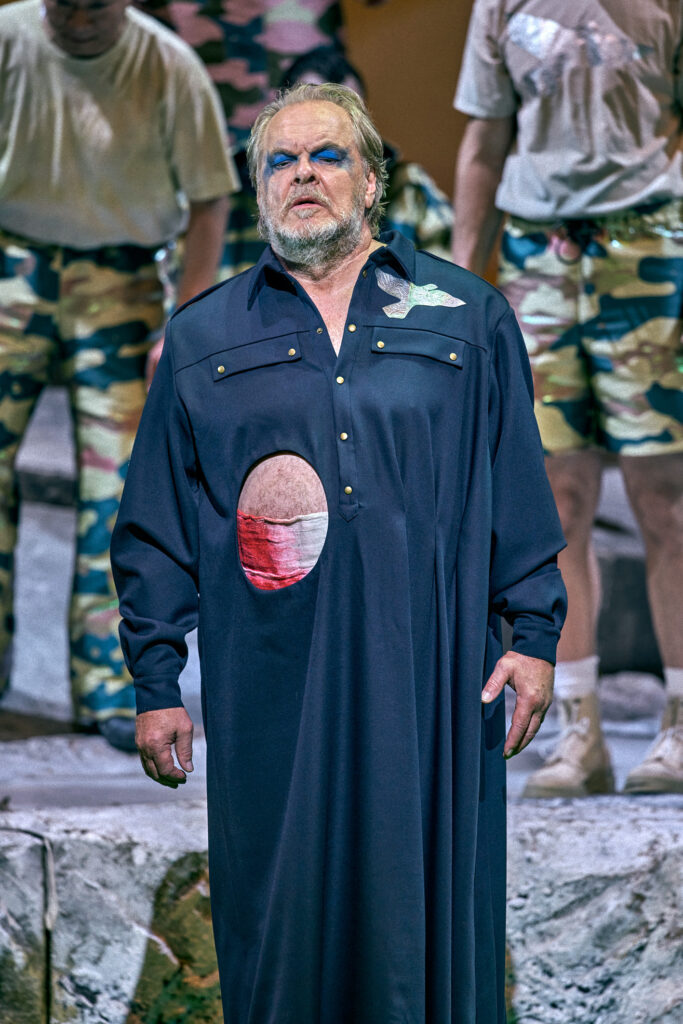
Michael Volle (Amfortas) in Bayreuth Festival’s Parsifal. Photo: Enrico Nawrath
As Amfortas, baritone Michael Volle was a luxury. His opening phrases, as he painfully made his way onto the stage, were sung with Lied-like sensitivity of tone and attention to text. His cries of “Erbarmen!” (Mercy!) contained all of the character’s physical pain, and mental anguish. Baritone Jordan Shanahan sang forcefully as the sorcerer Klingsor, but is saddled with a cliched, camp persona complete with high heels and pelvic thrusts.
The festival chorus under its new director, Thomas Eitler de Lint, were competent but somehow missed that extra frisson that the all-male sections can send through an audience. Staging-wise, a few chorus members offered some very unconvincing resistance to Parsifal as their new leader in Act 3, waving machine guns around rather unthreateningly.
Pablo Heras-Casado led the festival orchestra in a measured but always propulsive performance. The orchestral introduction of the knights was sonically spectacular.
There are two more performances of Parsifal at the 2025 Bayreuth Festival on Aug. 24 & 26. www.bayreuther-festspiele.de