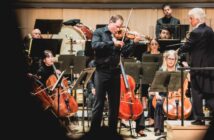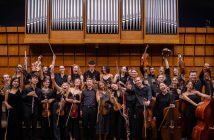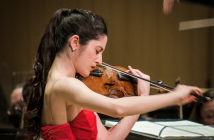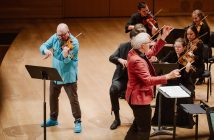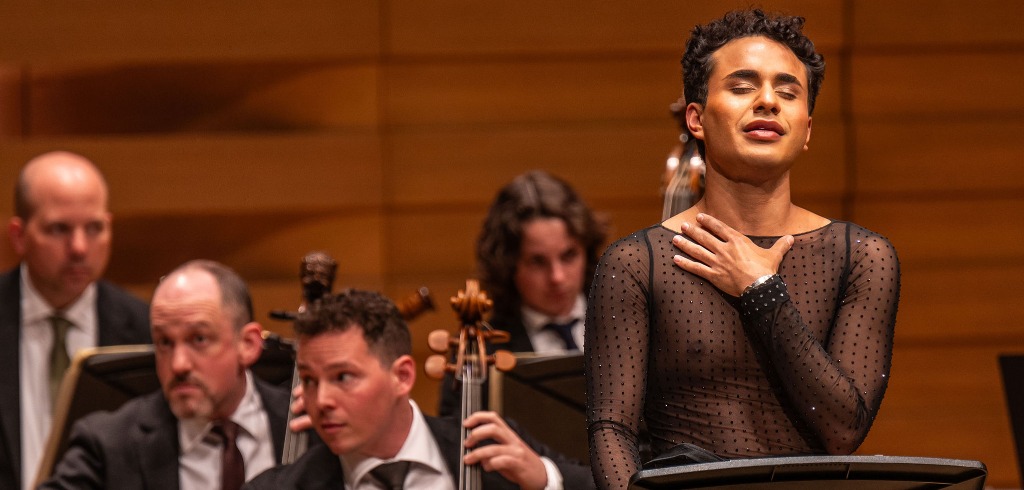
“I want to thank the musicians, and I want to thank you for accepting me for who I am … . When I’m in Canada, I always feel accepted, and free.” Samuel Mariño’s speaking voice is boyish, pure, and ever-so-melodious, and his words went down a storm. But it was his singing that had drawn the audience to the first of his three Koerner Hall concerts alongside the early-music ensemble, Tafelmusik on May 23.
Venezuela-born and now based in Berlin, Mariño has that rarest of voices: the male soprano. As an adolescent his voice never fully broke, making him the object of bullying at school in his hometown of Caracas. Surgery was discussed, but in the end the doctor suggested that the young Samuel should continue singing. Good thinking, Doctor!
As a male soprano or sopranist, Mariño’s timbre is quite different from that of a countertenor, who sings falsetto, and from female sopranos. It is warm and rounded in the lower range, and free-floatingly radiant in the upper, all tinged with a touching vulnerability that helps make his personality so endearing.
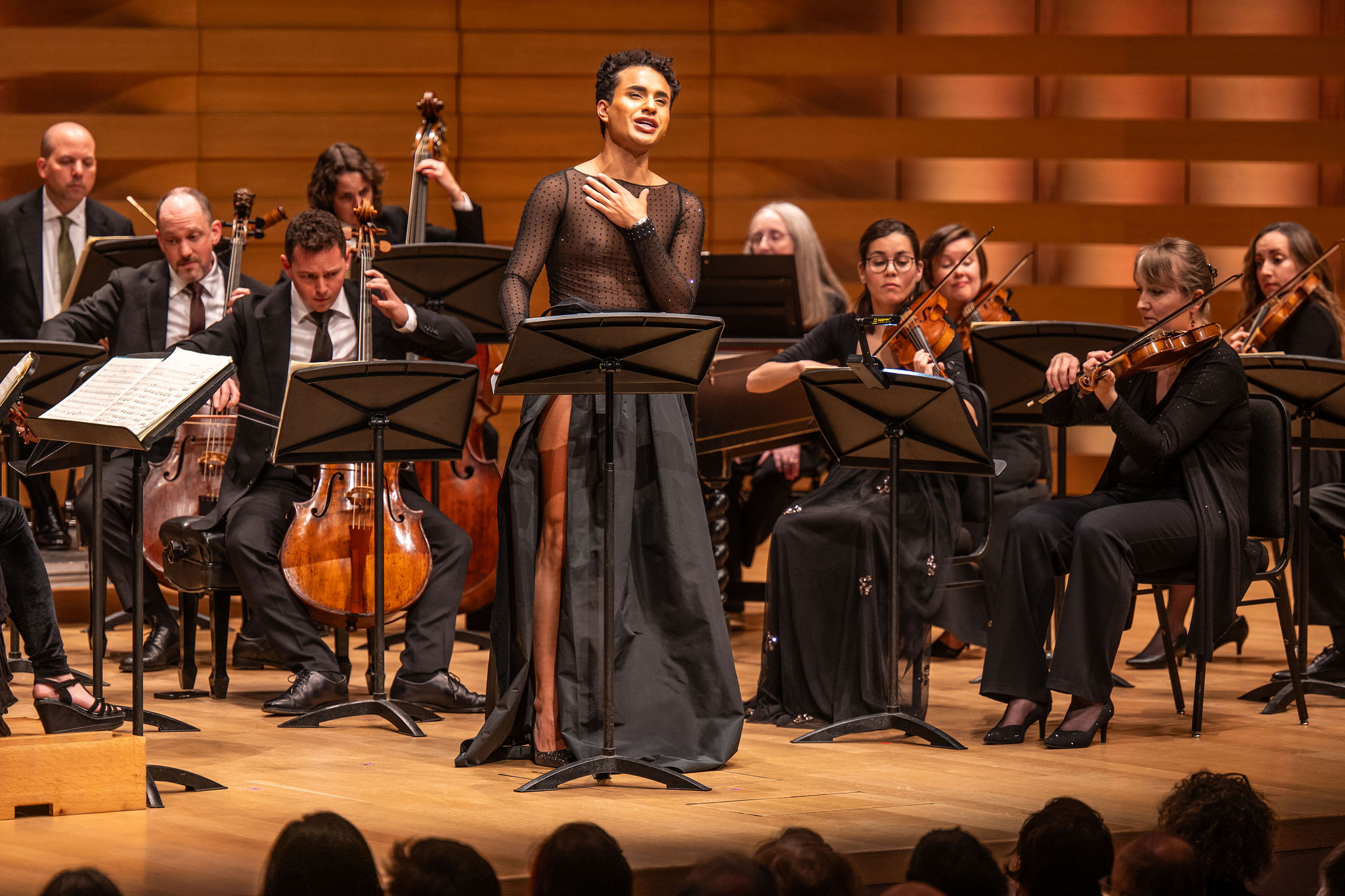
Samuel Mariño with Tafelmusik. Photo: Dahlia Katz
Although his sound may be the closest thing we have to a castrato’s, it‘s not exactly the equivalent of say, what was digitally-created for the 1994 film, Farinelli. Not a ‘musical orgasm’ (to quote the Countess in that film), and not quite the thing that famously made Handel faint during a castrato’s long-held coloratura note. Technically Mariño’s voice may still be work in progress, but it is certainly the gateway to an abundance of joyful and sincere music-making.
Despite his reputation for glamorous fashion, Mariño is surprisingly modest and even self-effacing. Yes, it’s hard to look away from that sheer black top and wrap-around full skirt, with enough high slit to show off his legs, or from the sleek, silky, lilac bolero suit he donned for the second half. And how elegantly he can walk on those vertiginously high heels! But in an almost Bowie-esque way, everything about this gender-defying ensemble seems naturally blended, and the same goes for the relationship between the voice and the exquisite support provided by Tafelmusik.
The program, juxtaposing purely instrumental numbers with extended recitative-aria scenes, included a selection from lesser-known 18th-century figures, including bi-racial and female composers, alongside Mozart, Haydn and Gluck. The whole was designed as an imaginary four-act opera, revolving around the pains and misfortunes of love.
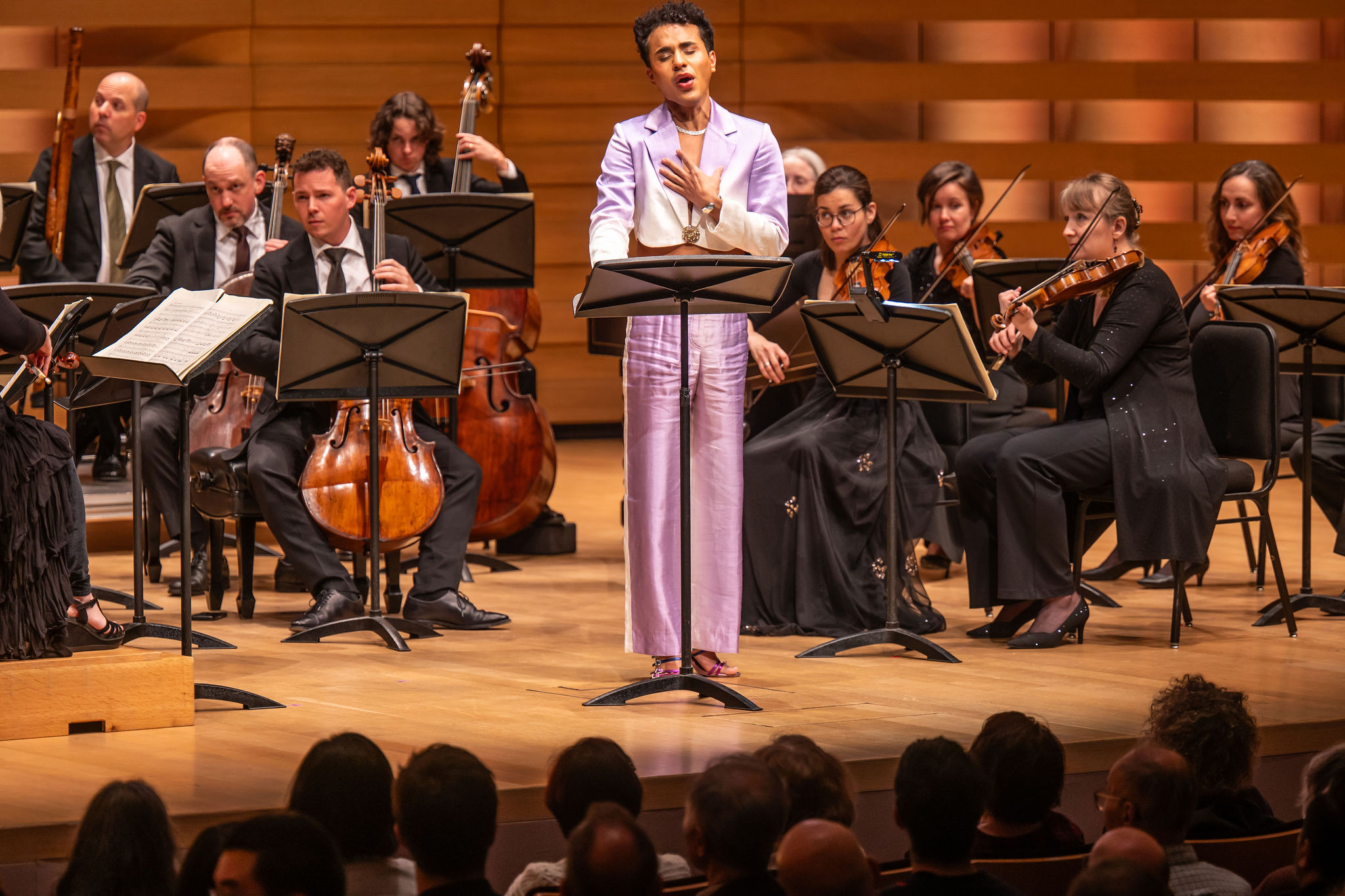
Samuel Mariño with Tafelmusik. Photo: Dahlia Katz
The opening overture from Joseph Bologne’s L’amant anonyme was jovial yet elegant: no complexities to speak of, but brimming with energy in the hands of Tafelmusik, under the live-wire leadership of Julia Wedman. The recitative-aria from the same opera moved between despairing melancholy and defiant fury. Separating these was the slow movement from one of Bologne’s violin concertos, in an arrangement for two violins and orchestra that made it easy to understand why comparisons are drawn between this minority composer and his near-contemporary Mozart, whose Sinfonia concertante seemed to hover in the background.
Two teenage works by Mozart were then interspersed with an Overture by Marianne Martines, one-time piano duet partner of Wolfgang Amadeus: inevitably, her simple, wistful style paled beside a movement from Mozart’s effervescent Symphony No. 10, composed at the age of 14.
Mariño returned for the Contessa’s aria from The Marriage of Figaro—heartfelt throughout, and touchingly withdrawn in the reprise. A delightful aria from Salieri’s Semiramide featuring three woodwind soloists to wrap up the first half. Here Mariño’s melismas and repeated notes sometimes lacked laser-sharp precision (if we take the likes of Cecilia Bartoli and Philippe Jaroussky as the gold standard) but they were still full of character and charm, especially in the dialogues with the bassoon.
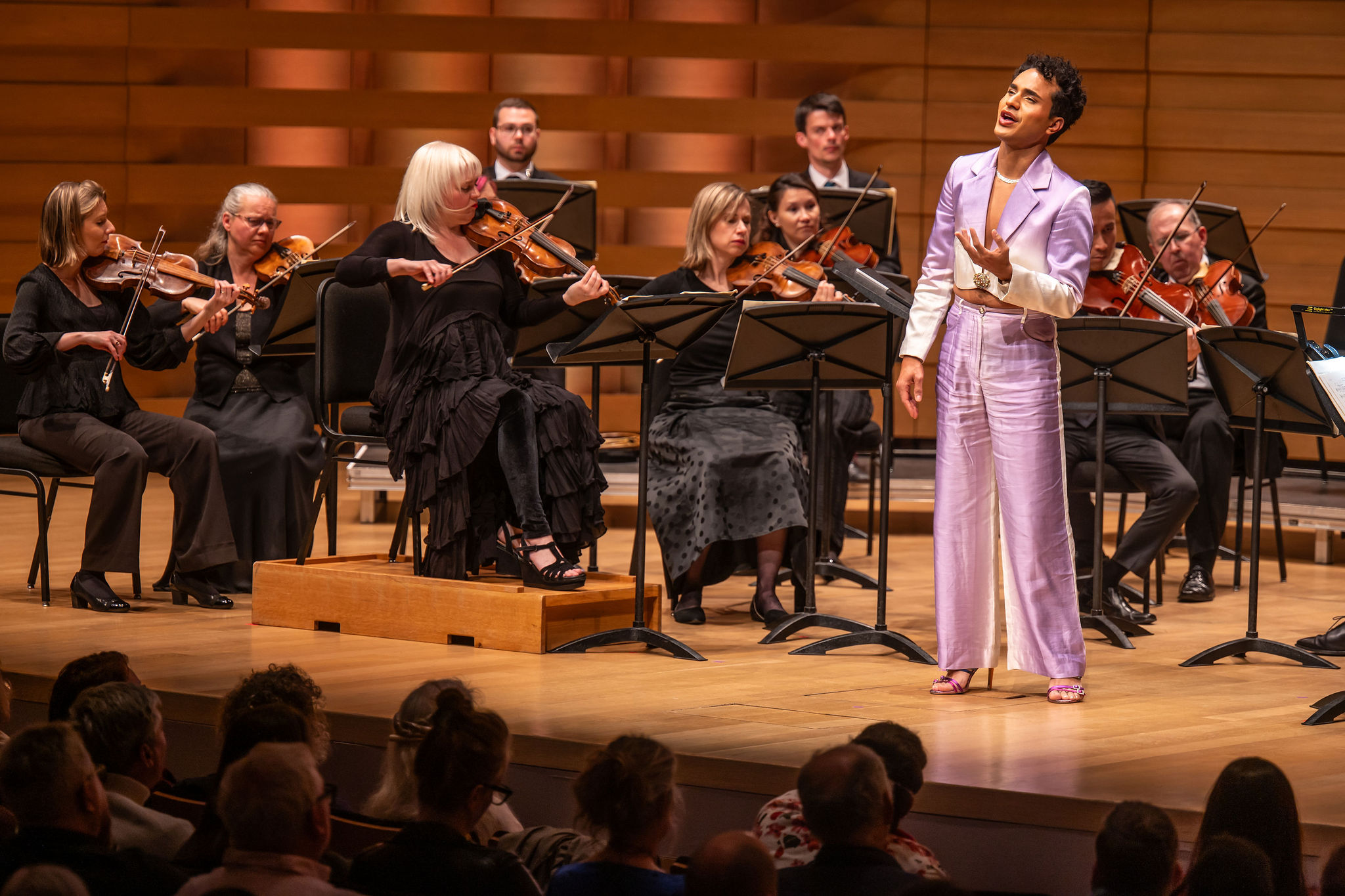
Samuel Mariño with Tafelmusik. Photo: Dahlia Katz
In the second half, the Sinfonia from Salieri’s Armida was restlessly adventurous, moving from an ominous opening to a tempestuous middle section and a peaceful ending. Mariño’s personification of Berenice from Gluck’s Antigone was spellbindingly dramatic, while his “Che faró” from Orfeo ed Euridice was heartbreakingly poignant, even at an unusually flowing tempo.
Another female composer, Maria Antonia Walpurgis, was then showcased with an arrangement for cello and orchestra of an aria from her opera Talestri, before Haydn’s Armida closed the programme with a fiery, rageful aria. “I think I just broke a heel,” Mariño added, referring to his vigorous stomping at the culmination of the aria.
He then followed his “intense program” with two Mozart encores: a supremely playful interpretation of Cherubino’s “Voi che sapete,” followed by the irresistible “Halleluja” from the motet, Exultate, jubilate. “It’s as sparkling as my grandmother’s brooch,” said Mariño smiling broadly, pointing to the diamante fastening of his bolero top. “What I love most in my life is to give joy by my singing,” he added. Mission accomplished.
Full details of Tafelmusik’s new 2025-26 season can be found at www.tafelmusik.org