On the opening night of the Canadian Opera Company’s pairing of Bartók’s Bluebeard’s Castle and Schoenberg’s Erwartung, the Four Seasons Centre for the Performing Arts proved as impenetrable as the eponymous Duke’s fortress. Heightened security, introduced after threats during the visit of the controversial Shen Yun Performing Arts, produced queues more suited to a stadium than to an evening of symbolist-expressionist opera. It was an oddly literal prelude. Before anyone set foot inside Bluebeard’s domain, entry had already become conditional.
Robert Lepage’s double bill has long been one of the company’s safest bets. First seen in 1993 at the instigation of Richard Bradshaw, it marked Lepage’s operatic debut and has been revived often enough to acquire the status of a house heirloom, most recently in 2015.
I came to it without prior exposure, which in this case felt less like a gap than a luxury. Lepage’s reputation in his Shakespeare productions had prepared me for inventiveness that divides opinion, so I avoided the usual advance glimpses and arrived with no images to confirm or resist. The production turned out to be almost exactly what one expects from him. That is both its strength and its limitation.
Composed either side of 1910, when Freud’s Interpretation of Dreams was still being digested, both operas circle the same subject from opposite directions. Bartók builds a structure of secrets, each door of the castle opening further into an archetypally male interior darkness. Schoenberg offers no such visible symbolic architecture. His heroine wanders through her own mind, losing all coherence as she goes. Bartók’s Judith discovers too much for her own good; Schoenberg’s Woman knows too much for her to deal with.
The pairing is persuasive. One gives us the rooms, the other the collapse of a mental map. Musically the contrast is just as telling. Bartók proceeds with a dark steadiness, his orchestra opening out in great expanses of colour. Schoenberg moves in flashes of fractured and distorted harmonies, refusing to settle, the lines pulled along by psychodramatic thought rather than melody.
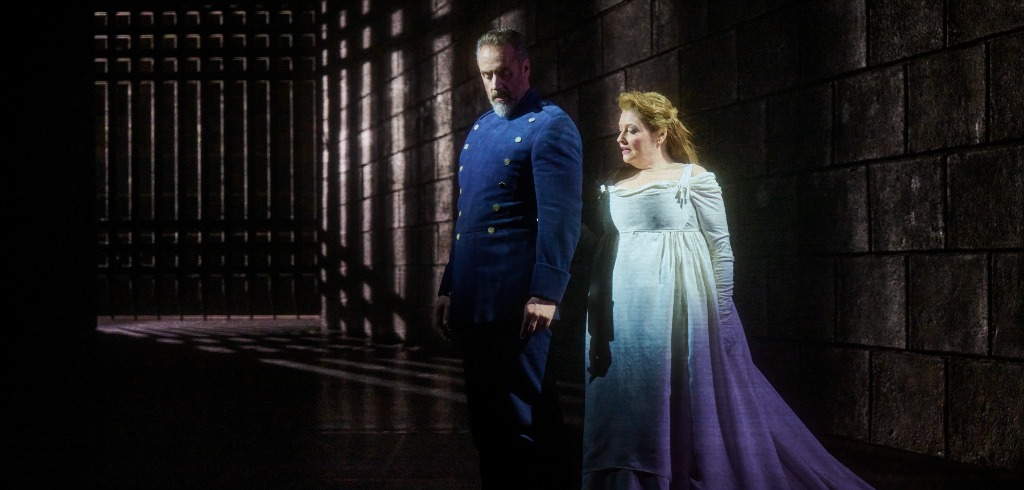
Christian Van Horn (Bluebeard) & Karen Cargill (Judith) in COC’s Bluebeard’s Castle, 2026.
Photo: Michael Cooper
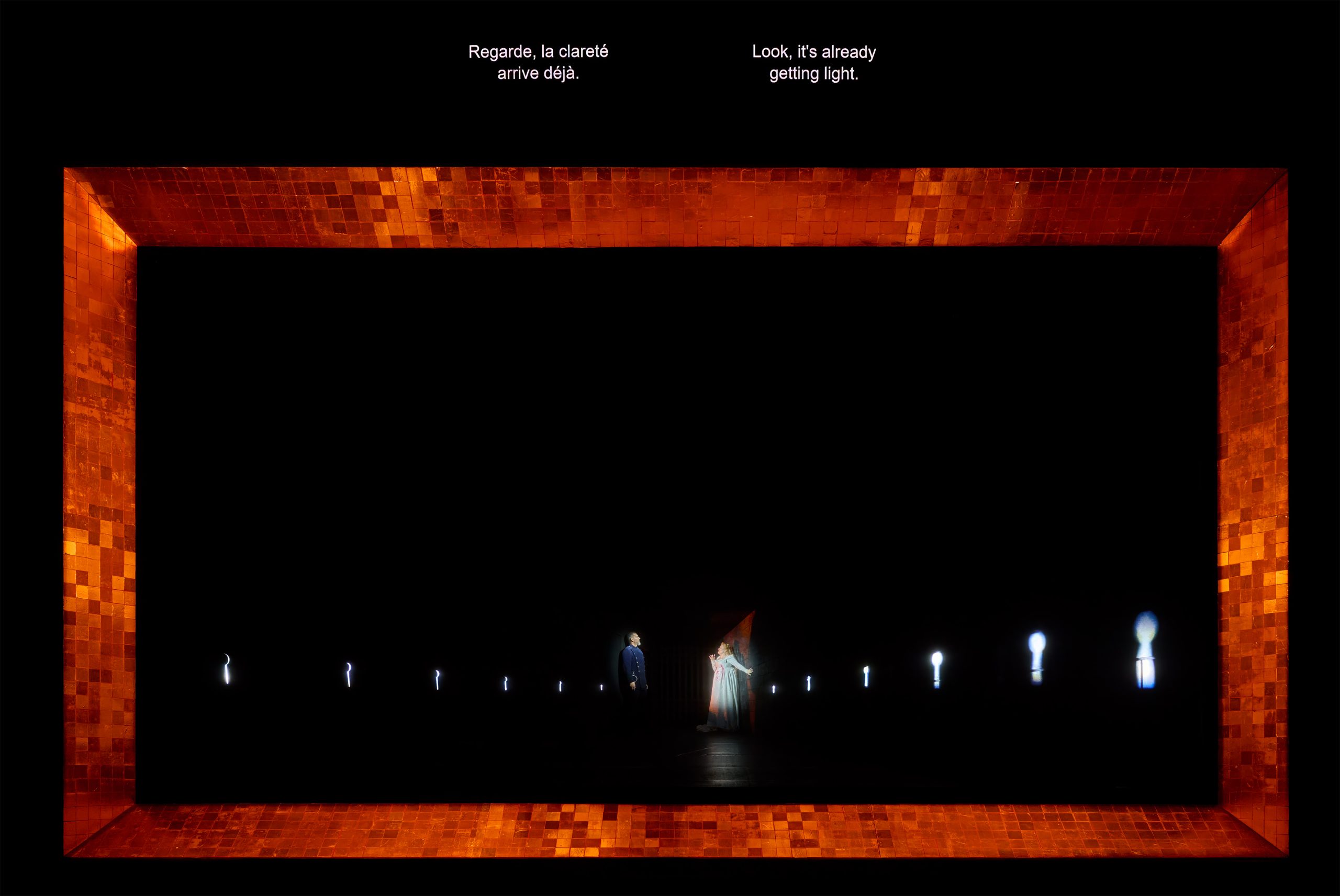
Lepage and revival director François Racine keep the visual parallels discreet. Both pieces are framed in a Klimt-like golden rectangle and seen through a constant scrim, with a concrete wall anchoring the space to one side. There are echoes in costume and gesture. The Woman of Erwartung could pass for Judith after a change of circumstances (Isolde after a nervous breakdown, as Adorno memorably put it), and the image of blood, contained then released, recurs with quiet insistence. The connections are there if you want them, but they are not forced—thankfully.
On the night, Bluebeard’s Castle made the stronger case. Its visual language recalls the warped shadows and skewed perspectives of The Cabinet of Dr. Caligari. The doors reduce to a row of keyholes cut into darkness. What lies behind them is only obliquely hinted at. Light does the work instead. A saturated red suggests the torture chamber, cold metallic tones the armoury, green and floral textures the garden, and a sudden expansion into a Space-Odyssey-like cosmic space the Duke’s domain. Our imagination is left to complete the picture, and the drama benefits from this restraint.
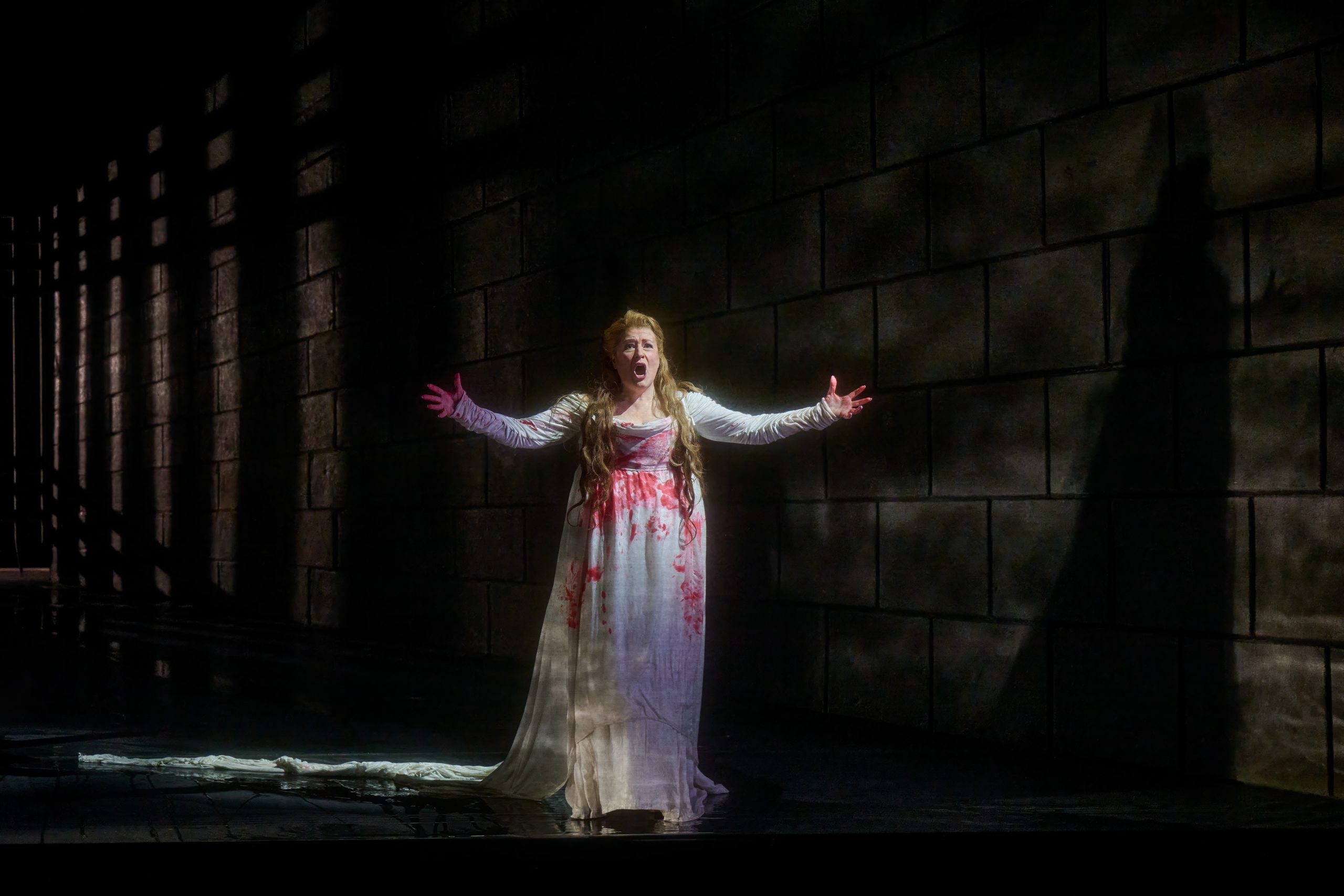
Karen Cargill (Judith) in COC’s Bluebeard’s Castle, 2026. Photo: Michael Cooper
Karen Cargill’s Judith enters this world with a sound that is both grounded and urgent. She pushes forward, as she must, without ever convincing herself that the answers to her questions will be worth the asking. Opposite her, Christian Van Horn gives us a Bluebeard already weary of his own secrets. He is less tyrant than casualty, a man caught between habit and the faint possibility of change. The voice carries authority without excess weight—appropriate to the shadow of power reduced to memory and self-torment.
If there is a weakness, it comes at the point where the production stops implying and starts stating. After the lake of tears has turned into a pool of blood, Bluebeard’s former wives appear unmistakably as victims resurrected. Their blood-drenched wedding dresses are effective but perhaps no longer as unsettling as they might have been in the 1990s. Suggestion rather than explicitness would surely have lingered longer in the mind.
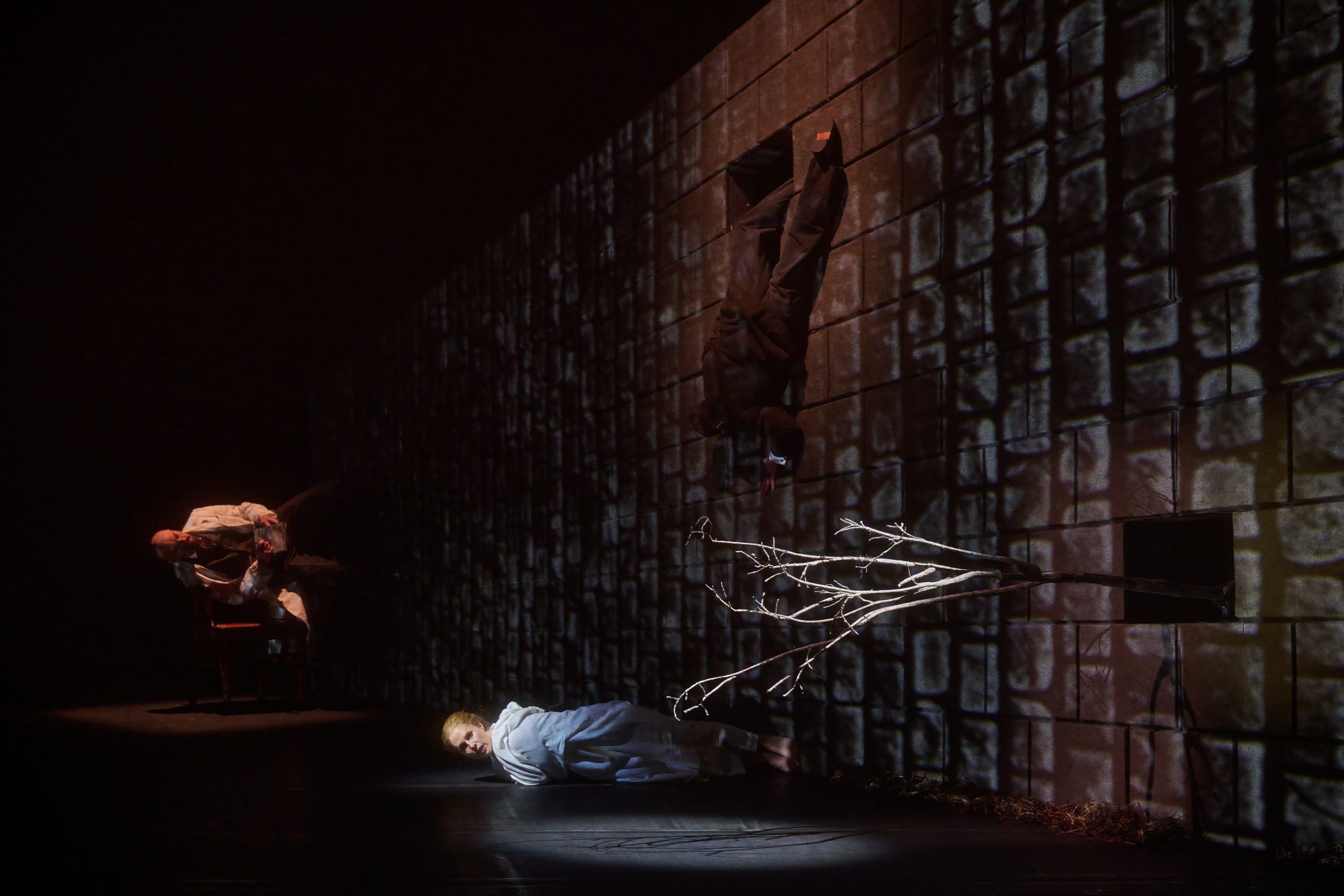
A scene from COC’s production of Erwartung, 2026. Photo: Michael Cooper
That instinct to clarify continues into Erwartung and to far more questionable effect. The curtain rises on a psychiatrist, notebook in hand, while the Woman appears restrained and observed. The reference to Freud is unmistakable, but also didactic and superfluous. To be sure, the work depends on its uncertain grasp of reality, but to frame it so neatly at the outset is to enfeeble its power.
From there, the staging proceeds to illustrate rather than to unsettle. The forest specified by Schoenberg disappears into a mental landscape that borrows from Magritte and Dalí. Trees lean at 90-degree angles, hands reach without bodies, and images follow the text with a determination that leaves little to the imagination (literally so, when the naked body of the man the Woman has murdered rolls towards the front of the stage). The stagecraft and the cinematic pacing (slow-motions; jump-cuts) are effective in a way and may have been even more so back in 1993.
But these cues impose too much order on a piece designed to resist structure. Erwartung should feel as if it is happening too quickly to be psychologically processed. Here it feels too carefully arranged.
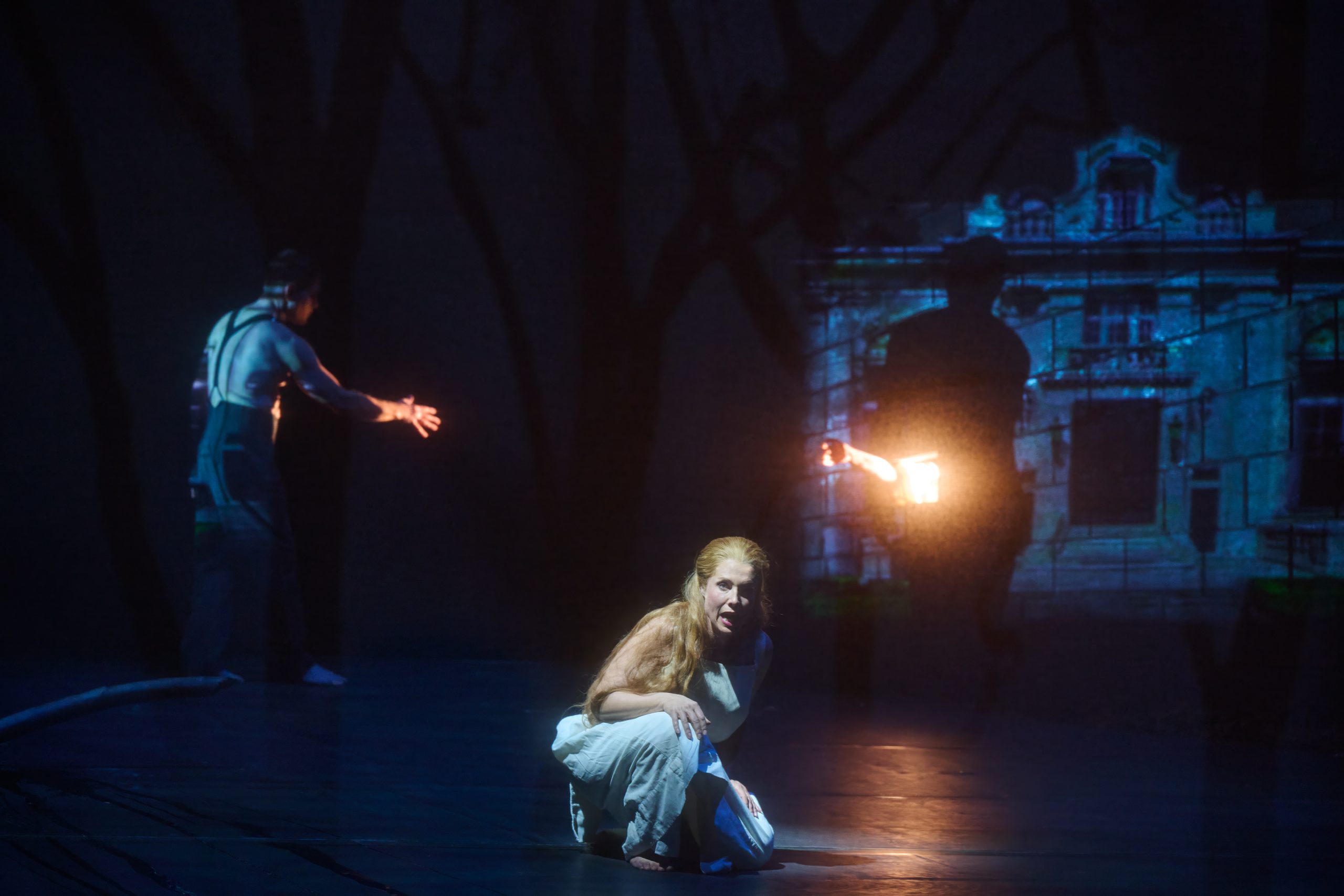
Anna Gabler (The Woman) in COC’s production of Erwartung, 2026. Photo: Michael Cooper
Much depends on the soprano, and on the opening night Anna Gabler, despite her dedicated and committed performance, did not quite command the space in the way the role demands. The part asks for extreme and abandon. What we hear instead is effort and control. At the curtain call, her gesture of relief felt like a confirmation of that suspicion. As in Bluebeard, the orchestral playing under Jonathan Debus was idiomatic and heroically assured.
For all its arguable limitations, the evening remains one of the most compelling operatic experiences the COC has offered in recent years, and proof that experiment and artistic bravery can pay off. The revival reminds us why Lepage’s production mattered, but also why opera needs his brand of risk-taking, which makes it matter in the first place.
Canadian Opera Company’s Bluebeard’s Castle/Erwartung continues its run at Toronto’s Four Seasons Centre for the Performing Arts through May 16.