
What is the ideal duration for a concert opener? For TSO’s Conductor Emeritus Peter Oundjian, the answer would seem to be 12 minutes, give or take. That’s the duration of his “sampling” of Joan Tower’s 1991 Concerto for Orchestra, to use the composer’s less than glowing endorsement. A distilled version of a longer work is nothing new in itself, as Oundjian himself pointed out in his notes, using Prokofiev and Stravinsky’s ballet suites as examples.
But in the case of Tower, the original work is just 28 minutes long, and as charming as the onstage chat between conductor and composer was, it took probably almost as long as the missing half of her work. Given the continued under-representation of female composers, the “slicing up” (to quote Tower again) felt curious—especially as Wynton Marsalis’s 30-minute Concerto for Orchestra as concert opener a few days prior seems not to have raised any complaints.

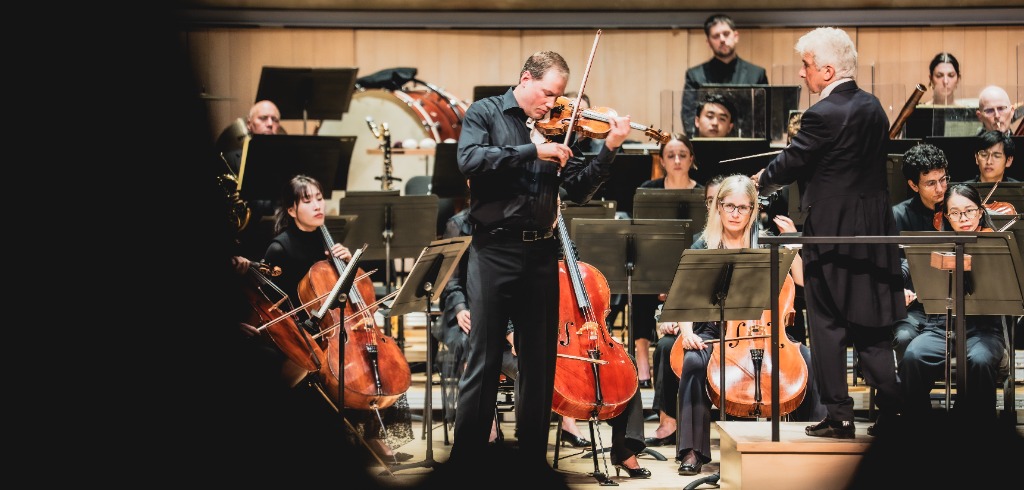
Jonathan Crow with the TSO conducted by Peter Oundjian. Photo: Allan Cabral/Courtesy of the TSO
My doubts were confirmed after listening at home to the work’s full version. The compelling rhythmic drive of the original were preserved at the TSO, as was the imaginative orchestration and texturing. But the structural proportions were deformed, with all moments of respite and resolution (and plenty of solos) excised. The result is a frenetic hyper-stimulation without much satisfaction. And the “shrinking” (Tower again) only serves to highlight a weakness in the original Concerto, namely its lack of memorable thematic material.
There are no shortage of themes—glorious ones—in Mendelssohn’s Violin Concerto. The TSO’s own Jonathan Crow went with the natural flow and uplifting rhythmic impetus of the opening, counterbalancing it with the poetic nobility of the second subject. Other soloists might place more emphasis on Mendelssohn’s appassionato, but Crow’s reserved sensitivity never imposed any grandstanding. The slow movement was delicately serene, warm and sweet-toned, without a grain of excess sugar, and the finale’s effervescent energy had plenty of charm to compensate for any lack of caprice. Oundjian was a trusted partner, never allowing the not-so-straightforward acoustics of Roy Thomson Hall to leave the solo lines submerged.

Peter Oundjian conducting the TSO. Photo: Allan Cabral/Courtesy of the TSO
Elgar’s Enigma Variations are no stranger to conductor or orchestra, who recorded them together in 2008. If anything their approach 17 years on is now even more natural and flowing. The theme—the Enigma of the title—was ideally elegiacally introvert and graceful, as was the soulful Twelfth Variation (personifying Basil George Nevinson, Elgar’s cello-playing chamber music partner) with its quietly solemn framing cello solos.
In fact all the more intimate variations (such as the first, depicting Elgar’s wife) were captivating in their delicately contoured portrayals, and the beloved “Nimrod” was all the better for its quietude and reserve, never milking the harmony or making gratuitous points. Yet there was also plenty of whimsy and mischief when the character studies called for those qualities.
The orchestra sounded fully at home with the idiom and seized gratefully on every opportunity to display virtuosity and refinement. It was just a pity that anyone in the audience hoping to follow the titles and stories in the helpful program note would have been frustrated by the subdued lighting (as reviewers of programmatic works in this hall have repeatedly pointed out).
For more on the TSO’s upcoming concerts, visit www.tso.ca