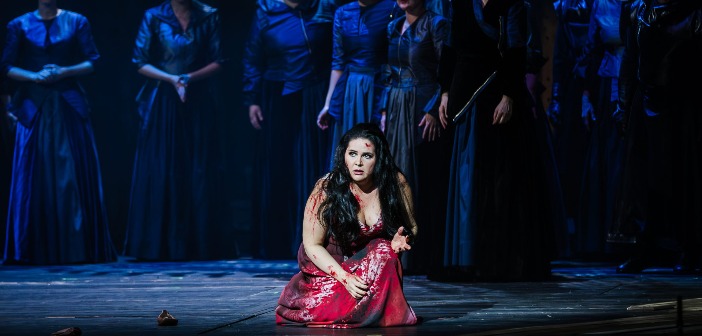

Hungarian State Opera’s revival of their 2016 production of Donizetti’s Lucia di Lammermoor by Máté Szabó gives us a new Lucia ascendant who succeeds within a dramatic vacuum. Up until now, soprano Zita Szemere has mostly been known for lyric roles such as Ilia, Norina, and Blonde. Here, she cranks things up a notch on her own vocal terms. She offers a beautifully sung, and convincingly dramatic Lucia, the tragic heroine abused by the men in her life, who only gains agency once she has been driven mad. Would that the production around her could offer a better showcase for her compelling portrayal.
Set designer Balázs Cziegler’s geometric towers, platforms and balconies remain unchanged throughout, but offer a variety of levels and viewpoints that, if used more competently, could have been effective. Ildi Tihanyi’s costumes, with long, leather coats and hoods for the men, give a nod to the past and to a sort of sci-fi, video game future. Like the sets, they work well enough in themselves, but are unfortunately not tied to a coherent, overall vision.

A scene from Hungarian State Opera’s Lucia di Lammermoor
Photo: Attila NAGY / Hungarian State Opera
This brings us to Szabó’s staging itself. The overall impression on March 1 was that the singers had been left to themselves with little evidence they had been coached beyond the level of basic blocking. There was a lack of specificity and intention in their actions and interactions. Lucia‘s well-constructed libretto with its believable (and disturbing) personal relationships were not sufficiently explored.
Tension was lacking in key scenes like Lucia’s duet with her brother, Enrico, who forces her into a marriage to benefit his own financial position. Likewise, in the following duet with the family chaplain, Raimondo, Lucia deals with another manipulative man who uses religion and the spectre of Lucia’s dead mother to force the union. It too lacked the spark contained within these encounters that should make for exciting drama.
The production also suffered from random directorial interventions that in better hands might have contributed something of interest, but were underdeveloped. Chief among these was a cadre of supernumeraries dressed mostly in white, the women with long platinum blond wigs. They first appeared at the opening of Lucia’s fountain scene in which she sings of seeing the ghost of a girl murdered by a jealous ancestor of her lover, Edgardo. If they are manifestations of Lucia’s visions of this historical crime, it was not entirely clear. The ghosts reappear throughout, to no great significance, including in the finale after Edgardo kills himself when he apparently joins their ranks (?).
Other directorial flourishes were overused, or seemed out of context. A (quite loud) shower of mist pours down throughout Lucia’s opening aria, and seems to represent her retreat into the world of her mind, but long outstays its welcome (as do its multiple reappearances). After discovering Lucia has killed her husband, Arturo, the priest Raimondo starts to swallow large amounts of alcohol from a bottle he grabs from a chorus member which seems completely out of character. Husband-to-be Arturo is encouraged by Enrico to ‘conduct’ the chorus that greets his arrival. It’s a kind of joke that lands badly, coming from a different era, or a very different type of staging.
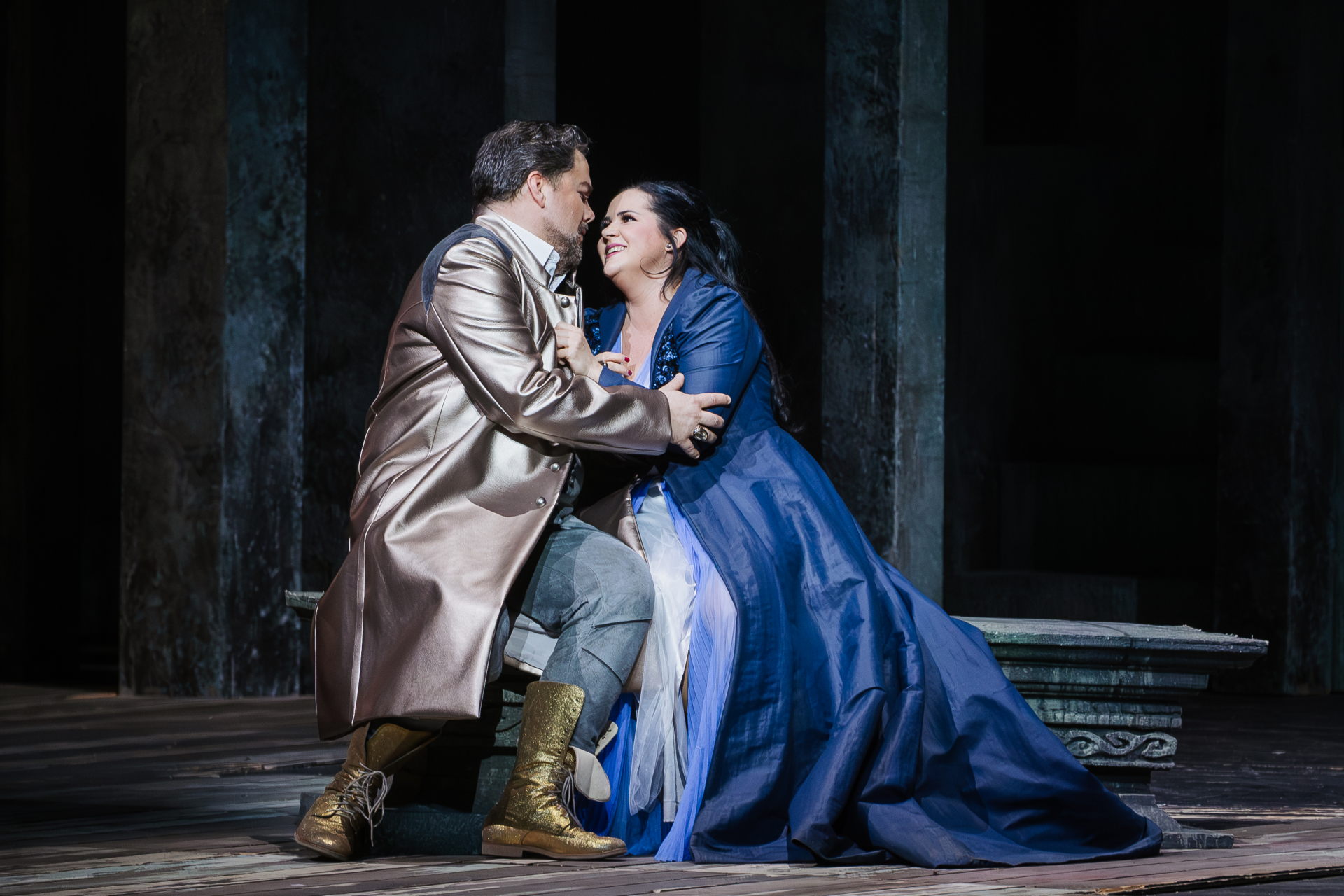
Adorján Pataki (Edgardo) & Zita Szemere (Lucia) in Hungarian State Opera’s Lucia di Lammermoor
Photo: Attila NAGY / Hungarian State Opera
There were some strong vocal performances that deserve to be heard in these roles again, in a more coherent dramaturgical context. Tenor Adorján Pataki possesses the absolutely correct, bright, ringing sound for Italian roles like Edgardo. The big, double aria he sings in the final scene is notoriously challenging and Pataki handled it well. His portrayal, however, lacked optimal dramatic range, but it’s difficult to know how much guidance he received in this context.

István Kovács (Raimondo) in Hungarian State Opera’s Lucia di Lammermoor
Photo: Attila NAGY / Hungarian State Opera
Veteran baritone Alexandru Agache has of course enjoyed an international career in the world’s top houses, and it shows in his command of dramatic declamation of text, and a still impressive instrument. Bass István Kovács also has the right vocal material for Raimondo, rolling out impressive long legato lines throughout the evening. His diction sometimes lacked clarity and bite.
As Arturo, tenor Tibor Szappanos was one of the few singers to break out of the overall lethargy with a sparky, humorous portrayal of the victim of Lucia’s mariticide. Lusine Sahakyan offered a rich mezzo-soprano as Lucia’s companion, Alisa and Balázs Papp, a penetrating tenor as Normanno.
But Zita Szemere proved how a gifted artist can overcome even the least felicitous of stagings. She is definitely within the lighter, more lyric tradition of voices who have taken on this iconic role. And yet, her beautiful tone carried extremely well over the orchestra.
At the end of the great sextet that concludes Act 2, she was perhaps somewhat overwhelmed and eschewed the interpolated high note on this occasion. Her mad scene saw her engage with the character’s rage over the abuse she has endured which informed some spectacular vocalism. Szemere’s emotional curtain call signaled that she was aware she had just achieved a big career breakthrough.

Zita Szemere (Lucia) & Lusine Sahakyan (Alisa) in Hungarian State Opera’s Lucia di Lammermoor
Photo: Attila NAGY / Hungarian State Opera
Conductor Kálmán Szennai led with a firm musical hand, the always-excellent orchestra offering some beautiful solo moments. The chorus sang well, and it wasn’t their fault that they weren’t asked to do much except stand in place before moving to their next position.
So, Budapest crowned a new Lucia—hopefully Zita Szemere will be offered a more dynamic context for her next role debut.
Hungarian State Opera’s Lucia di Lammermoor continues its run through March 8.