Browsing: La Scena Online

La Scena Online is the digital magazine of La Scene Musicale.Contents: News, Concert reviews, CD reviews, Interviews, Obituaries, etc; Editor: Wah Keung Chan; Assistant Editor: Andreanne Venne
ISSN: 1206-9973

Tenor Asitha Tennekoon’s May 8th recital at the Women’s Musical Club of Toronto explored the idea of Belonging. The first set, Vaughan Williams’ setting of six poems from Housman’s On Wenlock Edge explored a geographically settled but psychologically unsettled sense of self. The accompaniment of piano quintet (Steven Philcox, piano; Yolanda Bruno and Aysel Taghi-Zada, violins; Laurence Schaufele, viola and Amahl Arulanandam, cello) provided lots of colour for these sometimes lyrical, sometimes dramatic, but always death-obsessed poems. Tennekoon sang them with perfect diction and great expressiveness, navigating the tricky dialogue in “Is my team ploughing?” very effectively. Ian Cusson’s Where…

Share:

Roy Thomson Hall was filled from the main floor to the choir loft on May 7. The concert program features two mammoth works. The first, a contemporary premiere exploring artificial intelligence. The second, a treasure that highlights the everlasting capability of music to express emotional intelligence . A pre-concert program offered in the lobby included Schubert’s Trout Quintet performed by members of the Toronto Symphony Youth Orchestra. The quintet is a challenging work. Kudos to the dedicated TSYO faculty coaches, performer members of the TSO who are also dedicated teachers: Shane Kim and Peter Seminovs (violin), Ivan Ivanovich (viola), Lucia…

Share:

What’s this record doing on my deck? I have listened to Furtwängler’s own recordings of his overlong second symphony and have heard it performed live by Daniel Barenboim with the Berlin Philharmonic without walking out. The works spends three-quarters of an hour going nowhere. Furtwängler composed it in Switzerland after fleeing Berlin in January 1945, abandoning his musicians to a desperate fate. The work propounds motifs of fate and destiny beloved of German composers from Schumann to Strauss, alternating massive ffffs and church-organ simulations, all the tricks of the orchestral trade. There are some tender woodwind strands in the third…

Share:

On May 3, the Chan Centre for the Performing Arts was filled with the enthusiastic voices of both young and experienced choral singers. This event, The Big Roar, is Chor Leoni’s signature community choral festival. Chor Leoni was joined by MYVoice educational choirs, the young singers of its PRÉLUDE program, its Emerging Choral Artist Program (ECAP), and The Leonids, bringing joy and vigor to this special afternoon event. The programme was diverse, featuring traditional Malaysian folk music, Broadway as well as classical a cappella pieces such as “O Nata Lux.” After the intermission, Chor Leoni performed Melissa Dunphy’s major choral…

Share:

The satirical stories of Svatopluk Čech may not be well known to Anglophone readers, yet these Czech tales are classics in their own right. They inspired the great Czech composer Leoš Janáček to write The Excursions of Mr Brouček. One of his lesser-heard masterpieces, it’s a highly amusing, true oddity of an opera. With a gaggle of librettists, it seems this was originally a difficult work to stage, filled with problems. As one would expect, Janáček enthrals with his uniquely robust orchestral writing, often piercingly dramatic and essentially Czech. Scurrying arpeggios, earth quaking timpani and blazing brass are just a…

Share:

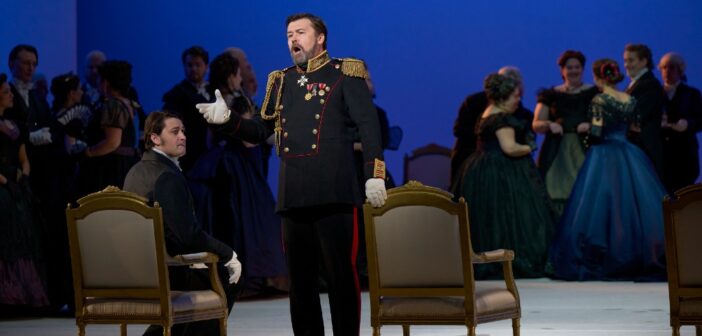
Canadian director Robert Carsen’s staging of Tchaikovsky’s Eugene Onegin was originally created for the Metropolitan Opera in 1997 and has achieved iconic status in the intervening years. The Canadian Opera Company eventually acquired the production which it first presented in 2018. A model of perfectly-judged austerity, it once again lives up to its vaunted status in its latest revival (seen May 2). What takes this iteration to the next level is the casting. The COC has conjured up the magic that can result when superb singers are ideally matched to their roles.   As Carsen states in his program notes, “When…

Share:

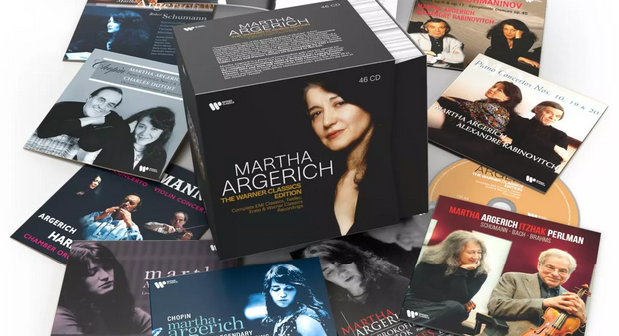
Some artists stop at nothing to get attention. Others shy away from it like birds of an endangered species. No prizes for guessing which category Martha Argerich belongs to. The Buenos Aires-born pianist has never given a sit-down interview in her life, never posed for cover shots, never taken a political stance. Despite these modest precautions, she became the world’s most sought-after keyboard artist. At 83, after bouts of ill-health, each recital she now gives seems like a miracle. The present box-set, combining former EMI, Teldec and Erato releases and her festival events at Lugano, is but a partial record…

Share:

Although acclaimed as one of Giacomo Puccini’s greatest works, Madama Butterfly has received plenty of criticism over the years for its orientalism. Historically, productions have infantilized and sexualized Asian women, simplified and stereotyped Asian culture in design and performance, and used yellowface to change the appearance of white performers playing East Asian characters. For this production of Butterfly, Vancouver Opera (VO) reflected on these criticisms of the opera’s story and past performances. Their conscious effort to listen, learn, and prioritize East Asian perspectives adds a refreshing and necessary layer of depth to this beautifully tragic opera (seen Apr. 26th). Recontextualizing…

Share:

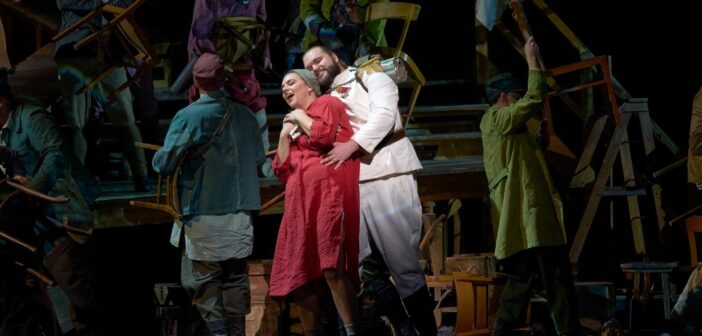
It has been a bit of a wait, but South African artist William Kentridge’s production of Alban Berg’s Wozzeck has finally had its Canadian Opera Company debut following outings at fellow co-producing companies, the Salzburg Festival (premiere, 2017), Metropolitan Opera and Opera Australia (both 2019). Its seamless amalgam of fine art, video, stagecraft, music and drama results in one of the most convincing artist-driven concepts to have graced Toronto’s Four Seasons Centre stage (seen Apr. 27th). Kentridge has taken World War I as his primary inspiration. Berg began to write the opera in 1914, just before the war’s outbreak, completing…

Share:

The second cello concerto of Dmitri Shostakovich has never matched the first in public appeal or soloist appreciation. Premiered on the composer’s sixtieth birthday, at a concert where he was proclaimed a Hero of Socialist Labour, the concerto is ambivalent both in meaning and in its balance between soloist and orchestra. There are stretches where the cello is left to find its own way home as a huge orchestra sits idly by. Quite possibly a metaphor for Socialist Labour. Mstislav Rostropovich, for whom the work was written, made a hash of its first recording and the work has, to some…

Share:
1 17 18 19 20 21 172