The idea of an abridged Les contes d’Hoffmann troubles many opera lovers, yet Theater Lübeck’s compact two-hour version without intermission proved remarkably effective (seen June 5). The cuts were largely intelligent ones, mostly affecting secondary characters and comic diversions, though the omission of the Venetian septet, “Hélas! mon cœur s’égare encore!” remains regrettable both musically and dramatically.
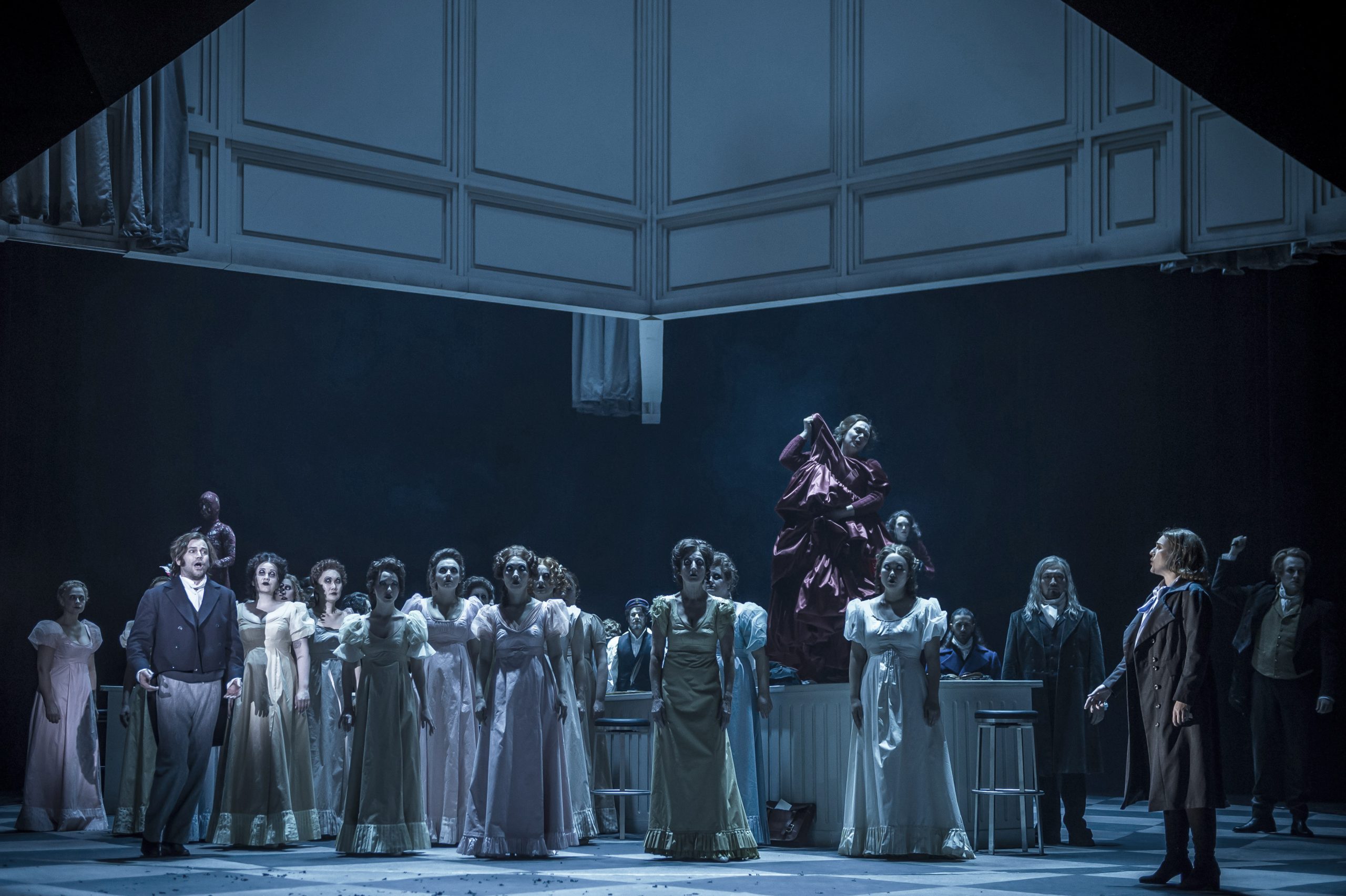
Scene from Theater Lübeck’s Les contes d’Hoffmann. Photo: Olaf Malzahn
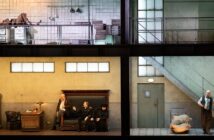
In Philipp Himmelmann’s imaginative staging, Les contes d’Hoffmann becomes less a succession of supernatural tales and more an exploration of the poet’s creative mind. The three women emerge as projections of Hoffmann’s imagination. This idea is reinforced by the recurring visual device of each heroine singing from pages handed to her by Hoffmann himself. The revolving stage and expert lighting compensated admirably for limited means, creating an atmosphere of unease reminiscent of expressionist horror cinema. Particularly effective was the shadowy lighting, which imbued the production with a genuine sense of dread. One missed the visual opulence usually associated with Giulietta’s Venice, but the psychological focus proved compelling.
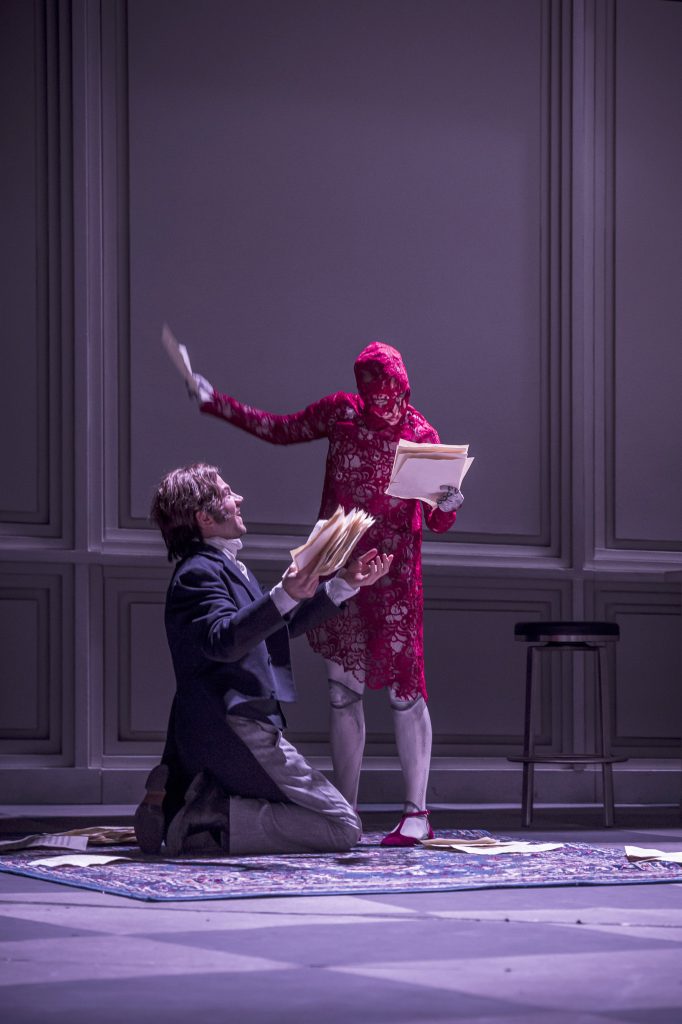
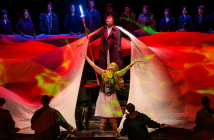
Konstantinos Klironomos (Hoffmann) & Sophie Naubert (Olympia) in Theater Lübeck’s Les contes d’Hoffmann. Photo: Olaf Malzahn
Greek tenor Konstantinos Klironomos offered an ardent and deeply committed Hoffmann. Endowed with a beautiful lyric tenor of uncommon warmth and remarkable ease in the upper register, he sustained the demanding role effortlessly from beginning to end. His French diction was exceptionally clear, and he conveyed both Hoffmann’s passion and touching naïveté with conviction.
The revelation of the evening, however, was Canadian soprano Sophie Naubert as Olympia. Having already impressed me greatly as Zerlina in Opéra de Montréal’s production of Don Giovanni last September, she was the principal reason Lübeck made its way into my travel itinerary. She more than justified the journey. Himmelmann abandoned the usual porcelain doll cliché in favour of a mysterious Olympia veiled in red lace, transforming the mechanical doll into something far more unsettling. Naubert’s physical characterization was superb, her abrupt movements perfectly synchronized with Offenbach’s musical wit.
Vocally, she was outstanding. “Les oiseaux dans la charmille” was delivered with elegance, sparkling coloratura and brilliant high notes, all while maintaining immaculate diction. As a native French speaker, every word landed clearly and naturally. More importantly, Naubert brought charm, intelligence and subtle humour to a role often reduced to vocal acrobatics. Unsurprisingly, hers was the evening’s most warmly applauded aria.
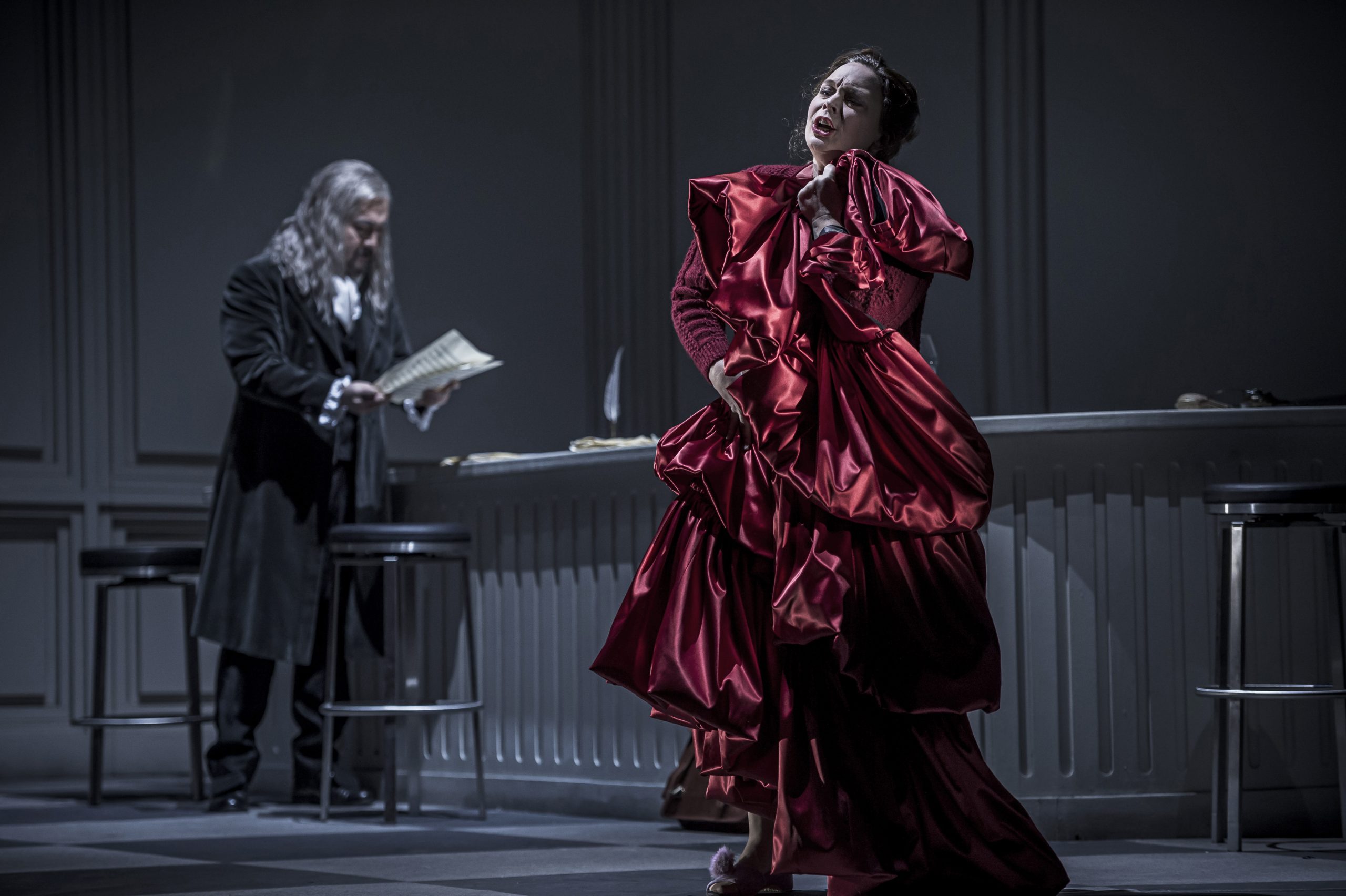
Changjun Lee (Crespel) & Andrea Stadel (Antonia) in Theater Lübeck’s Les contes d’Hoffmann.
Photo: Olaf Malzahn
German soprano Andrea Stadel portrayed an unusually fragile and psychologically troubled Antonia, amplifying the role’s tragedy with touching sincerity. Her “Elle a fui, la tourterelle” was deeply moving. Dutch soprano Aditi Smeets made for an elegant yet cold Giulietta, her rich voice blending beautifully in the Barcarolle. German mezzo Frederike Schulten was a convincing Nicklausse/Muse, dramatically committed and vocally appealing.
Jacob Scharfman (Coppelius) in Theater Lübeck’s Les contes d’Hoffmann. Photo: Olaf Malzahn
American baritone Jacob Scharfman nearly stole the show as the four villains, roles usually sung by a bass-baritone. Vocally and dramatically commanding, he relished every moment of malevolence while bringing an appreciated comic-tragic balance to the opera. Scharfman did not hesitate to use his physicality to portray the lugubrious characters. Tall, slim and clearly athletic, he contorted like an acrobat. channeling actor Philippe Clay’s resident French cabaret singer in the legendary magic related film Bell, Book and Candle (1958). A certain sexual ambiguity made him even more threatening than had he been a true basso profondo.
Under the energetic baton of Takahiro Nagasaki, the orchestra played with passion and admirable sensitivity toward the singers. Despite several cuts, musical continuity remained strong, and voices were never overwhelmed.
This production demonstrated what can be achieved through ingenuity rather than lavish budgets. With Himmelmann’s intelligent staging and, above all, Klironomos’s outstanding Hoffmann and Naubert’s luminous Olympia, Theater Lübeck offered a stimulating and memorable account of Offenbach’s masterpiece.
There is one more performance this season of Theater Lübeck’s Les contes d’Hoffmann on June 18.