
This page is also available in / Cette page est également disponible en:
 Français (French)
The sessions at the CMIM that follow one another are all different. So far, the one constant is that we hear the most remarkable voices in the evening. Could this be a coincidence, or does the timing of the performance have something to do with it?
Aria I – Afternoon
This second day started rather well with Katerina Burton. The American soprano was generous in her interpretation and legato, but her repertoire choice was very cautious. Later in the evening, other competitors in her voice category took real vocal risks that were rewarded in the end.
Given his vocal qualities in the deep register, Thai bass-baritone Pete Thanapat truly deserves the term “bass” like no other. His timbre flourished equally well in the upper register, with rich colours and rare solidity. The close resemblance in repertoire to his direct competitor, German bass Valentin Ruckebier—the same arias from Simon Boccanegra and from Bilodeau’s La beauté du monde—was flattering for the Thai. Ruckebier, who actually had a bass-baritone range, appeared more reserved, sometimes choosing to focus more on dramatic expression than on the beautiful resonances his voice was capable of producing. It’s not clear that an opera competition jury would approve, but on the other hand, he could have a bright future in the song competition.
Tenor Ricardo Garcia, one of our favorites in the Aria category, initially gave us a powerful impression on recordings. In the aria from Puccini’s La Rondine, he graced us with percussive high notes, but his voice was generally less vibrant than expected. Garcia particularly stood out in the softer passages, particularly in a song by Daniel Catán. He presented himself as one of the most expressive and moving candidates in the competition. However, technically, Tchaikovsky’s “Kuda, Kuda” was not as well executed.
Aria I – Evening
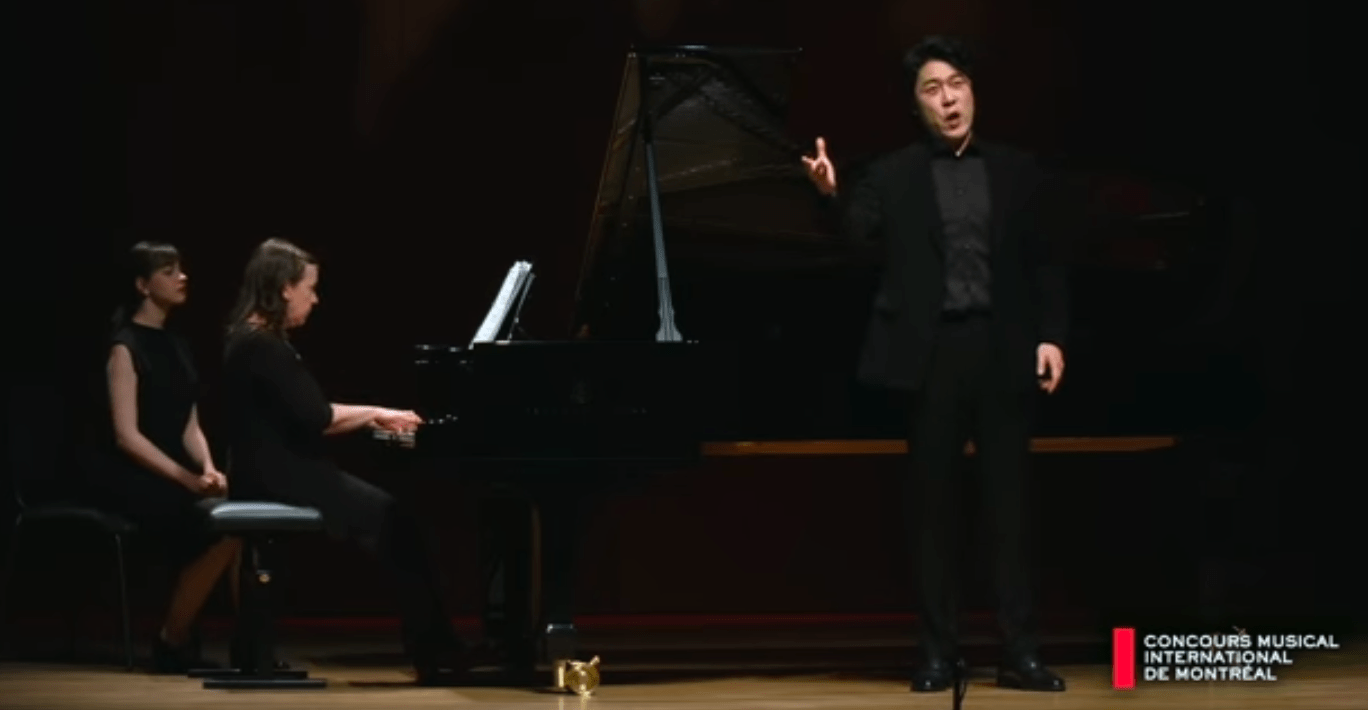
Starting at 7:30 p.m., the audience was treated to a first line trio worthy of the NHL! The level of performance and connection with the audience reached unparalleled heights thanks to the presence of South Korean bass-baritone Chanhee Cho, German soprano Isabel Weller, and South Korean coloratura soprano Jaeeun Shin. One after the other, these three candidates reminded us that we were indeed in a competition, that it was no longer about charming with mini-recitals, but about winning the hearts of the judges and the audience, and winning.
Cho, who had already participated in the competition in 2018, was the most convincing of the three bass-baritones of the day. His first aria—the catalogue of Don Giovanni—was very entertaining to hear and watch, in addition to offering a flamboyant example of ease and vigor. The technical challenges of Schweig, damit dich niemand warnt!, from Weber’s Freischütz, were met brilliantly, with the joy of singing always as a common thread.
Speaking of challenges, Udo Zimmermann’s “Einmal noch einmal” was by far the most difficult contemporary piece in the competition, with its numerous a cappella passages. For a cold start, let’s face it, it was a suicide mission! Weller clearly knows herself very well, and she was breathtakingly accurate and confident. The German soprano, who is a Mozartian at heart, was able to “rest” briefly in “Deh vieni non tardar” from The Marriage of Figaro before taking off again with renewed vigor and soaring through the virtuosity of a Haydn aria. The classical style definitely suited her perfectly!
Finally, Shin offered a stratospheric program, marked by an aria by Meyerbeer and John Adams. The opening notes of Ravel’s “Arrière! Je chaleur les bons” set the tone from the outset. Her goal was clear: she came to win. The competition promises to be fierce with the other coloratura soprano, Julia Muzychenko-Greenhalgh.
Places in the final are limited to five, but at least two of tonight’s final three candidates deserved a spot. The jury will have a difficult choice.
As for the Canadians, unfortunately, it’s hard to see how Sophie Naubert could continue her adventure. While her stage performance was full of humor in Harder’s “Take It to Tumblr,” her voice lacked fullness and versatility beyond the baroque repertoire that seems most appropriate for her.
Ariane Cosette, for her part, struggled to channel her vocal energy and vibrato, causing the melodic lines to lose their precise contours, despite her expressive and very legato singing.
All opera lovers are invited to come to Bourgie Hall to experience opera in person. The final performance in the Aria category is Tuesday, May 27. Will we be treated to another vocal firework? Find out at 7:30 p.m.!
For the schedule, tickets and profiles of the candidates, go to https://concoursmontreal.ca/fr/voix-2025/
This page is also available in / Cette page est également disponible en:
Français (French)