This page is also available in / Cette page est également disponible en:
 Français (French)
The second half of Société de musique contemporaine du Québec (SMCQ)’s anniversary season promises to be particularly busy, with five concerts, eight premieres and numerous collaborations with leading orchestras, ensembles and soloists. On the occasion of this 60th season, SMCQ reaffirms its role as a bridge between generations of composers. Artistic Director Simon Bertrand, a 2026 Opus Awards nominee for “Artistic Director of the Year,” offers an overview of the upcoming concerts in the following text.
> Intergenerational dialogue is at the heart of this second part of the season. How did you come up with this theme for the 60th anniversary?
Since 2024-25 was the year of the Montréal/Nouvelles Musiques (MNM) festival, we would now normally be in the Tribute Series, dedicated to a composer. However, since this is our 60th anniversary, we decided to pay tribute to music creators in general, from yesterday to today.
Rather than celebrating an anniversary in a “traditional” way, simply looking back on how far we’ve come and doing a simple retrospective, I wanted to offer a lively overview of several generations of composers. This dialogue between the past, present and future allows us to hear a wide spectrum of contemporary music—from the pioneers to the next generation—but also to bring out a synergy between these generations. I also wanted to paint a representative portrait of the creative music scene by giving a voice to others, hence the inclusion of two carte blanche selections that reflect visions different from my own. This idea of dialogue is well represented by the season’s visual, which evokes a bridge connecting composers from different generations.
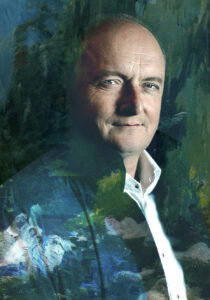
Conductor François Leleux, Jeux de couleurs
Photo: Jean-Baptiste Millot
> How do you stay in touch with different trends and composers?
I try to stay connected to the new generation and attend as many concerts as possible to keep abreast of different genres and esthetics. I also work with constantly changing selection committees, whether for the Montréal/Nouvelles Musiques festival or for calls for submissions related to commissions. These committees help me ensure fair representation of the styles that coexist today. For me, this is the essential duty of an artistic director: to present an accurate picture of the field. The scene is more diverse than ever; there are fewer dominant esthetic trends in contemporary music today than in the past, which makes it necessary to give voice to a wider range of perspectives. However, this is complemented by a duty to remember, in order to maintain a living link between the works and leading figures of the past and present.
> The Fougue concertante concert will kick things off on Jan. 30 with an evening dedicated to contemporary concertos. Tell us about the program.
This concert explores different ways of rethinking the concerto form today. The three soloists selected following a call for submissions have proposed concertante works with very contrasting esthetics. Percussionist Catherine Cherrier will perform a highly virtuosic and effervescent work by Philippe Leroux, in which a fascinating dialogue takes shape with the other instruments. Élise Poulin, for her part, will introduce us to a work by Martín Matalon, Trame I, in which the timbre of the oboe is at the heart of a more lyrical dialogue with the ensemble. Finally, violinist Bailey Wantuch will present Kaija Saariaho’s violin concerto, a very colourful work in which everything seems to arise organically from the sound of the violin. The program as a whole thus offers a fragmented and resolutely contemporary vision of the concerto, far removed from the traditional Romantic model with a soloist who is a kind of hero simply accompanied by the orchestra.
We also wanted to pay tribute at the beginning of the program to composer Margareta Jerić, who passed away last November. The work presented, which was unfortunately her last, was commissioned by SMCQ and premiered at the last MNM festival. It is a vibrant tribute to her native Croatia. The concert will, therefore, be dedicated to her memory.
> A Carte blanche à la relève will follow on Feb. 20 with five creations presented by the Ensemble Éclat. So we’re making way for young people?
Absolutely. We entrusted this carte blanche to the highly dynamic Ensemble Éclat and its conductor, Charles-Éric Fontaine, following a particularly successful collaboration at the last MNM festival. This project perfectly embodies the energy and audacity of the young generation gathered here: Geneviève Ackerman, Olivier St-Pierre, Lily Koslow, Louis-Michel Tougas and Jeffrey Fong. On the one hand, the very form of the concert is renewed; instead of a succession of separate works, the audience will hear an uninterrupted musical flow, resulting from a unique collective process. On the other hand, it is a transdisciplinary project in which music dialogues with poetry and light, in a scenography designed by composer Geneviève Ackerman, with original texts by poet Frédérik Dufour. In addition to the musicians of the Ensemble Éclat, the project also features young performers closely associated with contemporary creation, notably the Quatuor Mémoire and soprano Élisabeth Boudreault, whose presence helps to broaden the expressive palette of this immersive evening.
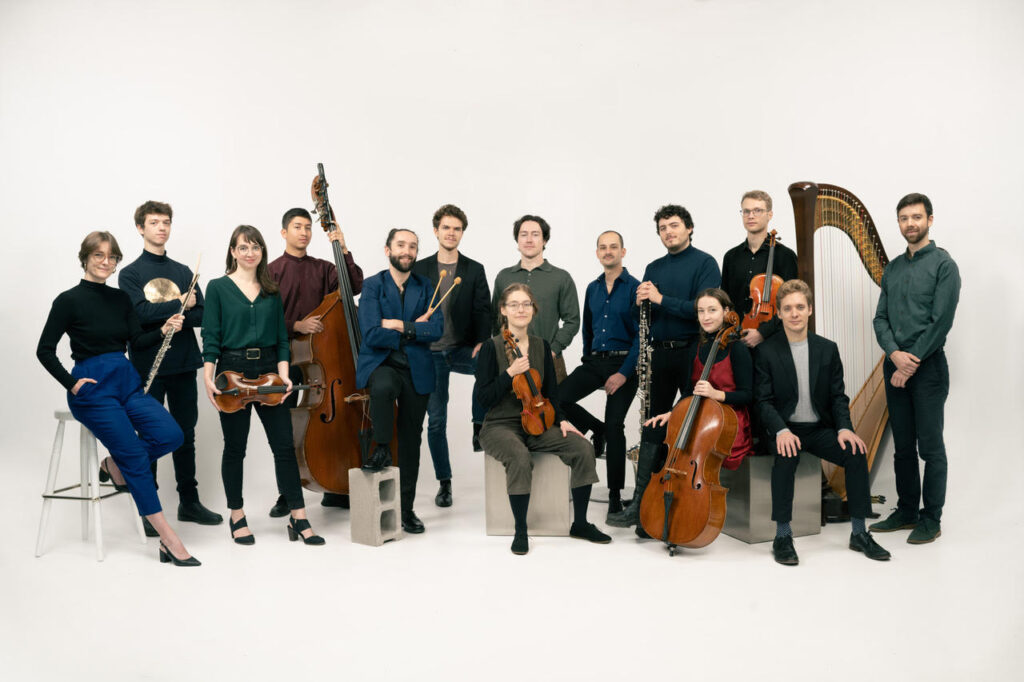
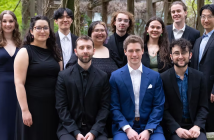
Ensemble Éclat is featured in Carte Blanche à la Relève
Photo: Philippe Latour
> Tell us about one of the works on the concert program.
SMCQ commissioned Olivier St-Pierre to write a concerto for string quartet and ensemble, which will be performed by the Quatuor Mémoire, a new ensemble known for its commitment to contemporary music. I particularly appreciate the dramaturgy of St-Pierre’s works, in which the musical lines unfold very slowly and organically.
Supporting emerging artists is one of my priorities, and this carte blanche is an eloquent illustration of that; it allows young composers to freely develop ambitious projects, both musically and formally.
> The concert Des classiques aux créations on March 21 will feature works by Jacques Hétu and Claude Vivier alongside creations by Alexandre David and Maggie Ayotte. Can you tell us more about it?
It’s a prime example of the dialogue we want to see between generations. Jacques Hétu and Claude Vivier are two major figures in Quebec’s musical heritage. It’s therefore essential to keep their works alive, while bringing them into contact with new creations. We are very pleased with this collaboration with the Orchestra de l’Agora and its guest conductor, Benoît Gauthier,which allows us to present large-scale Quebec orchestral works. The concert will feature leading soloists Marina Thibeault, Thomas Beard and Noémie Caron-Marcotte, whose commitment to contemporary music is remarkable.
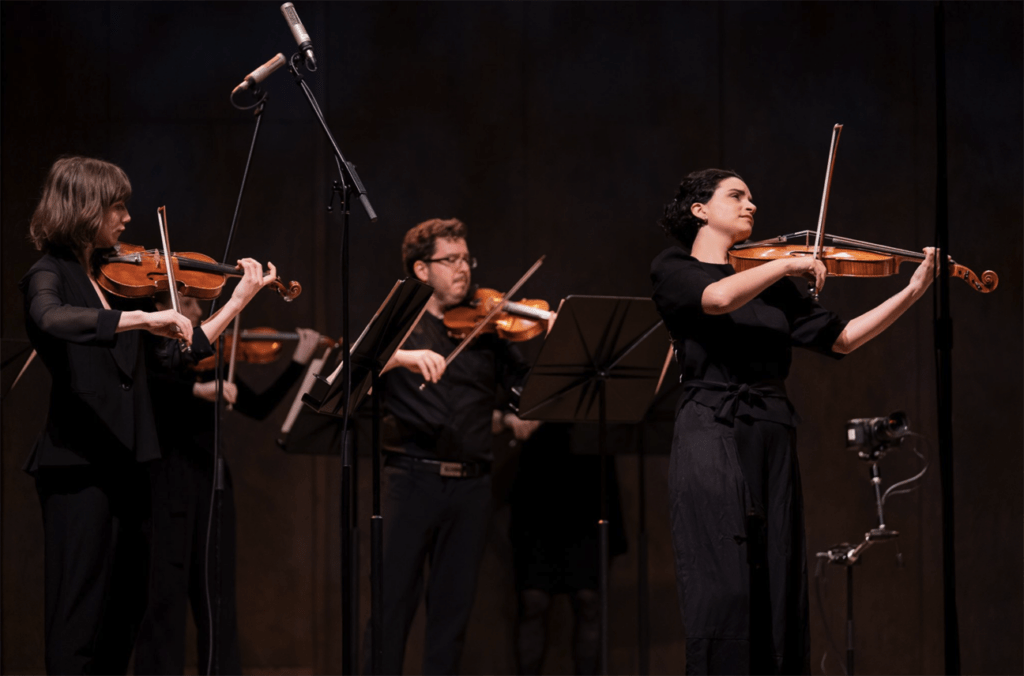
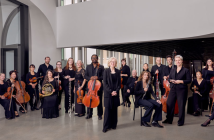
Marina Thibeault and the orchestra
Photo: Antoine Saito
> What will audiences discover with these two new creations?
Beyond the generational contrast, there is also a significant esthetic divide between the two works by these emerging composers: Maggie Ayotte’s piccolo concerto is distinguished by its delicate, fairly refined writing—yet rich in colour—while Alexandre David’s music is denser, deliberately opaque, with often complex layers of sound.
> Jeux de couleurs will feature Jacques Hétu’s Triple concerto in a concert by the Orchestre Métropolitain on April 17. Why does this work deserve to be rediscovered?
We are extremely pleased to renew our collaboration with the Orchestre Métropolitain, with which SMCQ has a longstanding relationship. In fact, at one time, former artistic director Walter Boudreau conducted this orchestra on several occasions. I would like to thank them for agreeing to program this triple concerto to celebrate our 60th anniversary. Jacques Hétu is a composer deeply rooted in modernity, nourished by influences such as Messiaen, Shostakovich and Berg. His music, remarkably structured and of high quality, has its rightful place alongside the great composers of the 20th century.
> Carte blanche à Cristian Gort will close the season on May 21. What criteria guided his choices?
This carte blanche to Cristian Gort, principal conductor of the SMCQ Ensemble, continues the season’s theme by bringing together works by Nicolas Gilbert, Florence M. Tremblay, John Rea, Philippe Leroux and Frédéric Le Bel. The notion of transmission is also very present: some teachers are reunited with their former students. The creation of an ambitious work by Frédéric Le Bel, another commission from SMCQ, once again illustrates the SMCQ’s desire to commission significant works in order to enrich the repertoire in a lasting way.
 > Does this dialogue, in general, define your approach to artistic direction?
Yes, absolutely. Today, the divergence of esthetics is such that it is crucial to offer them a fertile playground where they can coexist. We saw this at the MNM 2025 festival, where the aesthetics, as well as the audience, could change radically from one concert to the next. Our role is, therefore, to offer a variety of powerful experiences, while encouraging encounters between audiences. Bringing together artists with contrasting esthetics also helps to build bridges and encourage curiosity and openness within this wonderful diversity.
To find out about all of SMCQ’’s upcoming programming, visit www.smcq.qc.ca.
This page is also available in / Cette page est également disponible en:
Français (French)