
Canadian Opera Company opened its 2025-26 season on Sept. 27 with Gounod’s Roméo et Juliette, an opera they have not presented in 33 years. It returns in a production that originated at Sweden’s Malmö Opera in 2022, staged by British director Amy Lane. For lovers of French opera, it was a long wait for this repertoire mainstay, unfortunately saddled here with an incoherent concept. Usually this is a cue to say, “but the musical delivery compensated”—sadly, it wasn’t the case.
This is a classic example of a staging that only begins to make sense once you have read more about it after-the-fact. On my subway ride home I did just that, perusing an interview with Lane which answered some of my questions, but also added a few more head-scratchers.

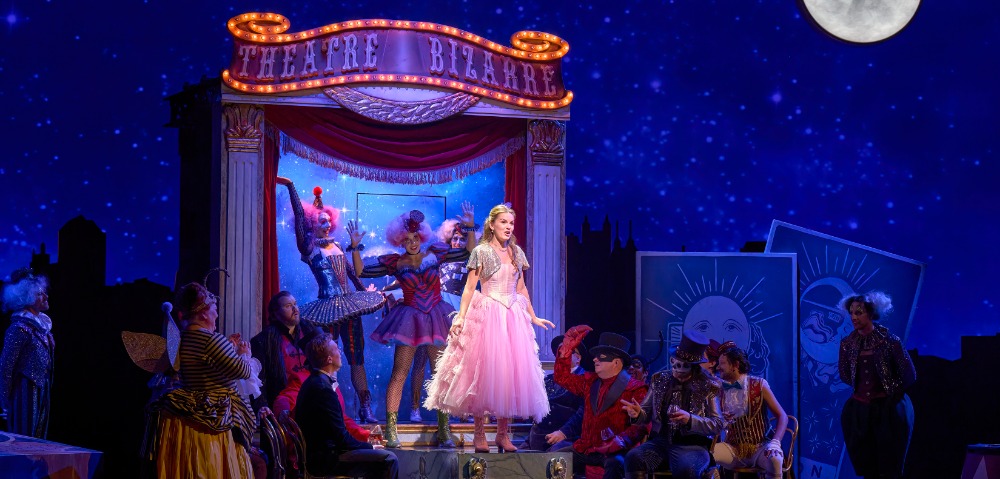
Scene from the Canadian Opera Company’s Roméo et Juliette. Photo: Michael Cooper
The action opens on a circus scene with a troupe of stylized clown dancers and the entire chorus dressed like circus performers. Juliette sings her famous waltz on a stage within the stage emblazoned with the moniker, “Théâtre bizarre.” It appears the action has been transferred to a big top environment, at least for Act 1. The circus setting never appears again, and it’s reasonable to ask why not? Its inclusion was puzzling, and seemingly random, given how little it did to enlighten our understanding of the piece.
In the program, Lane explains she has moved the action to New York City during the late 19th-century Gilded Age, and this opening scene is a costume party to celebrate Juliette’s 16th birthday. However, there was nothing to signal the party guests weren’t actual circus performers. The director makes statements such as “We imagined the Capulets to have an entertainment empire, with great social power and presence, owning restaurants, theatres, and clubs; and they were to be renowned for throwing parties that were always the talk of the town.” This isn’t of much use when the ideas aren’t fully-supported by intentional characterization and design. Lane goes further to note that Roméo’s family are immigrants encroaching on Capulet territory. There was nothing to indicate this in the way the Montagues were costumed, nor in terms of their onstage interactions.

Kseniia Proshina (Juliette) & Stephen Costello (Roméo) in Canadian Opera Company’s Roméo et Juliette, 2025. Photo: Michael Cooper
Lane also directed another Gounod classic, Faust, at the COC last season. It was similarly afflicted with too many disparate design elements and a penchant for clichés like slow motion clapping. Once past the surface-pretty circus opening, the dark, minimalist settings could have belonged to any standard production of Roméo et Juliette. The lack of visual specificity extended to the direction of the principals as well. Seldom have literature’s most famous star-crossed lovers exhibited so little onstage chemistry.
Would that the musical values had been of a standard to compensate for the dramaturgical black hole. For opera to make its full impact, careful attention must be given to both the music-making and the declamation of text. Gounod’s librettists, Jules Barbier and Michel Carré, supplied an interpretation of Shakespeare that is full of poetry and also moves the narrative along efficiently. French is notoriously difficult to sing with its abundance of nasalized vowels and shadowy schwas. While we can acknowledge these challenges, it’s still quite shocking that in a bilingual country where French is one of the official languages, the COC couldn’t have coached more idiomatic pronunciation in a cast, barring the two title role singers, almost entirely comprised of Canadians. There were just too many mispronounced vowels and misplaced stresses to be ignored, with some honourable exceptions.

Kseniia Proshina (Juliette) in Canadian Opera Company’s Roméo et Juliette. Photo: Michael Cooper
American tenor Stephen Costello and Russian-born, Paris-based soprano Kseniia Proshina took the title roles. Costello is no stranger to the COC having played the Duke in Rigoletto in 2018 and Edgardo in Lucia di Lamermoor in 2013. He sings with a formidable, secure technique that allows him to sustain high notes for days, perhaps to a fault. After the umpteenth fermata, the effect begins to wear off, and there is little ring to his upper register to elicit aural thrills. Dynamics were consistently loud, and sadly, he was one of the worst offenders in terms of intelligibility of text. Costello’s stiff stage manner worked against creating meaningful connection with his Juliette.
Proshina possesses a bright, light instrument which is suited to some of the role’s demands such as her silvery entrance ditty and the coloratura heights of her waltz. As is the current practice, Juliette’s demanding Act 4 “poison aria” was included, often cut in the past. To make its full effect, it requires a voice at least one size larger and richer in colours than Proshina’s. She navigated its challenges well, but was unable to offer the extra oomph a more substantial tone can deliver. Her acting was effective throughout.
It was two lower-voiced men who came closest to balancing excellent vocalism with authentic-sounding text. Canadian bass and COC veteran Robert Pomakov sang Frère Laurent with big, gravelly sound, but also, properly-weighted syntax. That this cleric was costumed in a scientist’s lab coat for his first entrance is only one small example of the production’s visual confusion.
In the smaller, but still impactful, role of the Duke, Canadian bass Alex Halliday made an impressive upstage, scaffold entrance to bring peace after the deaths of Mercutio and Tybalt. This young singer always impresses for the utter homogeneity of his tone, evenly delivered from top to bottom, and his French was admirably clear. In perhaps the staging’s most egregious moment, he was stabbed to death by a chorister for no discernable reason.
Mercutio’s big moment is his “Queen Mab” aria in Act 1, a superb example of how orchestration, melody and text can come together to embody a quicksilver image of a fairy riding her spider-leg wagon. Gordon Bintner is one of our busiest singers with an enviable international career. He was a recent, memorable Eugene Onegin and Don Giovanni for the COC. Mercutio, however, just doesn’t sit well in his bronzed bass-baritone. The role is usually cast with a lighter, higher baritone for good reason.
As Tybalt, tenor Owen McCausland was an energized presence and his pingy, well-projected sound is perfectly married to the role’s demands. As Juliette’s nurse Gertrude, mezzo-soprano Megan Latham once again excelled in the type of fruity, sassy companion role she knows how to deliver so well. Veteran British baritone Mark Stone made a belated COC debut as Capulet and offered a masterclass in declamation even if his vocal resources sounded fragile at times.
In the pants role of Roméo’s servant Stéphano, mezzo-soprano Alex Hetherington convincingly embodied the young man. She has one big moment, the aria “Que fais-tu, blanche tourterelle,” that opens Act 2, scene 3. Hetherington was not helped by a staging that gave her not one Capulet at whom she could direct her barbs.

Stephen Costello (Roméo) & Kseniia Proshina (Juliette) in Canadian Opera Company’s Roméo et Juliette. Photo: Michael Cooper
Canadian guest conductor Yves Abel made a welcome return. He is something of a French romantic opera specialist, and demonstrated this by coaxing an elegant sound from the COC Orchestra, and maintaining a flexible, yet not overly indulgent, pace. The COC Chorus was especially effective in delivering the prologue outlining the warring family factions, offering a wide range of dynamics.
One can’t help but reflect on the COC’s current artistic state. There was a time not so long ago when Toronto audiences were exposed to some of the most thought-provoking stage directors currently working on the international opera scene. Launching a season two years running with decorative, dramatically-confused stagings of operas long out of the company’s repertoire doesn’t serve anyone well. There will be revivals this season of more solidly-conceived concepts by Robert Lepage, Christopher Alden and Robert Carsen. But given the expense and relative rarity of new stagings in Toronto, one can only lament the opportunity missed to present these great French romantic works in a more compelling manner.
Canadian Opera Company’s Roméo et Juliette continues its run at Toronto’s Four Seasons Centre for the Performing Arts until Oct. 18.