Opera Atelier opened its season on Oct. 15 with a revival of Mozart’s The Magic Flute, an opera which has played a key role in the company’s history starting with its first production in 1991. As founding co-artistic director Marshall Pynkoski mentioned in his pre-show speech, back then it was Canada’s first historically-informed, period staging of the perennial classic. In this, the company’s 40th-anniversary season, the period elements are still at the fore, but the strength of this revival lies in how strongly it connects with the audience both textually and visually.
This effect is largely due to an artistic choice: to use Andrew Porter’s witty 1984 translation instead of the original German text. There’s nothing to compare with the effect of jokes making their impact directly, without having to rely on an oft-ill-timed surtitle translation. And with a cast that delivers Porter’s words with such expert timing, you’re suddenly more in the world of vaudeville and music theatre than grand opera, which is exactly what Mozart would have intended. Flute fans are often subject to polyglot casts struggling to deliver their lines in German with less-than-humurous results. For an opera that contains reams of spoken text, and for a largely anglophone audience, using the Porter translation is a smart choice.
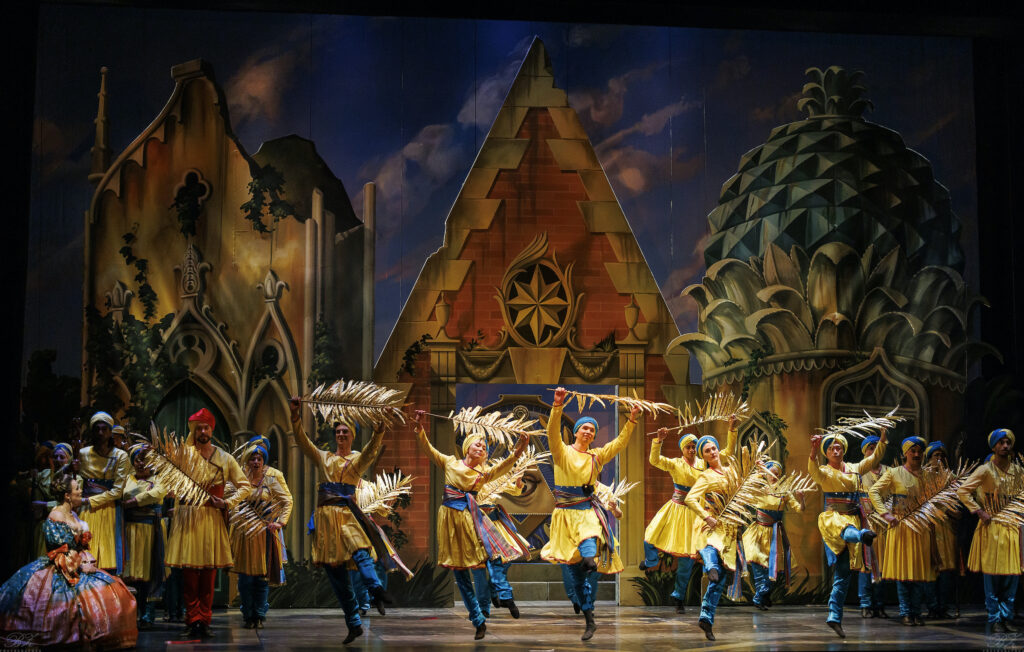
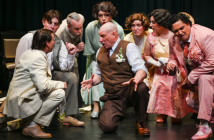
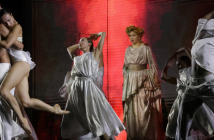
Artists of Atelier Ballet in Opera Atelier’s The Magic Flute. Photo: Bruce Zinger
Pynkoski’s staging and co-artistic director Jeanette Lajeunesse Zingg’s choreography are also key elements in the production’s communicative success. The action just keeps moving; entrances and exits are exquisitely choreographed. Small touches like the sudden swish and turn of a skirt as a character goes into the wings have a huge cumulative visual effect. Beyond the formal dancing itself in the choral scenes, each character exhibits a body language that telegraphs their personality. A prime example is Douglas Williams’ Papageno, whose skips, hops and relevés are perfectly-attuned to his creature-of-nature status. All of the physical elements coalesce to maximally deliver text and music to the audience.
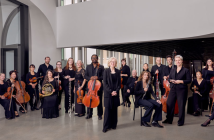
For this performance, Opera Atelier was back at the historic Elgin Theatre on Yonge Street in downtown Toronto. Its 1920s gilded, golden-age interior is legendary. So are its notoriously bad acoustics. It always takes some auditory adjustment as the excellent Tafelmusik orchestra under OA’s resident music director David Fallis plays their opening notes. The extremely dry acoustic doesn’t flatter historic instruments resulting in an occasionally sour sound that isn’t an issue when they play in more resonant venues like Koerner Hall and their Trinity-St. Paul’s home on Bloor Street.
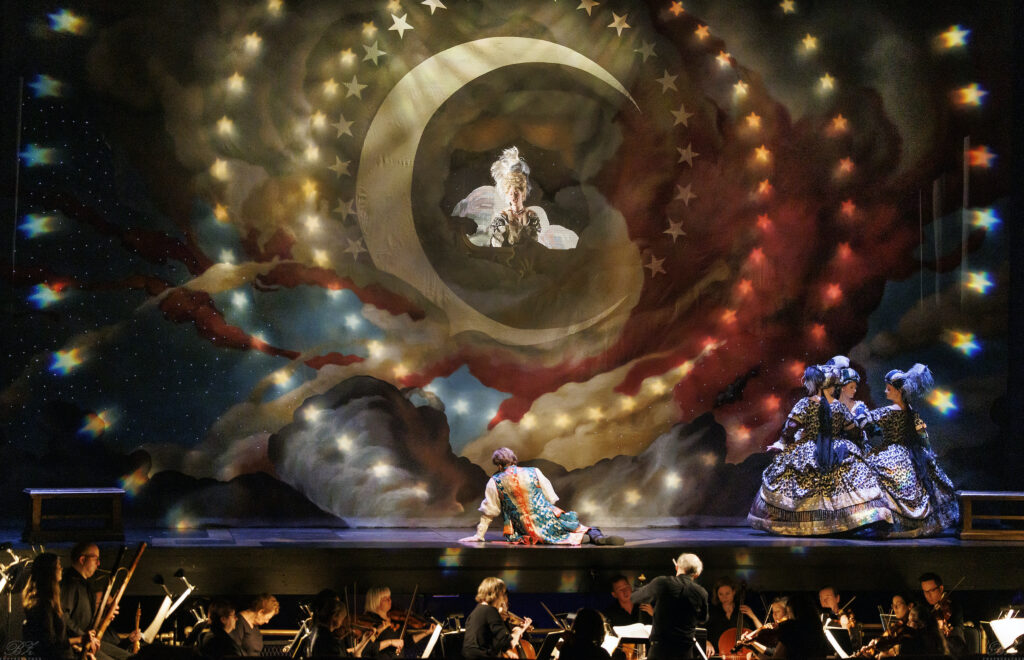
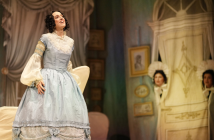
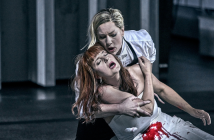
Scene from Opera Atelier’s The Magic Flute. Photo: Bruce Zinger
The singers also must overcome the acoustic dryness. Everyone could be heard, but some were more successful than others in their efforts to project. Tenor Colin Ainsworth as Tamino was outstanding in this regard. Every word is clear but he still produces beautiful legato tone, his vocalism absolutely secure. He exuded princely goodness without ever tipping over into the maudlin.
The other outstanding characterization was delivered by bass-baritone Douglas Williams as Papageno. At first, his rich, dark tone pricked up my ears given the role is usually entrusted to lighter, higher baritones. But he quickly showed how eminently suited he is to one of opera’s greatest comic creations, both vocally and dramatically. Papageno can sometimes outstay his welcome, but Williams ensured this didn’t happen with his witty asides and nimble physicality. What a versatile singer he is; he’ll return as the tortured Golaud in OA’s Pelléas et Mélisande this spring.
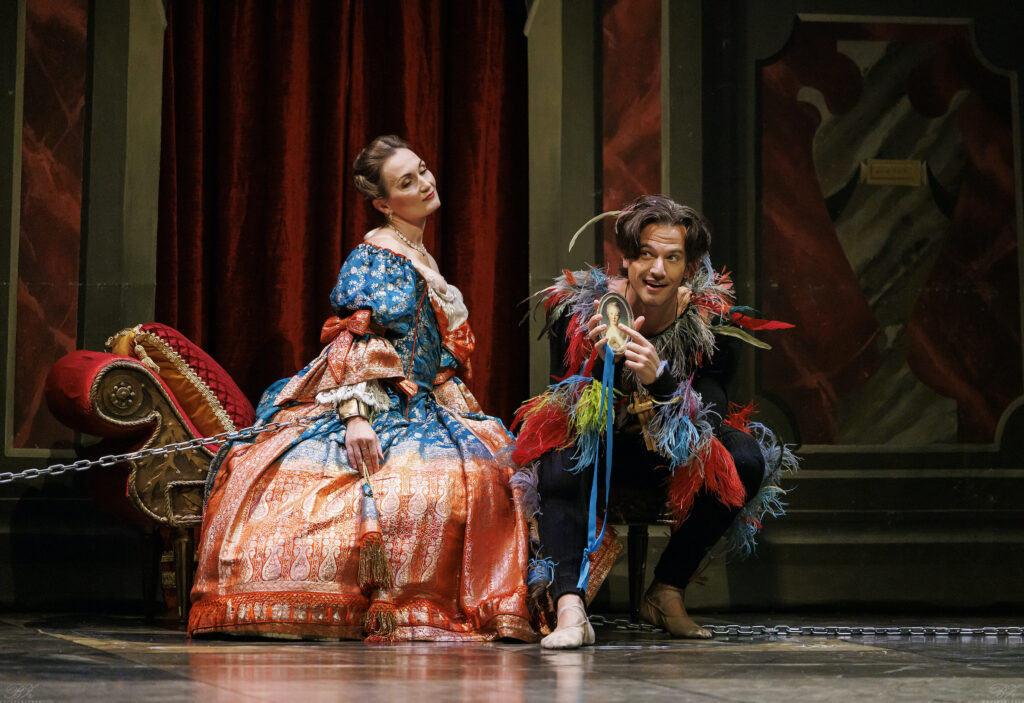
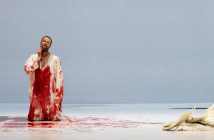
Meghan Lindsay (Pamina) & Douglas Williams (Papageno) in Opera Atelier’s The Magic Flute. Photo: Bruce Zinger
For many, Magic Flute is inextricably connected with the Queen of the Night and her two stratospheric, show-stopping numbers. It’s a very tricky proposition for any soprano who must contend with a million YouTube renditions and the pressure to be spot-on perfect, but with only two relatively short appearances to prove her vocal mettle. OA has lucked out with Rainelle Krause, probably the most spectacular Queen I have heard live. Not only were her higher-than-high notes perfectly delivered, but she managed to do so with a voluminous, projecting tone that often eludes coloraturas. Given her virtuosity, she was allowed to reprise the last portion of her second aria, adding in ever higher interpolations and decorations. It’s no wonder she’ll perform this role at the Metropolitan Opera in December.
Soprano Meghan Lindsay was a beautiful Pamina. It’s no secret that her voice has developed in amplitude in recent years (she sings her first Tosca with Pacific Opera Victoria later this season), but she was still able to deliver the role with gorgeous lyricism. Like Williams, she’ll also return in a very different role as Mélisande in the Debussy in May.
Bass-baritone Stephen Hegedus was perhaps an unusual choice for Sarastro given his instrument is more on the lyrical side, but he proved that the role’s lower reaches held no terrors. And his beautifully-clear delivery of the text meant that what can sometimes be a rather stiff assignment, came to light in a much more sympathetic way.

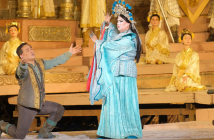
Colin Ainsworth (Tamino) with Carla Huhtanen, Danielle MacMillan & Laura Pudwell as the Three Ladies in Opera Atelier’s The Magic Flute. Photo: Bruce Zinger
Magic Flute is really an ensemble piece, and there were no weak links in the supporting cast. The Three Ladies were hilarious in their opening mean girls bickering over who should be closest to hunky Tamino. Carla Huhtanen, Danielle MacMillan and Laura Pudwell also blended expertly in what is perhaps the most beautiful music in an opera filled with it. As Monostatos, tenor Blaise Rantoanina was a comic villain, with an acrobatic presence.
Karine White was a fun Papagena, but the character was robbed of her first scene when she appears to Papageno as an Old Lady. This meant that his later lament that he had lost her didn’t make a lot of sense. OA elected to cast three sopranos as the three boys, often a better, more practical choice. Alison Beckwith, Katie Lair and Cynthia Akemi Smithers harmonized beautifully as the spirits that guide Tamino and Papageno through their trials. Alexander Cappellazzo and Olivier Laquerre projected appropriate severity as the armed men. Cappellazzo in particular was hilariously dry in his exchanges with Papageno.
The choral numbers were delivered expertly onstage and off by the Nathaniel Dett Chorale. Gerard Gauci’s monumental sets, Michael Gianfrancesco’s sumptuous costumes and Kimberly Purtell’s atmospheric lighting were intrinsic to the overall success of the staging.
A more accessible, democratic and entertaining Magic Flute would be hard to imagine. The company should be lauded for investing so much care in this loving, but still vital, revival.
Opera Atelier’s The Magic Flute continues its run at Toronto’s Elgin Theatre through Oct. 19.