
With Matthias Davids’ new production of Die Meistersinger von Nürnberg (seen Aug. 22), the Bayreuth Festival seemed determined to offer something that was the polar opposite of its last two stagings of Wagner’s comedy. Festival artistic director Katharina Wagner’s 2007 concept, and its 2017 successor by Barrie Kosky both deconstructed the work, referencing its co-opting by the Nazis, and the anti-Semitic underpinnings of characters like Beckmesser.
Davids, who is artistic director of musicals at Austria’s Landestheater Linz, has underlined his intention to emphasize the comedy in Wagner’s opera. But in doing so, the production barely penetrates beyond the level of a television situation comedy.

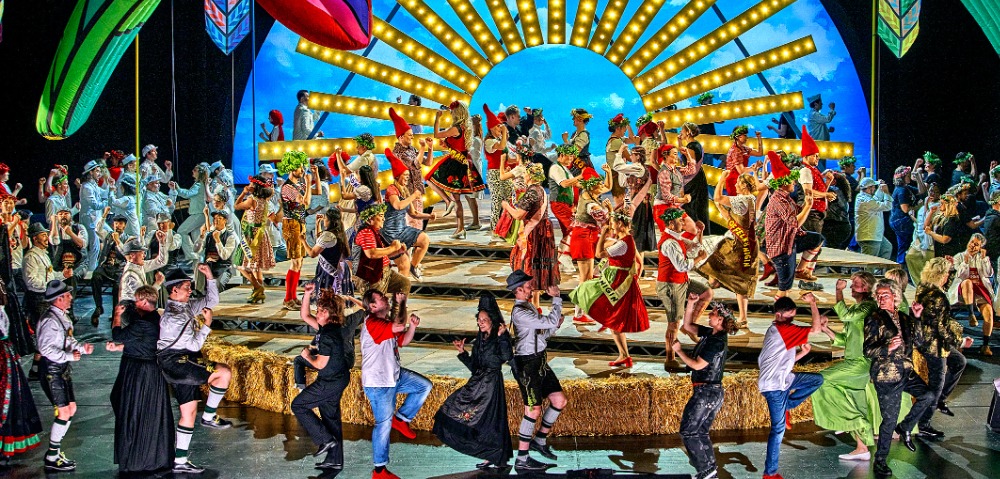
Scene from Bayreuth Festival’s Die Meistersinger von Nürnberg. Photo: Enrico Nawrath
As a director who probably has triple threat performers at his disposal for the musicals he stages in Linz, it’s much more difficult to achieve the same “all-singing, all-dancing” results with performers who aren’t necessarily trained in that style. This was especially apparent in the choreography given to the youthful chorus. A lot of it was extremely trite with lots of nodding of heads and hands from side to side in time with the music.
Individual choristers were encouraged to react to the main action, but this often came off as slightly high school musical. And yet, in the grand melée that ends Act 2, Davids seemed to have given up with the idea of blocking and instead, installed the large chorus in a lump upstage.
Visually, this was a handsome presentation in Andrew D. Edwards’ monumental sets which included a vertiginous church atop what looked like 100 stairs in Act 1, and stylized half-timbred facades in Act 2. The latter were brightly-coloured in candy store colours giving off a technicolour, Disney Babes in Toyland aesthetic. Susanne Hubrich’s costumes were eclectic, evoking small town 1960s with loud patterns and colours and yet, the churchgoers exiting in Act 1 were straight out of the 19th century.
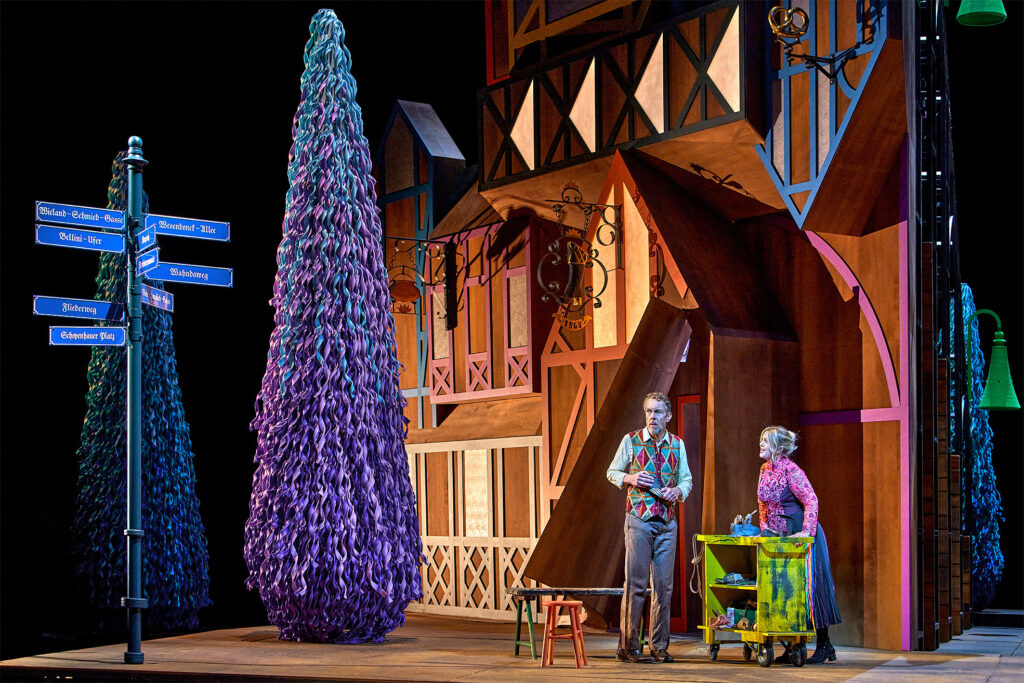
Georg Zeppenfeld (Hans Sachs) & Christina Nilsson (Eva) in Bayreuth Festival’s Die Meistersinger von Nürnberg. Photo: Enrico Nawrath
The problem with treating the libretto more or less at face value, is that incidents like the cruel beating of Beckmesser in Act 2 elicit little sympathy. Here, an impromptu boxing ring is set up in the town square to maximize the comic effect. It’s admittedly difficult to erase memories of the same scene in the previous Kosky staging where the beating was clearly related to Beckmesser’s Jewish identity. In a different vein, Hans Sachs’ deep ruminations on art and its relationship to national identity slip by with nary a nod to their multifarious depths.
Performances were at a high level all-round. As with his Siegmund in Die Walküre, tenor Michael Spyres impressed with his beautiful tone, and careful attention to the text. His instrument has a soft quality which sometimes meant it was covered when the orchestra and chorus were going full tilt, but this Walther can be counted as another success in the American’s growing list of Wagnerian roles.
As Eva, the object of his infatuation, soprano Christina Nilsson offered almost-ideal clarity of tone and pingy projection. It’s gratifying to see how the festival promotes singers from smaller roles like Freia in Das Rheingold over successive seasons.
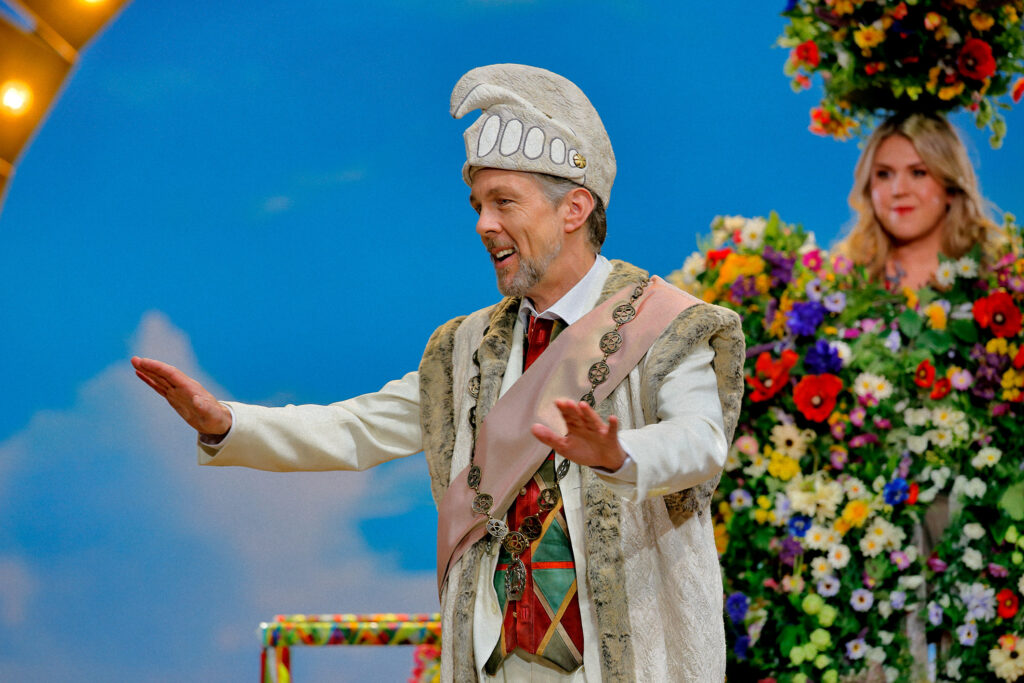
Georg Zeppenfeld (Hans Sachs) & Christina Nilsson (Eva) in Bayreuth Festival’s Die Meistersinger von Nürnberg. Photo: Enrico Nawrath
Georg Zeppenfeld possesses all the attributes of a great Hans Sachs with his lyric bass, sympathetic presence, and masterful delivery of the text. That his portrayal didn’t quite plum the emotional depths it could have probably had more to do with the lack of seriousness surrounding him. Baritone Michael Nagy offered an uncaricatured Beckmesser who extracted what comedy he could from the rockstar delivery of his second act song.
Veteran Wagnerian mezzo Christa Mayer was a vocally-rich, mature Magdalene opposite tenor Ya-Chung Huang as David. The latter used his small but bright tone to good effect but seemed more like a son than potential lover…kudos to Magdalene?
Daniele Gatti offered a beautiful account of the score from the depths of the Festspielhaus’s submerged pit. The company received tremendous ovations for what is undoubtedly a crowd-pleasing staging. Whether it has the legs of more recent, and more serious, grapplings with this great score is doubtful.
Information about the Bayreuth Festival’s 2026 season can be found here.