This page is also available in / Cette page est également disponible en:
 Français (French)
“L’amour est un oiseau rebelle que nul ne peut apprivoiser, Et c’est bien en vain qu’on l’appelle, S’il lui convient de refuser.” With these lines, Georges Bizet’s Carmen bursts onto the stage, declaring that love is wild, untameable, and indifferent to human desire.
This is the heart of Carmen: a tale of irresistible attraction and fatal freedom, set against the sun-drenched streets of Seville. Nearly 150 years after its premiere, Carmen remains a fan favourite. According to OperaBase, it is the third most performed opera in the world, with 19,405 performances across 4,686 productions, including 232 performances in Canada.
History of Carmen
Carmen, composed by Georges Bizet with a libretto by Henri Meilhac and Ludovic Halévy, premiered on March 3, 1875, at Paris’s Opéra-Comique. Inspired by Prosper Mérimée’s novella, Bizet’s opera defied opéra comique conventions, replacing lighthearted tales with realism, grit, and tragedy. Early audiences and critics were scandalized by its raw depiction of passion, criminality, and death. The production struggled initially, and tragically, Bizet died of heart failure at 36, unaware that his opera would soon become a cornerstone of the repertoire. As European audiences warmed to Carmen’s power and innovation, it was quickly recognized for its masterful orchestration and unforgettable melodies, solidifying its place in operatic history.
Plot Synopsis
In Seville, soldier Don José becomes entangled with the seductive gypsy Carmen, who works at the local cigarette factory. She enchants him with her free spirit, symbolized by her iconic Habanera. After causing a fight and being arrested, Carmen seduces José with the Seguidilla, convincing him to let her escape. José’s passion leads him to abandon his military duty and join Carmen and a band of smugglers. Meanwhile, the toreador Escamillo arrives, his bold presence underscored by the famous Toreador Song, and he, too, vies for Carmen’s affection. Jealousy and obsession consume José as Carmen’s love turns to Escamillo. Micaëla, José’s childhood sweetheart, pleads with him to return home to his dying mother. Ultimately, Carmen rejects José, and in a fit of rage outside the bullring during Escamillo’s triumphant fight, José kills her.
What to Listen For
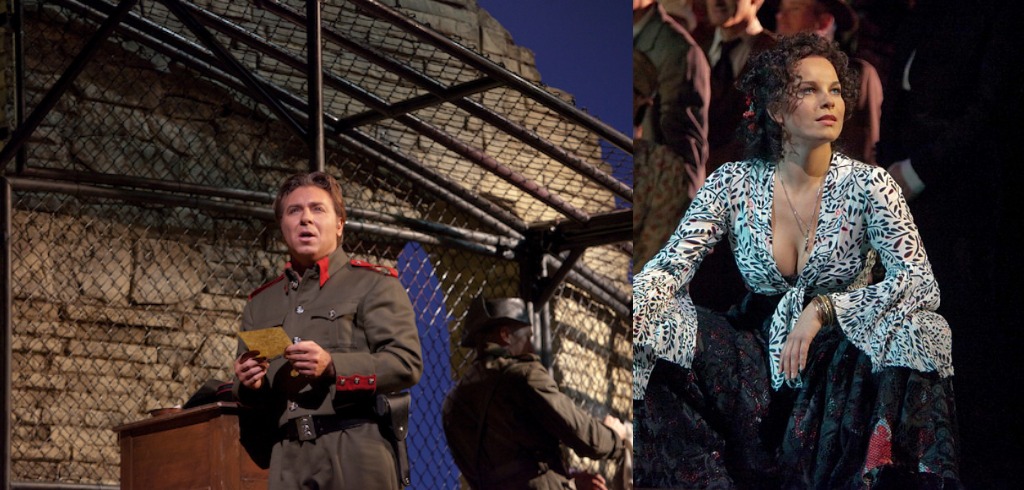
The Habanera (“L’amour est un oiseau rebelle”) embodies Carmen’s untamed spirit. Maria Callas’s legendary 1964 performance at the Paris Opéra, conducted by Georges Prêtre and directed by Franco Zeffirelli, remains a towering interpretation. Elīna Garanča’s sultry 2010 Metropolitan Opera performance under Yannick Nézet-Séguin’s baton, directed by Richard Eyre, has also become a modern benchmark.
The Flower Song (“La fleur que tu m’avais jetée”) captures Don José’s longing. Plácido Domingo’s 1978 recording with the London Symphony Orchestra, conducted by Claudio Abbado and directed for stage by Jean-Pierre Ponnelle, is noted for its vulnerability and warmth. Jon Vickers’s performance in the 1967 video from the Salzburg Festival captures its drama.
Micaëla’s Aria (“Je dis que rien ne m’épouvante”) often brings a moment of grace amid turmoil. Régine Crespin’s interpretation in the 1963 Metropolitan Opera production, conducted by Thomas Schippers and directed by Jean-Pierre Ponnelle, showcases her luminous tone and emotional sincerity.
The Toreador Song (“Votre toast”): José Van Dam’s performance in the 1980 recording with the Orchestre National de France, conducted by Seiji Ozawa and staged by Louis Erlo, is highly recommended.
The Choruses
The choruses in Carmen are also true gems that enrich the storytelling with vivid atmosphere. The chorus of cigarette girls brings the bustling factory courtyard to life with playful banter, while the smugglers’ chorus adds intrigue and excitement. Most striking is the stirring chorus that sings of liberty, a rousing moment that reflects not only the characters’ desire for freedom but the opera’s deeper themes of independence and rebellion. Recommended essential listening for these choruses is the 1964 Paris Opéra recording conducted by Georges Prêtre.
Recommended Complete Recordings
The 2009 recording featuring Roberto Alagna as Don José, with Béatrice Uria-Monzon as Carmen, conducted by Michel Plasson and staged by Nicolas Joël at the Théâtre du Capitole de Toulouse, offers a passionate and modern take on the classic. Also, the historic 1930 recording with Georges Thill as Don José and Germaine Cernay as Carmen, conducted by Elie Cohen with the Paris Conservatoire Orchestra, is an extraordinary document capturing the French style and authenticity of an earlier era.
Canadian Interpreters
Richard Verreau’s standout interpretation of Don José can be heard in his 1958 CBC recording with the Montreal Symphony Orchestra, conducted by Jean-Marie Beaudet. His smooth phrasing and elegant French diction make this recording a treasured example of Canadian artistry in French opera. In addition, baritone Claude Corbeil brought strength to the role of Escamillo in productions at the Opéra de Montréal during the 1980s, conducted by Raffi Armenian. Soprano Pierrette Alarie and baritone Louis Quilico have also contributed memorable performances in Canadian stages and broadcasts.
Nouvel Opéra Métropolitain presents Bizet’s Carmen on June 7, 7:30 p.m., at Cocathédrale Saint-Antoine-de-Padoue, Longueuil. A star-studded Canadian cast led by Marie-Nicole Lemieux (Carmen), Etienne Dupuis (Escamillo), Emmanuel Hasler (Don José), Suzanne Taffot (Micaëla), Catherine St-Arnaud (Frasquita), Florence Bourget (Mercedes), Dominique Côté (Dancaïre), Thomas Vinals (Remendado), Dion Mazerolle (Zuniga), and Pierre Rancourt (Morales). Jean-Marie Zeitouni directs the Orchestre du Festival Classica. Staging by Isabeau Proulx-Lemire.
This page is also available in / Cette page est également disponible en:
Français (French)