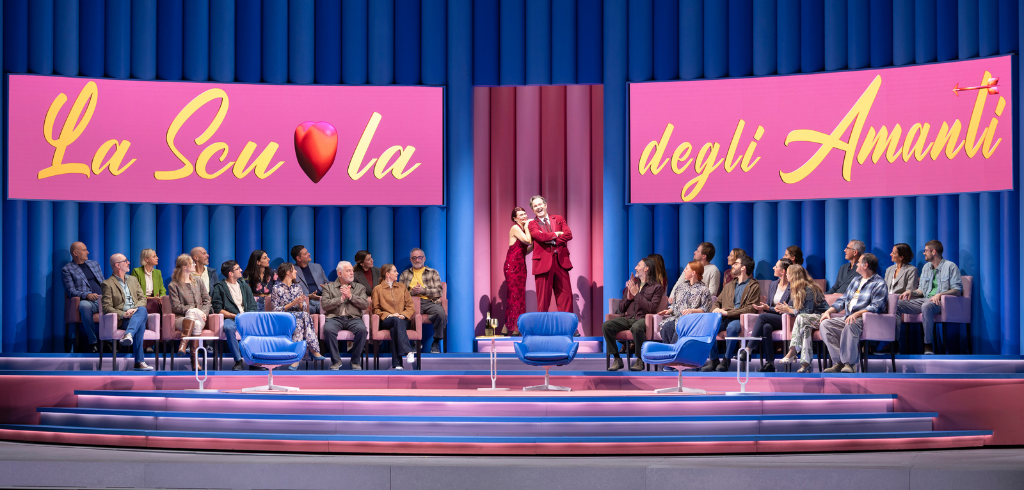
The evening begins inside a dazzling television studio. Cameras glide, applause signs flash, and a suave host greets a group of young couples assembled to test their love on live television. From among them he singles out two pairs whose fidelity will be put to the test before an audience and a bank of cameras. The million-euro prize glitters across giant screens. A revolving stage slides between pastel-pink dormitories and a shimmering poolside patio, while a pristine warship glides across an AI-generated sea.
It all feels like a parody of Love Island or Big Brother—a world of total surveillance, where every gesture is performed for unseen spectators—yet this is Mozart’s Così fan tutte, reimagined by Robert Carsen for an age when even love has become a public experiment (seen Nov. 5).
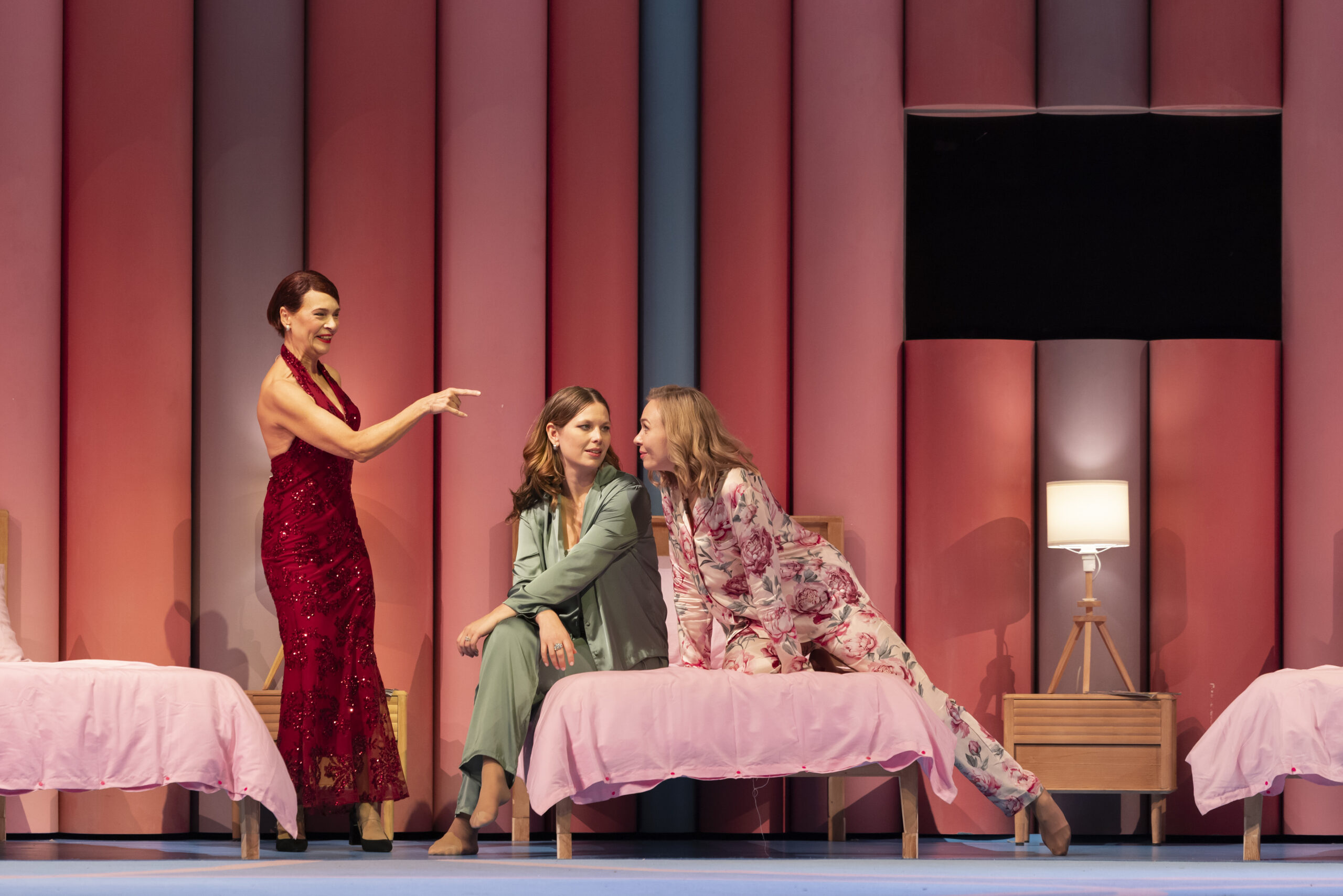
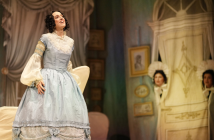
Sandrine Piau (Despina), Elsa Dreisig (Fiordiligi) & Nina van Essen (Dorabella) in Teatro alla Scala’s Così fan tutte. Photo: Vito Lorusso
The opera unfolds in a fluorescent, AI-generated “Barbie world,” a universe of perfectly polished surfaces that makes no pretense toward naturalism. These synthetic images—projected and animated by video designer Renaud Rubiano using generative software—create an aesthetic that is both absurdly artificial and conceptually precise.
The choice is far from decorative. It reflects Carsen’s central conceit: that Così fan tutte is not only about love, but about the idea of love—its representation, its idealisation, its performance. The television game show becomes an emblem of that idealised, public love: a contest, a façade, a projection of sincerity. The subtitle of Da Ponte’s libretto, La scuola degli amanti, becomes literal. We are watching an experiment in fidelity, with Despina and Don Alfonso recast as hosts rather than conspirators, and the four lovers as contestants in a live emotional laboratory.
“Our concept is called The School for Lovers,” Carsen explains. “It puts the couples to the test, probes their solidity, and exposes them to temptation to see what happens.” A master of psychological theatre, he handles the collision between 18th-century sentiment and 21st-century media culture with ease. The result is both entertaining and unsettling.
The Theatre of Illusion
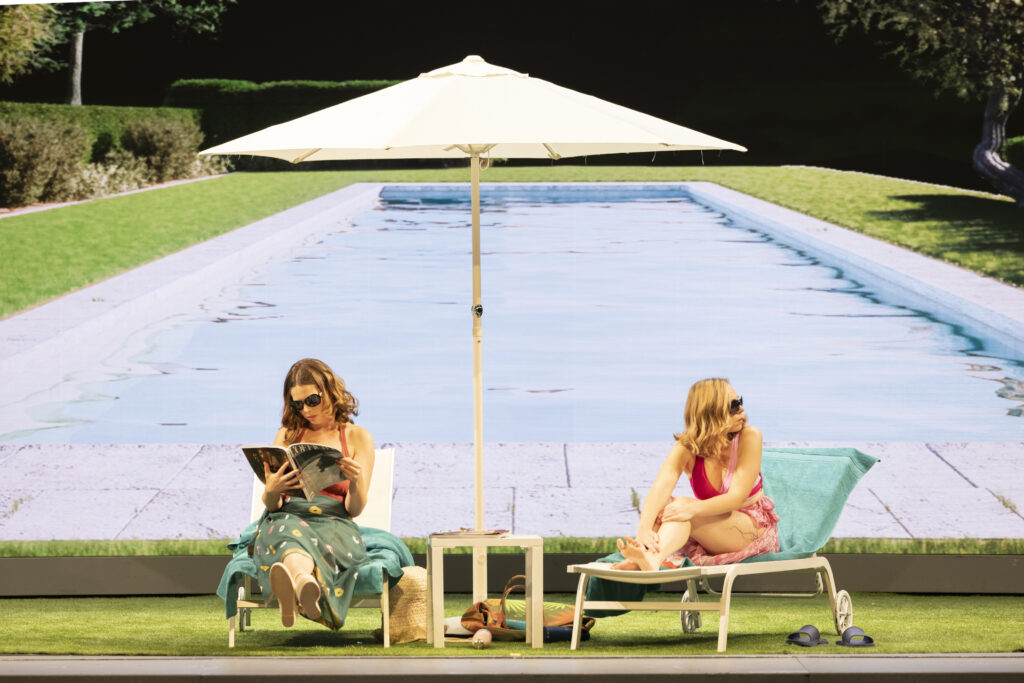
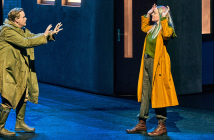
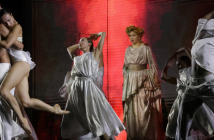
Elsa Dreisig (Fiordiligi) & Nina van Essen (Dorabella) in Teatro alla Scala’s Così fan tutte. Photo: Vito Lorusso
The stage, designed by Carsen and Luis F. Carvalho, with lighting by Carsen and Peter van Praet, permits endless transformations. Rebecca Howell’s choreography keeps the ensemble scenes sharp and dynamic, while Rubiano’s projections mutate constantly: pastel clouds, hyperreal shorelines, digital reflections that shimmer like dreams.
In the suicide scene, Carsen turns tragedy into another tour de force of AI-manipulated absurdity. As the lovers dramatically drink their “poison,” the onlookers—our hapless fellow contestants—seem to get caught in the digital spillover, their faces melting into psychedelic delight. The once-pristine pool begins to swirl like a screensaver on hallucinogens, the cypress trees pulse in impossible colours, and everyone moves in slow motion as if trapped inside a beauty filter set to “Renaissance meltdown.” It’s all deliriously over the top—Mozart in the age of AI, a Così fan tutte that looks as if it’s been rendered by Midjourney, the image-generating program for turning text prompts into surreal, hyper-saturated dreamscapes.
Carsen aligns this hyperreality with Mozart’s dramaturgy so precisely that the disguises and tests of fidelity seem to anticipate our own culture of performative intimacy. When the men return in disguise, the reveal feels like an episode twist. When Fiordiligi sings “Come scoglio” into a camera, her private vow becomes a public confession, her sincerity tested under scrutiny. The interplay of video and performance turns Così into a meditation on exposure itself—how easily love becomes content.
Vocal and Dramatic Excellence
Under Alexander Soddy’s baton, the Orchestra and Chorus of La Scala perform with spirited precision. The phrasing remains supple, the textures transparent, and the pacing natural, even when shaped by the production’s technical cues. Soddy strikes a balance between elegance and vitality, ensuring that the musical heartbeat of the piece never feels constrained by the staging.
The cast is uniformly strong. Elsa Dreisig brings a clear, silvery tone and emotional truth to Fiordiligi, her poise never compromising intensity. Nina van Essen’s Dorabella is bright, spontaneous, and dramatically alert—a lively foil to Dreisig’s restraint. Sandrine Piau, as the co-host of the show, exudes both mischief and authority.
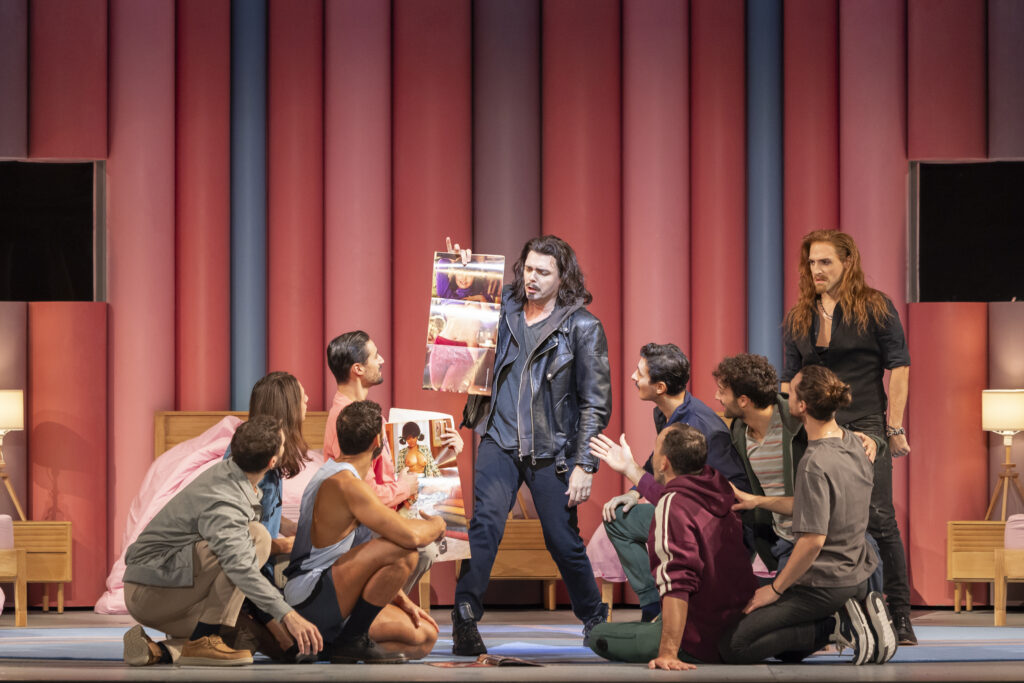
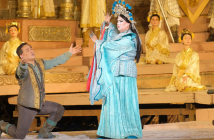
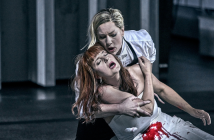
Luca Micheletti (Guglielmo) & Giovanni Sala (Ferrando) in Teatro alla Scala’s Così fan tutte. Photo: Vito Lorusso
Luca Micheletti and Giovanni Sala, as Guglielmo and Ferrando, embody the show’s performative premise with conviction. Sala’s Act II aria, set in the same armchair (and it’s double on the screen above) where Fiordiligi just sang her lament “Per pietà,” becomes one of the evening’s most poignant moments, a reflection on love’s mirrored illusions. Gerald Finley, as Don Alfonso, combines gravitas with elegance; his measured detachment transforms the manipulative philosopher into a producer of emotional theatre—wise, amused, and entirely in control.
A Television Studio for the Heart
The final ensemble leaves us suspended between resolution and performance. The couples reunite, but the cameras continue to roll; the applause sign flashes; the show goes on. Carsen refuses closure, offering instead a mirror to our own world, where even reconciliation can feel staged. His ending, quietly ironic, perfectly captures the bittersweet ambiguity of Mozart’s final chords.
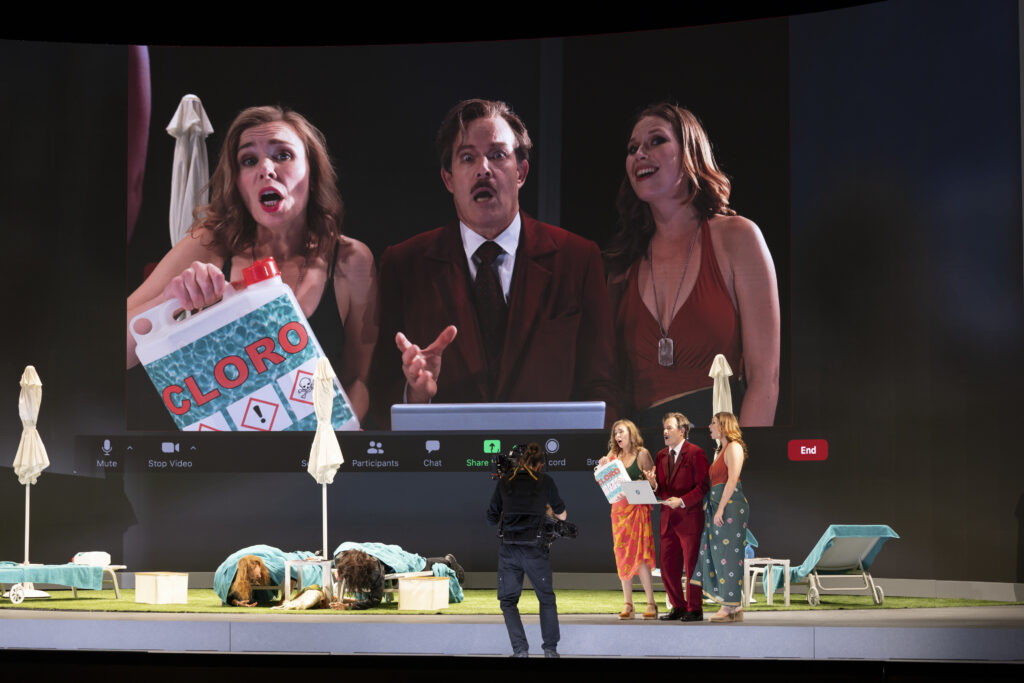
Scene from Teatro alla Scala’s Così fan tutte. Photo: Vito Lorusso
Finally, Carsen’s Così fan tutte is dazzling, witty, and conceptually coherent—a high-risk production that succeeds because it remains faithful to Mozart’s human insight. Together with Soddy’s precise musical architecture and the cast’s poised interplay, La Scala’s Così achieves rare clarity: love appears not as sentiment but as experiment—a mirror in which the self rehearses its own undoing.
Così fan tutte continues its run at Milan’s Teatro alla Scala through Nov. 26.