
This page is also available in / Cette page est également disponible en:
 Français (French)
For its 16th edition, FestivalOpéra de Saint-Eustache proved that all you need is a voice, a piano, and an audience willing to listen. Over three nights, the festival delivered music that was as honest as it was ambitious.

Serhiy Salov performs at FestivalOpéra de Saint-Eustache. Photo: André Chevrier
The festival opened with pianist Serhiy Salov, whose Chopin-focused recital was no small gesture. In a modest room, in a modest town, Salov played as though the music were being broadcast from Carnegie Hall. And in a way, it was. His emotional commitment gave the concert a kind of gravity that made the walls seem larger. The music felt like it mattered to him deeply, and so it mattered to us.
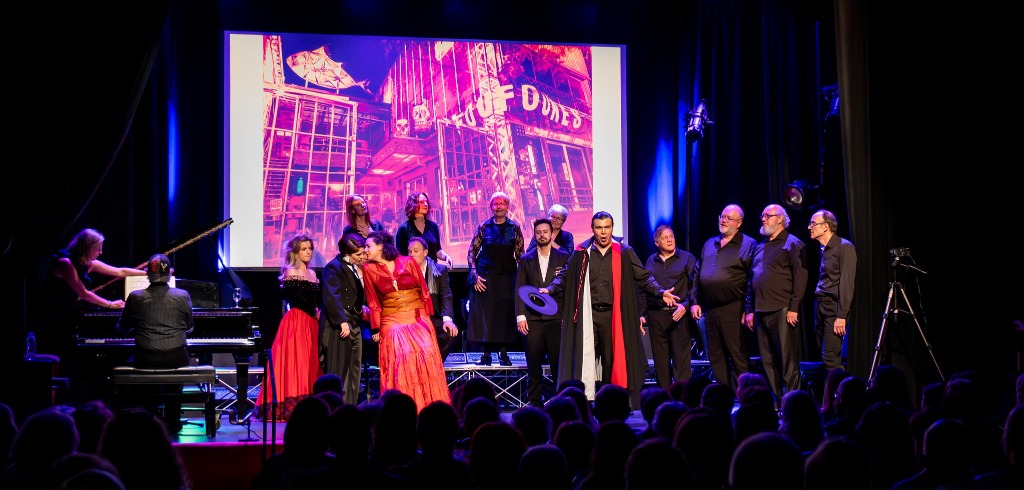
The following evening, Carmen took over. This production by Odette Beaupré under the banner Carmen de Montréal, brought a community feel and theatrical energy to the stage. The standout was mezzo-soprano Rose Naggar-Tremblay in the title role. She may well be entering the prime of her vocal life. Her voice flowed with buttery ease, her vowels both precise and flexible. One had the feeling she could sing the role twice over without fatigue. There was joy in her singing, and something deeper, an uncontrolled control, the kind that only reveals itself through mastery.

A scene from Carmen de Montréal at FestivalOpéra de Saint-Eustache. Photo: André Chevrier
On the last day of the festival, drama took a different form. The Jeunes Ambassadeurs Lyriques concert was originally planned for outdoors, but wisely reading the weather forecast, it was decided to relocate to the “petite église” where the rest of the festival had taken place. Bullet dodged, or so we thought…
The concert began in relative calm. A few drops of rain tapped at the windows. Then, about 20 minutes in, a thunderstorm rolled in like a curtain. The power cut out. The stage went black.

Lauren Margison performs at FestivalOpéra de Saint-Eustache. Photo: André Chevrier
Soprano Lauren Margison was mid-aria, Rusalka’s “Song to the Moon.” She didn’t flinch. Not a single sound wavered. The audience held its breath as I ran to the back and found a portable LED light, not quite an oil lamp, though it felt like one in the moment, and stood five feet from the stage, holding it in my hand like a modern-day candle bearer. The result? A kind of theatrical intimacy that no lighting designer could have planned. Margison’s voice rose into the darkness, warm and silvered, gliding effortlessly to the final high B-flat. It was one of those moments you don’t forget.
I was surprised how none of the young singers seemed fazed. If they were rattled, they didn’t show any signs of it, and kept the magic alive.

Ellita Gagner performs at FestivalOpéra de Saint-Eustache. Photo: André Chevrier
Among the evening’s voices, beyond Margison, who at this point can be considered a seasoned professional (she recently sang a successful Mimì at Opéra de Montréal), mezzo-soprano Ellita Gagner stood out for her clarity of voice and theatrical instinct.
Tenor Andrew Derynck impressed with a sturdy instrument and a top range that suggested great promise, a voice still in formation, but already striking.
And in a moment of contemporary resonance, the concert featured the premiere of Jacques Faubert’s Ave Maria, given a just and sober interpretation by mezzo-soprano Mariana de La Rosa and pianist Jérémie Pelletier.

Mariana de La Rosa performs at FestivalOpéra de Saint-Eustache. Photo: André Chevrier
Three days of fine music, made possible by the support of local authorities and key voices in Quebec’s operatic scene, including soprano Sharon Azrieli, reminded us of the delicate ecosystem that keeps this art form alive.
It is essential to keep nurturing small organizations like this. In Quebec, there are precious few spaces where emerging artists can develop their craft in a context that is both professional and forgiving. It is equally vital to create opportunities for amateurs, like the FestivalOpéra (FOSE) chorus, whose members not only lent their voices but also their time, often as volunteers, to help bring this edition to life.
In their enthusiastic singing, we see the social value of opera at its most honest: the ability to generate cultural wealth within a local community.
Festivals like this are necessities. One hopes founder Leila Chalfoun and her team will continue their mission. FestivalOpéra de Saint-Eustache has built a curious and loyal public, and it has the perfect venue in the Petite Église. All it needs now is more nights like these.
For more on FestivalOpéra de Saint-Eustache, visit www.festivaloperasteustache.com
This page is also available in / Cette page est également disponible en:
Français (French)