
This June, Vienna State Opera revived its production of Wagner’s Ring (first seen in its entirety in 2009), offering two cycles at the end of this season. Wagnerians the world over flocked to Vienna. More foreign languages than one could count, chattering everywhere. Though commentary over time has generally been lacklustre around director Sven-Eric Bechtolf‘s concept and Rolf Glittenberg’s sets, Ring fans returned nonetheless for the glorious cast.

Iain Paterson (Wotan) and Daniel Behle (Loge) in Vienna State Opera’s Das Rheingold. Photo: Wiener Staatsoper – Michael Poehn
In Das Rheingold (June 20th), Nibelheim was more like a factory, with huge metallic shelves into which the enslaved Nibelungen amassed gold in the shape of human body parts. These parts were likely an allegory for enslavement. The same idea was used to build a stylized Venus de Milo as the gold payment to the giants Fafner and Fasolt. These two images were easily the most striking of the Ring’s first instalment. The Rhinemaidens, Alberich’s transformation, the giants, and the passage to Walhalla were uniformly underwhelming.
Scottish bass-baritone Iain Paterson has been Wotan in several Ring cycles, and it’s no doubt taken its toll. His portrayal exudes authority, but with a much-diminished voice. German tenor Daniel Behle was an appropriately frivolous demigod, Loge. In addition to great acting, Behle’s phrasing was truly delectable. Another great voice was Hungarian mezzo Anna Kissjudit (Erda) who, despite her young age of twenty-nine, is a vocal phenomenon reminiscent of Marilyn Horne in her prime. Watch out for this impressive young singer.

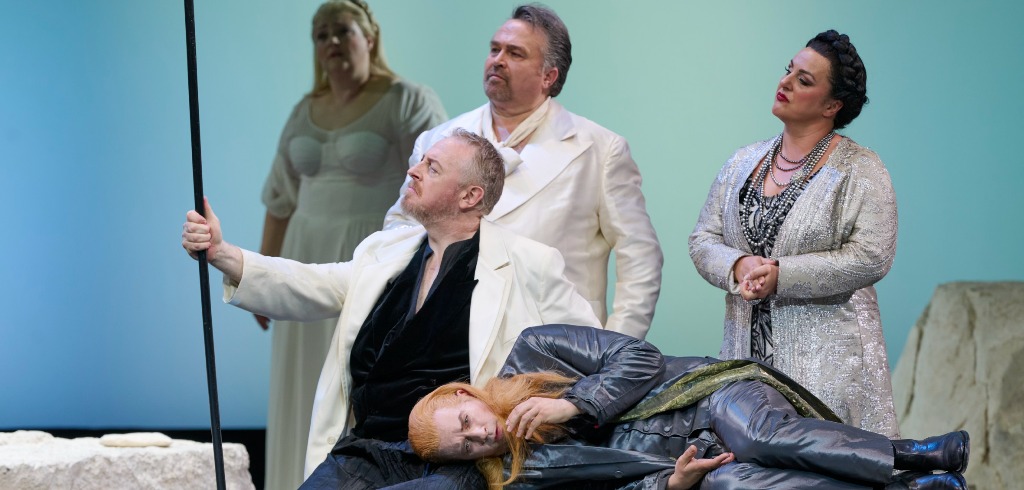
Simone Schneider (Sieglinde) and Anja Kampe (Brünnhilde) in Vienna State Opera’s Die Walküre. Photo: Wiener Staatsoper – Michael Poehn
Die Walküre (June 22nd) was vocally sumptuous thanks to two great voices: Andreas Schager as Siegmund and Anja Kampe as Brünnhilde. Schager is today’s most impressive Wagnerian tenor. His dramatic sound is tireless and his high notes, beautiful. Anja Kampe has been singing Wagnerian roles for some time, but her voice bears no trace of fatigue. Simone Schneider’s Sieglinde sported too big a voice to suitably contrast with Kampe’s Brünnhilde.
Scenically more appealing than Das Rheingold, this second instalment featured some striking images as well as some underwhelming ones. Hunding’s dwelling was oddly centered around the tree that bore the sword Nothung, which Siegmund removed from behind while he faced the public, rendering the Herculean task seem almost trivial. The shockers in this production were the Valkyries, who for some mysterious reason were vampires that fed on fallen heroes. They’re supposed to collect those who perished in battle and lead them to Walhalla. Instead, they corralled the terrified men like cattle, a disturbing image antithetical to Norse mythology.
Despite his diminished voice, Iain Paterson was a great Wotan who movingly captured the required pathos in “Leb’ wohl, du kühnes, herrliches Kind!”, his farewell to Brünnhilde. The protective ring of fire was disastrous: Wotan laid Brünnhilde among the Valkyries’ stationary horses (wooden effigies from Act III’s opening scene). As the surrounding horses had been waiting for over an hour, one could imagine Brünnhilde’s resting place was an unwelcome bed of manure. A video projection of flames engulfed the horses and then eventually the entire stage. This normally moving scene was reduced to horrifically gratuitous carnage.

Iain Paterson (Wotan) and Anna Kissjudit (Erda) in Vienna State Opera’s Siegfried. Photo: Wiener Staatsoper – Michael Poehn
The sets for Siegfried (June 25th) were more elaborate: a 19th-century state-of-the-art blacksmith’s workshop for Mime, whose only likely forest customers are bears and wolves. The pastoral setting surrounding the dragon’s cave was imaginative and stylized: wolves, boars and deer crawling up the walls. The dragon never appears, just a yellow reptile’s eye into which the image of a sword-waving Siegfried is projected.
Once Fafner is slayed, he reassumes a human form. His giant status is indicated by making South Korean bass Kwangchul Youn three times the height of Siegfried, a remarkable image, alas only seen during the giant’s dying moments. In the final act, the amazing Kissjudit once again commanded the stage with her deep, dark contralto, effectively portraying Erda as a crawling creature, a hybrid of caterpillar and ghost, overburdened by the weight of the earth she carries.
Alas, the final scene, the most glorious awakening of Brünnhilde, was a disappointment. Instead of majestically laying on the top of a cliff, she laid at the bottom of some stairs covered with a shroud, like a cadaver following a traffic accident. Even Brünnhilde’s armour was missing.
Vocally, Kampe was at her most glorious in her short appearance as the awakened Brünnhilde. Schager too was a terrific Siegfried, but his tendency to sing forte and fortissimo was starting to become tedious. More nuance is required here. The fearless hero is frightened upon discovering a woman, who he has not encountered until this moment.

Andreas Schager (Siegmund) and Anja Kampe (Brünnhilde) in Vienna State Opera’s Götterdämmerung. Photo: Wiener Staatsoper – Michael Poehn
The best of this Ring was the last instalment, Götterdämmerung (June 28th). At its opening, Brünnhilde’s cliff is replete with saplings rather than majestic trees. The effect was a sad Christmas tree lot on December 25: sparse. Perhaps these trees had only just grown after her awakening in what used to be a barren cliff. Alas, this was another underwhelming image.
Schager fared much better here and was able to find vocal nuance, allowing him to show different facets of the character. In Act II, after having used the Tarnhelm to cross the sacred fire surrounding Brünnhilde so that he might claim her for Gunther, Siegfried morphs into Gunther. Schager transformed his voice, making it more baritonal, and changed his proud hero’s posture into one resembling Gunther’s.
Austrian baritone Clemens Unterreiner portrayed Gunther as a weak potentate of a vassal principality, clad in an elaborately-decorated vest and quasi-military pants with a stripe on each side. His warm baritone contrasted with Jochen Schmeckenbecher’s (Alberich) harsher baritone and Falk Struckmann’s (Hagen) bass. The latter’s call of the vassals was terrifying, in part due to the ominous orchestral sounds, and also thanks to the vassals’ helmets and garb evoking SS officers.
The greatest moment in the opera, and possibly in this entire Ring cycle, was the “Immolation Scene.” Thanks to Anja Kampe’s admirable phrasing and booming dramatic soprano, this final scene was truly electrifying. Unfortunately, director Bechtolf used video to generate another barbecue fire, a ridiculously underwhelming final image for a vocally outstanding and memorable Götterdämmerung. Even more than the great singers, the Vienna Philhamonic under outgoing music director Philippe Jordan was the best aspect of this Ring cycle. Let’s hope the rumours of a new one are not just that.
Vienna State Opera’s Sven-Eric Bechtolf‘/Rolf Glittenberg Ring Cycle returns in May/June 2026.