
Unlike the Roman Arena di Verona, Macerata’s 2,500 seat Arena Sferisterio is a more recent creation. Created two centuries ago for an Italian variant of handball, it hosted its first opera, Verdi’s Aida, in 1921, but opera did not regularly appear there until the 1960s. In 1992, an official Macerata Opera Festival was established. It takes place in late July/early August and features three to four operas. Opera aficionados flock to this festival in coordination with Pesaro’s Rossini Opera Festival that begins after Macerata’s, or with the Arena di Verona’s season, which extends from mid-June to early September.
This season, Macerata’s offerings included a Flamenco ballet version of Carmen (which I did not attend), Verdi’s operas Macbeth and Rigoletto and the festival’s first incursion into operetta, Lehár’s The Merry Widow.

A scene from Macbeth at the Macerata Opera Festival (2025). Photo: Luna Simoncini
Macbeth’s director was the controversial Emma Dante, whose taste tends to the sordid. Her stagings of Rossini’s La cenerentola for Barcelona’s Teatro Liceu and Dvořák’s Rusalka for Milan’s La Scala were more horror shows than operatic fairy tales. Fortunately, her take on Macbeth was far from outrageous. In some respects, it was even inspired.
Excellent choreography was used in many unexpected moments, such as an entire corps de ballet as witches, and a macabre dance by men dressed in tutus as King Duncan is received at Macbeth’s castle. Even Banco’s assassination was stylized in dance form. Religious imagery was used to reinforce the tragedy of Macbeth as a morality play. Most impressive was a choreographed religious procession of King Duncan’s funeral in the style of a Renaissance painting of the crucifixion and absolution of Christ.
The cast of Macbeth was dominated by Marta Torbidoni as Lady Macbeth. The Italian lirico spinto managed the dramatic passages such as Act I’s “Vieni! t’affretta!” and Act II’s “La luce langue” with the same ease that she dispatched her coloratura in the banquet scene. Alas, Lady Macbeth’s somnambulism scene, “Una macchia è qui tutt’ora,” though brilliantly interpreted, was botched by idiotic staging. Lady Macbeth appeared sitting on a bed, then other beds on wheels appeared on stage, each with a small spot of blood that eventually grew to cover more of the white sheets. With a waltz of eight beds, the tragic scene ended up being comical, like a possessed furniture outlet.

Marta Torbidoni (Lady Macbeth) in Macbeth at the Macerata Opera Festival (2025). Photo: Luna Simoncini
Russian baritone Roman Burdenko was an effective Macbeth, thanks to his strong stage presence, appealing timbre and nuanced diction. His Act I scene “Mi si affaccia un pugnal?” was brilliantly staged, choreographed with a dancer playing Macbeth’s alter ego reenacting King Duncan’s assassination several times while Macbeth is contemplating the horrid act. Macbeth himself is weak, but his alter ego is rehearsing the crime. The opera’s final aria “Pietà, rispetto, amore” was Burdenko’s best, where he conveyed profound emotion. With his puppet master Lady Macbeth dead, the weakling persists, knowing he’s out of his depth.
Spanish bass Simón Orfila was a noble Banco and his interpretation of “Studia il passo” was affecting, helped by his clear diction and warm timbre. Rising tenor Antonio Poli as MacDuff showed that despite the brevity of his role, he had the most beautiful voice of this performance. His aria “O figli miei” was truly stirring. Without question, this young tenor will soon be a superstar.

A scene from Macbeth at the Macerata Opera Festival (2025). Photo: Luna Simoncini
In Italian director Federico Grazzini’s staging of Rigoletto, the Duke of Mantua is downgraded to mafia capo, and the setting, to Tony Soprano’s New Jersey. The elegant palazzo ducale is now a seedy entertainment park. Rigoletto is no longer a court jester, but rather the park’s clown, who locks up his daughter Gilda in his caravan wagon.
The modernized staging was mostly effective, except for logistics in some scenes, such as Gilda’s abduction, where a ladder was certainly not needed to break into a simple caravan wagon. As the Duke, the not-so-young-looking Ivan Magrì was unconvincing in his disguise as a student in the Act I duet “È il sol dell’anima”. The Italian lyric tenor’s voice seems to have been damaged by having taken on too many heavy roles.
Sadly, his bright voice no longer has squillo, a necessary attribute for the Duke of Mantua. He sang the Act I aria “Questa o quella” sotto voce and gradually improved to a better Act II “Ella mi fu rapita” and a respectable Act III “La donna è mobile,” for which he undoubtedly had been saving his voice.

A scene from Rigoletto at the Macerata Opera Festival (2025). Photo: Luna Simoncini
Spanish soprano Ruth Iniesta was convincing as the ingénue Gilda. Endowed with a beautiful timbre and brilliant technique, her rendition of the Act II aria “Caro nome” was the evening’s musical high point. Unfortunately, one felt little chemistry between her and the mafioso Duke.
Though a late replacement as Rigoletto, Italy’s Damiano Salerno did not disappoint. Thanks to his pleasant high baritone and excellent phrasing, he was able to express the complex emotions of this broken man: paternal love, sarcasm, pathos, rage and utter despair.

Damiano Salerno (Rigoletto) and Ruth Iniesta (Gilda) in Rigoletto at the Macerata Opera Festival (2025). Photo: Luna Simoncini
Alas, Act III was a dramatic fiasco, as Grazzini made assassin-for-hire Sparafucile the proprietor of a hot dog stand on the park grounds, itself a cover for a prostitution ring. Two of its five sex workers are cross‑dressing men. The mafioso seemed to have an insatiable sexual appetite for everything that moved. It’s unlikely that a man who is into seducing innocent ingénues like Gilda and Monterone’s daughter would also appreciate she‑men and professional working girls.
The famous quartet “Bella figlia dell’amore” involves Rigoletto and Gilda spying through the window on the Duke and Maddalena’s amorous flirtations. In Grazzini’s production, it was unconvincingly all’aperto, with Gilda behind a bench and Rigoletto behind a lamp post.
In the opera’s finale, instead of the dying Gilda singing from the sack in which she was to be dumped into the river, an unbloodied, healthy Gilda, or possibly her ghost (though at this point, she’s still living), stands facing the public. This idiotic and unnecessary confusion diluted the potency of the opera’s powerful dramatic conclusion.

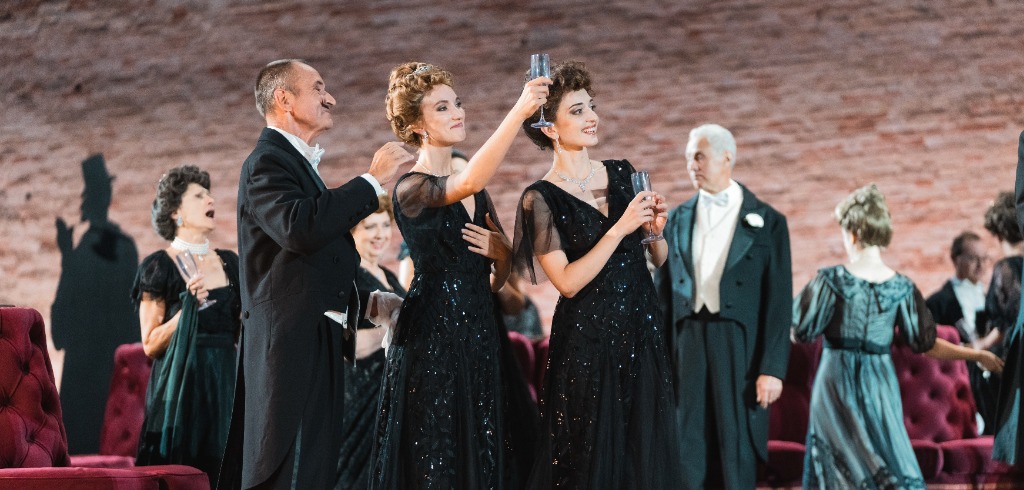
A scene from La vedova allegra at the Macerata Opera Festival (2025). Photo: Luna Simoncini
The operetta La vedova allegra (Lehár’s The Merry Widow in Italian) proved to be the festival’s most popular attraction, due to a dearth of operetta in today’s Italy and the persistent popularity of the art form. The usually inspired French director Arnaud Bernard envisioned the operetta as a prolonged but nonetheless visually appealing dance revue.
By adding extraneous music, such as Chopin’s Marche funèbre and Offenbach’s French Can-Can, the relatively short work was prolonged. This was further aggravated by two intermissions and interminably long dialogue. Despite recycled old jokes, the production was not cheesy. The sets were quite remarkable, especially Hanna Glawari’s party at her posh Normandy home in Act II, in pastel colours, inspired by Impressionistic paintings.

Mihaela Marcu (Glawari) and Alessandro Scotto di Luzio (Count Danilo Danilovitch) in La vedova allegra at the Macerata Opera Festival (2025). Photo: Luna Simoncini
Romanian soprano leggero Mihaela Marcu was a charming Glawari, in beautiful voice, with aristocratic deportment. Italian baritone Alessandro Scotto di Luzio had the necessary charisma to be playboy Count Danilo Danilovitch.
Macerata is a lovely town in the hilly region of Le Marche in Central Italy. There’s plenty of art and history to discover, as well as the region’s delectable cuisine. The Adriatic is just thirty kilometres away, with its sandy beaches, as is historic Ascoli Piceno and the religious pilgrimage site of Loreto. In all, the Macerata Opera Festival is a highly recommended operatic experience.
Macerata Opera Festival www.sferisterio.it/en