
For the past decade or so, Canadian pianists have been punching above their weight in major international piano competitions: from Charles Richard-Hamelin’s second prize at the 2015 Chopin Competition, to Bruce Liu’s first prize the next time round, to Jaeden Izik-Dzurko’s victory at last year’s Leeds Piano Competition, from which he also took away the Dame Fanny Waterman Gold medal.
To say that there is a certain Canadian piano school emerging would be misleading, however. These pianists are radically different in temperament, artistry and even technique, and this year’s Toronto Summer Music gave us the rare chance to compare two of them: Richard-Hamelin in a mainly chamber music concert last week, and Izik-Dzurko, in a recital that paired Bach’s rarely heard Fourth Partita with Chopin’s warhorse Piano Sonata no. 3 in the first half and Scriabin with Rachmaninoff in the second.
As with Richard-Hamelin, the 26-year-old, BC-born pianist had to be content with the more intimate setting of Walter Hall and its less than ideal acoustics (compared to Koerner Hall a few metres away). The piano itself could also do with some TLC: in particular, unless extraordinary care is taken, the damper mechanism creates a slight yowl when the pedal is taken off.

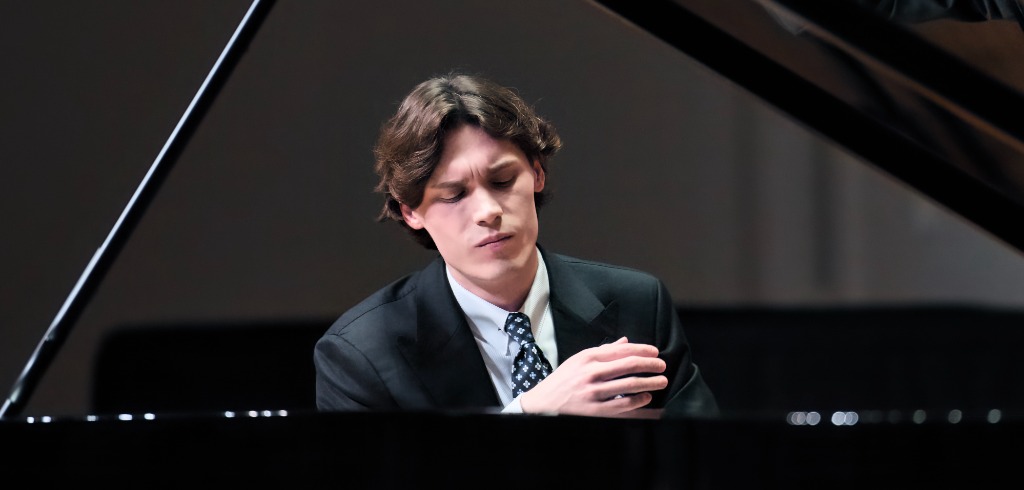
Jaeden Izik-Dzurko performs at Toronto Summer Music. Photo: Lucky Tang
This was hardly a problem in Bach, which Izik-Dzurko took crisply and lightly, with an improvisatory drive and minimal pedal. Bach’s unexpected harmonic turns were all marked subtly and naturally, and the composer’s profuse ornamentation relished, with Izik-Dzurko showing why he has acquired a reputation as a highly intelligent pianist.
The polyphonic sophistication of Chopin’s sonata followed on neatly from Bach. Others may have found more dramatic extremes of exaltation and mystery here, but Izik-Dzurko was certainly not lacking in poetry or intimacy, especially in the slow movement’s episodes of quietude. And clarity of detail in the fastest episodes, such as the finger-twisting scherzo second movement, was as exceptional as we might expect from a major competition winner. If cantabile lines were sometimes less than ideally seductive, that can be put down in large part to the piano’s rather muffled treble register, which only grudgingly releases a singing tone.

Jaeden Izik-Dzurko performs at Toronto Summer Music. Photo: Lucky Tang
Scriabin’s Fantasy was another logical segue, since it falls within his Chopinesque period, and its dazzling exhibitionism made a fine vehicle for Izik-Dzurko’s multi-faceted technical prowess. A short speech, in which he probably had half his mind on the music he was about to play (touchingly mistaking Toronto for Ottawa), prefaced Rachmaninoff’s Opus 23 Preludes, delivered here as an unbroken cycle. For all of the artist’s poetic and narrative good intentions, the more lyrical Preludes needed a more cushioned attack to give the sound more glow and the phrasing more lift. Still, there was plenty to enjoy in the energy of the famous Alla marcia G minor, the lightning-fast double notes of the Presto E flat minor, and the mercurial Tempo di minuetto D minor.
The abiding impression is of a self-effacing but richly talented young musician. But it was a special treat to see Izik-Dzurko letting his hair down somewhat in a rollicking Oscar Peterson encore.
Toronto Summer Music’s programming continues through August 2. For event information visit www.torontosummermusic.com