
This page is also available in / Cette page est également disponible en:
 Français (French)
When the “unranked” candidates for the CMIM Aria Finals were announced yesterday, Friday, June 6th, at Maison symphonique, Julia Muzychenko-Greenhalgh’s face was a mixture of dismay and disbelief. Just like her direct competitor, South Korean soprano Yewon Han, who opened the evening and performed just before her, the Russian soprano was indeed not going to win any prizes.
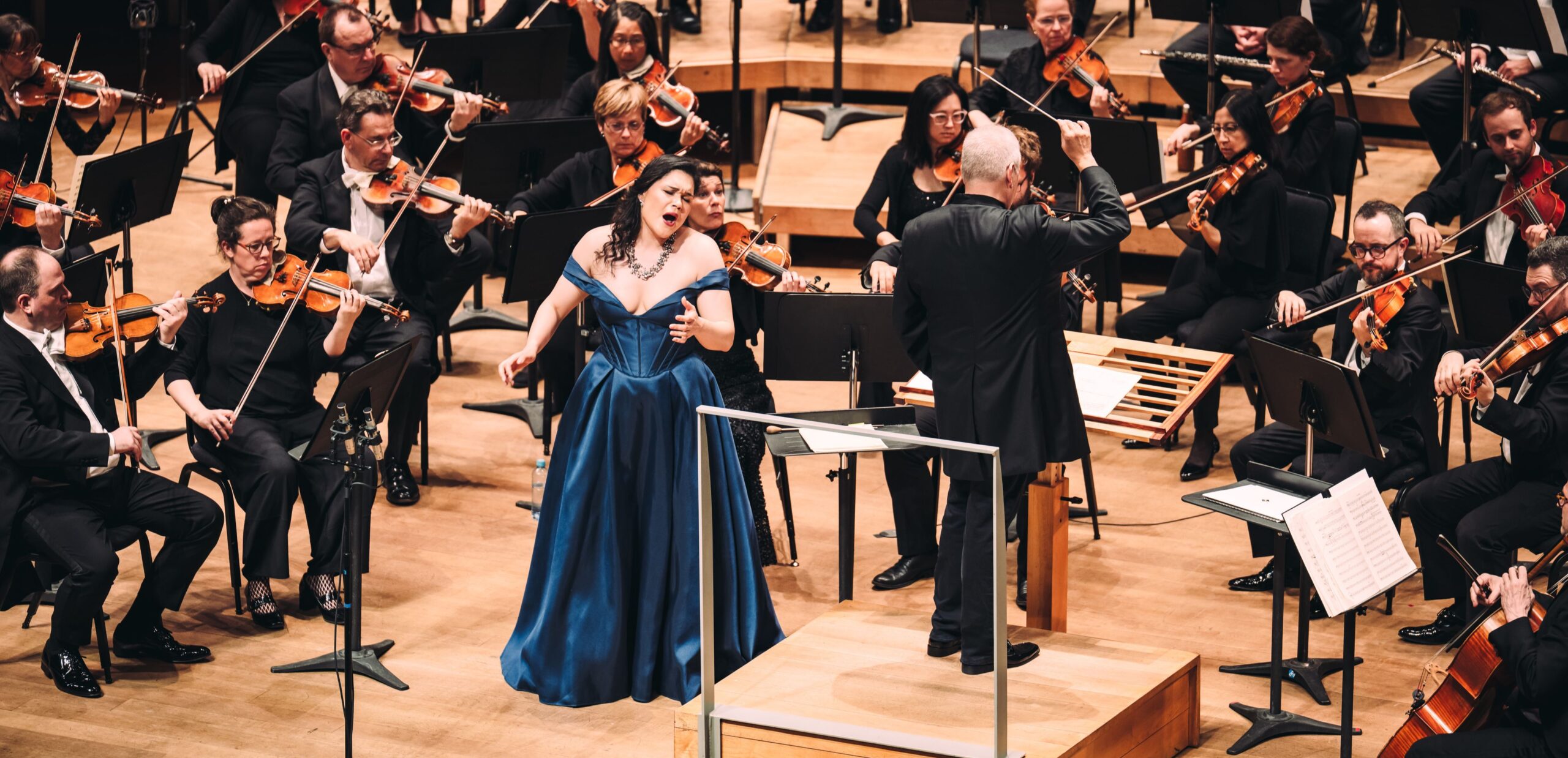
First surprise, then. The jury chose not to decide between the sopranos in this climactic battle, offering instead a draw that nobody really expected. And yet, the battle lived up to all its promise! In terms of technical execution and demonstration of strength, the South Korean soprano came out on top. She dared to use cadences and ornamentation that were particularly fast, full-bodied and naturally carried towards the high notes. In this sense, her interpretation of Rossini’s “Una voce poco fa” was most original, and certainly deserved better than a non-ranking. Faced with this high-flying performance, Ms. Muzychenko-Greenhalgh fought with her own weapons. Although she did not shine as brightly in the coloratura register, she came out on top, in the end, thanks to her emotional commitment, her obvious stage experience and the richness of her timbre, which made the walls of the Maison symphonique vibrate like no other, apart from South Korean tenor Junho Hwang.
Another major surprise: Theodore Platt, as third prize winner. Although the British baritone sang his repertoire with the interpretative qualities he already possessed, the narrowing of his voice in the upper register put him in a difficult position compared to all the other candidates at this level of the competition.
Hwang, for his part, continued to gain momentum throughout his program. His interpretation of an aria from Rachmaninoff’s Aleko, with only the harp as accompaniment, will go down in the history of the CMIM as one of its most memorable performances. Nothing less. The richness of his high notes and his phrasing were worthy of a resounding victory in the final. The tenor, however, had to settle for second place. Perhaps the fault lay in a rendition of Puccini’s “Che gelida manina” marked by a certain eagerness. It must be said that Patrick Summers, conducting the OSM, was of little help to the candidate in allowing him to find his breath.
Hwang, for his part, grew from strength to strength as his program progressed. His interpretation of an aria from Rachmaninov’s Aleko, with harp as sole accompaniment, will go down in CMIM history as one of his most memorable performances. Nothing less. The richness of his high notes and phrasing was worthy of a resounding victory in the final. However, the tenor had to settle for second prize. The fault, perhaps, lies with a rendition of Puccini’s “Che gelida manina” marked by a certain eagerness, perhaps rushing. We must point out that Patrick Summers, conducting the OSM, wasn’t much help to the candidate in relaxing the tempo.
As we had already sensed in the semi-final, Australian mezzo Fleuranne Brockway’s momentum put her in the best possible shape for the final. And then some! She won first prize, thanks in particular to a final tour de force: Bellini’s “Se Romeo t’uccise un figlio,” an aria that not only allowed her to show off the upper register of her voice, but also gave her performance in the final a moment of dramatic intensity that touched the audience and, obviously, the jury. That said, there were a few inaccuracies in pitch and color disparities in timbre. With this perspective, the Australian mezzo-soprano’s performance in the semi-final remains, in our opinion, the highlight of her CMIM journey.
This concludes two weeks of competition and this series of reports. Congratulations to all the contestants on a fine Voice 2025 edition. Next year’s CMIM will be dedicated to the violin. Mark your calendars for May 27 to June 4, 2026.
ReWatch
Special prize winners
Prizes and bursaries worth over $160,000 were awarded at the end of the First Round and Semi-Final.
Laureano Quant (baritone, Colombia)
Winner of the Mélodie Prize ($10,000)
Offered in partnership with the Nawacki Family Foundation
Fanny Soyer (soprano, France)
Winner of the ICI Musique Audience Award ($5,000)
Offered in partnership with ICI Musique
Ariane Cossette (soprano, Canada)
Winner of the André Bourbeau Award for Best Canadian Artist ($5,000)
Offered in partnership with the Fondation Bourbeau
Ihor Mostovoi (baritone, Canada | Ukraine)
Winner of the André Bachand Award for the best interpretation of a Canadian work ($2,500)
Offered in partnership with Claudette Hould
Theodore Platt (baritone, United Kingdom)
Winner of the Prize for the best interpretation of a contemporary aria ($2,500)
Offered in partnership with Dixi Lambert
Fleuranne Brockway (mezzo-soprano, Australia)
Winner of the Prix du Jury de la relève ($1,000), selected by the CMIM Jury de la relève at the end of the First Round
Offered in partnership with Richard Tremblay
Ariane Cossette (soprano, Canada)
Winner of the Prix de l’Observatoire québécois d’art lyrique ($1,000)
Offered in partnership with the Observatoire québécois d’art lyrique
Laureano Quant (baritone, Colombia)
Winner of the Salle Bourgie Schubert Prize, selected by Salle Bourgie
Offered in partnership with Salle Bourgie
Fanny Soyer (soprano, France)
Winner of the Prix de la Résidence UdeM-McGill en piano-art vocal ($7,500), prize not determined by the international jury
Offered in partnership with the Résidence UdeM-McGill en piano-art vocal
Julia Muzychenko (soprano, Russia) | Yewon Han (soprano, South Korea)
CMIM Prize for the 2 non-winning finalists ($3,000)
Offered in partnership with Dixi Lambert and the Rouleau family
This page is also available in / Cette page est également disponible en:
Français (French)