Music has always played an integral role in storytelling. Long before ancient Greek myths were written down and compiled into notable collections like The Homeric Hymns, myths were passed down orally through singers and bards. This long-standing tradition of trading myth through song has been carried forward into modern musicals like Hadestown whose live capture was recently released for a limited-time run in movie theatres.
Hadestown retells the mythical love story of Orpheus and Eurydice, as Orpheus must journey to the Underworld to reclaim his dead wife, in a production heavily influenced by Dixieland jazz and folk music, and modernized to reflect themes of poverty and class divide. The proshot of the Tony award-winning musical, written and composed by Anaïs Mitchell, and directed by Brett Sullivan, premiered on July 24 featuring its original Broadway cast including Reeve Carney as a hopeful and lovestruck Orpheus, and Eva Noblezada as a worn-down Eurydice.
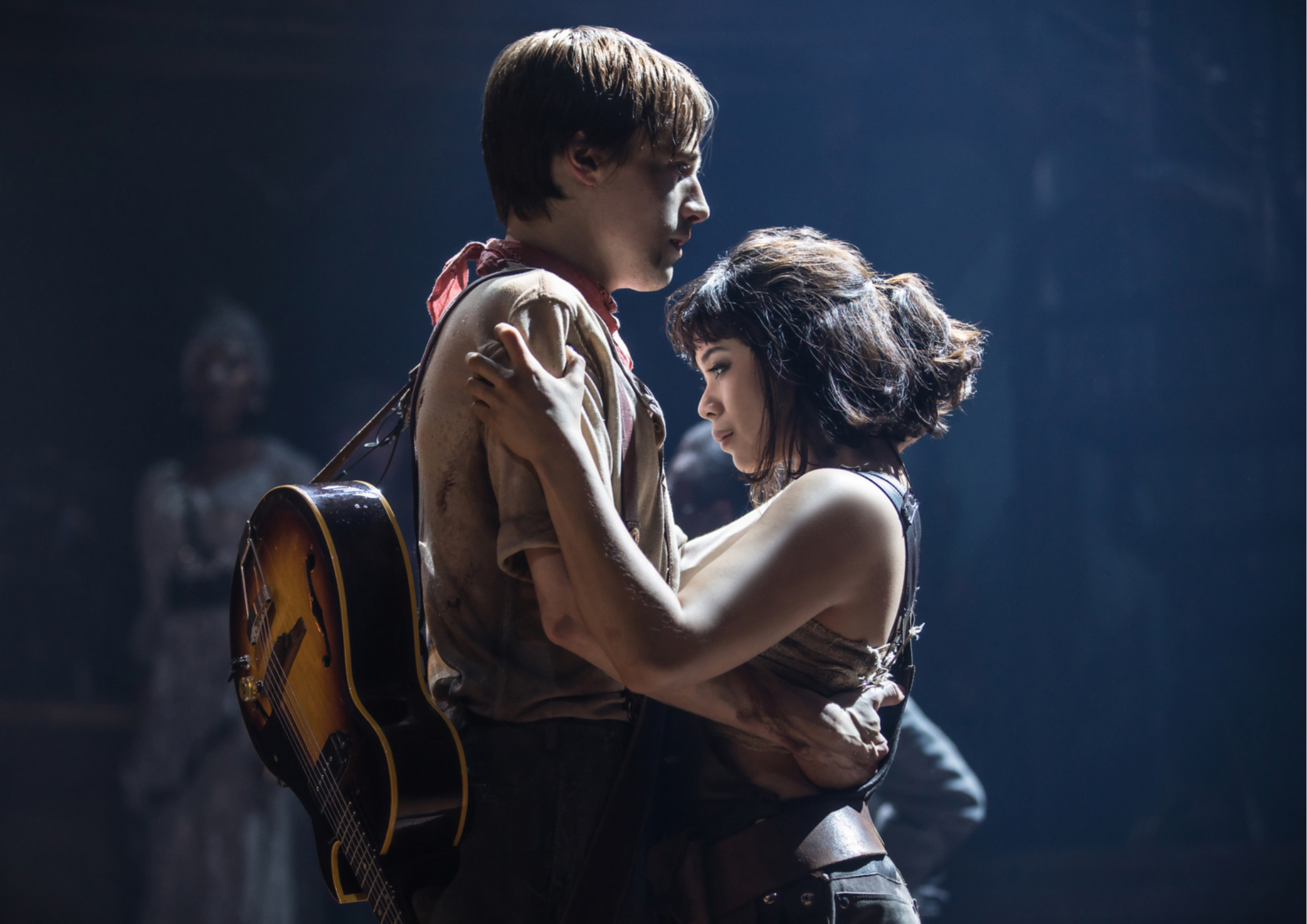
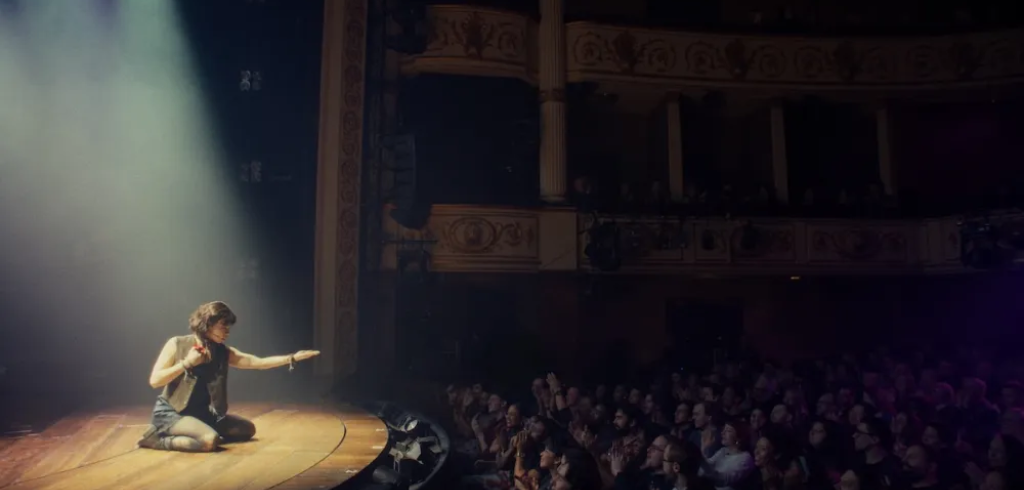
Reeve Carney (Orpheus) and Eva Noblezada (Eurydice) in Hadestown. Photo: Matthew Murphy
The live capture begins with exclusive backstage shots of the cast as they make their way to the stage where Tony award-winner André De Shields opens the show as Hermes with “Road to Hell.” De Shields’ rich baritone is a landmark of the show, providing comfort and guidance both to Orpheus and the audience. This is matched by the inimitable baritone of Patrick Page as Hades, who drags dread behind him each time he limps onto the stage (the result of an injury Page experienced close to filming). He is paired with Amber Gray’s raspy-voiced Persephone.
Not only is each vocal performance a standout, but the on stage band brings an unparalleled energy and spirit to the production. Instruments become the characters’ limbs, like the violin plucked by one of the fates to foreshadow Eurydice’s demise, or Orpheus’ guitar in place of a lyre which provides the backing instrumental for the show’s climactic song, “Epic III.” There is never a moment when the band, or its instruments, are absent from the stage, but there are moments when their silence, contrasted with the bare vocals of Carney or De Shields, makes the entire theatre hold its breath.
The proshot does what the stage production cannot, allowing for close-ups of the actors which makes the story more impactful, as well as the abundance of overhead or nose-to-the-stage shots, which offer perspectives you can’t get from a live show.
Hadestown is by far not the only musical adaptation of Greek myth that has come down to us through the ages. Greek myth has been adapted over and over again through mediums like musical theatre, opera, and ballet, to tell stories of love, justice, loss, and more, including:
Euridice
Known as the oldest surviving opera, Jacob Peri’s Euridice premiered in 1600 with a libretto by Ottavio Rinuccini. It subverts the myth’s original tragic ending and allows Orpheus and Eurydice to live happily after escaping from the Underworld. Peri established the basics of operatic composition with Euridice, combining solo, ensemble, choral, aria and recitative singing.
L’Orfeo
Written in 1607 with music by Claudio Monteverdi and a libretto by Alessandro Striggio, L’Orfeo tells the tale of Orpheus’ descent into the Underworld to bring back his dead wife, Eurydice. While Monteverdi’s background was in theatrical music, L’Orfeo pushed the evolving form of the intermedio (the musical sequence between acts of a straight play) into its own being as an “opera”.
The Creatures of Prometheus
Composed in 1801, The Creatures of Prometheus is Ludwig van Beethoven’s only ballet and rarely performed. This could be attributed to its less catchy melodies, but its lighter musical score and varied orchestrations have ensured its place in concert performances. In the ballet, Prometheus brings to life two clay figures and takes them to Mount Parnassus to be taught the arts, but both the clay figures and Prometheus ultimately face the tragedy of mortality.
Elektra
Written in 1909, Elektra is considered to be Richard Strauss’ most modern opera. Elektra, the daughter of Agammemnon and his wife/murderer Clytemnestra, grapples with avenging her father’s death. The opera explores modern themes of how to obtain justice without creating any more wrongdoing of one’s own. Strauss’ score is known for its overwhelming intensity.
Mythes, mvt. I, “La fontaine d’Arethuse”
A pair of chamber works composed by Karol Szymanowski in the first years of World War I, Métopes, for solo piano, and Mythes, for violin and piano, took inspiration from Szymanowski’s own odyssey through the Mediterranean. Mythes is based upon the Fountain of Arethusa where the nymph, Arethusa, metamorphosed into the fountain to escape the unwanted advances of the river god Alpheus.
Mythology Symphony
In her first album of orchestral music, released in 2015, American composer Stacy Garrop maps five movements inspired by famous female figures in Greek mythology including Medusa and Penelope. In “Becoming Medusa,” Medusa is represented by a single violin and as she transforms into the gorgon she is infamously known to be, strings, woodwinds, and percussion all wind sonically around each other.
“It’s an old song / And we’re gonna sing it again”—so says Hermes in “Road to Hell,” the opening number to Hadestown. Likewise for the numerous other composers throughout musical history inspired by Greek myths who have continued to reintroduce their compelling themes to new, contemporary audiences.