
How do you make a 90-minute opera with only three characters, staged against a black, white and grey backdrop interesting? That is a challenge the Canadian Opera Company is completely up to with its current revival of Christoph Willibald Gluck’s Orfeo ed Euridice (seen Oct. 9).
Orfeo ed Euridice is the first of Gluck’s reform operas, characterized by the “noble simplicity” of its story and music. It acts as a bridge between the baroque and classical worlds and went on to inspire composers like Mozart, Beethoven and Wagner who echoed its themes and dramatic innovations in their own operas.

Iestyn Davies (Orfeo) & Anna-Sophie Neher (Euridice) in Canadian Opera Company’s Orfeo ed Euridice. Photo: Michael Cooper
Based on the story of Orpheus from Greek mythology, the opera follows Orfeo as he descends into the underworld to retrieve his wife Euridice. The gods allow her return on one condition: Orfeo must not look at her until they return to Earth, and he cannot tell her why. As we already know, he does, and loses her again. In Gluck’s version, however, divine intervention ultimately reunites the lovers.
With only three characters, it goes without saying that the success of this opera hinges completely on the strength of the singing. Carrying the majority of the weight is British countertenor Iestyn Davies (Orfeo), who is on stage for the entire duration in his COC debut. From his very first note that pierces the choral element, Davies proves to be a remarkable Orfeo, both in voice and drama. His almost mezzo-sounding instrument is pure liquid gold with a clarion top. His “Che farò senza Euridice,” the opera’s showpiece aria, is deeply moving. He portrays a stark range of human emotions from grief, despair and anger to elation with emotional restraint, complemented by subtle dynamic shifts and delicate legato phrasing that reflect his inner turmoil.

Iestyn Davies (Orfeo) & Anna-Sophie Neher (Euridice) in Canadian Opera Company’s Orfeo ed Euridice,. Photo: Michael Cooper
Act III is no doubt the most exciting part of the opera, with the most action and gripping exchanges between the two main characters. Orfeo pleads with Euridice to follow him and not ask questions, while she is confused as to why her husband will not embrace or look at her, and starts to have doubts about his love for her. Canadian soprano Anna-Sophie Neher, a graduate of the COC Ensemble, is magnificent in her role debut as Euridice. She is an impactful presence, brilliantly acting out Euridice’s doubt and confusion, with a touch of spitfire defiance. Her full-bodied soprano is simply mellifluous—she has never sounded better.
Davies and Neher are a perfect vocal match, their duets sung with a precise unison and heart-wrenching emotion, all the more challenging when the singers cannot look at each other.

Catherine St-Arnaud (Amore) & Iestyn Davies (Orfeo) in Canadian Opera Company’s Orfeo ed Euridice. Photo: Michael Cooper
In the role of Amore is the lighter and brighter-voiced soprano Catherine St-Arnaud, also making her COC debut. Her character sometimes mirrors the movements of Orpheo and Euridice, which can perhaps be interpreted as a reflection of their subconscious minds.
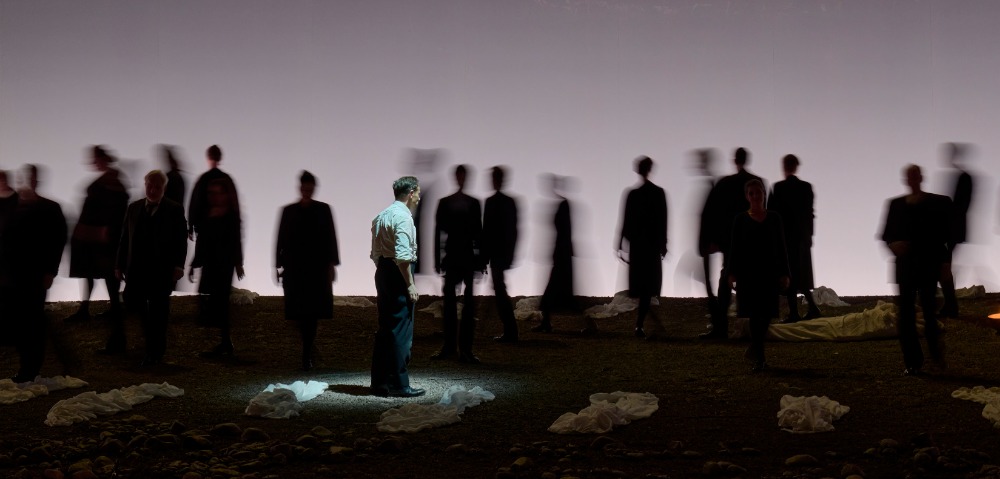
The minimalist aesthetic of Robert Carsen (director and lighting), Tobias Hoheisel (set and costumes) and Peter Van Praet (lighting) are effective in keeping Gluck’s original intentions of simplicity. The clever use of backlighting that casts shadows across the stage with much of the action seen in silhouette provides a vivid imagery of the underworld, even when the palette is dark with only flickering candles offering a touch of colour. The overall aesthetic invokes the inner thoughts of Orfeo who sings to nature and the gods, while externalizing the torment he experiences at the loss of his wife.

Iestyn Davies (Orfeo) & COC Chorus in Canadian Opera Company’s Orfeo ed Euridice. Photo: Michael Cooper
The staging is most compelling in the second act, in which the chorus are bodies in the underworld, strewn across the stage floor. When they surprisingly come alive as the Furies, there was a collective gasp from the audience. Although this production forgoes the dances that would have been part of the original version of the opera, it is more than made up by the strong and mighty COC chorus, which is always in top form.
Similarly, the COC Orchestra can always be counted on for a fine performance. Under the baton of Quebec early music legend Bernard Labadie, it plays with a period instrument-like lightness of touch.
Even if the opera’s ending can beggar belief—Amore promptly brings Euridice back to life for the second time without any supplication from Orfeo—all can be forgiven. This time, the COC has succeeded in its less is more approach, and their casting of Orfeo and Euridice is a match made in heaven.
Canadian Opera Company’s Orfeo ed Euridice continues its run at Toronto’s Four Seasons Centre for the Performing Arts through Oct. 25.