As part of its Toronto Opera Festival, Opera 5 presented the premiere of Parḗlios on June 12, a new work by composer Cecilia Livingston and librettist Duncan McFarlane. It is an amalgam of choral and solo vocals, percussion ensemble and complex choreography that, as stated on the company website, “explores themes of climate change, migration, and humanity’s connection to the planet.” Parḗlios is complex, with a brainy, layered text and challenging sound world. It intrigues on an intellectual level but lacks the kind of narrative hooks that offer emotional connection.
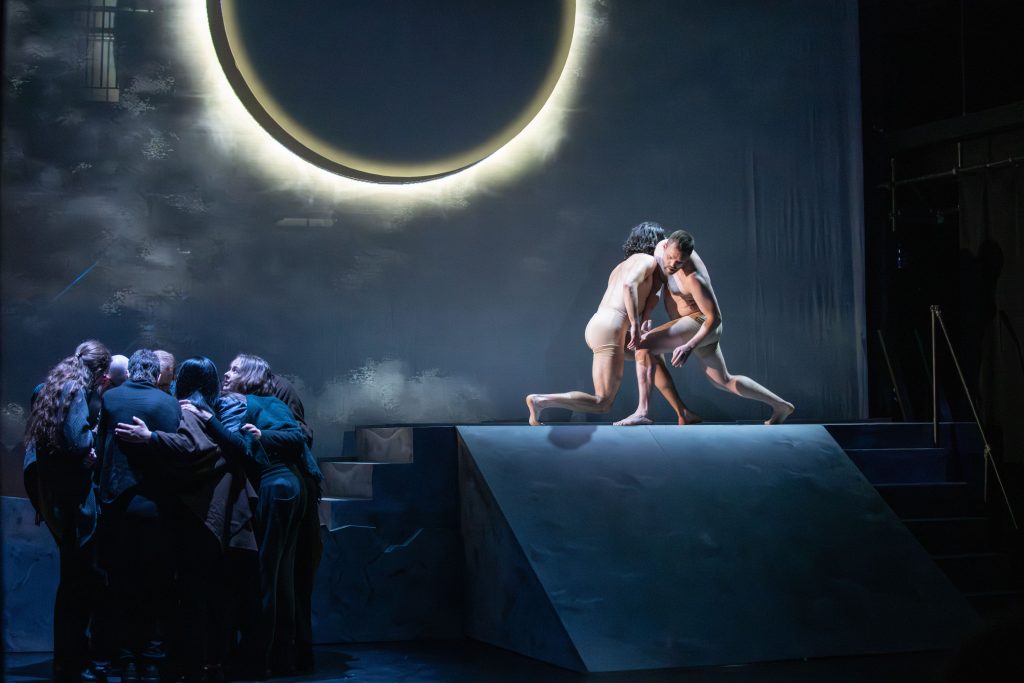
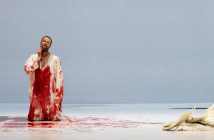
Sully Maleab Proulx & Jarrett Siddall in Opera 5’s Parḗlios. Photo: Emily Ding Photography
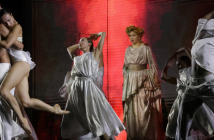
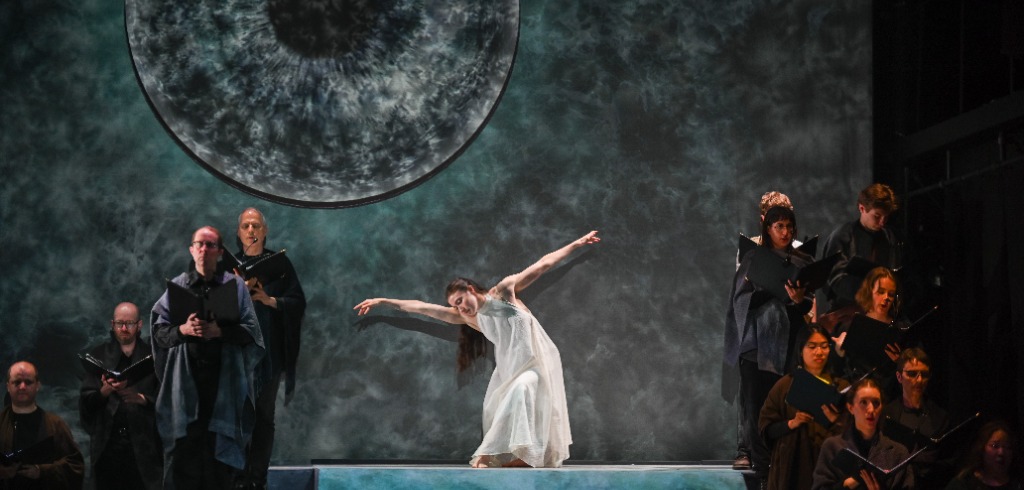
The production’s most successful element was undoubtedly director Jennifer Nichols’ choreography for three dancers, Sully Malaeb Proulx, Jarrett Siddall and Miyeko Ferguson. They were integral to the overall visuals whether in the more lyrical solos for Ferguson, or the striking, sculptural poses for the two men, Malaeb Proulx and Siddall. Theatre Passe Muraille’s stage is not very deep and constrained dancer and chorus movement throughout. One can imagine a future iteration where they are given more space to show off Nichols’ beautiful work.
Given the complexity of the choral writing, the chorus worked with their scores, carrying them in hand with portable lights for legibility. There was an attempt to provide them with movement which didn’t quite convince. The choristers were noticeably uncomfortable, often stealing glances at the conductor, Evan Mitchell, placed stage right, or at video monitors. So much of their text is extremely poetic and not necessarily pushing a linear narrative, so it might have made sense to have arranged them in a more static oratorio configuration.
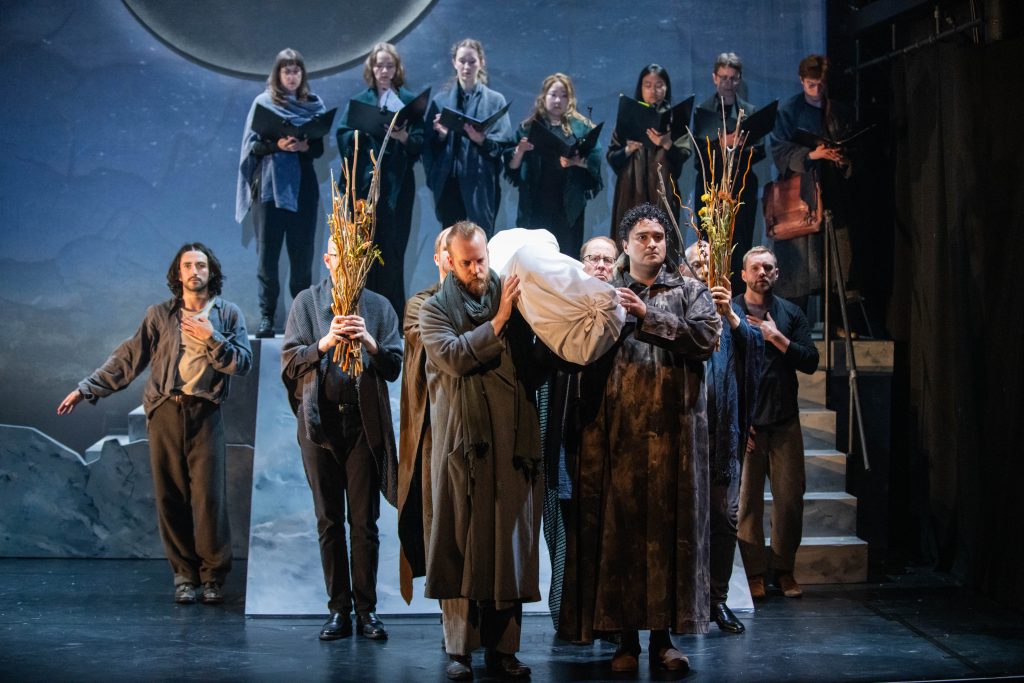
Aaron Dimoff & Ryan Nauta (front) in Opera 5’s Parḗlios. Photo: Emily Ding Photography
As mentioned in the program notes, McFarlane’s text is drawn from a wide variety of sources including Old English poetry, Aeschylus, Aesop and Aristotle. As such, upon first listening especially, its evocative nature was a little hard to pin down. But, it suits the stated aim of a sort of return to pre-dramatic, pre-Thespian theatre of the ancients. Swathes of Greek text were projected at the beginning of each of the work’s 12 sections, quickly followed by an English translation. Given the length of these text slides, it wasn’t really possible to read them before they disappeared. Whether they were necessary for audience comprehension of the work’s themes remained unclear.
Alongside the dancers and chorus, four soloists also take us on the journey of a people who are suffering through a climate crisis. Soprano Len Crino was a beaming presence with a clear, light tone that suited the lyrical lines of their part. Tenor Ryan Nauta also succeeded on the lyrical end of things in his solos.
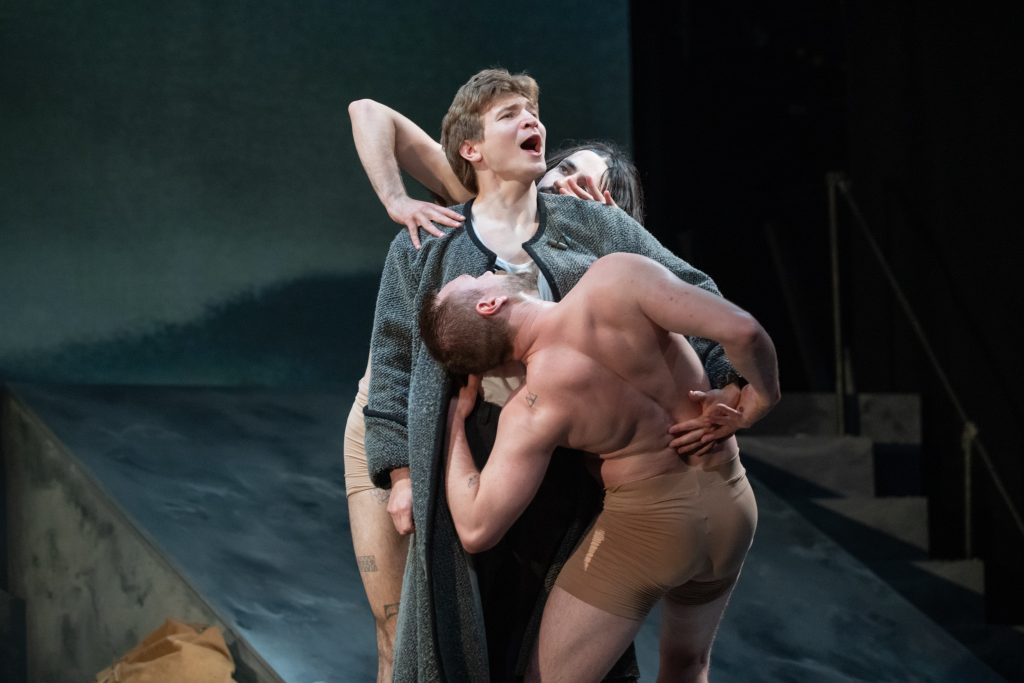
Brenden Lengsfeld (centre) with Jarrett Siddall & Sully Maleab Proulx in Opera 5’s Parḗlios. Photo: Emily Ding Photography
Baritone Aaron Dimoff was gifted with perhaps the most striking vocal solo which he sang from a raised platform. It had echoes of early 20th-century English art song—think Ralph Vaughan Williams at his most trenchant and appealing.
Countertenor Brenden Lengsfeld made a great impression. Not only with his beautiful vocalism, but also the intensity with which he projected his text. He was gifted with the only opportunity for interaction between soloist and the dancers. This resulted in the production’s most compelling set piece as the singer was tossed between dancers, finally bringing movement elements together with the singing. Nichols is a master of getting ‘non-dancing’ singers to move convincingly. One might have hoped for more of this instead of cordoning off the movement as it was in the rest of the production.
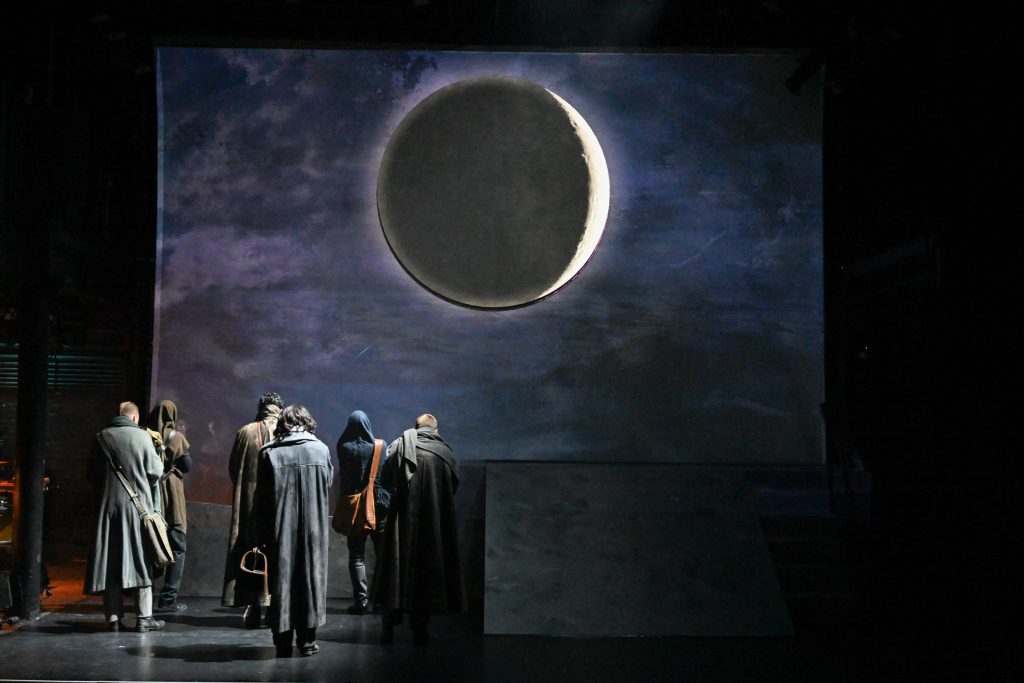
Scene from Opera 5’s Parḗlios. Photo: Emily Ding Photography
The contribution of TorQ Percussion Ensemble cannot be underestimated. They are largely responsible for creating Parḗlios’s unique soundworld. Evan Mitchell must have had his work cut out for him in uniting all the elements of this complex score.
Carlyn Rahusaar Routledge’s stage designs included a ramp down which the dancers slid. Again, the effectiveness of the set would likely have been greater on a bigger stage. Nathan Bruce’s projections included depictions of the eclipse of the sun and created a suitable futuristic, sci-fi, dystopian atmosphere.
Parḗlios is a genre-defying work. As such, it’s probably best to accept its occasional inscrutability for what it is—an experimental amalgamation of disparate artistic forms. On this viewing, they didn’t quite come together to illustrate the stated themes but nevertheless provided an intriguing evening.
For more about Parḗlios, read our interview with the creators from the June/July 2026 issue of La Scena Musicale.