This page is also available in / Cette page est également disponible en:
 Français (French)
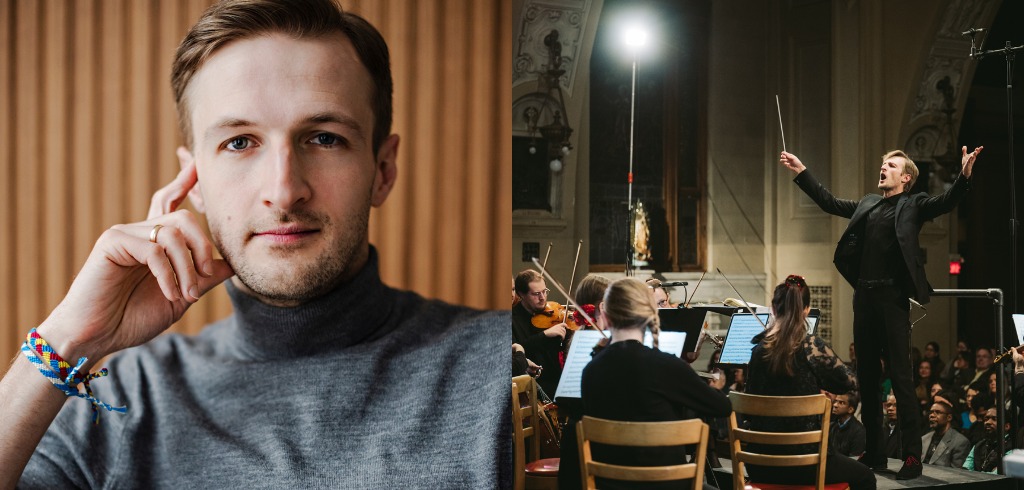
Andrei Feher knows something about the importance of cultural accessibility. The conductor, now musical director of Orchestre Classique de Montréal (OCM), spent the first 13 years of his life in the provincial city of Satu Mare, Romania. Despite its modest size, his hometown boasted a vibrant cultural scene. “There was a theatre company, a symphonic orchestra, and the city has about 100,000 inhabitants,” he says. “Especially in Europe, we often see that no matter the size of the city, there is something very central—whether it’s theatre, opera, or orchestra. Something that truly sits at the heart of the city.”
With a population much more dispersed than Europe’s, Canada still has its share of regional ensembles that bring art to these communities. Before his appointment at OCM, Feher served as music director of the Kitchener-Waterloo Symphony. Like all arts companies—but especially smaller, more regional ones—KWS was hit hard by the COVID-19 pandemic. Although the orchestra continued its season with online concerts throughout closures, it ultimately filed for bankruptcy in 2023. “What I learned during the pandemic is that everything on a screen—recorded or filmed—is far from the experience of being in a concert hall or a space where music is performed live by musicians,” says Feher.
Despite severe financial challenges, orchestra and community members mobilized to keep the ensemble alive in whatever form they could. Today, KWS has re-established itself within new parameters, offering a selection of chamber and orchestral concerts throughout the year. “The experience of being together, of sharing a concert or music in real time, is incredibly precious,” Feher adds. “I believe that access to this kind of experience should be available to everyone.””
OCM in Montreal’s Cultural Landscape
Like KWS, OCM has also experienced significant changes over the past few years. One of the oldest chamber orchestras in Canada, it was deeply shaken by the untimely death of its longtime conductor, Boris Brott, in 2022. Having been led by the Brott family since 1939, the orchestra suddenly found itself rotating among various conductors. Feher notes that, in addition to the shock, the ensemble also faced the realities of the pandemic—“getting people back into concert halls and dealing with funding challenges.”
Feher admits that he arrived at the orchestra at a strange time. On one hand, the ensemble formerly known as the McGill Chamber Orchestra had been a fixture of Canada’s classical music scene for decades, with musicians and administrators still connected to the Brott era. At the same time, “with all the changes that have happened in recent years, this really feels like a moment to rebuild—to work almost from a blank page, where we can draw all our dreams, put them into place, and try to build something for the future.”
“My ultimate dream,” he continues, “is to have a large, loyal audience that doesn’t even need to look at the evening’s program—people who simply buy a ticket, come to the concert, and know they’ll experience something beautiful, rich in emotion and musical energy.” Building such a faithful audience doesn’t happen overnight; it is cultivated over years through strong relationships between the conductor, the musicians, and, ultimately, the public.
While audiences in Kitchener-Waterloo have relatively few classical music options, Montreal is a true metropolis, where classical music abounds. The city hosts numerous chamber ensembles and orchestras, including two full symphony orchestras. To attract audiences, each ensemble must distinguish itself—not just through performance quality, but through the type of experience it offers.
The OSM and the Orchestre Métropolitain present major symphonic works in grand concert settings. Chamber orchestras, by contrast, perform smaller-scale repertoire in more intimate venues. While it does not perform the grand-scale works of larger symphonies, Feher’s orchestra offers a distinctive experience even among ensembles its size. “We can’t offer the same thing as Les Violons du Roy in Quebec,” he explains. “That’s a very specialized orchestra in a certain repertoire.” Although they have branched out into more diverse genres, “we know them for everything that is baroque and classical.”
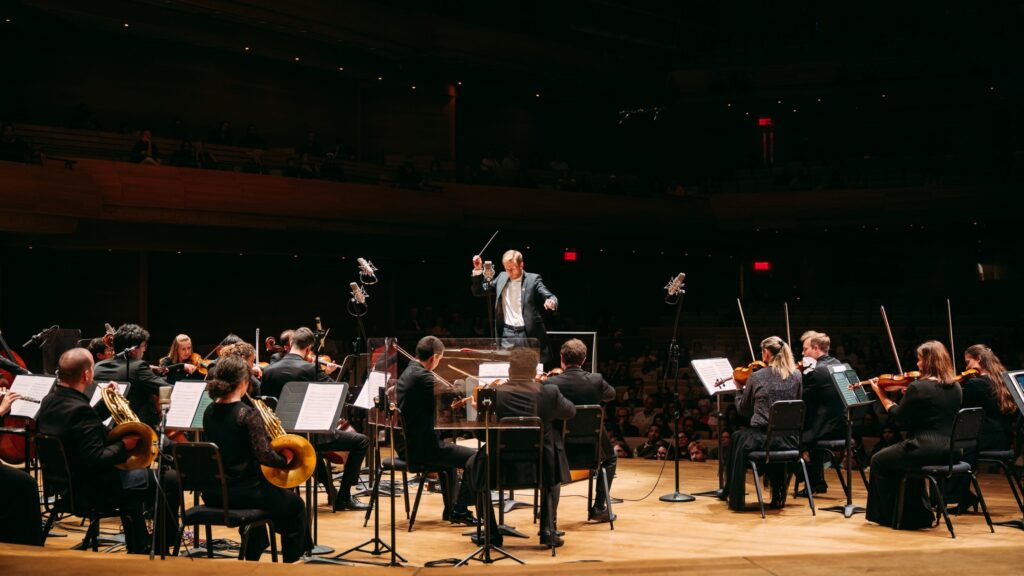 Instead of grounding its identity in mastery of a specific repertoire, the OCM is defined by its engagement with the city of Montreal, particularly with its multicultural communities. This orientation, Feher explains, is rooted in Brott’s tenure, when he pushed innovative and culturally significant repertoire, such as contemporary Armenian and Klezmer works. Today, the orchestra’s concerts also function as community cultural events. Feher points to Le Flambeau, an opera by David Bontemps rooted in a Haitian cultural context, which premiered in 2023 and drew large audiences from Montreal’s Haitian community. There was something “incredibly effervescent,” he says, about seeing a community gather around a contemporary opera infused with Afro-Haitian rhythms and Vodou-inspired mythic librettos.
While the 2025–26 season has already included Argentinian tangos and a Native American mythic violin concerto, Feher is especially excited to conduct the upcoming From Chopin to Weinberg concert on March 12. The evening journeys through Polish music across the centuries, and Feher is particularly looking forward to introducing audiences to the music of Mieczysław Weinberg, which he describes as a “mixture of Prokofiev and Shostakovich.” The program will feature Weinberg’s Chamber Symphony No. 1, “a very lively piece, and challenging for the players.”
A Conductor’s Journey

Photo: Hilary Gauld/One for the Wall
Feher admits he has a particular affinity for Eastern European music. “Perhaps,” he muses, “it is my Romanian background, which is very close to Slavic languages, to all that is Slavic culture—this music speaks to me more easily.” He explains that, because Romania was under communism for more than 30 years, it absorbed many Russian influences.“Russian culture and mentality, with all the good and the bad, spread throughout the region, and that influence became part of who I am,” he says.
Born into a family of musicians—with parents, grandparents, and relatives who all played and taught—Feher was immersed in music from an early age. “I think that since everyone around me was making music, they put the violin in my hands and I had to do it. But I never questioned it. My childhood was very normal. I never practised for hours when I was very young.”
It was during his adolescence, when his family relocated to Canada, that Feher’s passion for music truly took shape. He studied at Montreal’s Joseph-François-Perrault High School, benefiting from the school’s intensive music program, which included daily choir, chamber music, and orchestral rehearsals after classes. He spent long days practising the violin, burning CDs of Bruckner and Tchaikovsky symphonies in the school library, and studying orchestral scores. When a teacher was late or absent from rehearsal, Feher was encouraged by his peers to take the lead. These early experiences shaped the budding conductor, giving him the “confidence to tell myself that conducting professionally could be a real option, and not just something that remained a dream.”
At the Conservatoire de musique de Montréal, Feher continued his studies in both violin and conducting. His conducting teacher, Raffi Armenian, proved to be a formative influence, teaching him not only the craft of conducting but, as Feher puts it, “about art in general.” Armenian, he recalls, led through humility. “He never put himself in front of the music or the composer. He has a huge respect for the great composers.”
Another conductor who guided Feher’s path was none other than Boris Brott, whom Feher met at the National Academy Orchestra summer training institute toward the end of his studies. Although not officially part of the program, the young conductor offered to step in as a replacement should Brott ever be late for a rehearsal. Brott, he recalls, gave him a chance. Supporting emerging artists, Feher explains, was central to Brott’s character. “He was someone who always supported young people and gave opportunities to those who needed them. Even if they weren’t yet ready for major contracts, Boris had a very interesting eye for emerging artists. He could recognize real talent in young soloists—sometimes only 17, 18, or 19 years old—and sense that there was something very interesting there that was going to develop.”
An Open Approach
After graduating from the Conservatoire, Feher had the opportunity to serve as assistant conductor for both Orchestre symphonique de Québec and Orchestre de Paris. He continues to learn from Fabien Gabel, former artistic director of the OSQ, whom he describes as having an extraordinary knowledge of repertoire, especially French music. “We’re still in touch very often,” Feher says. “I reach out to him whenever I have questions about a repertoire I know he knows extremely well.”

Photo: Hilary Gauld/One for the Wall
While a conductor must know the music, he must also know how to relate to people. In terms of interpersonal skills, Feher has learned a great deal from watching Yannick Nézet-Séguin lead Orchestre Métropolitain rehearsals. “Watching how Yannick has developed and grown since 2008–09 has been completely fascinating,” he says, “because he’s someone who has reached the very biggest stages—and he’s done so in a warm, deeply human way. He’s someone we all learn from—not just me—because he maintains very high standards, yet it never feels oppressive; it’s always grounded in kindness. In that sense, he’s deeply inspiring, because it can be difficult to be demanding without going too far, becoming overly rigid, or getting trapped in your own head.”
Like any “boss,” a conductor can fall into the trap of over-controlling musicians’ playing. Feher strives instead to balance structure with trust. Being a string player, he says, helps him understand life on the other side of the podium, and to know “what to do, what not to do, when we can be useful, and when it’s better not to interfere.” Ultimately, he believes a conductor’s responsibility is “to offer a clear framework in which people can develop and grow as musicians—without ever being controlling.”
Andrei Feher conducts From Chopin to Weinberg with Orchestre Classique de Montréal on March 12 at Montreal’s Salle Pierre-Mercure. Find Orchestre Classique de Montréal at www.orchestre.ca.
This page is also available in / Cette page est également disponible en:
Français (French)