
Even though one of the main focuses of Musikfest Berlin is newer music of the 20th and 21st centuries, it also holds a place for works from the opposite end of the timeline. A regular guest is the renowned early music pioneer, Belgian conductor Philippe Herreweghe. This year he brought with him the French authentic-instrument group Orchestre des Champs-Élysées of which he is music director, along with Collegium Vocale Gent which he founded in 1970. They performed Beethoven’s “Eroica” Symphony (1802/03) and Cherubini’s Requiem in C minor (1815/16) on Sept. 5.

Philippe Herreweghe with Orchestre des Champs-Élysées at Musikfest Berlin. Photo: Fabian Schellhorn
The orchestra’s very lean sound takes a little getting used to for a North American ear more used to hearing Beethoven on modern instruments. The famous third movement scherzo probably benefitted most from this treatment given how the crisp, transparent sounds of the early instruments lent clarity to Herreweghe’s fleet tempi. Overall though, there was a lack of incisiveness from the podium—any attack seemed to be coming more from the concertmaster.
The choice of Luigi Cherubini’s Requiem was purposeful. It was played at Beethoven’s funeral and the German was an admirer of the Italian composer’s work. Unusual for a setting of this Latin text, there are no soloists, only the choir. The Belgian forces were committed, but their emphasis on articulation of rhythm led to a rather syllabic, non-legato delivery. The tenor section was especially impressive; the altos rather lacked vocal colour.
The following evening, another historically-informed orchestra visited Berlin’s Philharmonie and the contrast was striking. The French ensemble Les Siècles was only established in 2003, but it has quickly become one of the world’s leading exponents of playing repertoire on the historical instruments appropriate to the time of its creation.

Isabelle Faust & Ustina Dubitsky with Les Siècles at Musikfest Berlin. Photo: Fabian Schellhorn
On Sept. 6 they were led by Ustina Dubitsky and accompanied violinist Isabelle Faust in Beethoven’s Violin Concerto of 1806. From the first notes, the difference from the previous night’s period-Beethoven were immediately heard in infinitely varied dynamics, more incisive attacks but also, silky legato. Faust was incredibly virtuosic, dispensing the fastest trills at the softest dynamics. Her cadenza at the end of the first movement seemed improvised on the spot. The delicate moments were so hushed that the fortes actually meant something. Dubitsky knew exactly how to coax the utmost flexibility from the ensemble to match Faust’s mercurial approach.
In the second half, Les Siècles presented one of their party pieces, Berlioz’s Symphonie fantastique (1830). The use of period instruments only seemed to enhance the French iconoclast’s strange harmonies and haunted narrative of scaffolds and sabbaths. Things got entirely manic by the end with one of the percussionists almost losing control as he pounded his drums. Dubitsky likewise displayed the dramatic flair required for this fever dream of a symphony.
On Sept. 7, Rome’s Accademia Nazionale di Santa Cecilia, under their Music Director Daniel Harding, took us back to one of the festival’s centenary celebrations with two major works by Luciano Berio. His five movement Sinfonia (1968/69) incorporates snippets of Mahler, Berg, Beethoven and Debussy buried in a multi-layered extravaganza not only involving full-on orchestra with three different keyboardists, but also, eight singers (here, the London Voices).
Knowing that the vocals were handled by the Swingle Singers at the 1968 New York premiere perhaps helps to indicate the sound world we’re in with tight, jazz-like harmonies and plenty of declaimed text. I’m not sure if the words were supposed to be understood, as they weren’t, even with the use of microphones. Nevertheless, it was a chance to hear a very trippy product of its times.

Daniel Harding with Accademia Nazionale di Santa Cecilia at Musikfest Berlin. Photo: Fabian Schellhorn
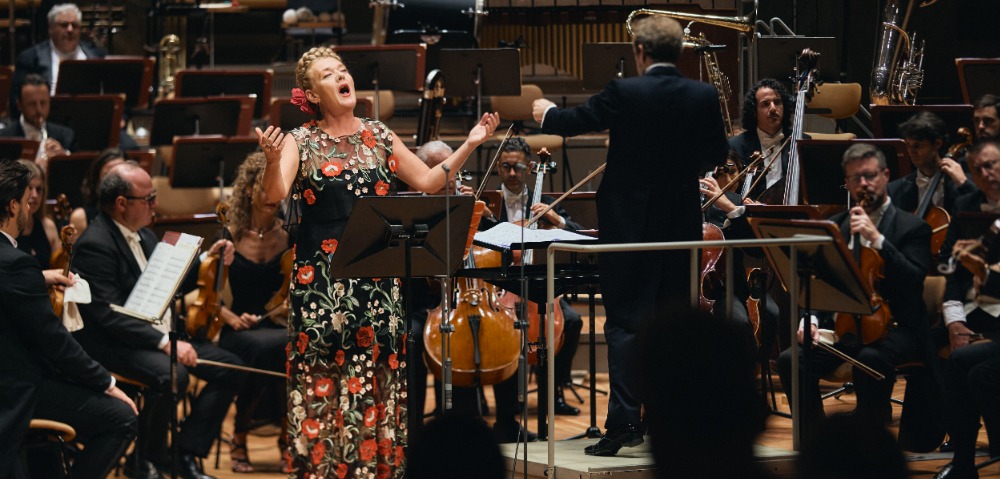
Next, mezzo-soprano Magdalena Kožená joined the orchestra for Berio’s more well-known Folk Songs (1964/1973) drawing on recognizable melodies from America, Sicily, Sardinia, France, Armenia and Azerbaijan. Kožená embodied the work’s eclecticism in a Hungarian-inspired red-on-black poppy dress and elaborately braided hairdo. The songs are so varied in their setting, sometimes with just flute or cello/violin accompaniment. The Czech mezzo brought her customary verve and commitment, but the lower, gutsier passages didn’t always seem suited to her more lyric instrument.
With Debussy’s La Mer (1903-05), the Santa Cecilia under Harding demonstrated the orchestra’s capacity to bring Italian warmth to this French depiction of the sea in all its moods. The strings were especially forceful in their attack as egged on by their dramatically-committed concertmaster Andrea Obiso. As an encore, the orchestra offered what must be core repertoire for them, Verdi’s overture to La forza del destino. Harding was outstanding here, channeling his inner Italian, to elicit an interpretation that was flexible, deeply moving and chills-inducing.
Staatskapelle Berlin is one of the oldest orchestras in the world with roots going back to 1570. It is the resident orchestra of the Berlin State Opera, Unter den Linden. On Sept. 8, it made its annual appearance at the festival, here under Hong Kong-born, US-trained conductor Elim Chan. Guest violinist Patricia Kopatchinskaja joined them for Bartók’s Violin Concerto No. 1 (1907/08). She was a flamboyant presence, bare-foot and sporting a flowing red coat. Completely mesmerizing in the virtuoso second movement, she made no bones about engaging with the players around her, unafraid to mine the work’s humour and earthiness. As an encore she got the audience to sing a round…a ditty about a silly child…I think!

Patricia Kopatchinskaja & Elim Chan with Staatskapelle Berlin at Musikfest Berlin. Photo: Fabian Schellhorn
Next came Dvořák’s Symphony No. 8 in G major (1889), and Chan’s outsized gestures ensured that all of the work’s multifold folk and dance origins were front and centre. The second movement’s flute and clarinet traversal of the ‘folk’ tune was especially poignant, and its twinge of melancholy continued in the following movement’s famous waltz theme. The final furiant was excitingly-paced, but risked turning muddy in the process. Chan revved up the final passages with an accelerando that ensured maximal audience ovations.
Berlin is of course blessed with several top-notch orchestras, but the Rundfunk-Sinfonieorchester Berlin (Berlin Radio Symphony Orchestra) stands out for its bold program choices. Their Sept. 11 concert was also my first chance to visit a different venue, the sumptuous Konzerthaus Berlin, architect Karl Friedrich Schinkel’s neo-classical masterpiece. I was immediately struck by the warmth of its acoustic that can amplify even the softest tone. It provided an intriguing aural ‘wake-up’ to contrast the slightly drier sound at the Philharmonie.
Given the date, Vladimir Jurowski, the orchestra’s Chief Conductor and Artistic Director since 2017, settled on a program that explored dark chapters of history and their present-day repercussions. Martinů’s Memorial to Lidice (1943) commemorates the 2,000 victims who were murdered when the Nazis slaughtered the entire populations of the Czech villages of Lidice and Ležáky as retribution for the assassination of the SS Obergruppenführer Reinhard Heydrich, the “Butcher of Prague”. The Czech composer’s unmistakable harmonies which encompass all manner of early and mid-20th-century musical languages movingly surrounded his quotation of the 12th-century St Wenceslas chorale, an ancient hymn of resistance for all Czechs.
This was followed by a related Czech work, Suk’s Meditation on the Old Czech Chorale “St. Wenceslas” (1914), more conventional in its tonality, but never tipping over into pastiche or schmaltz. With it, Suk expressed the hope for an autonomous Czech state after the end of World War I.
Schoenberg had Adolf Hitler in mind when he set Lord Byron’s poem in Ode to Napoleon Buonaparte (1942/43) for string orchestra, piano and speaker. British baritone Omar Ebrahim delivered the English text in characteristic Schoenbergian Sprechstimme pitching spoken words with impressive dramatic intent. If the audience was meant to comprehend any of this, the resonant acoustic worked against Ebrahim. A German translation was printed in the program, and an English one could be found online—not that useful in a rightfully ‘no-phone’ zone. It’s an ongoing issue for all music organizations as printed programs become less the norm.
The centrepiece of the concert was Shostakovich’s Symphony No. 11 in G minor, “The Year 1905” (1956/57). Like the Martinů, it commemorates the victims of political slaughter, the infamous “Bloody Sunday” in St. Petersburg on Jan. 9, 1905, when Tsar Nicholas II ordered the shooting of the starving, unarmed crowd in front of the Winter Palace. Shostakovich quotes numerous songs—Russian church hymns and workers’ songs, international revolutionary songs—that were likely familiar to 20th-century Soviet and Eastern European audiences.

Vladimir Jurowski with Rundfunk-Sinfonieorchester Berlin at their Sept. 10 Philharmonie concert at Musikfest Berlin. Photo: Fabian Schellhorn
Jurowski expertly guided his forces through the work’s extreme contrasts beginning with the opening section’s melancholic theme that keeps returning, winding back on itself like a question that can’t be resolved. There were some truly roof-raising cymbal crashes followed immediately by shimmering, barely audible sounds navigated expertly by the violins. While seemingly demonstrating complete control, Jurowski still enabled the players to deliver the piece’s devastating emotional punches.
Sept. 13 saw the first of two distinct Berlin Philharmonic programs at the festival. Guest conductor François-Xavier Roth coordinated eight separate ensembles placed throughout the concert hall for Boulez’s Rituel—in memoriam Bruno Maderna (1974/75), written in memory of the death of the French composer’s Italian conducting colleague and compositional friend. Each group contains a percussionist, but otherwise is made up of a variety of instruments. The piece begins with a gong accompanied by several brass; another group is just clarinet and drum. The ensembles sometimes play by themselves, or in communion with others. The surround-sound effects were striking in a piece that is subdued and contemplative overall.
Next came the world premiere of Czech composer Ondřej Adámek’s Between Five Columns, itself a homage to Boulez. It begins with some xylophone reverb that morphs into a super speed trill. Sounds often fade in a slippery, sliding way reminiscent of Berio. As is the festival’s custom, the composer was present and rightly feted onstage.
In the company of so much experimental material, Stravinsky’s Le sacre du printemps (1911–13) felt right at home. Roth encouraged the right kind of woodwind cacophony in the opening section making it easy to see why the work was notorious in its time.
One of the joys of concert-going in Berlin is to witness the exuberant, full-body commitment of the players here epitomized by the second violins. It’s a style of playing very much in contrast to the relatively staid state of affairs on North American orchestral stages. Roth’s leaps and jumps didn’t come off as showy, but rather, inspirational of the huge accelerandi and violent string-banging one expects in a piece that seems to describe the very bubbling up of the planet.
Musikfest Berlin which continues through Sept. 23. Full programming details can be found here.