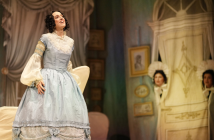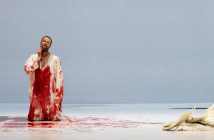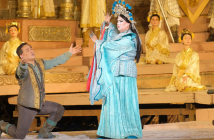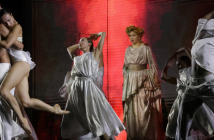
Yes, Glimmerglass Opera in Cooperstown, New York has reached its half-century mark. What began in 1975 as a plucky community-based initiative to mount a production of La bohème in a high school auditorium has effloresced in the course of five decades into one of North America’s premier summer opera repertory companies.
And no, the referenced “Season in Red” emphatically does not denote financial deficit. In fact, the company’s latest fundraising campaign has handily attained its goal of $5,000,000, and is reportedly on course to reach its next target of $7,500,000.
Red Alert
Rather, the red in question is “Conklin Red” – a specialty shade created by John Conklin, the company’s veteran set designer and former associate artistic director, to serve as a visual theme linking all his set designs for the anniversary season.
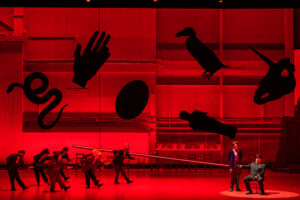
(L to R) Kellan Dunlap as Sellem and Aleksey Bogdanov as Nick Shadow with members of the ensemble in the 2025 Glimmerglass Festival production of The Rake’s Progress.
Photo credit: Kayleen Bertrand/The Glimmerglass Festival
Conklin had emerged from retirement for the 50th-year celebration, but sadly passed away in June just as build-out of his designs was underway. “Conklin Red” is thus both his posthumous aesthetic signature and an impactful commemoration of one of the company’s most beloved sustainers.
Bill of Fare
This year’s Glimmerglass roster includes a world premiere – the operatic adaptation of Sandra Cisneros’ bestselling novel The House on Mango Street; a new production of Igor Stravinsky’s landmark English-language opera The Rake’s Progress; a Broadway crossover – the musical Sunday in the Park with George by Stephen Sondheim and James Lapine; and a provocative new take on Puccini’s passionate and bloody melodrama, Tosca, based on Victorien Sardou’s diva-driven stage play originally made sensational by ultra-diva Sarah Bernhardt.
Open House
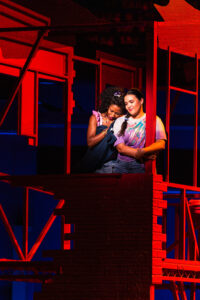
(L to R) Taylor-Alexis DuPont as Sally and Mikaela Bennett as Esperanza in the 2025 Glimmerglass Festival world premiere production of The House on Mango Street. Photo Credit: Kayleen Bertrand/The Glimmerglass Festival
Sandra Cisneros’ 1984 novel The House on Mango Street has to date sold over 7,000,000 copies worldwide, and has become recommended or even required reading in the curricula of many American school districts (while being banned in some others due to what are perceived as discomfiting depictions of violence, racial disharmony and even sexual assault).
Now, in a collaboration between librettist Cisneros and composer/co-librettist Derek Bermel, Mango Street emerges as an engrossing and richly-rhythmed new English/Spanish-language opera.
The work’s central character is the sensitive and precocious 12-year-old Esperanza Cordero. The House on Mango Street is her coming-of-age story, tracking with her from an initial social and emotional alienation from the world of Mango Street – a poverty-stricken enclave in the Chicago barrio to which her family has recently moved – to her eventual self-discovery and embrace of vocation in the redemptive act of writing stories.
Sandra Says…
Autor and educator Sandra Cisneros is known for urging her students to “write about things you’d like to forget,” whether it be painful personal experience or the witnessed adversities of others. Cisneros stresses the transformational power of the written word, and positions the writer as vital observer and conservator of all those small yet crucial human triumphs – events and people that might otherwise so easily be lost to memory and time.
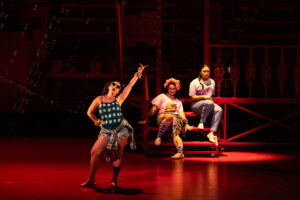
Samantha Sosa as Lucy, Kaylan Hernandez as Rachel, and Mikaela Bennett as Esperanza in the 2025 Glimmerglass Festival world premiere production of The House on Mango Street. Photo Credit: Kayleen Bertrand/The Glimmerglass Festival
And while Cisneros’ libretto doesn’t shy from her novel’s largely vignette-driven structure, she also manages to gratify the incumbent demands of operatic amplitude by the well-placed inclusion of two major dramatic crises – one crowning the first act with high melodrama, and a second that unfolds with brutal trauma, followed by a responding rite of mystical restoration to resolve the action. (No spoilers here!)
The Mango Beat
Derek Bermel’s music for Mango Street is multi-layered and eclectic. A noted ethnomusicologist, Bermel offers a score that sports persuasive emulations of a wide range of Latin and Hispanic music styles, from a witty parody of the habanera to character-evoking passages of salsa, merengue, ranchera and “cumbia Tejana,” plus excursions into such other forms as hip-hop, rap, gospel – even a nod to klezmer.
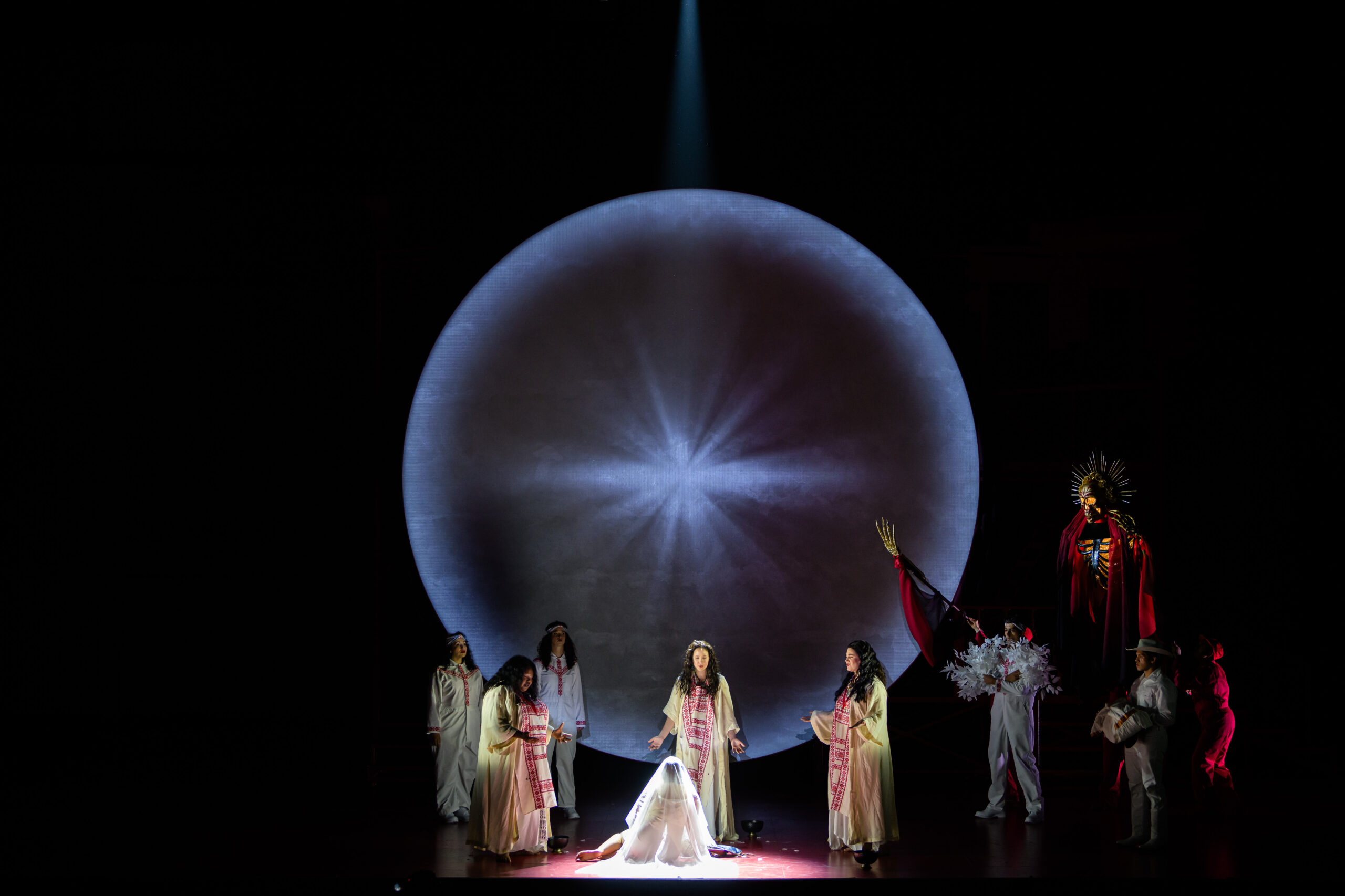
(L to R) Catherine Thornsley, Kendra Faith Beasley, Tzytle Steinman, Mikaela Bennett (center, seated), and Sedona Libero in the 2025 world premiere production of The House on Mango Street. Photo Credit: Brent DeLanoy/The Glimmerglass Festival
In the Mango Grove…
The large cast of mostly young performers is uniformly appealing. Mikaela Bennett, a native of Ottawa, portrays the protagonist Esperanza Cordero with spunky charm and a lovely and flexible vocal instrument.
Other standout performances (many of them by members of the company’s Resident Artists program) include the amber-toned mezzo-soprano of Taylor-Alexis DuPont as Esperanza’s beleaguered friend Sally, who suffers regular abuse at the hands of her hardhearted and religion-obsessed father (the latter fearsomely portrayed by potent bass-baritone Shyheim Selvan Hinnant); and a performance of uniquely noble and genteel delicacy by supple-voiced tenor Angelo Silva as the doomed street vendor, Geraldo.
The premiere is conducted by the seemingly ubiquitous Nicole Paiement with her customary assured and detail-oriented finesse; and Chía Patiño directs with a keen eye for the complex rhythms and organic life on Mango Street. John Conklin’s ingenious and versatile set design is another touching reminder of his contribution to the season.
Progress Report
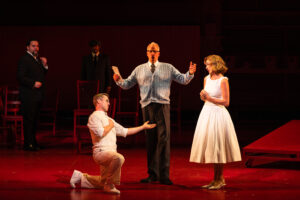
(L to R) Adrian Kramer as Tom Rakewell, Marc Webster as Trulove, and Lydia Grindatto as Anne Trulove in the 2025 Glimmerglass Festival production of The Rake’s Progress.
Photo credit: Kayleen Bertrand/The Glimmerglass Festival
Amidst Igor Stravinsky’s vast, multi-genre canon, The Rake’s Progress stands as his most monumental work for the stage. Premiering in 1951, the opera has accrued increasing popularity and coin in the modern production rotation ever since.
The work was inspired by a viewing by Stravinsky and his librettist, W.H. Auden, of the famous 1735 series of titillating and monitory “Rake’s Progress” engravings by artist William Hogarth, dramatizing the exploits, career and eventual downfall of a loose-living young ne’er-do-well, Tom Rakewell, among the bawds, panders and bunco artists of 18th-century London.
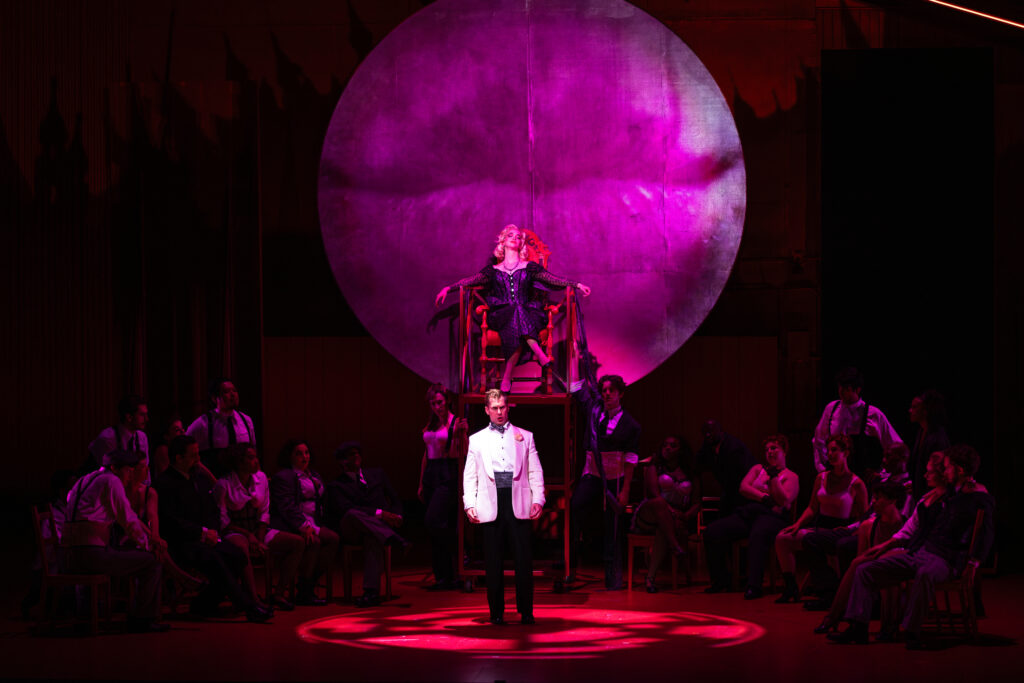
Adrian Kramer as Tom Rakewell (front) and Tzytle Steinman as Mother Goose (back) with members of the ensemble in the 2025 Glimmerglass Festival production of The Rake’s Progress.
Photo credit: Kayleen Bertrand/The Glimmerglass Festival
Hogarth period would logically suggest a Handelian or Mozartian stepping off point, and Stravinsky had mined neoclassic praxis in a variety of veins since the 1920s. But what he crafted for Rake was something new– a pungent, modernist “wrong-note Mozart” sound and texture that nonetheless possessed rigorous deep-structure coherence, and startling theatrical impact – boisterous, mischievous and subversive.
Devil Take the Hindmost
British poet/philosopher/social provocateur W. H. Auden (with augmentations from his longtime partner, Chester Kallman) provided a witty and highly literate libretto that spins a Faustian morality tale of innocence traduced. Tom Rakewell begins as a countrified naïf, content amidst Arcadian simplicity and the devotion of his troth-plighted Ann Trulove. Complications arise, however, with the sudden appearance of an ingratiating yet vaguely sinister retainer, Nick Shadow, however, who brings word of Tom’s inheritance from a previously unknown uncle, now conveniently deceased.
Tom follows Shadow into the snares of louche London, with a pledge that he will linger only so long as required to secure his fortune.
Take a guess as to whether he ever makes it back.
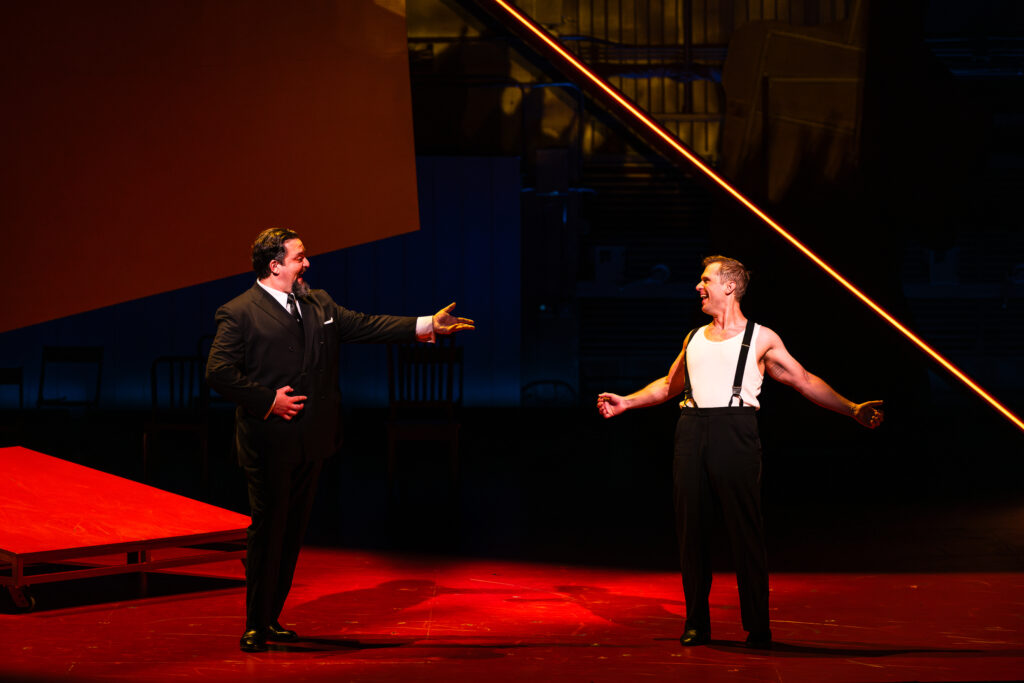
Aleksey Bogdanov (L) as Nick Shadow and Adrian Kramer (R) as Tom Rakewell in the 2025 Glimmerglass Festival production of The Rake’s Progress.
Photo credit: Kayleen Bertrand/The Glimmerglass Festival
Tenor Adrian Kramer gives a winning turn as Tom Rakewell, his rich and expressive voice complementing an endearing affect of antic boyishness. This is a rake for whom an audience can root, even while beholding his inexorable descent into soul-stealing moral desuetude.
Soprano Lydia Grindatto is spot-on as the aptly named Anne Trulove, limning the jilted heroine’s quiet sufferance with dignity and vocal delicacy.
Baritone Aleksey Bogdanov plays Nick Shadow with devilish glee and coiled restraint, modulating his gorgeous dark vocalism right up to the moment of his climactic self-revelation; and soprano Deborah Nansteel portrays the role of carnival sideshow bearded lady “Baba the Turk” with rich tones and delightful comic abandon.
Sunday Meeting
Continuing the theme of musical work inspired by visual art is Stephen Sondheim’s and James Lapine’s 1986 Sunday in the Park with George.
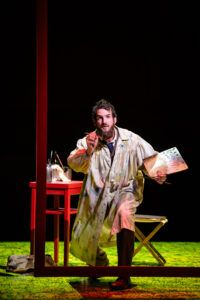
John Riddle as George in the 2025 Glimmerglass Festival Production of Sunday in the Park with George. Photo by Brent DeLanoy/The Glimmerglass Festival.
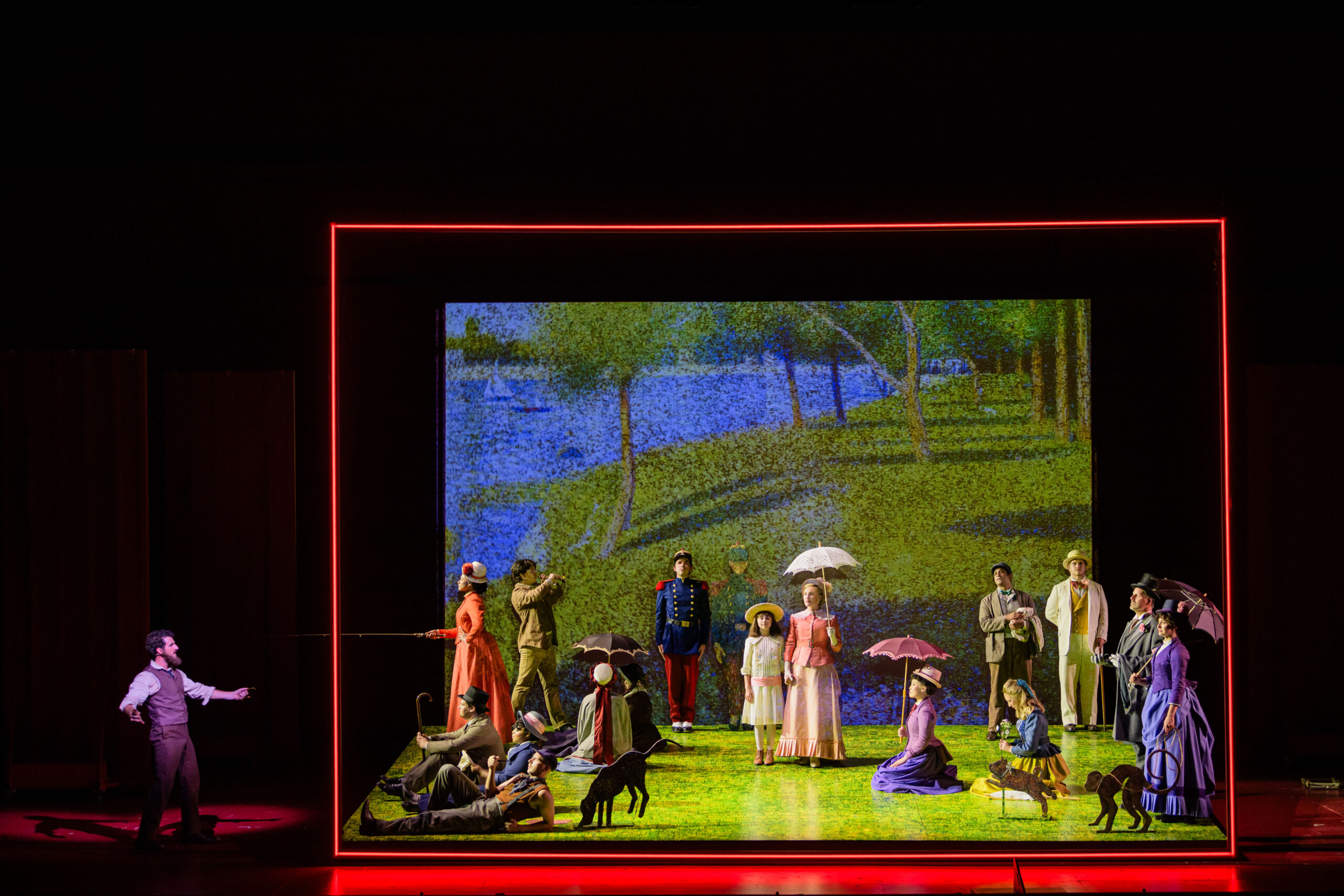
The musical is actually a tale of two Georges. The eponymous George of Act I being 19th-century French painter Georges Seurat, most famous for his large canvas titled “A Sunday on La Grande Jatte” which depicts a heterogenous – and rather stiltedly cartoonish – array of figures, all strolling, sunning or lazing on the grass in a riverside Parisian greenspace circa 1886. The musical introduces many of the painting’s figures to the audience in a procession of vignettes and character cameos that (not unlike the early portions of Mango Street) at first seems almost random, until deferred narrative disclosures clarify matters. The narrative then focuses principally on the strained and dysfunctional relationship between Seurat and his on-again-off-again model and mistress, Dot.
Act II leaps gamely ahead a century, advancing us from 19th-century Paris to 20th-century Chicago, and features another George – not a painter so much as a high-concept installation artist.
He is averred by his pixie-witted and winsome grandmother, Marie (who alleges herself to be the natural daughter of Seurat and Dot) to be Seurat’s great-grandson; and while George himself is skeptical of the claim, he has exploited it to his professional ends, making his institutional bones with a series of high-tech son-et-lumière sculptures, dubbed “Chromolumes,” which he peddles as modernist reinterpretations of Seurat’s painterly style.
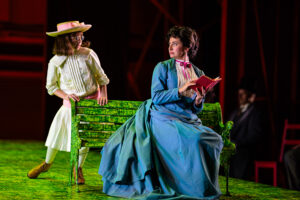
Ella Swift as Louise (L) and Marina Pires (R) as Dot in the 2025 Glimmerglass Festival Productioin of Sunday in the Park with George. Photo by Brent DeLanoy/The Glimmerglass Festival.
Thus constructed, the musical’s two-part book manages to activate myriad clever contrasts, ironic reversals and transformations, with characters, concepts and musical themes mirrored and repurposed in Act II to provide both trenchant satire about modern-art mountebankery, and a more serious examination of the burden of legacy, the solipsism and isolation that aesthetic ambition can impose, and the paradoxical ruthlessness required to maintain emotional distance from others in order to create humane art.
Being Alive
Interestingly, The Janus-faced characters of Georges and George might be considered near cousins to the (anti)heroes of at least two other Sondheim studies in emotional arrest – Bobby of Company who (while no artist) is just as emotionally frozen in place; and the barber Sweeney Todd, that monomaniacal aesthete of vengeance who sacrifices all for the symmetry of a settled score. Though the book here is by Lapine, while that of Company is by George Furth and Sweeney Todd‘s by Hugh Wheeler, it is hard to gainsay a poignant, confessional thread running through all three — an elegantly sublimated cri de coeur from Sondheim himself.
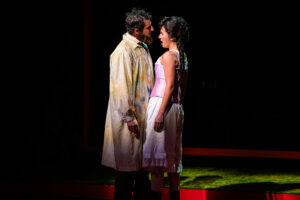
John Riddle as George and Marina Pires as Dot in the 2025 Glimmerglass Festival Production of Sunday in the Park with George. Photo by Brent DeLanoy/The Glimmerglass Festival.
Scoring Points
Seurat’s major technical contribution to post-impressionism was his innovation of “pointillism” – the practice of creating an optical illusion of unitary color by applying a multitude of tiny dabs of constituent colors.
Seurat posited eleven such base colors, plus white. And Sondheim is purported to have begun work on his score by assigning each of the twelve tones of the chromatic scale to one of Seurat’s elements. He appears to have retreated from fully embracing the concept, however, though the general idea survives in the quasi-serialism of many smaller chromatic riffs deployed throughout the score in imitation of the pointillist process.
In fact, Act I especially is packed almost to a fare-thee-well with such signature Sondheim figurations and structural devices – vamps, ostinati and flashy, pleonastic vocal patter. But in contract to the dry and staccato music of artistic labor, the score also opens broadly at times to music of lush emotional aspiration – longing, despairing, resigning.

Marina Pires as Marie and John Riddle as George in the 2025 Glimmerglass Festival Production of Sunday in the Park with George. Photo by Brent DeLanoy/The Glimmerglass Festival.
Dot has several such aching passages, as does George the latter, who visits the Paris site of his great-grandfather’s most famous painting and, in the dying light, wishes for and wonders about the possibility of finding renewed purpose, self-understanding, fulfillment, and maybe even love.
In the Gallery…
John Riddle portrays Georges/George with restrained charm, adroit physical aplomb and assured musical theater vocalism, while Marina Pires is charming, playful, coquettish and winning in the dual role of Dot in Act I and grandmother Marie in Act II.
Michael Ellis Ingram conducts Sondheim’s score ably and Ethan Heard directs the action with an eye toward optimal clarity, even if the pacing of the non-musical sections of Lapine’s occasionally overwritten book could be pushed a bit.
John Conklin’s set here is another winner, especially in the delightful moment of theater magic when a living tableaux of Seurat’s famous canvas composes itself before the audience’s eyes.
A New Tosca
Puccini’s engrossing tale of art pitted against authoritarian evil is a heady witch’s brew of post-Resorgimento Roman swagger, intoxicating Catholic mysticism and cloak-and-dagger Napoleonic-era intrigue.
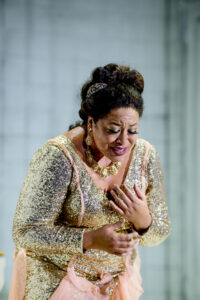
Michelle Bradley as Floria Tosca in the 2025 Glimmerglass Festival production of Tosca. Photo Credit: Brent DeLanoy/The Glimmerglass Festival
The opera is brought to life anew in this Glimmerglass mounting directed by Louisa Proske and conducted with unwavering authority by Glimmerglass’ music director Joseph Colaneri.
The opera’s central lovers, operatic diva Floria Tosca and painter Mario Cavaradossi, are evoked by Puccini with sweetly detailed emotional realism in Act I as they alternately quarrel over manufactured jealousies and look ahead to their next opportunity for stolen intimacy, away from the demands of performance and profession.
Cavaradossi, however, has a secret distraction in the person of a comrade from the resistance movement whom he is helping to conceal. It’s a fateful choice, as the city’s iron-fisted military commandant, Baron Scarpia, is implacable in his pursuit of such members of the underground.
Moreover, Scarpia is also an unremitting sybarite, and happens to have unsavory designs on Tosca. Thus, When his minions apprehend Cavaradossi, Scarpia is swift in seizing the opportunity to summon Tosca and offer her her lover’s freedom in exchange for her submission to his lusts.
Ringing the Changes
There are moments of unexpected and eyebrow-raising innovation in this Tosca that remain obstinately lodged in memory. Never, for instance, has the diva delivered her moving affirmation of art and love, “Vissi d’arte,” in more squalid and inapposite a setting. Nor has the drama ever culminated in quite so graphic and horrific a departure from the action specified in the original. But the substitutions made in this production are nonetheless well worth witnessing – if only to argue over.
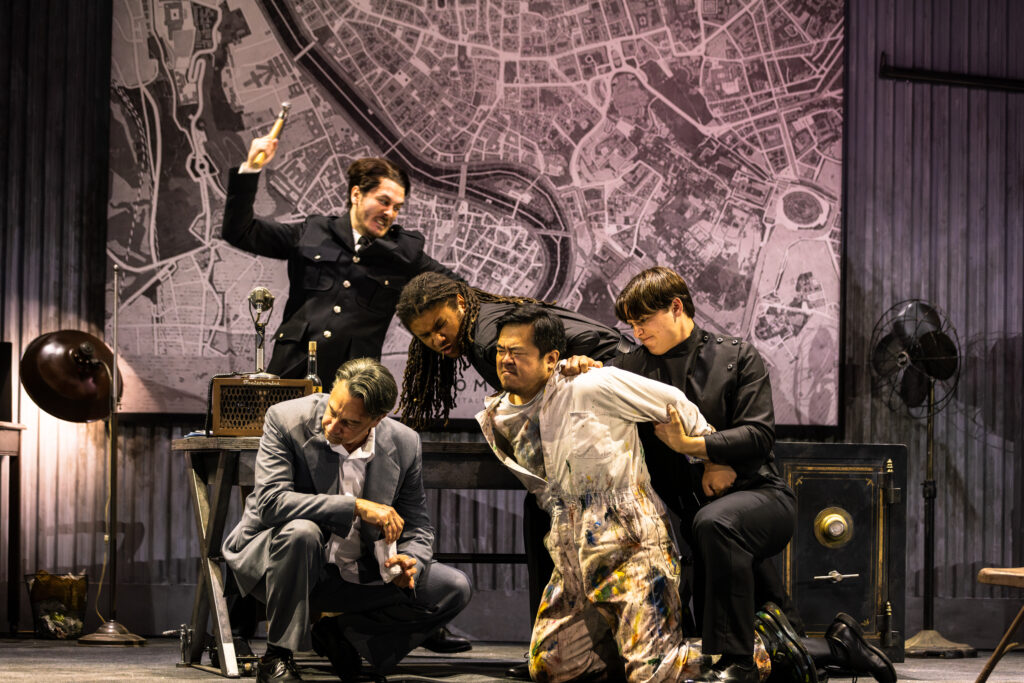
(L to R) Greer Grimsley as Baron Scarpia, Yongzhao Yu as Mario Cavaradossi, and Kellan Dunlap as Spoletta with Jabari Lewis and William Predmore as members of the ensemble in the 2025 Glimmerglass Festival production of Tosca. Photo Credit: Kayleen Bertrand/The Glimmerglass Festival
Firing Line
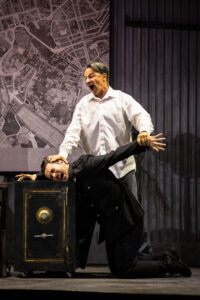
(Background) Greer Grimsley as Baron Scarpia and Kellan Dunlap as Spoletta (foreground) in the 2025 Glimmerglass Festival production of Tosca. Photo Credit: Kayleen Bertrand/The Glimmerglass Festival
Soprano Michelle Bradley brings a large, vital vocal power to her portrayal of Floria Tosca. She offers both a luscious embrace of diva capriciousness in her early scenes with Cavaradossi, and an undaunted ferocity in the unleashed and brutal staging of her tangle with the hulking and minacious Scarpia.
Tenor Yongzhao Yu gives us a Cavaradossi of rich and robust vocal virility. His “E lucevan le stelle” is moving and heartfelt.
Finally, bass-baritone Greer Grimsley gives us a plenary embodiment of what is arguably one of opera’s most deliciously irredeemable villains and libertines, Baron Scarpia. Grimsley’s relish in delivering his dark avowal of rough sex, “Ha più forte sapore,” is blood-curdling.
Onward to 100
Glimmerglass has subtitled this 2025 season “The Art of Making Art,” quoting a lyric from Sunday in the Park with George. The breadth and quality of stellar work presented fully justifies the borrowing.
Performances run through August 17.

The ensemble in the 2025 Glimmerglass Festival production of Tosca. Photo Credit: Brent DeLanoy/The Glimmerglass Festival
And the company’s 2026 season has already been announced, with productions slated of Rodgers’ and Hammerstein’s Oklahoma, Puccini’s Madama Butterfly, a new English-language translation of Mozart’s Così fan tutte, and the opera Fellow Travelers, based on Thomas Mallon’s 2007 novel of the same name.
The House on Mango Street was viewed at its premiere performance on July 18, 2025; The Rake’s Progress was viewed at the matinee on July 19; Sunday in the Park with George was viewed on the evening of July 19; and Tosca was viewed at the matinee on July 20.
Additional information and tickets for the 2025 Glimmerglass Opera season is available at https://glimmerglass.org/.