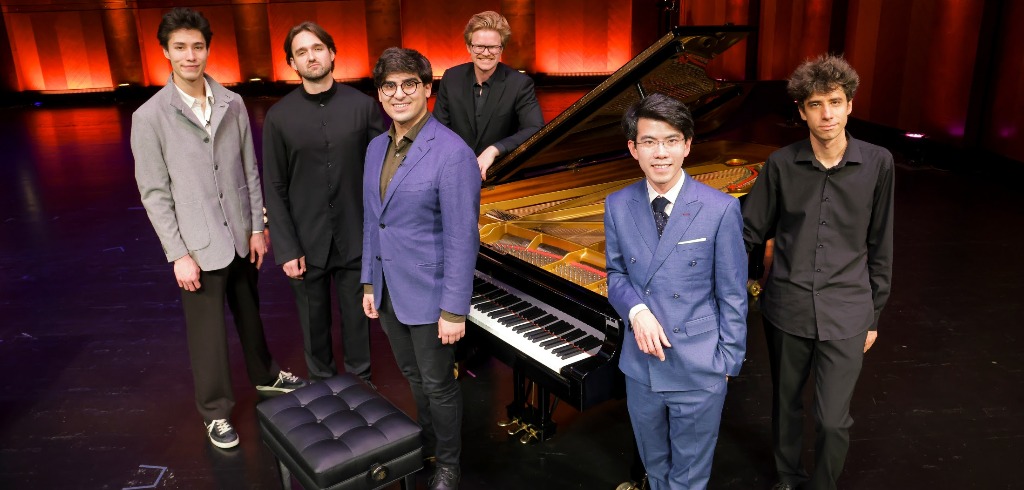

The six finalists of the Van Cliburn International Competition have been named. Given the low number of female contestants from the start, it’s not surprising the list did not include a single woman. Out of the six pianists, three are American – Angel Stanislav Wang, Evren Ozel, and Carter Johnson (also a Canadian); two are Russian – Philipp Lynov and Vitaly Starikov (also an Israeli); and one is from Hong Kong, China – Aristo Sham. Three of these finalists were on my list too, not a bad statistic.
After submitting my original list for publication, I felt compelled to do what all pianists do in Fort Worth. Passionately discuss the pros and cons of each of their favourites and least favourite candidates over endless supplies of ribs in Riscky’s Steakhouse at the Stockyards. Then proceed to resolve our disagreements by riding a longhorn bull. Obviously.
The Elephant(s) in the Room
After some reflection, I’ve come to the following observations.
Two finalists seemed to have gathered consensus among all my colleagues: Carter Johnson and Aristo Sham. Two other candidates seemed to have been unanimously eliminated by most pianists with whom I’ve spoken. The other four finals spots were split between the remaining eight semi-finalists. Be that as it may, the choice of finalists did not include, in my opinion, two of the best performances of a Mozart concerto: Piotr Alexewicz and Jonas Aumiller. The latter even wrote his own cadenza, demonstrating courage, originality, and an understanding of style that seemed to escape most competitors.
The jury’s choice of finalists did not include a single European pianist. Stylistically speaking, I do not count Russia as European. What I mean is the kind of playing reflecting the values of Central European pianism characterized by the likes of Maria João Pires, Alfred Brendel, or Daniel Barenboim (European by his playing, if not his origins). In this competition, these values were upheld by Alexewicz and Aumiller. Both brilliant, not showy, not eccentric. Not finalists.
As pointed out by Arthur Kaptainis, who quotes Cliburn CEO, Jacques Marquis, the evaluation process is a “A yes/no/maybe process. Simple and efficient.” What we get as a result, are “nine distinct opinions from nine concert pianists” says Marquis. This may appear a more clear cut solution than a jury deliberation, but talented musicians are still falling through the cracks under this system.
Then, of course, comes the biggest elephant of all: both this year’s Cliburn as well as the concurrent Queen Elizabeth International Piano Competition have and will result in exclusively male medalists. Historically, female winners have been very sparse among the top competitions. Overall, one woman has won the Tchaikovsky (Ayako Uehara), two women have won the Cliburn (Olga Kern and Cristina Ortiz), two women have won the Queen Elizabeth (Ekaterina Novitskaya and Anna Vinistkaya), and four women have won the Chopin (Yulianna Avdeeva, Martha Argerich, Halina Czerny-Stefańska and Bella Davidovitch).
Yet, by most accounts, women represent more than half of all the piano students at major conservatories and faculties worldwide. Anyone who has taught gifted children can attest that talent is widespread among the sexes. Why do women keep being disadvantaged at piano competitions?
Over the last few days, I have heard various arguments, some considering women’s biological clock ticking in their late twenties, others about society favouring women’s domestic roles. Yet, women flood medical or law schools and have achieved great success in professions that require comparative levels of commitment and sacrifice at an early age.
What may hit closer to the mark is the nature of evaluations that bring success in music competitions. Subjective judgement-based evaluations framed in a highly conservative milieu. In such conditions, it is not only men who judge women unfairly, but other women too, who may be protecting their hard acquired positions in a male dominated industry. Therefore, having more women than men on a jury may be the official excuse that temporarily brushes the issue of gender bias under the carpet.
What may be happening is a case of double bias: gender and conformity bias. If success is determined by repertoire meant for big hands, physical endurance, and the power of an Olympian – much of the Russian and 20th-century repertoire – then contests will be advantageous to men. If we hear eight out of ten performances of a Beethoven sonata that sound “more dominant”, “more powerful”, or whatever other dubious qualifications we may assign to performances by males – then any outlier will appear as “not up to standard”.
But, if we consider repertoire and approaches to performance that do not limit themselves to the use of physical force, we have another story. Consider this: ten female pianists have won the Bach Leipzig International Competition in Leipzig awarded 17 times between 1950 and 2018. This statistic includes second-prize winners when the first prize was not awarded – which is more than all the women prizewinners at the piano Grand Slam circuit (9).
Perhaps Bach lends itself equally to unisex physiques. Or, perhaps, a culture of diversity permeates the environment of the Bach Wettbewerg Leipzig. Or perhaps, women are smarter and better at learning fugues by heart, while men specialize in banging out ferociously Trois mouvements de Petroushka on the piano all day long – a plausible alternative.
The Guide for the Perplexed (Competitor)
Whichever way you lean, Johann Sebastian or Igor Fyodorovich, in the spirit of collegiality, I have come up with a guide to help my fellow youngsters in their quest for stardom. Dear reader, should you be so foolish to base your career in music solely on winning competitions, here is what you must do:
- Be a male.
- Don’t play Brahms (except perhaps the Paganini Variations).
- Do not improvise or write your own cadenza for a classical concerto – you might as well shoot yourself in the foot.
- Don’t bother writing your own arrangements of anything, it won’t help you.
- Don’t worry about playing sublime Mozart, it doesn’t matter.
- Forget about Haydn or Bach – unless they’re arranged by Rachmaninov.
- Forget that you’ve ever heard about music written after 1953 – it doesn’t exist.
- Play Ravel, Prokofiev, Scriabin, Stravinsky, or Rachmaninov.
- Don’t be too original in your demeanor, performance, or style (musical or fashion-wise).
- Have a rock-solid supporter in the jury who will carry you throughout each stage of the competition.
You’re welcome.
Now let’s hear these finalists.
For all of our Cliburn reports, articles and videos visit Spotlight | Cliburn 2025