Although acclaimed as one of Giacomo Puccini’s greatest works, Madama Butterfly has received plenty of criticism over the years for its orientalism. Historically, productions have infantilized and sexualized Asian women, simplified and stereotyped Asian culture in design and performance, and used yellowface to change the appearance of white performers playing East Asian characters.
For this production of Butterfly, Vancouver Opera (VO) reflected on these criticisms of the opera’s story and past performances. Their conscious effort to listen, learn, and prioritize East Asian perspectives adds a refreshing and necessary layer of depth to this beautifully tragic opera (seen Apr. 26th).
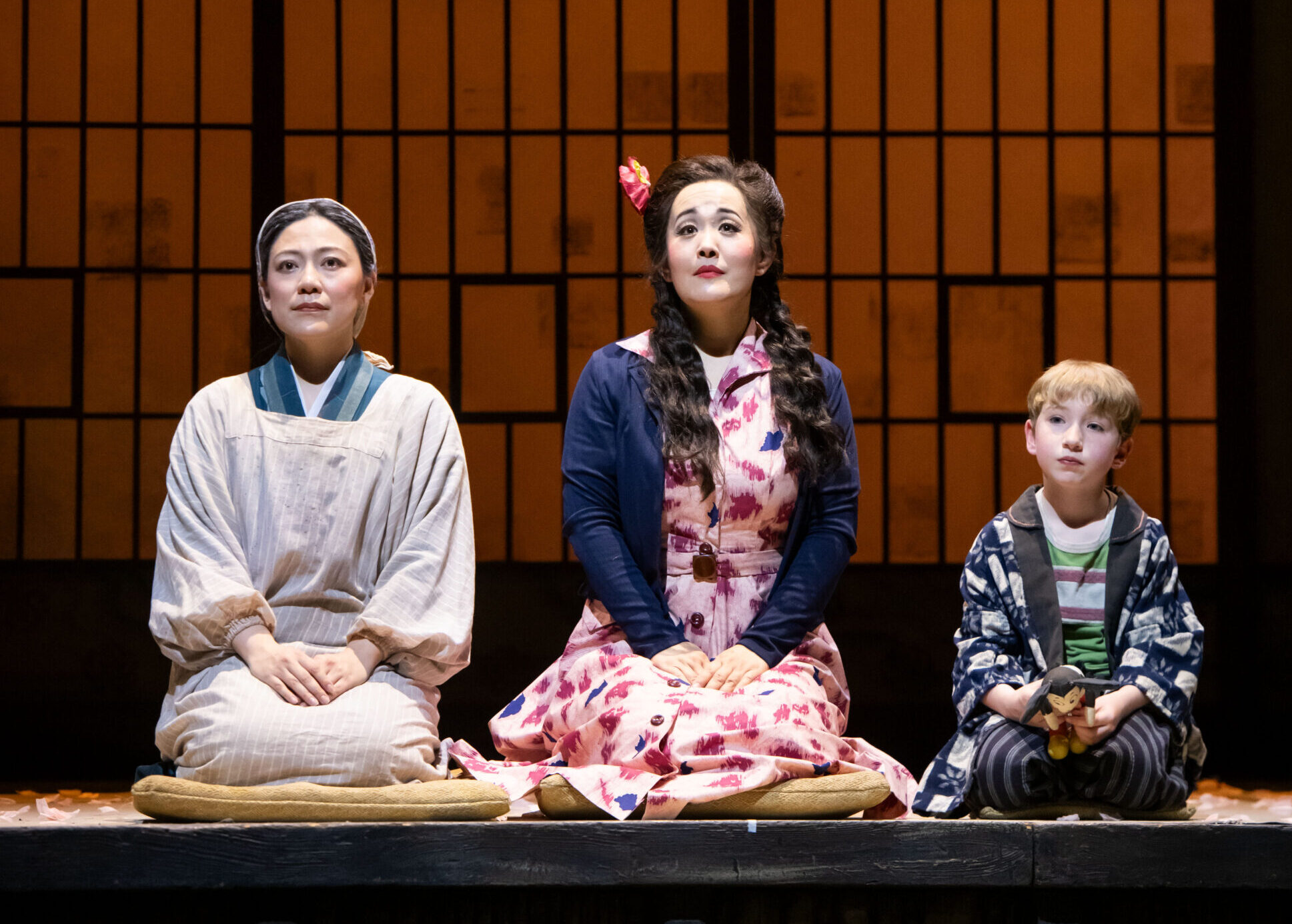
Nozomi Kato (Suzuki), Yasko Sato (Cio-Cio-San), and Myles Hunter-Gibbs (Sorrow) in Vancouver Opera’s Madama Butterfly. Photo: Emily Cooper Photography
Recontextualizing Madama Butterfly
In a recent interview, stage director Mo Zhou said, “I actually refused to assist or direct Butterfly for over a decade. As an Asian woman, I had a hard time justifying the story.” Zhou first agreed to stage the opera last season with Virginia Opera on the condition that the story be relocated to the years of Allied occupation in Japan (1946–1952), following the Second World War. Zhou’s reasoning for the change is that, with this new lens, “Cio-Cio-San [isn’t] just a jilted lover. She [becomes]a postwar survivor. She [becomes]real.”
While the curtain was still down during the prelude to Act II, information about the Allied occupation in Japan and Japanese war brides appeared on the surtitle screen. The text gradually became more confrontational, transitioning from historical facts to thought-provoking questions such as: “what about the women left behind?” The audience is left, in a powerful moment, to consider the lived experiences of many Japanese women.
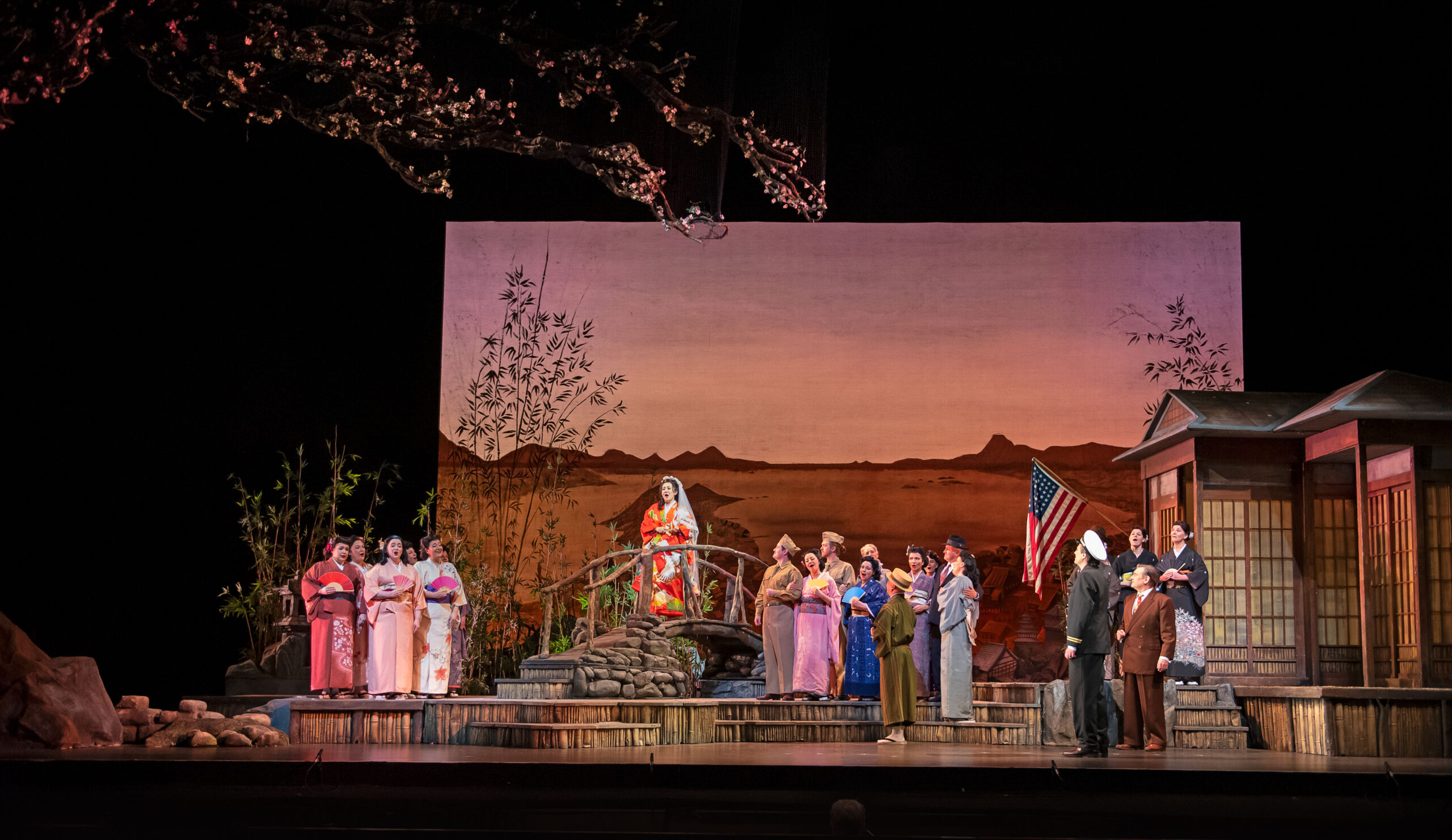
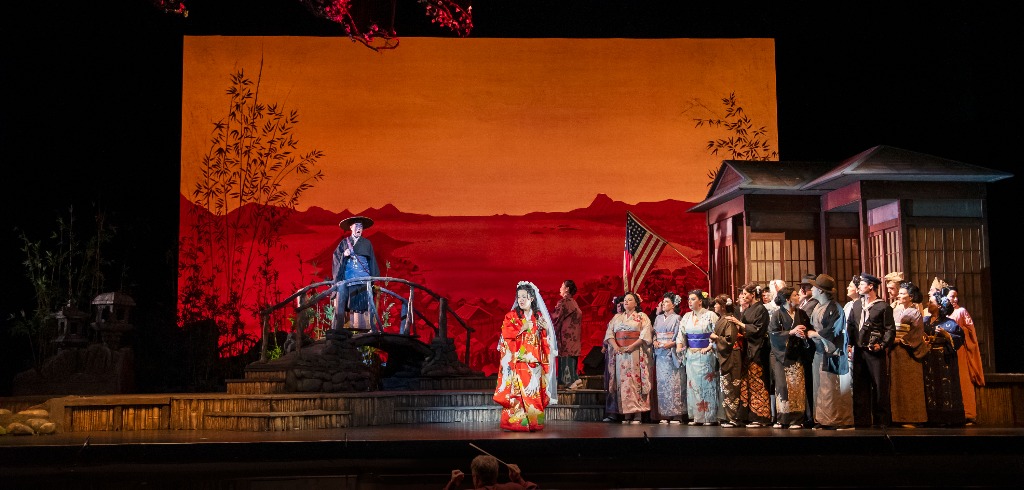
A scene from Vancouver Opera’s Madama Butterfly. Photo: Emily Cooper Photography
Details Make Perfection
Llyod Evan’s complex set design immediately pleases the eye. The layering of scenery elements turned the stage into a three-dimensional world. A tree hung overhead in the foreground, a garden and house stood in the middle ground, and plants and a view of the horizon were nestled in the background. When Pinkerton arrives, he ensures there’s a large American flag hanging outside his house. The flag seemed to impose itself in a loud, boastful way. No moment exists without the flag in the background, reflecting the American occupation of Japan where the U.S. controlled and influenced many of the country’s internal affairs.
In Acts II and III, we are taken inside of the house. Seven years later, the set design and costumes reflect Cio-Cio-San’s desire to act as the ideal American wife. There is a photo of U.S. President Dwight D. Eisenhower on the wall, a crucifix on the shelf, the large American flag at the door, and Cio-Cio-San herself is dressed in Americanized clothing. All these elements communicate how she is hanging onto the identity she has been told will bring her a better life.
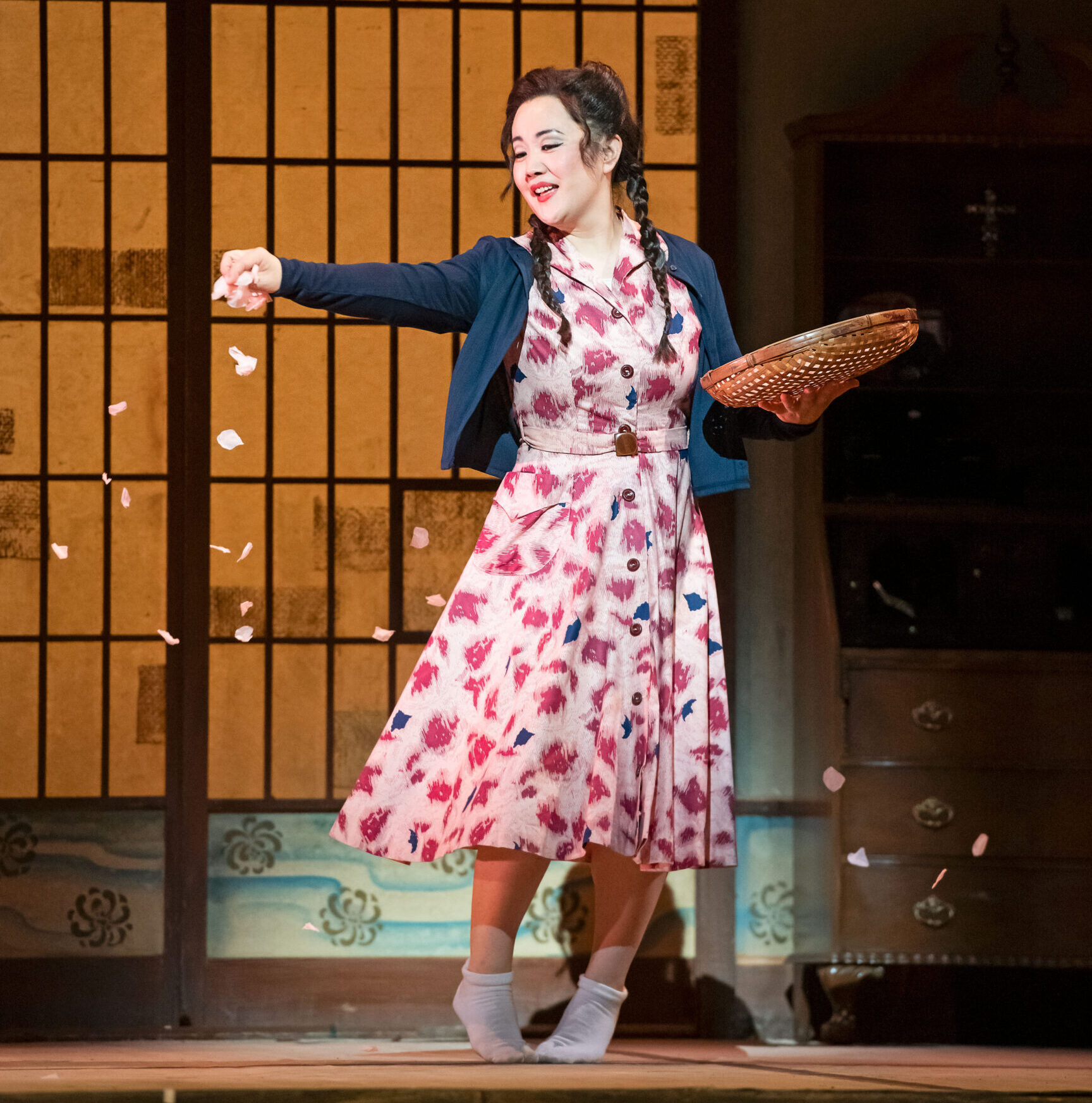
Yasko Sato (Cio-Cio-San) in Vancouver Opera’s Madama Butterfly. Photo: Emily Cooper Photography
Lighting Designer Marie Yokoyama created some beautiful moments with slow sunsets and moonrises, an illuminated house in the opening act, and lanterns in nighttime scenes.
The careful attention paid to detail by the entire creative team paid off. For example, the choice to have the Japanese characters remove their shoes inside the house while the American characters left them on, showcased the great care taken with every interaction.
The slightly altered ending, too, included measured decisions such as having Cio-Cio-San’s body lay on stage after her death, so that the audience must sit with its impact. Her son, who is supposed to go with Pinkerton to America, instead runs back into the arms of Suzuki, a woman who has shown him love throughout his childhood years. This provided a knife-twisting final beat as the two embrace while Cio-Cio-San lays lifeless behind them.
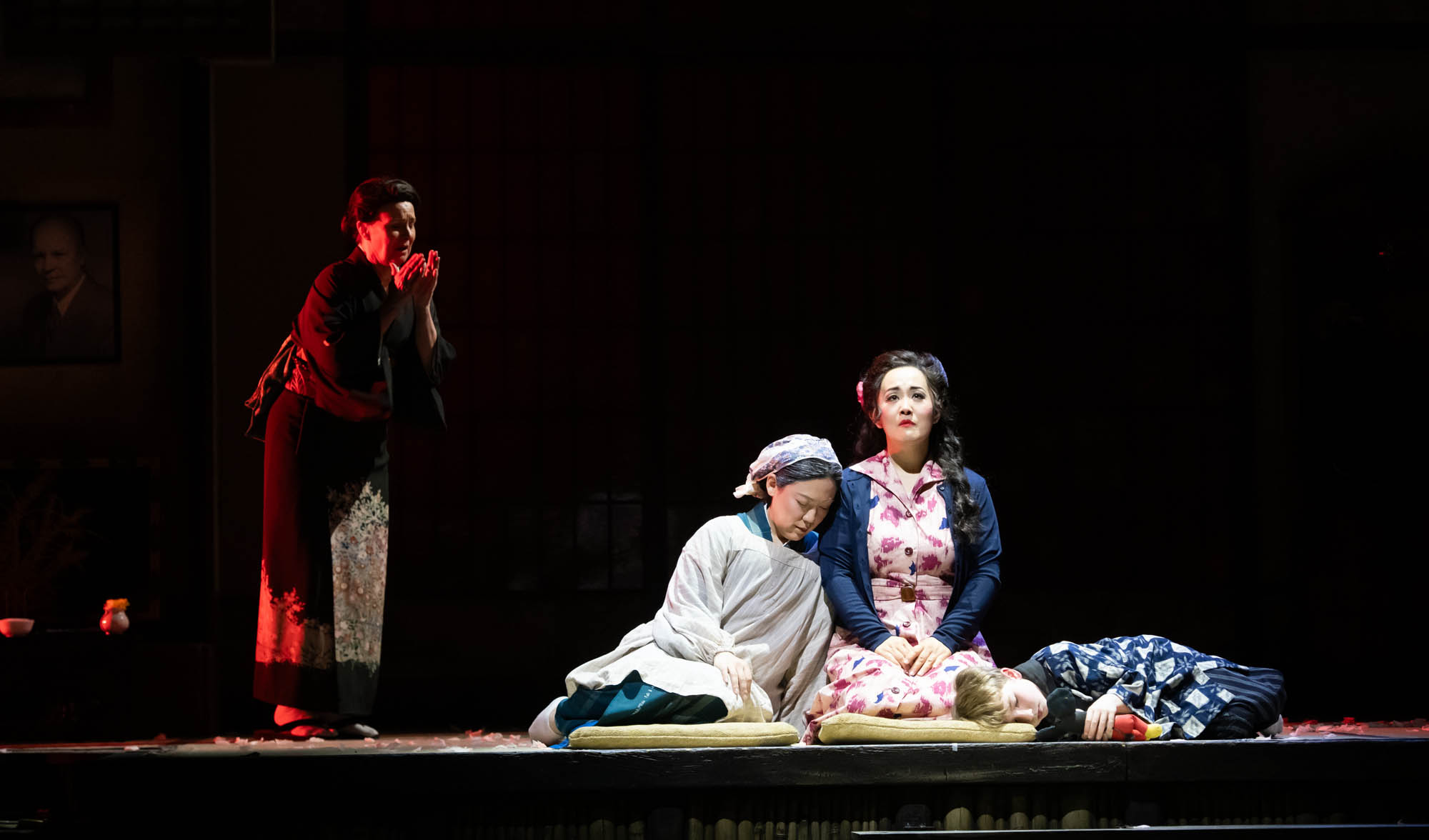
Karen Ydenberg (Mother), Nozomi Kato (Suzuki), Yasko Sato (Cio-Cio-San), and Myles Hunter-Gibbs (Sorrow) in Vancouver Opera’s Madama Butterfly. Photo: Emily Cooper Photography
Exemplary Performances
With VO, soprano Yasko Sato makes her Canadian debut as Cio-Cio-San, having previously sung the role in productions throughout Italy, USA, Belgium, Slovenia, Greece, Spain, and Japan. Sato has done thorough research into the character of Cio-Cio-San, and her understanding of the role’s complexities comes through in her nuanced performance.
In Act I, Cio-Cio-San is a young 15-year-old girl, and Sato embodied her playful, trusting nature. Her performance feels light and airy at the start of this opera, expressing genuine excitement about the arrangement to marry the American, Pinkerton. Sato’s portrayal makes Cio-Cio-San an instantly loveable character as she conveys a certain sunniness and resilience despite the hardships she has already had to overcome.
Sato brought incredible versatility to the performance. Though her initial demeanour was light and bright, the soprano quickly demonstrated her ability to fill the theatre with rich, powerful vocals in Act I’s duet with Robert Watson (Pinkerton). When she returns in Act II, she adopts a more mature sound to reflect the seven years that have passed since the marriage. The strength of her portrayal lies in these small details showing how thoroughly she understands the character and what each scene needs from her.
Nozomi Kato as Suzuki also brought incredible depth to her performance. The character’s personality came seeping through—especially her dislike for Pinkerton—even in moments where she stood silently. Kato’s expressive and raw performance makes the relationship between Suzuki and Cio-Cio-San feel realistic and moving.
As is customary with Puccini’s operas, the orchestra played a big role in seamlessly switching the tone on stage from lively to solemn to heartbreaking. With Conductor Jacques Lacombe at the helm, the Vancouver Opera Orchestra produced some showstopping moments both in their grandiose sounds and calculated silences.
VO’s Madama Butterfly places storytelling control in the hands of those who respect the culture and its influence on the story. The result is an intricate and stimulating production that maintains and even adds to the emotional value of Puccini’s opera.
Vancouver Opera’s Madama Butterfly continues its run from May 1 to 4. To read more about the production and purchase tickets, visit www.vancouveropera.ca