Belgian playwright’s Maurice Maeterlinck’s play Pelléas et Mélisande (1892) fascinated musicians of the epoch. Both Fauré (in 1898) and Sibelius (in 1905) wrote incidental music for it. Even Schoenberg wrote a tone poem (1905) on the theme. Fascinated by the symbolist play, Debussy adapted it into an opera, his only complete work for the stage.
Lebanese-Canadian Wajdi Mouawad’s take on one of the most significant operas of the twentieth century was remarkable (seen Mar. 12). The Parisian public’s reaction to this production was overwhelmingly positive, but a large contingent of critics retain an inexplicably inane adulation for Robert Wilson’s staging for l’Opéra de Paris. Widely seen over the past three decades, that interpretation once again finds the American director falling back on a stylized Kabuki aesthetic that never changes, no matter the opera.
Sabine Devieilhe & Huw Montague Rendall in Opéra national de Paris’ Pelléas et Mélisande. Photo: Benoîte Fanton/ONP
Mouawad was obviously inspired by Jean Delannoy’s film L’éternel retour (1943), an adaptation of Jean Cocteau’s telling of the Tristan and Isolde story which emphasizes its Nietzschian aspects. That other love story, also of Celtic inspiration and ethereal, is germane to the legend of Pelléas and Mélisande. Much more than Mary Garden (1874-1967), the Scottish creator of Mélisande, the production’s Sabine Devieilhe is modeled after the star of Delannoy’s film, Madeleine Solange’s platinum blond Nathalie. Likewise, Mouwad’s Pelléas, Huw Montague Rendall, is modeled after Patrice in the film, interpreted by legendary actor Jean Marais, Cocteau’s muse.
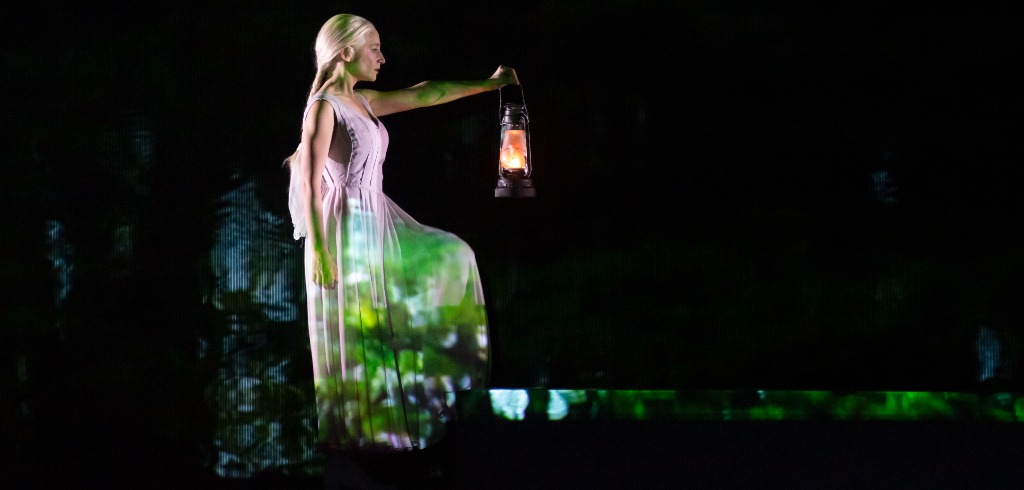
Emmanuel Clolus’s sets were impressionistic, at times evocative of Monet’s Water Lilies paintings, albeit darker and wilder. Vegetation and water are omnipresent in the sets and especially in the highly imaginative videography by Québec City native Stéphanie Jasmin. The impressionist videos of waterfalls, turbulent in the opera’s most intense moments, and of Mélisande with her lush blonde hair submerged in water, are haunting and mood setting.
Eric Champoux’s use of lighting was also a major element in helping to set the heavy mood of the production, from the dark thick forest that opens the opera, the caves where Pelléas and Mélisande meet and the bright light of their final quintessence.
At the opera’s end, the dead Pelléas reemerges centre-stage next to Mélisande, for their apotheosis, both dressed in regal coats and crowned. Indeed, it’s the Tristan theme: only in death can two beings truly fuse into one.
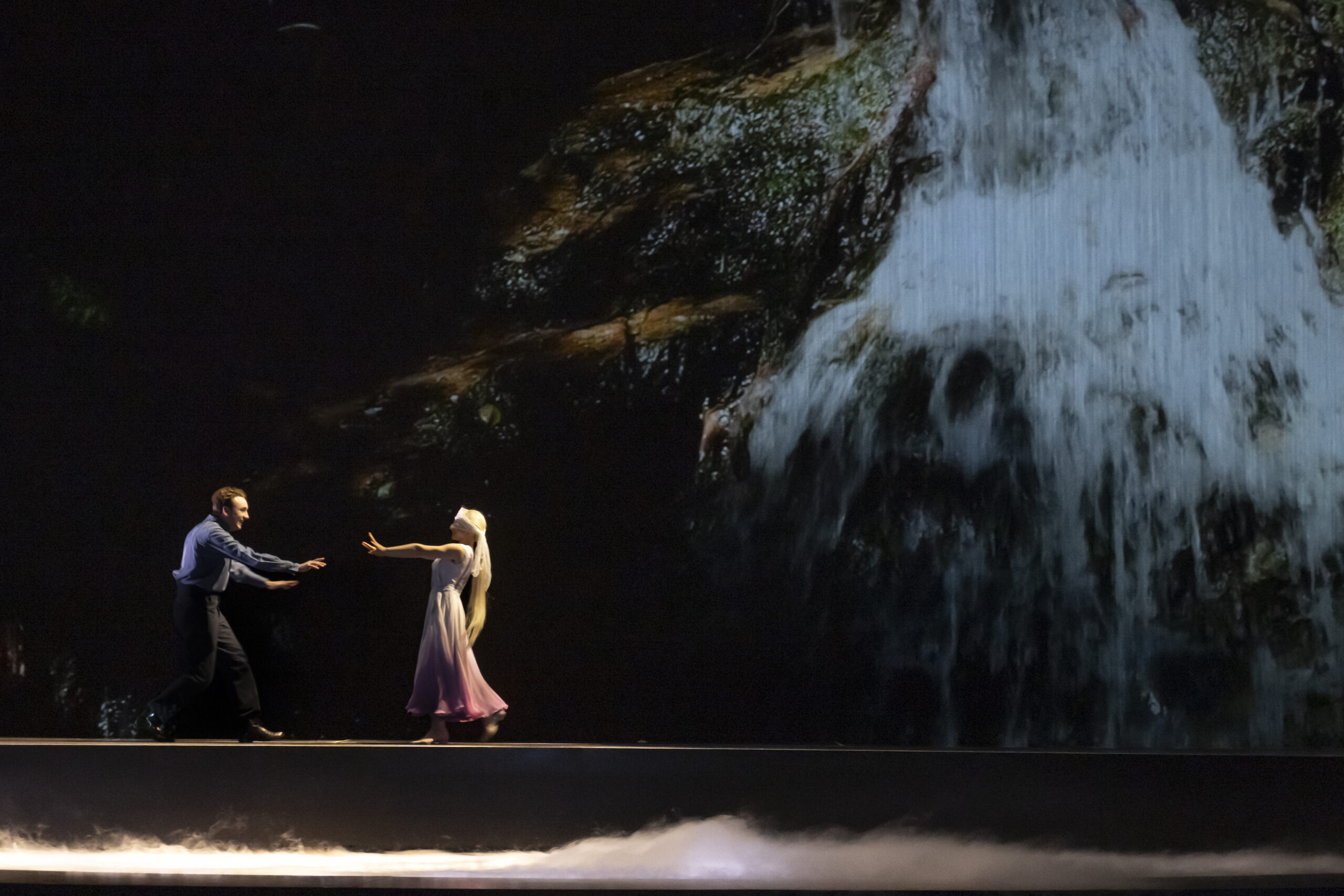
Sabine Devieilhe & Huw Montague Rendall in Opéra national de Paris’ Pelléas et Mélisande. Photo: Benoîte Fanton/ONP
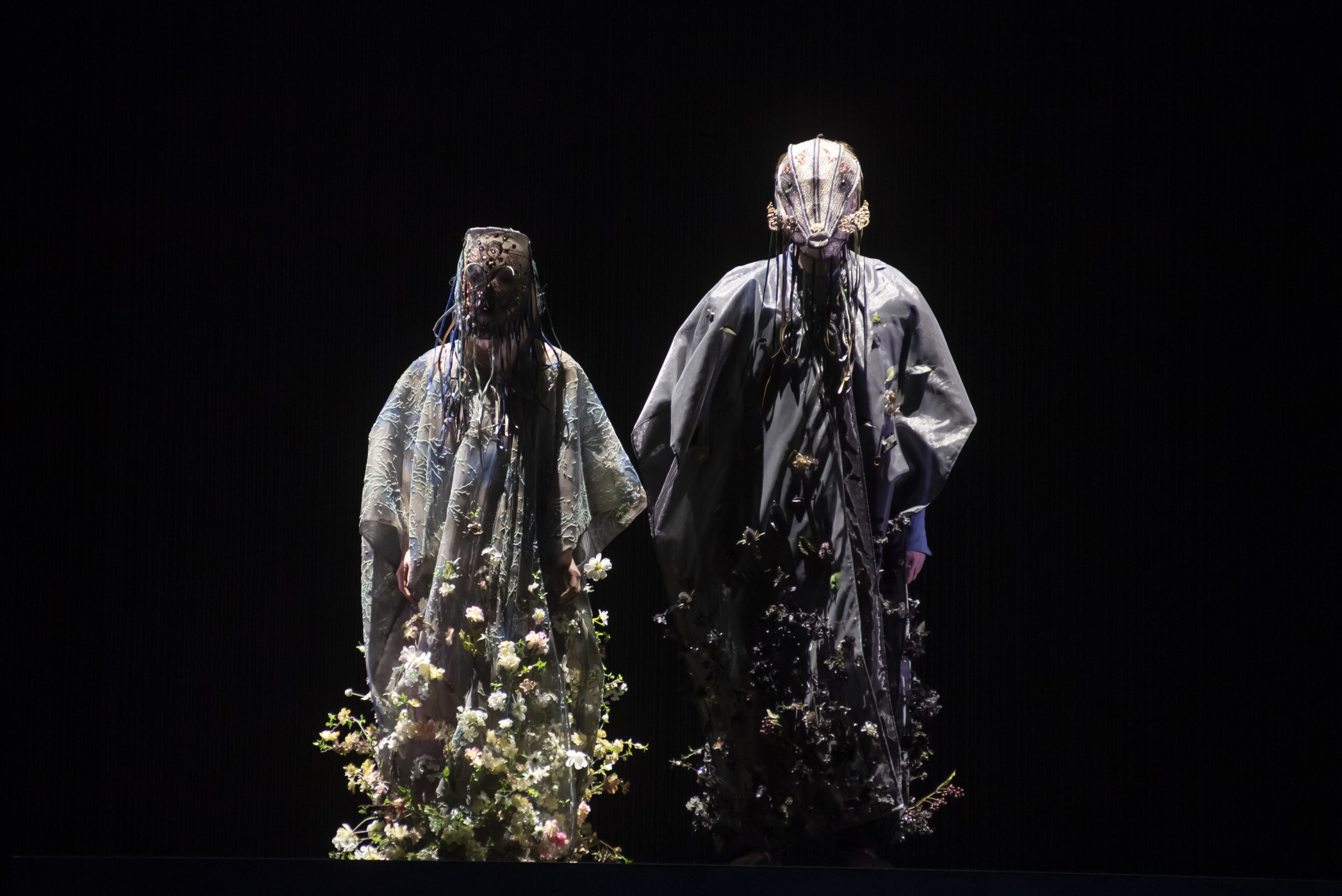
The opera opens with a wounded boar wandering in the forest. The three blind dwellers of the cave appear throughout the work. They are butchers in Mouawad’s staging, who amass carcasses of animals into a pile in the cave. This occurs during a famine in the mythical kingdom of Allemonde, thus emphasizing the waste. Mouawad sees Golaud’s world as a violent one where dreamy Pelléas is alienated. Mélisande, an obvious victim of earlier violence, meets Golaud in the forest during one of his hunting expeditions. He carries her off like one of the animals he hunts. Mélisande is, like Pelléas, alienated in this violent world.
In addition to an imaginative and provocatively creative staging, this production boasted a mostly excellent cast. British baritone Huw Montague Rendall, son of tenor David Rendall and mezzo Diana Montague, astounded with his diction. Few French singers savour the language with such elegance and expressivity. His high baritone is ideal for the role. He was able to perfectly convey the character’s fragility and poetic temperament.
Though she looked ravishing, just like Nathalie in L’éternel retour, soprano Sabine Devieilhe, making her role debut, was not an ideal choice vocally. France’s leading coloratura has too small a voice for the cavernous Opéra Bastille. I could hear her elegantly soft singing clearly, as well as her delicate murmurs, as I was fortunate enough to be in the first row. However, patrons seated twelve rows behind me, and others in the balcony, reported difficulties in hearing the French soprano. It’s a mystery why the Paris Opera opted for the Bastille rather than Opéra Garnier for such an intimate work.
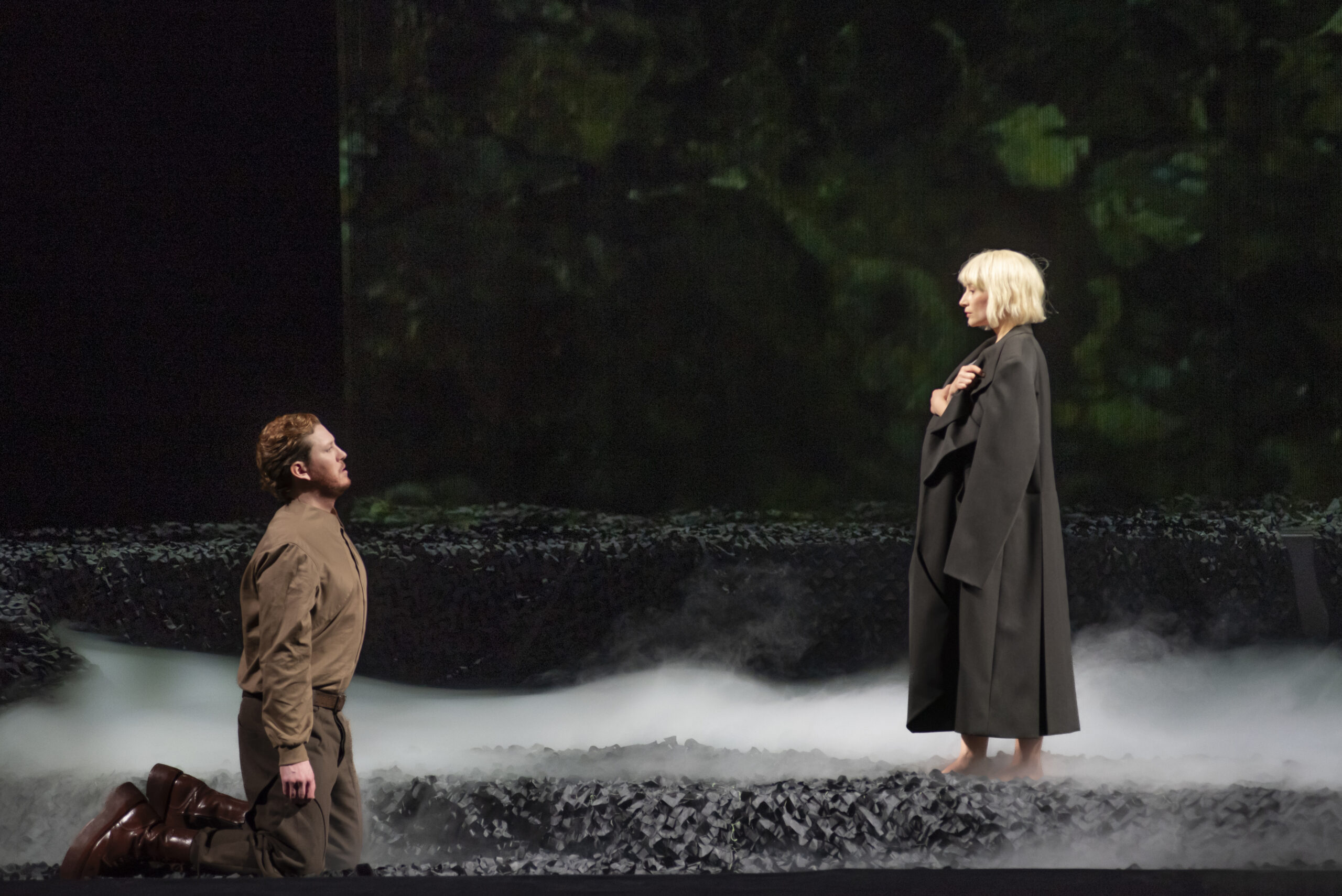
Gordon Bintner & Sabine Devieilhe in Opéra national de Paris’ Pelléas et Mélisande. Photo: Benoîte Fanton/ONP
Canadian bass-baritone Gordon Bintner was a poignant Golaud, more tormented than tyrant, despite Mouawad’s vision of the oppressive Kingdom of Allemonde. His diction was exemplary, though not quite at Montague Rendall’s level.
French mezzo Sophie Koch was too young to be Geneviève; her timbre is too light for the role. A dazzling Octavian not that long ago, she is hardly the matron Geneviève, mother of Golaud, who tells Mélisande she’s been in the palace for forty years. Her reading of Golaud’s letter did not convince.
French bass Jean Teitgen was a remarkable Arkel. He conveyed the old man’s understanding and compassion. Mercifully, he was not confined to a wheelchair or made too infirm, as is often the case. His deep, dark voice enhanced the gravitas and authority of the role.
Italian conductor Antonello Manacorda, founding member and long-time concertmaster of the Mahler Chamber Orchestra, led l’Orchestre de l’Opéra de Paris with precision. His conducting breathed poetry and mystery into one of the most sublime opera scores. Debussy’s palette of colours has rarely been this palpable.
Hopefully, the Canadian Opera Company and/or l’Opéra de Montréal will import this production for the benefit of the Canadian public, especially given its local connections. In fact, many Canadians are currently making their mark with this opera. Here, Bintner was an affecting Golaud. Seen last season in a production by the Canadian team of André Barbe and Renaud Doucet in Modena, Canadian baritone Philip Addis and McGill graduate, French soprano Karen Vourc’h, were a mesmerising Pelléas-Mélisande couple. Canadian contralto Marie-Nicole Lemieux impressed in her Met debut as Geneviève in 2019. Bass Philippe Sly will be Arkel in Toronto’s Opera Atelier production in 2026. One of the twentieth century’s most emblematic operas seems to attract Canadians. Tant mieux!
For more on the Opéra national de Paris season visit www.operadeparis.fr