
A revolution has erupted: the Swiss dancer and choreographer Martin Schläpfer, formerly director of Düsseldorf’s Ballet am Rhein (known for its innovative choreography), became director and chief choreographer of the venerable Wiener Staatsballett in the 2020/21 season. The Covid pandemic happened during his first year in that new position and hampered his creative projects.

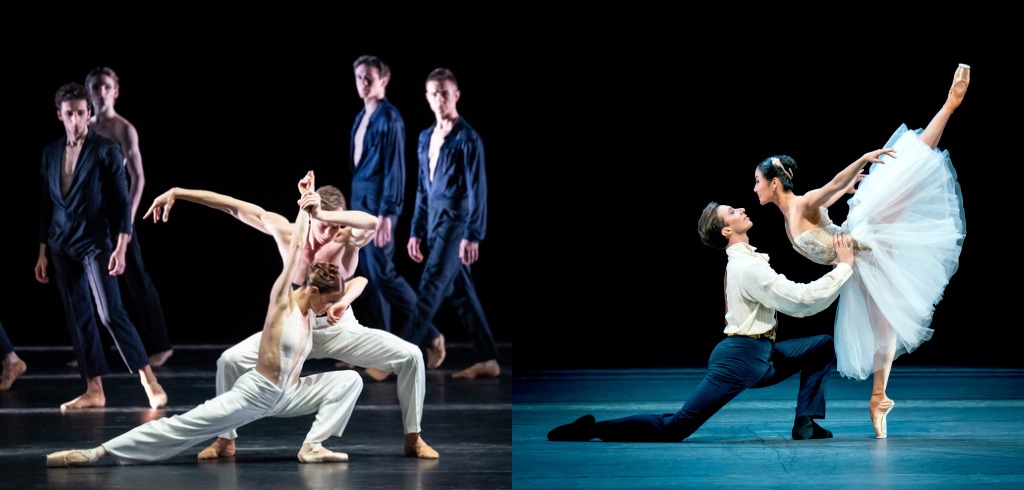
Claudine Schoch and Marcos Menha in Vienna State Ballet’s 4. Photo: Ashley Taylor
His first choreography, 4, was premiered during the pandemic to an almost empty theatre. Seen on June 22, 4, is set to the Fourth Symphony by Gustav Mahler, whose music is not the first thing that comes to mind when one thinks of ballet. Like his Symphonies No. 2 and No. 3, it contains a vocal section from the folk music anthology Das Knaben Wunderhorn. The Fourth Symphony uses the poem “Der Himmel hängt voller Geigen,” renamed “Das himmlische Leben,” as its last movement. This poem is a child’s imagination of heaven and the symphony is replete with bucolic images which are the inspiration of Schläpfer’s choreography.
The Symphony’s pastoral character gives an illusion of apparent cheerfulness, yet there is an undercurrent of anxiety. It is this aspect that lends to highly creative ideas in the choreography. One of the most striking images in Schläpfer’s conception is that of crouching frogs and rabbits that leap when there is a Mahlerian swing mood.
In general, the dance movements are more modern than classical, though they are always classically structured. The ballet’s protagonists are two female dancers, who represent the human condition. There is an alternation between scenes in which they are leisurely walking in a field, and crowd scenes. The crowds vary in size from small groups to the entire ensemble.
Though ballet-like, the symphony has no plot. It is clear that Schläpfer channels Mahler’s music to point to the fragility of the human condition. The two female dancers engage with others: individuals, small and large groups, all representing one’s interaction with society at large. These encounters, like Mahler’s music, are at times joyous and at other moments sad. Ultimately, they retreat into solitude.

Vienna State Ballet’s Sleeping Beauty. Photo: Ashley Taylor
The other choreography by Schläpfer seen in Vienna was Tchaikovsky’s Sleeping Beauty (June 26). He sets the ballet in different epochs: the Prologue and Act I seemed almost conventional, set in a fairytale kingdom. Astonishingly, the women wore no tutus and the men no tights, but all the dance moves were the usual classical ones. The rest of the ballet, Acts II and III, were set in the Victorian era and in the 1950s respectively.
Act II opened with a contemporary composition, Ferne Landschaft II, by Japanese composer Toshio Hosokawa (b.1955). This is a work inspired by traditional Asian music and marked by strident-sounding string instruments. It represented the enchanted, sleeping Princess Aurore’s subconscious.
Two characters were invented for this interlude: a faun-like creature and die Waldfrau/la femme de la forêt (the woman of the forest) who guides Prince Désiré, clad in Victorian, non‑regal clothes, through the actual forest on stage and the figurative forest of Prince Aurore’s subconscious. The horned faun is reminiscent of the male swans in Matthew Bourne’s celebrated homosexual take on Swan Lake. He seems on a mission to distract Prince Désiré. The three struggle and the prince ultimately reaches and awakens Princess Aurore.
Act III was further updated to the 1950s where the royal wedding resembled a graduation ceremony. Contrary to the original plot, the evil fairy, who caused Princess Aurore’s long sleep, accepts her own defeat and is forgiven. The King and Queen abdicate the throne in favour of Aurore and Désiré. This is conveyed by the monarchs and the newly wed couple joining together in a courtly dance. At the end of the dance, the King and Queen lay on the floor, signifying their death, a symbol of generational change and renewal.

Kiyoka Hashimoto (Princess Florine) and Timoor Afshar (l’Oiseau bleu) in Vienna State Ballet’s Sleeping Beauty. Photo: Ashley Taylor
As Aurore, South Korean prima ballerina Hyo‑jung Kang was grace personified. She had great chemistry with her Prince Désiré, Brazilian premier danseur Marcos Menha. Another premier danseur, American Timoor Afshar was l’Oiseau bleu (the Blue Bird) who had neither wings nor blue plumage. Beloved prima ballerina, Russian Olga Esina, was the Queen. Laura Cislaghi and Giorgio Fourés were adorable as La Chatte blanche and le Chat botté (Puss in Boots). Though they had no feline costumes, their mischievousness and grace were quite cat-like.
Wiener Staatsballett, together with Milan’s La Scala and Ballet de de l’Opéra national de Paris, have long been custodians of Rudolf Nureyev’s historic productions of such ballets as Swan Lake, Nutcracker, Coppélia, Don Quixote and La Bayadère. Though the Vienna ensemble has occasionally worked in a more modern vein, it has long had the reputation of being quite conservative.
With Martin Schläpfer at the helm, the dance scene is in the process of changing in a major way. His Sleeping Beauty seems almost to be a symbol of the bridge to modernity that Schläpfer is building. Judging from the public’s reaction, both young and old, Vienna is ready. The only trouble is that this is Schläpfer’s last season in Vienna where he will be replace with Italian star dancer, Alessandra Ferri.
For more on Wiener Staatsballett 2025-26 season, visit www.wiener-staatsoper.at/staatsballett